
Test 1 of 10 · 20 questions · Free 2026
MS Permit Practice Test 1
Jump to the test ↓A fixed 20 question set from the Mississippi bank with answers and plain English explanations.
Question 1 of 20 · 0 right so far
All 20 questions in test 1
Every question below comes from the Mississippi question bank on this page. Open a question to see the correct answer and the explanation. Nothing here is hidden behind a signup.
1. Your car stalls on Mississippi railroad tracks with a train coming. How does the manual say to run?
- Straight down the tracks away from the train
- Toward the rear of the car
- Stay inside and honk
- At a 45 degree angle away from the tracks toward the train, then dial 911
Show answer
At a 45 degree angle away from the tracks toward the train, then dial 911. If your vehicle is on the tracks and the crossing lights begin to flash, the manual says you may have only 20 seconds before the train reaches you, so remember the word GO and get out of your vehicle. Once outside, run at a 45 degree angle away from the tracks in the direction the train is coming from, then immediately dial 911. If the warning lights have not activated yet, get out and call 911 and the Emergency Notification System number on the blue sign, giving the crossing location.
Study this in the handbook: Railroad Crossings
2. A yellow flashing arrow appears for your turn. What must you do?
- Turn immediately because the arrow gives a protected movement
- Turn in the arrow's direction only from the proper lane and yield to oncoming traffic
- Stop and wait until a solid green arrow appears
- Accelerate and claim priority over approaching vehicles
Show answer
Turn in the arrow's direction only from the proper lane and yield to oncoming traffic. A yellow flashing arrow permits a turn in the arrow's direction from the proper lane, but it does not create a protected movement. Oncoming traffic has a green indication when that arrow flashes, so the turning driver must yield before entering its path. A solid green arrow is not required in every case, and acceleration cannot replace a safe gap. Line up in the marked lane, watch the approaching vehicles, and make the turn only after yielding. The key cue is flashing yellow, which combines permission to turn with an unprotected approach.
Study this in the handbook: Traffic Signals and Arrows
3. Why can the opening minutes of rain make the roadway especially dangerous?
- Rain removes all oil from the roadway before traffic arrives
- Rain immediately dries the pavement and reduces tire grip
- The first drops make brakes work more strongly than usual
- Water loosens dirt and grease, forming a dangerously slick film
Show answer
Water loosens dirt and grease, forming a dangerously slick film. At the beginning of a rain or drizzle, water mixes with accumulated dirt and grease on the pavement. That mixture coats the road with a slick film, so traction can fall before a driver has adjusted speed. The idea that rain dries pavement reverses the hazard described in the manual. Reduce speed as soon as rain starts, especially before curves, turns, or braking. A useful cue is the first change in pavement sheen: treat it as a warning to ease off the accelerator and leave extra room.
Study this in the handbook: Night Driving, Rain and Skids
4. How does the manual characterize yielding to a funeral procession?
- It is common courtesy, although the manual says it is not required by law
- It is required only when the procession uses flashing blue lights
- It is prohibited because processions must yield to every car
- It applies only inside a marked school zone
Show answer
It is common courtesy, although the manual says it is not required by law. The manual distinguishes courtesy from a legal command by saying drivers should yield to funeral processions as common courtesy, although it is not required by law. The procession does not need emergency-style blue lights for this courtesy, and nothing in the passage prohibits yielding. A school-zone restriction is unrelated. When a procession is present, patience and space help keep the group together and reduce conflict, but do not confuse considerate driving with the separate statutory priority given to emergency vehicles.
Study this in the handbook: School Buses and Pedestrians
5. Which traffic sign shape is used exclusively for stop signs?
- Pentagon
- Octagon
- Circle
- Pennant
Show answer
Octagon. The octagon is reserved exclusively for stop signs, so its shape remains useful when distance, glare, or weather makes the wording hard to read. A pentagon identifies school crossings or school zones, a circle warns of a railroad crossing, and a pennant marks a no-passing zone. Seeing an octagon should trigger preparation for a complete stop before entering the intersection. After stopping, check for traffic and pedestrians before proceeding. Shape recognition provides an early cue, but it does not replace the required stop.
Study this in the handbook: Sign Shapes and Colors
6. What does the pennant-shaped sign warn drivers about?
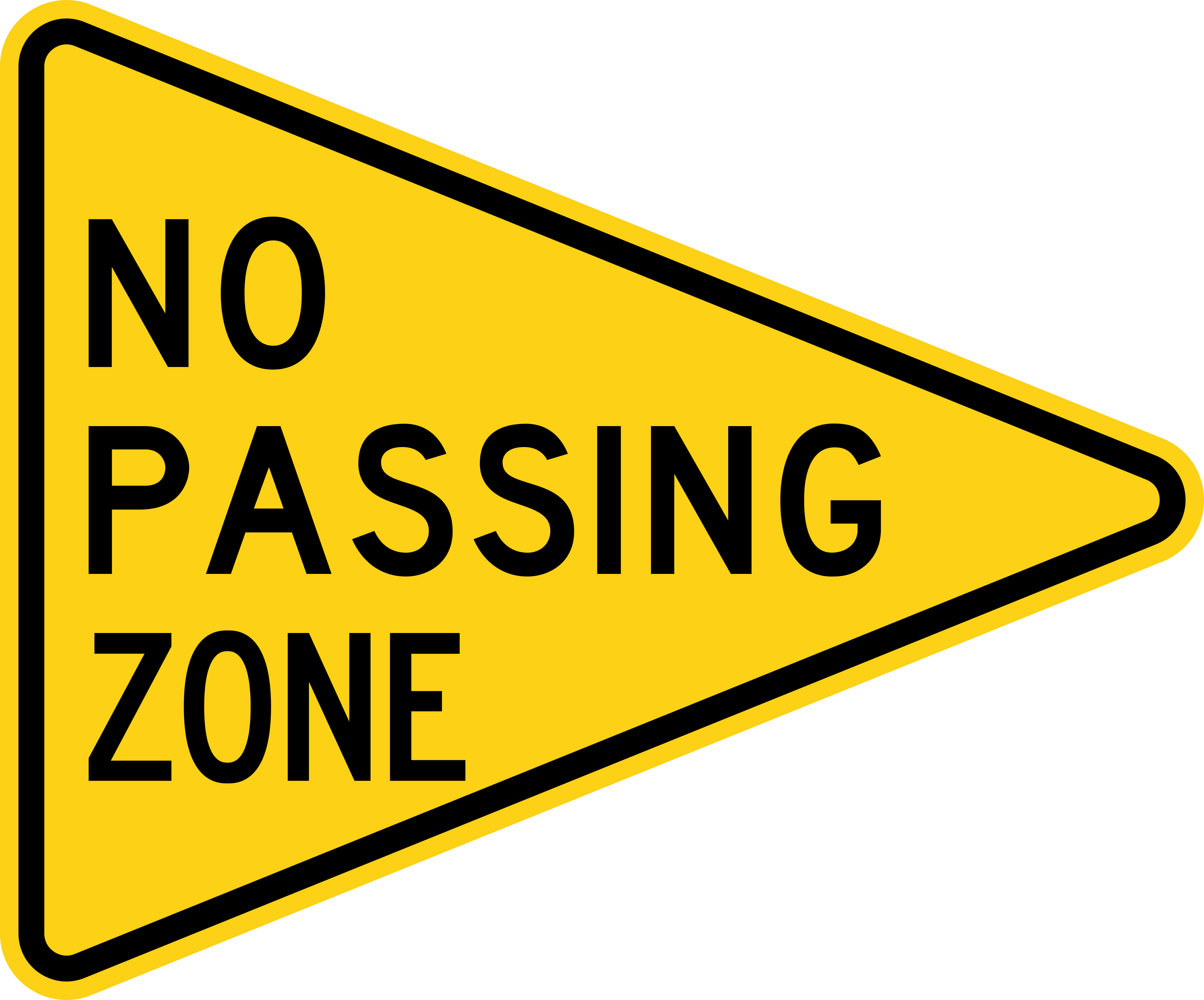
- A no-passing zone ahead
- A scenic overlook with parking nearby
- A school zone with a fifteen-mile-per-hour limit
- A lane that must turn at the next signal
Show answer
A no-passing zone ahead. The pennant is reserved for advance warning of a no-passing zone. It tells you to stop planning an overtaking maneuver and to watch the center markings as the restricted area approaches. The school-zone choice describes a different warning, while parking and mandatory lane movement use other signs. Treat the unusual sideways triangle as a visual reminder that sight distance or roadway conditions soon make passing unsafe.
Study this in the handbook: Sign Shapes and Colors
7. What does a DIVIDED HIGHWAY warning sign tell a driver?

- A traffic circle is ahead with no median
- The divided highway ends and two-way traffic begins
- A divided highway is ahead
- U-turns are permitted across the center separation
Show answer
A divided highway is ahead. The divided highway warning announces that a divided highway is ahead, meaning opposing directions will be separated by a median or other division. It is distinct from the sign that says the divided highway ends and two-way traffic is ahead. The roundabout and U-turn choices describe movements or features not stated by this warning. As the separation approaches, keep right of the median, follow lane markings, and avoid crossing the division. The split-arrow image is the cue to expect separated directions, not permission to cross between them.
8. What does the triangular YIELD sign require you to do?
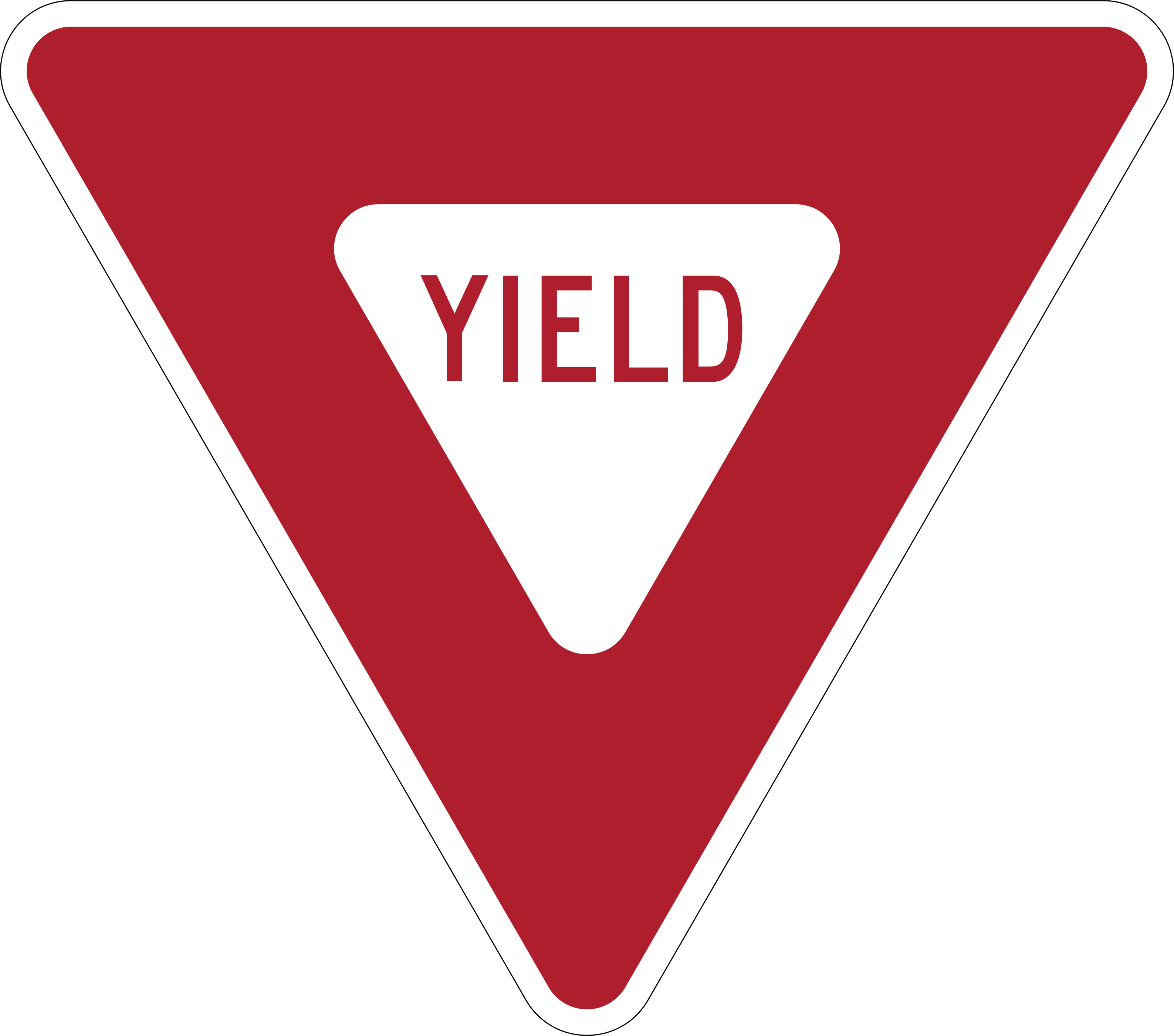
- Let other vehicles on the roadway have the right-of-way
- Stop for exactly three seconds before proceeding
- Enter first because the triangle grants priority
- Yield only to vehicles approaching from the left
Show answer
Let other vehicles on the roadway have the right-of-way. The equilateral triangle identifies a YIELD sign, and its instruction is to let other vehicles on the roadway have the right-of-way. The manual does not impose a fixed three-second stop, nor does the shape grant priority to the approaching driver. Limiting the check to the left could miss traffic from another direction. Slow enough to evaluate the entire conflict area, stop if needed, and proceed only after the roadway is safe. The key cue is triangle equals surrender priority, not automatic stopping for a set duration.
Study this in the handbook: Regulatory and Warning Signs
9. How close to the driveway entrance of a fire station may you park in Mississippi when no sign is posted?
- Within 5 feet
- No closer than 20 feet
- No closer than 100 feet
- Directly in front of the driveway entrance
Show answer
No closer than 20 feet. Mississippi prohibits parking within 20 feet of a fire station driveway entrance, and within 75 feet when that larger distance is posted. Five feet and directly at the entrance would block fire trucks, and 100 feet is not the Mississippi figure. Other listed distances include 10 feet from a fire hydrant, 20 feet from a crosswalk at an intersection, and 15 feet from the nearest rail of a railroad crossing.
Study this in the handbook: Parking Rules
10. A school bus is stopped in a loading zone that is part of the highway, where pedestrians are not allowed to cross. What must Mississippi drivers do?
- Stop at least 10 feet away until the stop arm retracts
- They do not have to stop
- Stop only if traveling in the same direction
- Honk and continue
Show answer
They do not have to stop. Mississippi carves out one exception for loading zones: if the bus sits in a loading zone on or beside the highway and pedestrians are not allowed to cross the roadway there, other drivers do not have to stop. Everywhere else, drivers must stop at least 10 feet away regardless of direction, except opposite direction traffic on a divided highway of four or more lanes. Honking is never the required response.
Study this in the handbook: School Buses and Pedestrians
11. What is Mississippi's reinstatement fee for a suspension that is not for DUI, implied consent, drug law, or child support?
- $25
- $175
- $500
- $100
Show answer
$100. The reinstatement table charges $175 after a DUI, implied consent, or controlled substances conviction, $25 after a child support suspension, and $100 for all other suspensions. So $175 and $25 belong to those specific categories, and $500 is not in the table. If a license was deposited in lieu of bond or the driver failed to appear in court, a corrected court abstract from the judge is also needed before reinstatement.
Study this in the handbook: Zero Tolerance, Revocation and Reinstatement
12. What fine and license suspension apply to a first Zero Tolerance DUI for a Mississippi driver under 21?
- No fine and a warning
- $1,000 and 1 year
- $250 and 120 days
- $500 and 30 days
Show answer
$250 and 120 days. Zero Tolerance applies to drivers under 21 with a BAC of 0.02 or higher but less than 0.08. A first offense brings a $250 fine and a 120 day license suspension. It is not a warning, and $1,000 with a year describes a third offense fine cap paired with a second offense suspension. A second Zero Tolerance offense within five years brings a fine of not more than $500 and a one year suspension.
Study this in the handbook: Zero Tolerance, Revocation and Reinstatement
13. How should a driver respond to a flashing yellow traffic signal?
- Stop and remain stopped until a green light appears
- Accelerate to clear the intersection quickly
- Slow down and exercise caution
- Treat it as a red arrow for a left turn
Show answer
Slow down and exercise caution. A flashing yellow light tells the driver to slow down and exercise caution. It is not a command to stop and wait for green, nor does it authorize speeding through the intersection. Treating it as a red arrow adds a turn restriction that the signal does not state. Approach at a controlled speed, look for pedestrians and cross traffic, and be prepared to yield. The key visual cue is the flashing yellow indication: caution and reduced speed, rather than the complete stop required by flashing red.
Study this in the handbook: Traffic Signals and Arrows
14. What does a diamond-shaped traffic sign warn a Mississippi driver about?
- A destination and distance to a town
- An existing or possible hazard on or beside the roadway
- A rule allowing parking for a limited time
- A required route for hazardous materials
Show answer
An existing or possible hazard on or beside the roadway. The diamond is reserved to warn of an existing or possible hazard on or adjacent to the roadway. A destination sign provides guidance, while parking and hazardous-material route instructions are different sign functions. The warning may involve a curve, intersection, school area, or another roadway condition, so the driver should reduce risk by scanning ahead and adjusting speed when needed. Shape recognition is the quick cue: diamond means warning of a hazard, not a direction, service, or ordinary regulation.
Study this in the handbook: Regulatory and Warning Signs
15. A 16 year old in Mississippi wants a Regular Driver's License. Along with the tests and the affidavit, how long must the teen have held a Learner's Permit?
- Six months
- Ninety days
- One year
- Two years
Show answer
One year. A 16 year old qualifies for the Class R license only after holding a Learner's Permit for one year, in addition to passing the exams and providing the 50 hour affidavit. Six months is the out-of-state license rule, ninety days is not a Mississippi permit period, and two years is how long the permit itself stays valid. Applicants 17 or older may apply directly regardless of earlier permits.
Study this in the handbook: Learner's Permits and the Regular License
16. What stopping rule applies to a school bus carrying even one child at a railroad crossing?
- It may cross after sounding its horn twice
- It stops only when the crossing gate is fully lowered
- It must stop at every railroad crossing, regardless of signs or flashing lights
- It stops only at crossings marked with a round warning sign
Show answer
It must stop at every railroad crossing, regardless of signs or flashing lights. A school bus carrying even one child belongs to the group that must stop at every railroad crossing, regardless of whether signs are present or warning lights are flashing. Waiting for a fully lowered gate or a round warning sign would miss the broader requirement. After stopping, the driver checks both directions before proceeding. The manual gives a stopping position of ten to fifty feet from the outer rail. The cue is the vehicle and passenger condition, not the appearance of the crossing equipment.
Study this in the handbook: Railroad Crossings
17. Above what height does a Mississippi vehicle's owner become liable for damage to overhead structures?
- Eight feet
- Fifteen feet
- Ten feet
- Twelve and one half feet
Show answer
Twelve and one half feet. If your vehicle exceeds twelve and one half feet in height, either you or the vehicle's owner will be held responsible for any damage caused by the excess height, and under no conditions may any vehicle exceed thirteen and one half feet. The manual separately limits the total outside width of a vehicle and its load to eight and one half feet. Eight, ten, and fifteen feet are not the height that triggers this responsibility, and fifteen feet would exceed the absolute height limit.
18. At an intersection, what should a driver do when another road user does not yield as expected?
- Slow or stop and let the other road user proceed
- Proceed because having priority makes a collision the other person's fault
- Sound the horn and continue at the same speed
- Move into the opposing lane to claim priority
Show answer
Slow or stop and let the other road user proceed. The manual treats right-of-way as a safety decision, not a guarantee that others will behave perfectly. If another driver does not yield, the prudent response is to slow or stop and allow that person to go. The choice “Proceed because having priority makes a collision the other person's fault” confuses priority with protection from a crash. Honking while maintaining speed can escalate the conflict, and moving into opposing traffic creates a separate hazard. Before entering an intersection, identify who should yield, but remain ready to give way when the other road user's action makes continuing unsafe.
Study this in the handbook: Right of Way at Intersections
19. When is farm machinery exempt from Mississippi size and weight limits?
- At any time on any road
- Never
- Only on county roads
- During daylight on any state highway within 50 miles of the point of origin
Show answer
During daylight on any state highway within 50 miles of the point of origin. Farm machinery is exempt from size, weight and height limitations when operated during daylight hours on any state highway within 50 miles of the point of origin. The exemption does not reach every road at every hour: farm machinery cannot be moved on interstate highways at all. The machinery, or the vehicle towing it, must have front and rear reflector lights and a blinking light clearly visible from the front and rear. A load beyond the limits otherwise needs a permit from the Department of Transportation.
20. When passing a bicyclist traveling in the same direction, how should a Mississippi driver pass?
- Reduce speed, move into the next lane, and leave plenty of room
- Stay beside the bicycle in the same lane to save time
- Pass within inches before an oncoming vehicle arrives
- Sound the horn continuously while squeezing by
Show answer
Reduce speed, move into the next lane, and leave plenty of room. The manual tells drivers not to try to share the lane while passing a bicycle. Reduce speed, move into the next lane, and pass in the normal manner, just as you would pass a motor vehicle, leaving at least three feet. If oncoming traffic is present, slow down behind the bicyclist and pass when that traffic clears. Staying beside the bicycle in the same lane leaves too little room, and squeezing by or sounding the horn while passing adds pressure. After passing, do not cut off the cyclist by turning in front of them.
Study this in the handbook: Bicycles and Large Vehicles
QualitySpace is expanding to Mississippi
We are a California-based independent insurance brokerage working on licensing in more states. We cannot help with Mississippi insurance yet. Leave your email and we will let you know when we can.
Every question is written from the official Mississippi Driver's Manual. Need paper? Printable MS practice test with answer key.
Last verified 2026-10-05. How we check every question · Study all 210 as flashcards
Frequently asked questions
How many questions are on this Mississippi practice test?
This fixed set has 20 questions. It is test 1 of 10 from the 210 question Mississippi bank.
How does this fixed test relate to the full Mississippi bank?
Each numbered test is a fixed set of questions in a fixed order, so you can retake the same test later and compare. Every test mixes road signs and the other topics in about the same proportion as the full bank. Tests 1 to 10 together cover 200 of the 210 questions in the Mississippi bank, each once. The full practice page mixes the whole bank at random.
Last verified 2026-10-05. See the Mississippi DMV facts page for sourced state details.
Return to the full Mississippi practice test · Study road signs