
Test 25 of 25 · 20 questions · Free 2026
MS Permit Practice Test 25
Jump to the test ↓A fixed 20 question set from the Mississippi bank with answers and plain English explanations.
Question 1 of 20 · 0 right so far
All 20 questions in test 25
Every question below comes from the Mississippi question bank on this page. Open a question to see the correct answer and the explanation. Nothing here is hidden behind a signup.
1. What does the Mississippi manual say about walking along or across an interstate?
- Walk on the left edge facing traffic
- Walk on the right shoulder with a flashlight
- Never walk along or across the interstate
- Walk only after the emergency flashers are on
Show answer
Never walk along or across the interstate. The advice to walk on the left facing traffic applies to ordinary highways, not to interstates. For an interstate breakdown, the manual is absolute: never walk along or across the interstate and never attempt to hitchhike. The left-edge option borrows the general highway rule, the right-shoulder option still puts a person beside high-speed traffic, and the flashers option improves visibility but does not make walking safe. Stay inside the locked vehicle and wait for reliable help instead of setting out on foot.
Study this in the handbook: Following Distance and Stopping
2. A pedestrian is already in the crosswalk when the signal changes to flashing. What should the pedestrian do?
- Return to the curb immediately
- Continue crossing to the other side
- Stop and wait in the middle of the road
- Wait for a green light before moving
Show answer
Continue crossing to the other side. The flashing signal tells pedestrians who have not left the curb to stay there, but it does not strand someone who is already in the roadway. The manual says pedestrians should continue if they started to cross before the sign changed to flashing. Returning to the curb can move a pedestrian back into traffic, stopping in the middle exposes the person to vehicles from both directions, and waiting for another green light keeps the person in the crossing longer than necessary. Drivers should give anyone already in the crosswalk time to finish.
Study this in the handbook: Traffic Signals and Arrows
3. Which laws govern vehicle traffic on the Natchez Trace Parkway?
- Only Mississippi traffic laws apply on the whole Parkway
- Federal regulations govern, and state laws also apply
- Only federal regulations, with no state laws at all
- County ordinances govern Parkway traffic
Show answer
Federal regulations govern, and state laws also apply. Vehicle traffic on the Natchez Trace Parkway is governed by federal regulations, and Mississippi traffic laws also apply there. A driver therefore cannot treat the Parkway as a law-free scenic road or follow only one set of rules. Federal rules come from the National Park Service administration of the Parkway, while ordinary state driving rules still shape speed, passing, and right-of-way conduct. Heed posted signs along the route, because lower speeds may be posted below the Parkway maximum in places.
4. A driver wants to leave a car parked on a bridge while fishing below. What does Mississippi say?
- Parking there is prohibited on any bridge or elevated structure
- Parking there is allowed if the hazard lights are on
- Parking there is allowed outside rush hours
- Parking there is allowed on the bridge shoulder
Show answer
Parking there is prohibited on any bridge or elevated structure. Mississippi lists bridges and elevated structures among the places where a driver may not stop and leave a vehicle parked and unattended. A parked car on a bridge narrows the crossing for traffic that has no escape path, and hazard lights or off-peak timing do not create an exception. The same list also bars parking in a highway underpass. Leave the car in a lawful area before fishing, even when that means a longer walk back to the water.
Study this in the handbook: Parking Rules
5. How must a cyclist signal a turn while riding on a public road?
- Use arm and hand signals for turning
- Shout the turn direction to nearby drivers
- Stand on the pedals before turning
- Ring a bell twice before turning
Show answer
Use arm and hand signals for turning. Cyclists must use arm and hand signals for turning, giving drivers the same advance notice a turn signal lamp provides on a car. The cyclist rules also require obeying traffic laws such as stopping for stop signs and stop lights. Shouting, standing on the pedals, and ringing a bell do not tell surrounding traffic which way the rider plans to go. A driver who sees a rider extend an arm should read it as a turn signal and yield or pass with room accordingly.
Study this in the handbook: Bicycles and Large Vehicles
6. An emergency vehicle is stopped on a four-lane highway. If moving away is unsafe, what should you do?
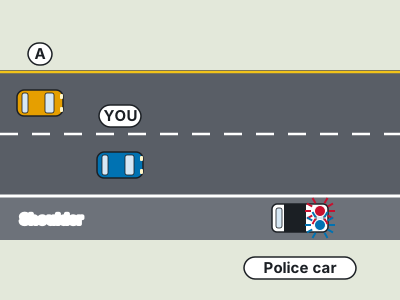
- Pass on the shoulder without reducing speed
- Maintain speed because the emergency vehicle is not moving
- Slow down and prepare to stop while yielding right-of-way
- Turn around before reaching the stopped vehicle
Show answer
Slow down and prepare to stop while yielding right-of-way. When a lane change away from a stopped emergency vehicle cannot be made safely, reduce speed and prepare to stop as necessary. The duty to yield remains even when the vehicle is parked, and passing at normal speed leaves responders exposed. The shoulder is not a shortcut for passing, and turning around creates a separate hazard. Scan early, move over when there is a safe opening, and otherwise approach slowly with room to stop.
Study this in the handbook: School Buses and Pedestrians
7. What should a driver do to always know current traveling speed?
- Glance frequently at the speedometer while monitoring posted signs
- Estimate speed from engine sound learned over years
- Follow the pace of the vehicle directly ahead always
- Check speed only when passing a patrol vehicle ahead
Show answer
Glance frequently at the speedometer while monitoring posted signs. Knowing your speed takes frequent speedometer glances paired with watching posted limit signs as they change along the route. Engine sound drifts with gearing and wind, and matching the car ahead imports that driver errors into your own driving. Build a rhythm: sign, speedometer, mirror, road, repeated without thinking twice. The speedometer check is needed because engine sound is a poor measure of legal speed.
Study this in the handbook: Mississippi Speed Limits
8. Until what point should a child stay in a rear-facing car seat?
- Until the child turns exactly one year old
- Until the child can buckle the seat belt alone safely
- Until reaching the maximum height or weight for a convertible seat
- Only until the child weighs twenty pounds in total
Show answer
Until reaching the maximum height or weight for a convertible seat. Rear-facing travel continues until the child reaches the convertible seat maximum height or weight, typically somewhere between ages three and five. A first birthday or twenty pounds ends rear-facing far too early, and self-buckling skill has no bearing on crash spine protection. Read the seat label limits; the child size, not the calendar, decides. The rear-facing position lasts until the convertible seat's stated limit, not a fixed birthday.
Study this in the handbook: Seat Belts, Child Seats and Distractions
9. A driver signals to turn across your lane. Who yields?
- You must yield because the signal claims the turn
- Both drivers proceed together at reduced speed
- The larger vehicle goes first regardless of signal
- The turning driver must yield and wait for your lane
Show answer
The turning driver must yield and wait for your lane. A driver turning across an opposing lane yields and waits, however early the signal appears, until that lane is clear. A blinking signal announces intent but grants no priority, and simultaneous slow entry puts two front ends in one space. As the straight driver, still cover the brake; as the turner, wait for headlights to pass. A turn signal announces an intention, but it does not remove the turner's duty to yield.
Study this in the handbook: Right of Way at Intersections
10. In the second step of parallel parking, which way do you cut the wheels?
- Toward the traffic lane
- Sharply to the left
- Keep them straight
- Sharply to the right
Show answer
Sharply to the right. The second step of the parallel parking sequence turns the wheels sharply to the right and backs slowly toward the curb, stopping when the front tire lines up with the rear bumper of the car ahead. Cutting left is the third step, used after the car is angled toward the curb. Straight wheels would not bring the rear of the car into the space, and turning toward the traffic lane moves away from the curb. Use the signal first, move slowly, and check the mirrors throughout.
Study this in the handbook: Parking Rules
11. By driving on a Mississippi public road, what does a motorist agree to under the implied consent law?
- Submit to testing for intoxicating substances
- Pay for any roadside sobriety equipment
- Waive the right to consult an attorney later
- Accept a breath test without any suspicion
Show answer
Submit to testing for intoxicating substances. Mississippi's implied consent law says that operating a motor vehicle gives consent to testing for intoxicating substances. The rule concerns a breath or chemical test, and the manual explains that an officer may request one when there is good reason to suspect impairment. It does not create a fee for roadside equipment or waive a driver's right to legal advice. It also does not authorize a test request without suspicion. The consent comes from operating the vehicle, not from signing a form at the roadside.
Study this in the handbook: DUI and Implied Consent
12. A solid green light is showing and you intend to turn left. What must you do?
- Turn at once because the green light protects you
- Wait for a green arrow before entering
- Yield only to pedestrians in the crosswalk
- Yield to oncoming traffic before turning
Show answer
Yield to oncoming traffic before turning. A solid green light lets traffic proceed, but a left turn from that signal is unprotected, so the turning driver must yield to oncoming vehicles. The green arrow is the signal that protects a left turn, and waiting for one when none is displayed holds up traffic needlessly. A driver who yields only to pedestrians still cuts across oncoming cars. Watch the opposing lane for a gap, keep the wheels straight until the path is clear, and complete the turn without hurrying.
Study this in the handbook: Traffic Signals and Arrows
13. What must be in place at least 100 feet before a right turn intersection?
- Your left signal on to warn cars behind you first
- Your right turn signal on and your speed already slowing
- Use hazard flashers and keep your traveling speed unchanged
- A horn tap plus a lane change at the corner itself
Show answer
Your right turn signal on and your speed already slowing. A right turn needs the signal lit and speed dropping at least one hundred feet before the intersection, giving followers fair warning. A left signal announces the opposite move, and hazard flashers at full speed give no direction while hiding your braking intent. Signal, brake gently, and settle near the right edge well before the crosswalk arrives. The early signal and slower speed give following drivers time to respond.
14. What use is forbidden for a TURN LANE ONLY center lane?
- Use it to prepare a left turn across opposing lanes
- Enter it with a turn planned and a signal showing
- Use it to prepare a right turn across opposing lanes
- It is never used for passing other vehicles
Show answer
It is never used for passing other vehicles. A center turn lane exists to prepare turns across opposing lanes, and it must never become a passing route. Entering with a turn planned and a signal showing is the proper use, whether the turn ahead is left or right. Passing there puts a driver head-on with lawful turners coming the other way and removes the refuge the lane gives turning traffic. Stay out until a real turn is close, then enter, signal, and complete that turn without traveling onward.
Study this in the handbook: Pavement Markings and Lanes
15. A charter bus that is not a school bus travels on a two-lane state highway. What maximum speed does the Mississippi table list?
- 45 miles per hour
- 55 miles per hour
- 65 miles per hour
- 70 miles per hour
Show answer
55 miles per hour. The bus table, which excludes school buses, lists 55 miles per hour for two-lane state and U.S. routes. A bus may run 65 miles per hour on a four-lane highway and 70 miles per hour on an interstate, so the 65 figure describes a wider road, not this one. The 45 miles per hour value is the bus limit in inclement weather or bad visibility. A driver new to a large vehicle should verify the posted limit and keep the speedometer at or below the figure that matches the road type.
Study this in the handbook: Mississippi Speed Limits
16. Why should you avoid following the same vehicle for long periods?
- The lead vehicle will eventually brake without warning lights
- You may become too relaxed and lose your concentration
- Following one car hides your vehicle from patrol officers
- Your headlights will damage the lead vehicle mirrors slowly
Show answer
You may become too relaxed and lose your concentration. Trailing the same vehicle or group too long breeds relaxation and lost concentration, so long drives need varied visual rhythm and breaks. Brake-light failure is not the stated reason, and mirror damage from headlights is not a fatigue problem the rule addresses. Change the scene: stop, stretch, and rejoin traffic behind different vehicles. Following one vehicle too long can turn attention into a dull routine.
Study this in the handbook: Seat Belts, Child Seats and Distractions
17. When carrying explosives or flammables, which warning device is prohibited?
- Electric flares are prohibited because they can ignite the load
- Lanterns are prohibited, but electric flares are allowed
- Burning flares or fuses may not be used
- Any warning device is allowed if it is stored in the cab
Show answer
Burning flares or fuses may not be used. For a vehicle carrying explosives or flammables, the manual permits electric flares, lanterns, or large flares for emergencies but prohibits every type of burning flare or fuse. Saying that electric flares are prohibited reverses the rule. Saying that lanterns are prohibited while electric flares are allowed bans a permitted device and leaves out the burning flare or fuse restriction. Allowing any warning device when it is stored in the cab removes the restriction altogether. The prohibition concerns the kind of warning device, not where it is stored. Electric flares and lanterns are permitted, but burning flares and fuses are not.
18. Why must speed be reduced when driving at night?
- Roads are legally slower at night in every location
- Headlights make objects appear closer than they are
- Night air reduces tire grip on all paved surfaces
- Visibility is greatly reduced, so speed and caution must adjust
Show answer
Visibility is greatly reduced, so speed and caution must adjust. Night reduces visibility greatly, so speed drops and caution rises to match the shorter distance your headlights actually reveal. No universal night speed law creates the duty, and grip loss from night air is not the mechanism the manual cites. Drive the distance you can see, not the distance you remember from daylight. Reduced visibility limits the time available to recognize and respond to hazards.
Study this in the handbook: Night Driving, Rain and Skids
19. What is the Mississippi reinstatement fee after a DUI or implied consent suspension?
- $175
- $25
- $100
- $500
Show answer
$175. The reinstatement fee for a suspension under the Mississippi Implied Consent Law, DUI or the Uniform Controlled Substances Act is $175, compared with $25 for failure to pay child support and $100 for all other suspensions. If the license was deposited in lieu of bond or you failed to appear in court, a corrected court abstract is required before reinstatement.
Study this in the handbook: Zero Tolerance, Revocation and Reinstatement
20. What does Mississippi say about driving at night with only the parking lights on?
- It is required on lighted city streets
- It is acceptable when the speed limit is 35 mph
- It is not allowed; use the headlights
- It is allowed only during the first hour after sunset
Show answer
It is not allowed; use the headlights. Parking lights are not a substitute for headlights when a vehicle is moving. The manual tells drivers not to drive with only the parking lights on and to switch on the headlights whenever lights are needed. The city-street option treats illumination from streetlamps as a reason to run dim lights, the speed option invents a threshold that does not exist, and the sunset option adds a time window the rule does not recognize. Use the headlight switch as soon as visibility drops, and remember that parking lights alone do not give you the seeing distance or the taillight brightness that night driving requires.
Study this in the handbook: Night Driving, Rain and Skids
Every question is written from the official Mississippi Driver's Manual. Need paper? Printable MS practice test with answer key.
Last verified 2026-10-05. How we check every question · Study all 500 as flashcards
Frequently asked questions
How many questions are on this Mississippi practice test?
This fixed set has 20 questions. It is test 25 of 25 from the 500 question Mississippi bank.
How does this fixed test relate to the full Mississippi bank?
Each numbered test is a fixed set of questions in a fixed order, so you can retake the same test later and compare. Every test mixes road signs and the other topics in about the same proportion as the full bank. Tests 1 to 25 together cover every question in the Mississippi bank once. The full practice page mixes the whole bank at random.
Last verified 2026-10-05. See the Mississippi DMV facts page for sourced state details.
Return to the full Mississippi practice test · Study road signs