
Test 9 of 10 · 20 questions · Free 2026
MS Permit Practice Test 9
Jump to the test ↓A fixed 20 question set from the Mississippi bank with answers and plain English explanations.
Question 1 of 20 · 0 right so far
All 20 questions in test 9
Every question below comes from the Mississippi question bank on this page. Open a question to see the correct answer and the explanation. Nothing here is hidden behind a signup.
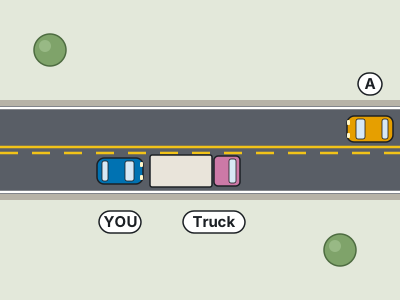
1. When a broken yellow line is closest to your lane beside a solid yellow line, what may you do?
- Never cross the lines under any circumstance
- Pass at any time because the solid line applies only to trucks
- Pass with caution when the oncoming lane is clear and it is safe
- Cross only to park on the opposite shoulder
Show answer
Pass with caution when the oncoming lane is clear and it is safe. With a broken yellow line closest to the driver's lane, crossing to pass is permitted only with caution and only when the oncoming lane is clear and the maneuver is safe. The solid line restricts the driver traveling beside it, not the driver beside the broken line. Passing at any time ignores the safety condition, while an absolute prohibition describes a double solid yellow marking. Before crossing, check sight distance, traffic, and the road conditions rather than relying on the line alone.
Study this in the handbook: Pavement Markings and Lanes
2. What is the fine for littering on Mississippi roads?
- $10
- Up to $5,000
- A warning only
- Not less than $50 and not more than $250
Show answer
Not less than $50 and not more than $250. Any person found guilty of littering on Mississippi's roads, highways, interstates or within their rights of way shall be fined not less than $50 and not more than $250. The manual's Keep Mississippi Beautiful section tells drivers never to toss litter from the vehicle, let trash blow out of it, or dump garbage on the roadside. It calls the offense easily preventable: keep a trash bag in your vehicle and dispose of trash responsibly. A $10 fine, a warning, or a fine up to $5,000 does not match the stated range.
3. A school bus is stopped on a divided highway with four or more lanes, and you are traveling opposite the bus. What may you do?
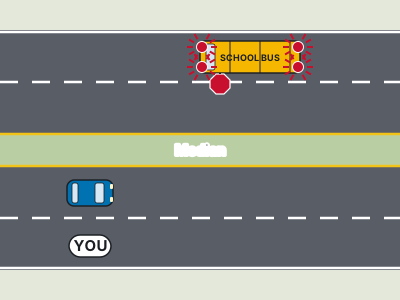
- Continue on your side without stopping when the divided-highway exception applies
- Stop at least ten feet away until the bus resumes motion
- Turn around and approach the bus from the same direction
- Stop only if the bus driver waves traffic down
Show answer
Continue on your side without stopping when the divided-highway exception applies. Mississippi makes opposite-direction traffic an exception when the stopped bus is on a divided highway with at least four lanes and opposing travel separated. A driver on the other side may continue along that side instead of stopping. The choice “Stop at least ten feet away until the bus resumes motion” describes traffic moving in the bus's direction, not the opposing lane. Keep watching for children and obey other traffic controls, because the exception concerns the bus stop procedure rather than general safe driving.
Study this in the handbook: School Buses and Pedestrians
4. When entering a public road from a driveway or other entrance without a stop sign, what must the driver do?
- Accelerate into the roadway because entering traffic has priority
- Stop and yield to oncoming traffic before proceeding when safe
- Yield only to vehicles approaching from the left
- Proceed without stopping whenever the entrance is private
Show answer
Stop and yield to oncoming traffic before proceeding when safe. A driveway or other entrance does not grant a vehicle priority over traffic already using the street or highway. The entering driver must stop and yield, even when no stop sign has been installed. The choice “Accelerate into the roadway because entering traffic has priority” reverses the relationship between entering and established traffic. Look in both directions, wait for a safe opening, and remember that a private entrance changes neither the duty to yield nor the need for caution.
Study this in the handbook: Right of Way at Intersections
5. How far before the tracks is a rural Mississippi railroad advance warning sign normally posted?
- 50 feet
- 500 to 900 feet
- One mile
- Directly at the crossing
Show answer
500 to 900 feet. In rural areas the round railroad advance warning sign is normally posted 500 to 900 feet in front of the tracks. That distance gives a driver time to look, listen, and slow down, because a stop may be needed at the crossing itself. Fifty feet or a spot directly at the crossing would leave almost no warning, and one mile is not the figure the manual gives. At the crossing, remain stopped until all tracks are clear, any gates are raised, and the lights no longer flash, and never try to beat a train.
Study this in the handbook: Railroad Crossings
6. Which headlights should be used while driving in fog?
- The lower beams
- The high beams only
- Parking lights without headlights
- No lights until the fog lifts
Show answer
The lower beams. Fog scatters the brighter beam and can make the air in front of the vehicle look even more opaque. The manual directs drivers to use the lower beam in fog during either night or day. High beams can reduce visibility, while parking lights alone do not provide the needed headlight illumination. Reduce speed as well, because the useful sight distance is short and stopping space disappears quickly.
Study this in the handbook: Night Driving, Rain and Skids
7. How many people die each day waiting for a transplant, according to the Mississippi manual's organ donation appendix?
- About 2
- About 200
- An average of 22
- About 1,000
Show answer
An average of 22. According to the U.S. Department of Health and Human Services, an average of 22 people die each day waiting on a transplant, which the manual cites to show the serious shortage of organ and tissue donors. Anyone can donate, regardless of age, race or gender. If you are not a registered organ donor at the time of death, your legal next of kin must give consent, and Mississippi Gift of Life Act of 1998 requires that all families be given the option to donate.
8. What does Mississippi's manual say about throwing litter from a vehicle?
- It is permitted when the vehicle owner did not throw the item
- It is allowed if the item is biodegradable
- It is prohibited only on interstates, with no listed fine
- It is prohibited, and a conviction can bring a fine from $50 to $250
Show answer
It is prohibited, and a conviction can bring a fine from $50 to $250. The manual tells drivers not to toss litter, let trash blow out, or dump garbage along the roadside. A person found guilty on the listed Mississippi roads, highways, interstates, or rights-of-way may be fined at least fifty dollars and no more than two hundred fifty dollars. Biodegradability does not create an exception. Keeping a trash bag in the vehicle is the practical prevention cue supplied by the manual.
9. What maximum speed does the manual list for a school bus?
- 45 mph
- 35 mph
- 55 mph
- 65 mph
Show answer
45 mph. The speed table sets the school-bus maximum at forty-five miles per hour. That figure is distinct from the fifteen-mile-per-hour maximum for any vehicle in a school zone and from the higher interstate and highway figures for passenger automobiles. Choosing fifty-five or sixty-five would import passenger-car roadway values into a bus-specific rule. A posted lower limit or hazardous condition can still require slower travel.
Study this in the handbook: Mississippi Speed Limits
10. What is the recommended first response to a tire blowout?
- Release the accelerator and brake slowly and cautiously
- Apply the brakes hard before touching the steering wheel
- Turn sharply toward the nearest shoulder immediately
- Accelerate rapidly to stabilize the damaged tire
Show answer
Release the accelerator and brake slowly and cautiously. A blowout can destabilize the vehicle, so sudden braking or a sharp steering input can make the loss of control worse. Ease off the accelerator, keep the vehicle directed safely, and apply the brakes slowly and cautiously. Hard braking is the tempting mistake because it feels immediate, but it transfers control too abruptly. Once the vehicle is stable and slowed, move toward a safe location and deal with the tire problem away from moving traffic.
Study this in the handbook: Night Driving, Rain and Skids
11. When an ambulance approaches with emergency lights or a siren, where should you move?
- Behind the emergency vehicle while matching its speed
- Toward the center line so the vehicle can use the shoulder
- Into the nearest intersection and remain stopped there
- Toward the extreme right shoulder until it has passed
Show answer
Toward the extreme right shoulder until it has passed. An ambulance, fire engine, or police car using emergency signals has priority. If possible, pull to the extreme right shoulder and remain there until the vehicle passes. Moving toward the center line narrows the responder's path, and stopping in an intersection can block crossing traffic. Following behind the emergency vehicle is unsafe and does not yield the roadway. If you are already in an intersection, clear it first, then pull right.
Study this in the handbook: School Buses and Pedestrians
12. What does a broken white pavement line between lanes permit?
- No movement across the line under any condition
- Passing only by crossing into opposing traffic
- A lane change when it is safe to do so
- Travel in opposite directions on each side of the line
Show answer
A lane change when it is safe to do so. A broken white line separates lanes moving in the same direction and permits a vehicle to cross for a lane change when the movement is safe. The choice “Travel in opposite directions on each side of the line” describes opposing traffic, which belongs with a broken yellow center line. A solid or double white marking can impose stronger restrictions, but this question identifies a broken white line. Check mirrors and the blind spot, signal, and move only after confirming the destination lane has room. The marking permits a maneuver; it does not make an unsafe maneuver acceptable.
Study this in the handbook: Pavement Markings and Lanes
13. You approach an intersection where another vehicle is already inside it. Who has priority?
- The approaching vehicle, because it has not reached the crosswalk
- The vehicle already inside the intersection
- The vehicle traveling at the higher speed
- Whichever driver sounds the horn first
Show answer
The vehicle already inside the intersection. Vehicles already inside an intersection have the right-of-way under the Mississippi manual. An approaching driver should yield and allow that vehicle to clear rather than entering based on speed, position at the crosswalk, or a horn signal. The choice “The approaching vehicle, because it has not reached the crosswalk” invents priority for the vehicle that has not yet entered. A horn does not assign legal precedence, and speed is never the deciding measure. Scan the whole intersection before moving, especially when traffic or sight lines make another vehicle easy to overlook.
Study this in the handbook: Right of Way at Intersections
14. When may a Mississippi driver who was out of state on military duty renew an expired license?
- Any time within 90 days of discharge or of returning to the state
- Only before it expires
- Within one year
- Never without retesting
Show answer
Any time within 90 days of discharge or of returning to the state. If you are out of state due to military service when your valid license expires, you may renew it at any time within 90 days of being discharged from military service or upon returning to the state. Non resident military personnel and their families may drive in Mississippi on a valid license from another state, and out of state college students may likewise drive with their out of state license. The rule is not limited to renewing before expiration, and the window is 90 days rather than one year.
Study this in the handbook: Who Needs a License and New Residents
15. A yellow solid arrow is displayed for a left-turn lane. What should the driver do?
- Treat it as a flashing yellow arrow and turn immediately
- Make a protected turn without checking oncoming traffic
- Slow down and prepare to stop because the signal is changing to red
- Continue straight even if the lane arrow requires a turn
Show answer
Slow down and prepare to stop because the signal is changing to red. A yellow solid arrow has the same meaning as a solid yellow light: the signal is about to change to red, so the driver should slow down and prepare to stop. The choice “Make a protected turn without checking oncoming traffic” mistakes it for a green arrow and ignores the approaching red phase. A flashing yellow arrow allows a turn only with a yield to oncoming traffic, but that is a different display. Read the arrow's steady or flashing condition, then stop safely when the change permits stopping before the intersection.
Study this in the handbook: Traffic Signals and Arrows
16. How fast can an experienced bicyclist ride, according to the Mississippi manual?
- 5 miles per hour
- 45 miles per hour
- 10 miles per hour at most
- 20 to 25 miles per hour, closer than you may think
Show answer
20 to 25 miles per hour, closer than you may think. Under Mississippi law a bicycle is a vehicle when ridden on public roads, and an experienced bicyclist can ride 20 to 25 miles per hour and may be closer than you think. The manual's rules for drivers say to yield to oncoming bicyclists as you would to oncoming motorists, leave at least three feet when passing, and avoid cutting off a cyclist by turning in front of them. After passing a bicyclist going your way, make a right turn only if it can be made with reasonable safety.
Study this in the handbook: Bicycles and Large Vehicles
17. What does a RIGHT LANE ENDS warning require a driver to anticipate?

- A new lane opens with no merging necessary
- The left lane ends and traffic must merge right
- The right lane ends and traffic must merge to the left
- The roadway becomes two-way at the sign
Show answer
The right lane ends and traffic must merge to the left. The warning identifies a right lane that will end and tells drivers to merge to the left. It is not the mirror-image left-lane condition, an added lane, or a conversion to two-way traffic. Begin checking the left lane early, signal your intention, and move only after confirming a safe gap. Waiting until the pavement narrows can force a hurried maneuver beside another vehicle. The directional cue is the side named by the sign: right lane ends means the remaining travel space is to the left, subject to traffic and lane markings.
18. What does the pentagon school crossing sign warn a driver about?

- A public parking area near a recreation center
- Children crossing the street on their way to and from school
- A railroad crossing located inside a school zone
- A required stop for every adult pedestrian
Show answer
Children crossing the street on their way to and from school. The pentagon school crossing sign warns that children must cross the street on their way to and from school. The manual notes that it can appear several blocks from the school, so a driver should slow and watch well before seeing a building. It is not a parking, railroad, or universal adult-stop sign. Expect unpredictable movement, especially near arrival and dismissal times, and yield when children are crossing. The pentagon is the fast shape cue, while the child-crossing message tells you why extra attention and reduced speed are needed.
Study this in the handbook: Regulatory and Warning Signs
19. A Mississippi driver is too badly hurt in a crash to make an immediate report. Who may report it instead?
- No one; the report must wait for the driver
- Only a lawyer
- Only the other driver's insurer
- Any one of the driver's passengers
Show answer
Any one of the driver's passengers. The manual says that if you are injured too badly to make an immediate report, any one of your passengers may make it. The report cannot simply wait, a lawyer is not required, and the other driver's insurer is not the reporting party. Crashes involving injury, death, or apparent property damage over $500 must be reported right away, and these reports are confidential.
Study this in the handbook: Accidents, Breakdowns and Insurance
20. What fine range and jail term does Mississippi list for a first DUI offense at 0.08 or higher?
- $600 to $1,500 and 5 days to 6 months
- $250 to $1,000 and up to 48 hours
- $2,000 to $5,000 and 1 to 5 years
- A $100 fine and no jail
Show answer
$250 to $1,000 and up to 48 hours. The DUI penalty table lists a first offense, a misdemeanor, at a $250 to $1,000 fine and up to 48 hours in jail, with a 120 day license suspension. The $600 to $1,500 fine and 5 days to 6 months jail are the second offense within five years. The $2,000 to $5,000 fine and 1 to 5 years in state custody are the third, a felony. A $100 fine with no jail is not in the table.
Study this in the handbook: DUI and Implied Consent
QualitySpace is expanding to Mississippi
We are a California-based independent insurance brokerage working on licensing in more states. We cannot help with Mississippi insurance yet. Leave your email and we will let you know when we can.
Every question is written from the official Mississippi Driver's Manual. Need paper? Printable MS practice test with answer key.
Last verified 2026-10-05. How we check every question · Study all 210 as flashcards
Frequently asked questions
How many questions are on this Mississippi practice test?
This fixed set has 20 questions. It is test 9 of 10 from the 210 question Mississippi bank.
How does this fixed test relate to the full Mississippi bank?
Each numbered test is a fixed set of questions in a fixed order, so you can retake the same test later and compare. Every test mixes road signs and the other topics in about the same proportion as the full bank. Tests 1 to 10 together cover 200 of the 210 questions in the Mississippi bank, each once. The full practice page mixes the whole bank at random.
Last verified 2026-10-05. See the Mississippi DMV facts page for sourced state details.
Return to the full Mississippi practice test · Study road signs