
Test 17 of 25 · 20 questions · Free 2026
MS Permit Practice Test 17
Jump to the test ↓A fixed 20 question set from the Mississippi bank with answers and plain English explanations.
Question 1 of 20 · 0 right so far
All 20 questions in test 17
Every question below comes from the Mississippi question bank on this page. Open a question to see the correct answer and the explanation. Nothing here is hidden behind a signup.
1. When may a cyclist move left, farther into the traffic lane?
- When the right side of the lane is unsafe.
- When the cyclist wants to avoid being passed.
- When a vehicle is following closely behind the cyclist.
- Whenever the cyclist reaches a marked intersection.
Show answer
When the right side of the lane is unsafe.. Mississippi expects a cyclist to ride as far right as safely possible. Moving farther left is allowed when the right side has an unsafe condition, such as broken pavement, a pedestrian, a parked car, gravel, or another road hazard. The cyclist may also move left to overtake and pass a vehicle traveling in the same direction. Wanting to avoid being passed does not create either condition, and a vehicle following closely behind is not listed as a reason. A marked intersection alone is not an exception. The trigger is a hazard on the right or a pass by the cyclist.
Study this in the handbook: Bicycles and Large Vehicles
2. While driving a truck downhill, which action follows the manual?
- Keep the clutch engaged while driving downhill.
- Shift to neutral while descending.
- Coast downhill with the clutch disengaged.
- Disengage the clutch when the downgrade is steep.
Show answer
Keep the clutch engaged while driving downhill.. The manual prohibits disengaging the clutch while driving a truck on a downgrade because that creates illegal and risky coasting. Keeping the clutch engaged follows the stated restriction. Shifting to neutral and coasting with the clutch disengaged both remove the engine's connection while descending. Disengaging the clutch only when the grade is steep is still the prohibited action, so the slope does not create an exception.
3. Which group must stop at every railroad crossing, even when no signal is warning of a train?
- A school bus with no children, a private passenger car, or a motorcycle
- A motorcycle, a pickup towing a small trailer, or a bus carrying adult passengers
- A school bus with a child, a passenger-for-hire vehicle, or a vehicle carrying explosives or flammables
- A vehicle older than ten years, a taxi without passengers, or a truck with no hazardous load
Show answer
A school bus with a child, a passenger-for-hire vehicle, or a vehicle carrying explosives or flammables. Some vehicles must stop at every railroad crossing even when lights are not flashing. The group with a school bus carrying even one child, a vehicle for hire carrying passengers, and a vehicle carrying explosives or flammable liquids names all three categories. A school bus with no child and ordinary private vehicles are not the listed group. A group containing a motorcycle, pickup, and bus with adult passengers omits the required passenger or hazardous cargo conditions. Vehicle age and empty status do not create the all-crossings rule. These vehicles must stop 50 to 10 feet from the outer rail before checking both directions.
Study this in the handbook: Railroad Crossings
4. When backing a large vehicle, what human help should you use if possible?
- Have someone guide you when you back up, if possible
- Have a passenger ride on the rear step while moving
- Guide yourself by opening the door and leaning outward
- Use only the backup camera if the vehicle has one
Show answer
Have someone guide you when you back up, if possible. For large-vehicle backing, the manual recommends having someone guide the driver when possible. A person outside can watch areas the driver cannot see from the seat, but that person should remain clear of the moving vehicle. Riding a rear step is dangerous, leaning out can interfere with vehicle control, and a backup camera does not replace the manual's recommended human guide. The question asks for the available assistance, not for a substitute that removes the driver's responsibility.
5. How early should you be in the correct exit lane on an interstate?
- At least one-quarter mile before your exit point
- At least fifty feet before the exit gore point
- Only after passing the last route confirmation sign
- In the exit lane from the moment you enter traffic
Show answer
At least one-quarter mile before your exit point. Interstate exits require lane position settled at least a quarter mile early, so the exit becomes a calm drift rather than a dive. Fifty feet forces a sharp cut across lanes, and riding the exit lane from entry blocks merging traffic for miles. Move over when the exit is announced, then simply hold lane as signs count down. Quarter-mile lane choice prevents a last-second weave across faster interstate traffic.
6. A WRONG WAY sign faces you. What danger and action apply?
- One-way traffic ahead; continue driving onward at a reduced speed
- A closed exit ramp; back up to the last interchange
- Head-on collision danger; leave the roadway and turn around soon
- Wrong lane choice; merge left at the next opening
Show answer
Head-on collision danger; leave the roadway and turn around soon. Wrong way means you travel against the lane flow with head-on collision danger, so leave the roadway and turn around promptly. Continuing slowly still meets traffic head-on, and backing toward an interchange multiplies exposure in the wrong direction. Pull fully off, turn around where safe, and re-enter only with the flow. The sign means the vehicle is traveling against the permitted direction.
Study this in the handbook: Regulatory and Warning Signs
7. After your complete stop at a stop sign, when may you carefully proceed?
- As soon as your wheels stop, regardless of cross traffic
- Only if your way through the intersection is completely clear
- When a driver in the intersection waves you forward once
- After counting three seconds with traffic still approaching
Show answer
Only if your way through the intersection is completely clear. After stopping, a driver proceeds carefully only when the way is completely clear of vehicles and pedestrians in the intersection. A stopped wheel does not clear cross traffic, and a wave from another driver cannot override your own check for hazards. Counting three seconds while traffic approaches still leaves the conflict in place. Stop, scan every leg, and roll only into a verified empty path. A stop sign does not authorize entry until every conflicting path is clear.
Study this in the handbook: Right of Way at Intersections
8. In step two of parallel parking, you back slowly toward the curb with wheels cut sharply right. When should you stop this stage?
- When your front tire aligns with the back bumper of the car ahead
- When your rear tire touches the curb
- When your car sits at a forty-five degree angle
- When you can see the whole space in the mirror
Show answer
When your front tire aligns with the back bumper of the car ahead. The second stage of parallel parking ends when the front tire aligns with the back bumper of the car ahead. Stopping at that alignment sets up the next stage, cutting the wheels sharply left to swing the rear toward the curb. Backing until a tire touches the curb goes too far, a forty-five degree check substitutes a guess for the stated landmark, and mirror view alone does not mark the change point. Watch the front tire line, stop, then reverse the wheel direction for the final swing in.
Study this in the handbook: Parking Rules
9. When should a driver reduce speed for an intersection?
- While crossing the intersection
- After completing the turn
- Only when the light turns red
- As the intersection is approached
Show answer
As the intersection is approached. Speed should be scrubbed off before the vehicle reaches the crossing, not while it is inside the intersection or already turning. The manual puts the slowdown at the approach, then calls for a gradual increase once the intersection is clear. Waiting until you are crossing leaves too little time to react to a pedestrian or a car that does not yield, braking after the turn is too late to help, and waiting for a red light ignores stop signs and unmarked crossings. Ease off the accelerator early enough that the car is already at a safe speed when it enters.
Study this in the handbook: Right of Way at Intersections
10. How does a driver signal a left turn with an arm signal?
- Raise the forearm upward from a bent elbow position
- Point the arm downward with the palm facing backward
- Wave the extended arm in a slow circular motion
- Extend the arm and hand straight out to the left
Show answer
Extend the arm and hand straight out to the left. For an arm signal left turn, the arm and hand point straight out, matching the direction the vehicle will travel next. The bent elbow with forearm up means a right turn, so using it here would send following drivers toward the wrong side. Hold the arm fully out where a driver behind can see it against your window line. The arm should point left directly, not up or down.
Study this in the handbook: Signals, Lanes and Passing
11. What does a broken yellow line separating opposing traffic permit a driver to do?
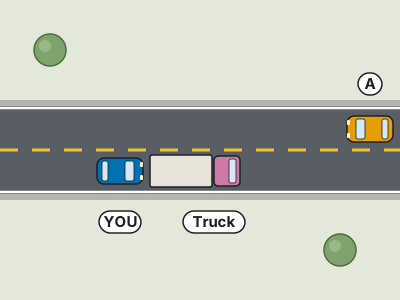
- Cross whenever the driver wants
- Cross only to pass when it is safe
- Cross only to park
- Never cross under any condition
Show answer
Cross only to pass when it is safe. A broken yellow center line separates traffic moving in opposite directions, and crossing into the oncoming lane is permitted only for passing when it is safe. The line is not an unrestricted invitation to cross, so the choice “Cross whenever the driver wants” ignores the safety condition. Parking is not the stated purpose, and the choice “Never cross under any condition” describes a prohibition that applies to a different marking. Check for oncoming traffic, sight distance, and other hazards before entering the opposing lane, then return when the pass is complete.
Study this in the handbook: Signals, Lanes and Passing
12. What is the best way to notify others you intend to turn or pass?
- Tap the brakes three times before every turn made
- Use your signal lights well in advance of the maneuver
- Wave one hand out the window toward following traffic
- Flash headlights at drivers waiting at side streets
Show answer
Use your signal lights well in advance of the maneuver. Signal lights used well in advance are the best notice of a turn or pass, giving others time to adjust before you move. Brake taps announce slowing, not direction, and hand waving is ambiguous at distance where signal lamps read clearly instead. Signal first, then brake, then turn: the order teaches itself to followers. Early signal lights make the intended turn or pass visible before the maneuver.
Study this in the handbook: Signals, Lanes and Passing
13. Why should you never pass a truck on the right near a possible right turn?
- Trucks always turn right without signaling their intent in advance to following drivers
- The right lane beside a truck is legally a parking lane
- Truck drivers can see every vehicle beside them through their mirrors
- Large vehicles swing left before turning right and may close the right side
Show answer
Large vehicles swing left before turning right and may close the right side. A large vehicle needs more room to turn and may swing left while preparing for a right turn. That movement can leave a driver passing on the right beside the truck's path as the vehicle turns back toward the curb. The danger is not that trucks always fail to signal, nor that the adjacent lane becomes a parking lane. Mirrors also do not guarantee that the truck driver sees every vehicle beside the rig. The manual's warning is about the truck's turning path and the shrinking right-side space.
Study this in the handbook: Bicycles and Large Vehicles
14. Repeatedly varying highway speed by five mph can cost how much mileage?
- Up to five miles per gallon on every highway trip
- Up to one and three-tenths miles per gallon from see-sawing speed
- Mileage does not drop if the average speed stays the same overall
- Exactly half a mile per gallon in city traffic only
Show answer
Up to one and three-tenths miles per gallon from see-sawing speed. The energy appendix gives a maximum loss of 1.3 miles per gallon for highway speed changes of five mph. The five-mile figure exaggerates the stated loss, and keeping the same average speed does not remove the repeated changes that the manual identifies. The passage places this example on the highway, not only in city traffic. The amount tested is one and three-tenths miles per gallon at most.
15. A driver holds a valid out-of-state license for motorcycles. What may Mississippi waive for the motorcycle endorsement?
- The requirement to wear a crash helmet
- The requirement to hold a driver's license
- Both the computerized test and the skills test
- The requirement to advise the examiner
Show answer
Both the computerized test and the skills test. Mississippi may waive both motorcycle tests for a driver who already holds a valid out-of-state license for motorcycle operation. That prior license shows the rider passed testing elsewhere, so repeating the computerized test and the skills test is not required. The waiver does not remove the helmet rule on Mississippi roads, does not replace the need to hold a driver's license, and does not excuse telling the examiner which test is wanted when testing is needed. Bring proof of the out-of-state motorcycle license.
Study this in the handbook: Learner's Permits and the Regular License
16. Which extra-light colors does the manual prohibit?
- It prohibits amber or white extra lights.
- It prohibits green or yellow extra lights.
- It prohibits red or blue extra lights.
- It prohibits clear or amber extra lights.
Show answer
It prohibits red or blue extra lights.. Mississippi's equipment rule prohibits red or blue on the extra lights covered by this passage. The question is about color, not the number of spotlights or auxiliary lights. Amber, white, green, yellow, and clear are not identified as prohibited by this quoted rule, so choices naming those colors do not answer the question. A private vehicle may not use the prohibited red or blue extra-light colors.
Study this in the handbook: Required Equipment, Tags and Tint
17. Which brakes must a Mississippi vehicle have?
- Both a foot brake and a parking brake fitted
- A foot brake alone, with chocks carried for parking stops
- Only a parking brake strong enough for all stopping
- Either brake, provided one works on all four wheels
Show answer
Both a foot brake and a parking brake fitted. Mississippi equipment rules require both a foot brake for service stops and a parking brake to hold the vehicle at rest. Chocks substitute for no required brake, and a parking brake alone cannot handle repeated service stops in moving traffic. Test the parking brake hold on a grade before you actually need it. Both braking systems are required, with the foot brake for stopping and the parking brake for holding.
Study this in the handbook: Required Equipment, Tags and Tint
18. On an interstate, where is passing allowed?
- Across the painted center line and into lanes for opposing traffic flow
- From left or right lanes in your direction across broken white lines
- Only from the right lane, never the left lane ever
- On the paved shoulder when traffic slows below forty
Show answer
From left or right lanes in your direction across broken white lines. Interstate passing happens within your direction from left or right lanes separated by broken white lines, never across into opposing flow. Crossing a center line on a divided interstate is impossible by design, and right-lane-only passing misstates lawful left lane use. Change lanes on broken white paint after a mirror, signal, and blind spot check sequence. Broken white lines divide lanes traveling the same direction on a divided highway.
Study this in the handbook: Signals, Lanes and Passing
19. What can happen to a person who breaks Mississippi's safety belt or child restraint law?
- The person's license is revoked for a year
- The vehicle is impounded at once
- The violator can be fined
- The person must serve thirty days in jail
Show answer
The violator can be fined. Breaking the safety belt and child restraint law exposes the violator to a fine. The manual states that consequence directly, without adding license revocation, impoundment, or a jail term for this violation. A fine still makes an unbelted trip a costly choice, and it applies to the belt rules for adults as well as the car seat and booster rules for children. Buckle every passenger before moving, and check that each child uses the restraint matched to age, height, and weight.
Study this in the handbook: Seat Belts, Child Seats and Distractions
20. What does the Mississippi manual say about parking on a blind curve?
- It is legal if the flashers are on
- It is legal for less than fifteen minutes
- It is legal if the road has no painted edge line
- It is illegal and can lead to arrest and towing
Show answer
It is illegal and can lead to arrest and towing. Parking on a blind curve or another dangerous spot is illegal in Mississippi, and the manual warns that the driver may be arrested and the vehicle towed. Flashers do not make the car visible soon enough to a driver who crests the curve. A fifteen-minute limit does not exist for this hazard, and missing pavement markings do not relax the rule. If the car breaks down, move it clear as quickly as possible and keep passengers away from the travel lane.
Study this in the handbook: Parking Rules
Every question is written from the official Mississippi Driver's Manual. Need paper? Printable MS practice test with answer key.
Last verified 2026-10-05. How we check every question · Study all 500 as flashcards
Frequently asked questions
How many questions are on this Mississippi practice test?
This fixed set has 20 questions. It is test 17 of 25 from the 500 question Mississippi bank.
How does this fixed test relate to the full Mississippi bank?
Each numbered test is a fixed set of questions in a fixed order, so you can retake the same test later and compare. Every test mixes road signs and the other topics in about the same proportion as the full bank. Tests 1 to 25 together cover every question in the Mississippi bank once. The full practice page mixes the whole bank at random.
Last verified 2026-10-05. See the Mississippi DMV facts page for sourced state details.
Return to the full Mississippi practice test · Study road signs