
Test 11 of 25 · 20 questions · Free 2026
MS Permit Practice Test 11
Jump to the test ↓A fixed 20 question set from the Mississippi bank with answers and plain English explanations.
Question 1 of 20 · 0 right so far
All 20 questions in test 11
Every question below comes from the Mississippi question bank on this page. Open a question to see the correct answer and the explanation. Nothing here is hidden behind a signup.
1. Where do you begin a turn-around in a confined space?
- From the center line, wheels straight, rolling forward quickly
- From the left curb, wheels right, backing into the street first
- From a stopped position across both lanes at once
- From the extreme right side, signaling, wheels sharply left while inching forward
Show answer
From the extreme right side, signaling, wheels sharply left while inching forward. A confined turn-around starts at the extreme right side with a signal, wheels cut sharply left, creeping forward to use available width. Starting at the center line wastes half the turning room, and backing first from the left curb enters traffic without forward control. Creep, do not roll, so you can stop inches short of the far curb. The extreme right side gives the turn the greatest available road width.
2. What does a KEEP RIGHT sign direct a driver to do?
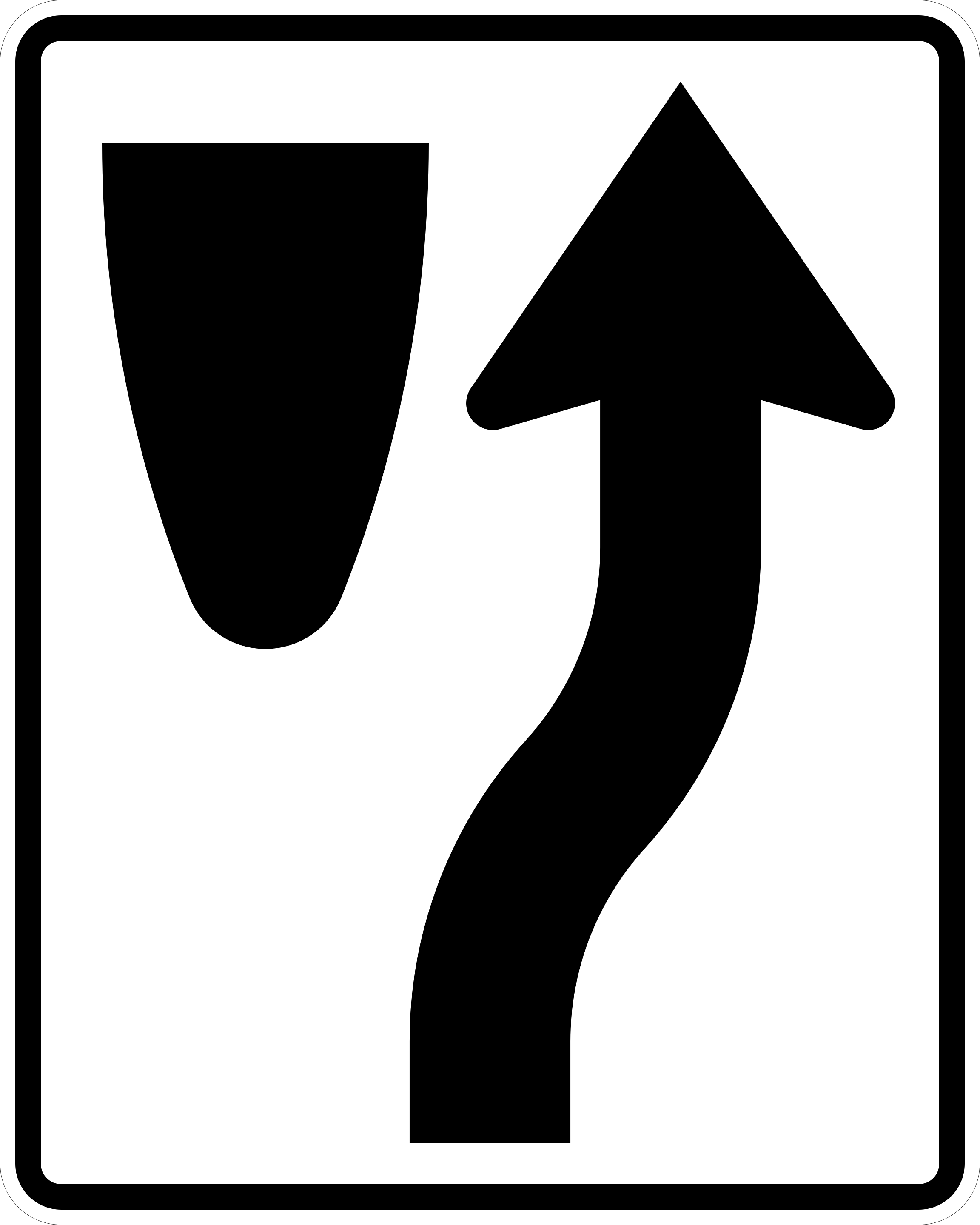
- Turn right at the next intersection regardless of lane markings
- Use the right lane only when preparing to pass
- Avoid driving on the right side of a divided road
- Keep the vehicle to the right of the obstruction or divider
Show answer
Keep the vehicle to the right of the obstruction or divider. The Mississippi manual labels this regulatory sign KEEP RIGHT, and its arrow curves to the right of the island or obstruction pictured on the sign. Pass that object on its right side. The sign does not reserve the right lane for passing, forbid ordinary right-side travel, or force a turn at the next intersection. Follow the arrow around the island while holding a safe lane position and watching nearby traffic, because the sign concerns which side of the separation to use, not where you are going.
Study this in the handbook: Regulatory and Warning Signs
3. Your vehicle becomes stranded on a railroad track. What does the word GO remind you to do?
- Get out of your vehicle immediately if stranded on tracks
- Go forward slowly across the tracks at any cost
- Call for a tow truck while remaining seated inside
- Go around the gates if they begin to lower down
Show answer
Get out of your vehicle immediately if stranded on tracks. A vehicle stranded on tracks triggers the word GO, meaning get out immediately rather than staying with the car awaiting rescue. Driving at any cost can stall you mid-crossing, and waiting inside for a tow places you where a train impact will occur. Out first, away from tracks, then call using the crossing notification sign. GO means leave the vehicle first, rather than remain inside to solve the problem.
Study this in the handbook: Railroad Crossings
4. At an unmarked intersection, what is the required approach?
- Yield to approaching traffic, then proceed only when safe
- Proceed first if your vehicle is larger than others
- Stop completely for one minute regardless of traffic
- Flash headlights and enter ahead of approaching cross traffic
Show answer
Yield to approaching traffic, then proceed only when safe. Unmarked intersections require yielding to approaching traffic and proceeding only when the way is genuinely safe to cross. Vehicle size confers no priority, and a timed one-minute stop substitutes superstition for the judgment the rule demands. Slow early, read every approach leg, and enter behind the last conflicting car. Yielding to approaching traffic is the safeguard at an unsigned intersection.
Study this in the handbook: Right of Way at Intersections
5. What arm position must never be used while driving?
- Never rest either hand at the nine o’clock position
- Never drive with your elbow resting in the window
- Elbow in the window is fine below thirty miles hourly
- Both elbows may rest if the road ahead is straight
Show answer
Never drive with your elbow resting in the window. An elbow resting in the window removes that arm from immediate steering duty and invites injury if the car is struck sideways. Nine o’clock is a recommended hand home, and slow speed does not restore the control a window-anchored arm has surrendered. Both arms belong inside, ready for the steering input you cannot schedule. An elbow outside the window reduces control and is specifically prohibited.
Study this in the handbook: Seat Belts, Child Seats and Distractions
6. What does a double solid white line permit?
- Travel in the same direction is permitted on both sides
- Passing across the line whenever traffic is light
- Opposite directions of travel are separated by the lines
- Parking along the line where no signs prohibit it
Show answer
Travel in the same direction is permitted on both sides. Double solid white paint separates lanes moving the same direction, channeling flow without inviting lane crossing at that point. Opposite-direction separation belongs to yellow paint, and light traffic never converts solid white into a passing invitation. Read color first: white keeps you with your flow, yellow faces opposing flow. White lines separate traffic moving in the same direction; yellow lines separate opposing flow.
Study this in the handbook: Pavement Markings and Lanes
7. Which control does the manual say never to use when trying to stop a skid?
- Use the steering wheel to steer in the direction of the skid
- Ease off the accelerator while the vehicle is sliding
- Apply the brakes gently when they are needed
- Use the clutch while trying to stop the skid
Show answer
Use the clutch while trying to stop the skid. The manual specifically says never to use the clutch while trying to stop a skid. It does not forbid steering in the direction of the skid, easing off the accelerator, or applying the brakes gently when appropriate. Sudden braking can increase a skid, but that warning is different from a complete ban on the brake. The control singled out by the manual is the clutch.
Study this in the handbook: Night Driving, Rain and Skids
8. You must park along a highway outside business or residential districts at night. What should you do?
- Turn on the high-beam headlights
- Switch off every light on the vehicle
- Leave parking lights or flashers on
- Leave only the interior dome light on
Show answer
Leave parking lights or flashers on. When a car is parked along a highway at night, Mississippi asks the driver to leave the parking lights or emergency flashers on so approaching traffic can see it. High beams point forward and can glare at oncoming drivers without marking the stopped car clearly. Turning off every light makes the vehicle nearly invisible, and a dome light alone is too dim to serve as a warning. Switch on the flashers before stepping out and keep passengers away from the traffic side.
Study this in the handbook: Parking Rules
9. What does a single solid white line mean on a Mississippi roadway?
- Traffic on the two sides moves in opposite directions
- Passing is permitted from either side of the line
- The lane nearest the line is reserved for turning
- Traffic on both sides moves in the same direction
Show answer
Traffic on both sides moves in the same direction. A single solid white line separates lanes that carry traffic in the same direction. The manual notes that travel on both sides is permitted and that crossing the line is discouraged rather than absolutely prohibited, which distinguishes it from a double solid white line. The opposite-direction option describes a yellow center line, the passing option ignores the caution against crossing, and the turn-lane option reads a restriction into a line that only separates same-direction lanes. Treat the line as a boundary to stay inside unless a safe lane change requires crossing it.
Study this in the handbook: Pavement Markings and Lanes
10. Bad visibility settles over a four-lane highway. What maximum does the Mississippi bus table set in inclement weather?
- 65 miles per hour
- 55 miles per hour
- 45 miles per hour
- 40 miles per hour
Show answer
45 miles per hour. The bus table lowers the maximum to 45 miles per hour when weather or visibility is bad, even on a four-lane highway where 65 miles per hour is allowed in clear conditions. The 55 miles per hour choice is the clear-weather bus limit on a two-lane road, so it ignores the weather condition. The 40 miles per hour figure is a minimum speed on interstates and four-lane roads, not a ceiling for storms. When rain or fog cuts visibility, slow to the bad-weather number and turn on the proper lights.
Study this in the handbook: Mississippi Speed Limits
11. What must a truck driver do at weigh stations on main highways?
- Slow to twenty miles per hour while passing the station
- Stop only when an officer waves the truck inward there
- Pull the truck in so it can be weighed for overload checks
- Present the cargo manifest at the station office window
Show answer
Pull the truck in so it can be weighed for overload checks. Trucks must pull into weigh stations on main highways so weight can be checked against overload limits for that vehicle. Slowing past without entering defeats the weighing purpose, and manifests are paperwork, not the scale check the station exists for. Enter every open station; an unchecked overload damages roads and brakes alike. The station stop lets officials determine whether the truck is overloaded.
12. May you drive using only your parking lights?
- Do not drive with only your parking lights turned on
- Parking lights alone are fine in well-lit city areas
- Parking lights may replace headlights during twilight hours
- Use parking lights only when following another vehicle closely
Show answer
Do not drive with only your parking lights turned on. Parking lights alone are not driving lights; headlights must illuminate your path and make your vehicle visible at road speeds. City lighting does not certify your visibility to others, and twilight is precisely when full headlights separate cars from shadows. If the wheels are rolling for travel, the headlights are on with them. Parking lights alone do not provide the headlight equipment required for driving.
Study this in the handbook: Night Driving, Rain and Skids
13. When preparing to turn, where should you watch for pedestrians?
- Pedestrians are only a concern when you drive straight
- Check crosswalks only after completing half the turn
- Turning drivers need not yield if the light is green
- Watch for pedestrians entering crosswalks as you prepare to turn
Show answer
Watch for pedestrians entering crosswalks as you prepare to turn. Turning drivers must watch for pedestrians entering crosswalks, since a green light for cars does not clear people lawfully crossing your path. Half-turn checking discovers walkers too late, and straight-only concern ignores that turns cross the crosswalk pedestrians actually use. Scan the far crosswalk before the turn, not during its final sweep. A turn can cross a pedestrian's path even when the vehicle has a green light.
Study this in the handbook: School Buses and Pedestrians
14. What must a Mississippi applicant under eighteen provide to show school enrollment?
- A school record from any prior school year
- A Certification of Attendance form no more than thirty days old
- A notarized letter from a neighbor
- A college transcript regardless of age
Show answer
A Certification of Attendance form no more than thirty days old. An applicant younger than eighteen must show school enrollment with a Certification of Attendance form requested from the school. The form must be no more than thirty days old, so an old school record may not satisfy the requirement. A neighbor cannot replace the school document, and a college transcript is not the form identified for this application. Home-schooled applicants follow a separate process involving a school or superintendent and a notarized parent signature. Check the date before bringing the certification to the licensing office.
Study this in the handbook: Application and the Driver Examination
15. Where are most interstate exits located, and from which lane do you leave?
- Most exits are on the left and use the left-hand lane
- Most exits are on the right and use the right-hand lane
- All exits are on the right without any exception ever
- Exits alternate sides so the center lane serves both
Show answer
Most exits are on the right and use the right-hand lane. Most interstate exits sit on the right and are taken from the right-hand lane, though signed left exits do exist occasionally. Left-side dominance reverses the usual pattern, and an absolute all-right claim ignores the signed exceptions the manual warns about. Follow the overhead sign for your exit side instead of assuming habit will serve. The usual right-side exit arrangement lets a driver prepare without crossing the highway.
16. Parking uphill with no curb, which way should wheels turn?
- Sharply to the left, toward the center of the road
- Straight ahead, relying only on the parking brake
- Sharply to the right, toward the edge of the road
- To the left first, then right as the car settles
Show answer
Sharply to the right, toward the edge of the road. Uphill without a curb, wheels point sharply right so a rolling car drifts off the roadway instead of into traffic lanes. Leftward wheels aim a runaway toward opposing traffic, and straight wheels with brake alone give no second line of defense. Picture the roll path before leaving; it should end on the shoulder, never the street. With no curb uphill, rightward wheels direct a rollback toward the road edge.
Study this in the handbook: Parking Rules
17. Traveling slower than other interstate traffic, which lane should you use?
- Use the left lane so faster cars pass on the right
- Stay in the right lane when traveling more slowly than traffic
- Alternate lanes so no driver must adjust speed
- Drive in whichever lane offers you the smoothest pavement surface
Show answer
Stay in the right lane when traveling more slowly than traffic. Slower interstate travel belongs in the right lane, letting faster traffic pass left without weaving around a rolling obstruction. Left-lane slow driving forces right-side passes at varied speeds, and alternating lanes makes your path unpredictable to everyone behind. Right lane, steady speed, and mirrors checked often keep the stream orderly. The right lane is the slower lane under the manual's interstate guidance.
Study this in the handbook: Following Distance and Stopping
18. Which action does the manual specifically tell drivers to avoid?
- Keep the vehicle registration card in the glove box
- Avoid hanging decorative items from the rearview mirror
- Store sunglasses in the center console
- Keep a parking hangtag in the glove box when driving
Show answer
Avoid hanging decorative items from the rearview mirror. Mississippi tells drivers to avoid hanging decorative items from the rearview mirror because those items can obstruct the view. Keeping a registration card in the glove box, storing sunglasses in the center console, and keeping a parking hangtag in the glove box do not place an object on the mirror and are not the warning in this passage. The caution concerns a dangling decoration that can interfere with what the driver sees through the windshield.
Study this in the handbook: Night Driving, Rain and Skids
19. How do refusal suspension times change with repeat refusals?
- Suspension times increase for later refusals
- Suspension times stay identical for every refusal event
- Second refusals receive shorter suspensions as a warning
- Repeat refusals convert automatically to a small fine only
Show answer
Suspension times increase for later refusals. Subsequent refusals that end in conviction or nonadjudication draw longer suspension times than a first refusal event. Identical timing would erase escalating deterrence, and fine-only conversion contradicts the license-focused penalty structure described here. A prior refusal makes the next one materially more expensive in driving time. The manual increases the suspension period as refusal consequences recur, so later refusals carry greater exposure.
Study this in the handbook: DUI and Implied Consent
20. When a Mississippi truck or bus is disabled at night, where does the third warning device go?
- Directly on the roof of the vehicle
- Fifty feet behind the rear bumper
- At the roadway side of the vehicle
- In the lane ahead of the front bumper
Show answer
At the roadway side of the vehicle. At night, the manual places one warning device about one hundred feet ahead, a second about one hundred feet to the rear, and a third at the roadway side of the disabled truck or bus. The roadway-side device is the one asked about here. A roof placement is not the listed location, and fifty feet is not the stated rear distance. The forward device belongs ahead of the vehicle, not in the traffic lane as a separate roadway obstruction.
Every question is written from the official Mississippi Driver's Manual. Need paper? Printable MS practice test with answer key.
Last verified 2026-10-05. How we check every question · Study all 500 as flashcards
Frequently asked questions
How many questions are on this Mississippi practice test?
This fixed set has 20 questions. It is test 11 of 25 from the 500 question Mississippi bank.
How does this fixed test relate to the full Mississippi bank?
Each numbered test is a fixed set of questions in a fixed order, so you can retake the same test later and compare. Every test mixes road signs and the other topics in about the same proportion as the full bank. Tests 1 to 25 together cover every question in the Mississippi bank once. The full practice page mixes the whole bank at random.
Last verified 2026-10-05. See the Mississippi DMV facts page for sourced state details.
Return to the full Mississippi practice test · Study road signs