
Test 7 of 10 · 20 questions · Free 2026
MS Permit Practice Test 7
Jump to the test ↓A fixed 20 question set from the Mississippi bank with answers and plain English explanations.
Question 1 of 20 · 0 right so far
All 20 questions in test 7
Every question below comes from the Mississippi question bank on this page. Open a question to see the correct answer and the explanation. Nothing here is hidden behind a signup.
1. How much better fuel economy does the Mississippi manual say most cars get at 50 mph than at 70 mph?
- About 28 percent more miles per gallon
- About 2 percent more
- No difference
- About 50 percent less
Show answer
About 28 percent more miles per gallon. Most automobiles get about 28 percent more miles per gallon on the highway at 50 mph than at 70 mph, and about 21 percent more at 55 mph than at 70. Repeatedly varying speed by 5 mph can cut mileage by up to 1.3 miles per gallon, and the manual also lists unnecessary air conditioning use as something that reduces fuel economy. Its advice is to drive at steady speeds and anticipate traffic ahead to avoid unnecessary braking. Two percent, no difference, or worse mileage at 50 mph do not match the stated figure.
2. A school bus carrying a child, a vehicle for hire carrying passengers, or a vehicle hauling explosives approaches a railroad crossing. How far from the outer rail must it stop?
- Within 5 to 10 feet
- At least 100 feet away
- Within 50 to 100 feet
- Within 10 to 50 feet
Show answer
Within 10 to 50 feet. A school bus carrying even one child, a passenger vehicle for hire, or a vehicle carrying explosives or flammable liquids must stop within 50 to 10 feet of the outer rail. The range is expressed from the farther distance toward the nearer stopping point. The 5-to-10-foot choice places the vehicle too close, while the larger ranges leave it farther away than the stated requirement. After stopping, the driver must check both directions for a train before proceeding, regardless of whether lights are flashing.
Study this in the handbook: Railroad Crossings
3. Who is liable when an adult signs a Mississippi minor's license application?
- The signer is liable for the minor's negligence or willful misconduct, and the signature must be notarized
- Only the minor
- No one, the signature is a formality
- The state
Show answer
The signer is liable for the minor's negligence or willful misconduct, and the signature must be notarized. Whoever signs a minor's application will be liable for the minor's negligence or willful misconduct and must have their signature notarized. If there is no custodial parent, legal guardian or employer, the application may be signed by a responsible adult who is willing to assume the obligations imposed by law. The signature is therefore not a formality, and the liability does not rest only with the minor or with the state. The signer should understand that legal responsibility before agreeing to sign.
Study this in the handbook: Application and the Driver Examination
4. Who may apply directly for a Mississippi Regular Driver's License without a previous permit or license?
- A person who is fourteen and enrolled in driver education
- A person who is at least seventeen years old
- Any person who has passed a vision screening
- Only a person who has held a permit for two years
Show answer
A person who is at least seventeen years old. The Class R eligibility section allows an applicant aged seventeen or older to apply directly for a Regular Driver's License, regardless of previous permits or licenses. Fourteen describes the Temporary Learner's Permit route, and vision screening alone is only one requirement. The permit validity period is two years, but holding it for two years is not the direct eligibility rule. Remember the distinction between starting age and the separate testing, documentation, and affidavit requirements that still apply to the license application.
Study this in the handbook: Learner's Permits and the Regular License
5. What must a Mississippi driver obtain to operate a motor-driven cycle?
- A Temporary Learner's Permit only
- A Class D commercial license
- A Motorcycle Endorsement added to the Driver's License
- A separate school-bus license
Show answer
A Motorcycle Endorsement added to the Driver's License. The manual requires a Motorcycle Endorsement along with the driver's license for operation of a motor-driven cycle. A commercial Class D license addresses commercial vehicles under a separate weight rule, while a temporary learner's permit is tied to driver education. The school-bus license is another distinct credential. The endorsement requirement is the specific document cue: the ordinary license alone is not enough for this vehicle type.
Study this in the handbook: Learner's Permits and the Regular License
6. How should a driver approach a crosswalk in Mississippi?
- Accelerate across it before pedestrians arrive
- Approach with care and never stop on any part of it
- Stop in the middle of it to wait for traffic
- Ignore it unless the paint is freshly visible
Show answer
Approach with care and never stop on any part of it. The manual directs drivers to approach crosswalks with care and never stop on any part of a crosswalk. The choice “Accelerate across it before pedestrians arrive” encourages rushing, while stopping in the marked area can obstruct pedestrians and other traffic. The absence of fresh paint is not a reason to ignore a crossing, because crosswalks can be associated with regular pedestrian movement. Reduce speed early, scan both sides, and keep the vehicle clear of the crossing while yielding as required to people in your path.
Study this in the handbook: Pavement Markings and Lanes
7. How close may a vehicle be parked to a fire hydrant in Mississippi?
- It may not be within 5 feet of the hydrant
- It may not be within 10 feet of the hydrant
- It may not be within 20 feet of the hydrant
- The manual sets no distance for hydrants
Show answer
It may not be within 10 feet of the hydrant. The prohibited-parking list places a ten-foot buffer around a fire hydrant. Parking closer can obstruct emergency access even when the vehicle is otherwise beside a public roadway. Twenty feet is used elsewhere in the list for a fire-station driveway and for a crosswalk at an intersection, so it is not the hydrant figure. Before leaving the vehicle, identify nearby emergency equipment and measure clearance conservatively.
Study this in the handbook: Parking Rules
8. What action is prohibited at a double solid white line?
- Crossing the line
- Traveling on both sides in the same direction
- Using a turn signal
- Driving in the right lane
Show answer
Crossing the line. The manual specifically prohibits crossing a double white line. The marking may separate lanes that carry traffic in the same direction, but that permission does not allow a driver to cross the pair. The choice “Traveling on both sides in the same direction” describes the direction of travel permitted beside the marking, not an action that is forbidden. Signaling or using the right lane is not prohibited by this pavement marking alone. If you need to change position, wait until a legal lane change is available beyond the double line.
Study this in the handbook: Pavement Markings and Lanes
9. A Mississippi driver refuses a breath test and surrenders the license to the officer. How long is the officer's receipt valid as a temporary permit to drive?
- 45 days
- 10 days
- 90 days
- One year
Show answer
45 days. After a refusal, the driver must hand over the license immediately, and the officer's receipt serves as a temporary driving permit valid for only 45 days. Ninety days is the length of the administrative suspension for refusing, not the temporary permit. Ten days and one year are not in the manual. A driver who takes the test and fails it gets a receipt good for 30 days instead.
Study this in the handbook: DUI and Implied Consent
10. Who must wear a crash helmet on a motorcycle or motor scooter on Mississippi public roads?
- Only riders under 18
- Only the operator, not a passenger
- Only riders on interstate highways
- Every operator and every rider
Show answer
Every operator and every rider. Mississippi law (Sec. 63-7-64) says no person may operate or ride upon a motorcycle or motor scooter on public roads unless wearing a crash helmet that meets the federal standard. The rule covers operators and passengers of every age, so limiting it to minors, to the operator, or to interstates is wrong. Operating a motor-driven cycle also requires a Motorcycle Endorsement on the driver's license.
Study this in the handbook: Learner's Permits and the Regular License
11. A driver is convicted of a third DUI in Mississippi within five years. What imprisonment range does the table list?
- Not less than 1 year nor more than 5 years, in MDOC custody
- Up to 48 hours in county jail
- Exactly 30 days
- 5 days to 6 months
Show answer
Not less than 1 year nor more than 5 years, in MDOC custody. A third or subsequent DUI within five years is a felony carrying not less than 1 year and not more than 5 years in the custody of the Mississippi Department of Corrections, plus a $2,000 to $5,000 fine. Forty-eight hours is the first offense and 5 days to 6 months is the second. Thirty days is not listed. After release, the person may get only an interlock-restricted license for three years.
Study this in the handbook: DUI and Implied Consent
12. What conditions are Mississippi posted speed limits intended for?
- Only congested traffic
- Heavy rain and poor visibility
- Ideal driving conditions
- Emergency road closures
Show answer
Ideal driving conditions. The manual describes posted speed limits as limits intended for ideal conditions. That means a driver must use judgment when rain, fog, curves, congestion, or a narrow roadway makes the situation less favorable. The poor-visibility choice describes a reason to slow down, not the condition assumed by the posted number. Congestion does not make the limit apply only to that situation, and an emergency closure may impose separate temporary controls. Read the sign, then adjust below the posted limit whenever conditions require safer operation.
Study this in the handbook: Mississippi Speed Limits
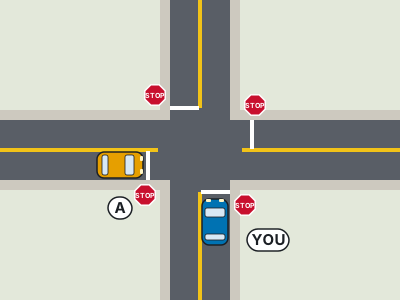
13. At a Mississippi four-way stop, two vehicles arrive together. Who proceeds first?
- The vehicle traveling at the higher speed
- The vehicle turning left
- The vehicle with more passengers
- The vehicle on the right
Show answer
The vehicle on the right. At a four-way stop, arrival time normally determines priority. If multiple vehicles arrive at the same time, the vehicle on the right has the right of way. A left turn does not automatically outrank a vehicle going straight, and passenger count or speed has no role in this rule. Come to a complete stop without trying to beat another driver to the line. After identifying the vehicle on your right, wait when necessary and proceed smoothly when your path is clear.
Study this in the handbook: Right of Way at Intersections
14. Before turning right at a red signal, which action is required first?
- Yield without stopping if the road appears empty
- Stop completely, then yield to traffic and pedestrians
- Continue straight until the signal changes to green
- Turn immediately after slowing below the posted speed
Show answer
Stop completely, then yield to traffic and pedestrians. A right turn on red is an exception to the normal requirement to remain stopped, but it still begins with a complete stop. After stopping, the driver must yield to other traffic and pedestrians, and the turn is forbidden when a sign prohibits it. Merely slowing and yielding is not enough under this rule. At an intersection, scan the crosswalk and both directions after the stop, then turn only when the path is clear and the signal does not ban the movement.
Study this in the handbook: Traffic Signals and Arrows
15. What range of penalties may follow a first conviction for failing to yield to a school bus?
- A fine from $50 to $100 with no possible imprisonment
- A fine from $350 to $750, imprisonment up to one year, or both
- A mandatory $1,500 fine and permanent license cancellation
- Five driver points with no fine or possible jail sentence
Show answer
A fine from $350 to $750, imprisonment up to one year, or both. Mississippi treats a first school bus yielding conviction as a serious offense. The manual lists a fine of at least $350 and no more than $750, imprisonment for no more than one year, or both. The $1,500 figure belongs to the higher second or subsequent offense range within five years, not the first conviction. When a bus displays red lights or its stop sign, stop at least ten feet away and remain there until the bus is moving and its warning devices are withdrawn.
16. What assumption should be made about the braking distances shown in the manual's chart?
- They assume worn tires and a loaded vehicle
- They apply unchanged on wet or icy roads
- They assume good tires, good brakes, and dry pavement
- They measure only the distance after braking begins
Show answer
They assume good tires, good brakes, and dry pavement. The chart is a baseline for ideal conditions: good tires, good brakes, and dry pavement. Wet or slick roads, tiredness, intoxication, and other changes can make the actual stopping distance drastically different. The chart also includes thinking and reaction distance, so it is not limited to the period after the brake pedal is pressed. Use the figures as a best-case reference, then leave extra room whenever the road, vehicle, or driver is less than ideal.
Study this in the handbook: Following Distance and Stopping
17. What should a driver do when weather or visibility is poor?
- Accelerate so the vehicle spends less time in poor visibility
- Keep the posted speed because it covers every condition
- Slow down to match the reduced conditions
- Use parking lights alone instead of headlights
Show answer
Slow down to match the reduced conditions. Poor weather or limited visibility calls for a lower speed, allowing more time to see and respond. The posted-limit choice overlooks that posted speeds are intended for ideal conditions, not every possible roadway environment. Accelerating reduces reaction margin, and parking lights alone are not the manual's lighting instruction. A practical cue is to compare what you can see with the space needed to stop: when visibility shrinks, reduce speed and use the vehicle lighting required for the situation.
Study this in the handbook: Mississippi Speed Limits
18. When overhead lane-direction signals are in use, when may a driver travel in a particular lane?
- Whenever the driver needs to pass slower traffic
- Whenever the lane is marked with either red or green
- Only after following a vehicle into a red-marked lane
- Only when the lane is marked with a green light
Show answer
Only when the lane is marked with a green light. Lane direction signals control whether a lane is available. The manual says a driver may travel only in a lane marked by a green light and must never travel in a lane marked red. The choice “Whenever the lane is marked with either red or green” erases the distinction between open and closed lanes. Following another vehicle does not make a red lane lawful, and passing is not an exception. Look directly above your lane before entering it, then remain within the green-designated lane until the signal arrangement changes or you can safely move elsewhere.
Study this in the handbook: Traffic Signals and Arrows
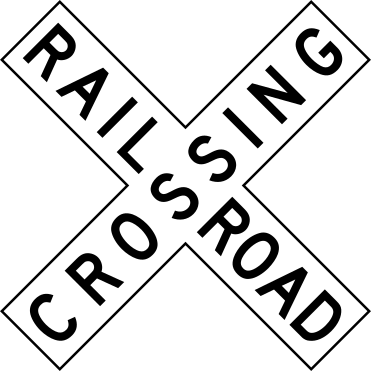
19. What does the X-shaped railroad crossing sign identify?
- A school crossing with a reduced speed
- A no-passing zone at the next hill
- A hospital entrance ahead
- The location of a railroad crossing
Show answer
The location of a railroad crossing. The white cross buck sign is posted at most railroad crossings and marks the crossing itself. It is different from the round yellow sign with a black cross buck and two R's, which means a railroad crossing is ahead. If there is more than one track, the number of tracks is shown on a sign below the cross buck. Flashing light signals are used with it at many crossings, so always stop when the lights flash and check carefully for a second train following close behind the first.
Study this in the handbook: Railroad Crossings
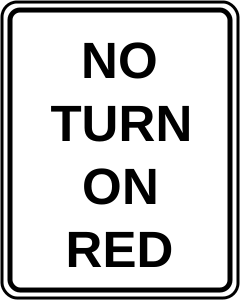
20. What does this NO TURN ON RED sign require at an intersection?
- A right turn is allowed without stopping if traffic is light
- A right turn is required whenever the signal is red
- Do not turn while the traffic signal is red
- Only trucks must wait for a green light before turning right
Show answer
Do not turn while the traffic signal is red. The NO TURN ON RED sign prohibits turning during the red signal. Stopping first does not remove this restriction, and a gap in traffic does not create an exception. Wait for a signal that permits the movement, then check for pedestrians and other traffic before turning. The sign does not prohibit every right turn at every signal phase. Read the posted restriction together with the traffic signal before deciding whether you may proceed.
Study this in the handbook: Regulatory and Warning Signs
QualitySpace is expanding to Mississippi
We are a California-based independent insurance brokerage working on licensing in more states. We cannot help with Mississippi insurance yet. Leave your email and we will let you know when we can.
Every question is written from the official Mississippi Driver's Manual. Need paper? Printable MS practice test with answer key.
Last verified 2026-10-05. How we check every question · Study all 210 as flashcards
Frequently asked questions
How many questions are on this Mississippi practice test?
This fixed set has 20 questions. It is test 7 of 10 from the 210 question Mississippi bank.
How does this fixed test relate to the full Mississippi bank?
Each numbered test is a fixed set of questions in a fixed order, so you can retake the same test later and compare. Every test mixes road signs and the other topics in about the same proportion as the full bank. Tests 1 to 10 together cover 200 of the 210 questions in the Mississippi bank, each once. The full practice page mixes the whole bank at random.
Last verified 2026-10-05. See the Mississippi DMV facts page for sourced state details.
Return to the full Mississippi practice test · Study road signs