
Key points
When parking, put it in park or low, set the parking brake firmly and turn off the ignition.
Source: Handbook p. 48
“Put the gear in park (automatic transmission) or low (standard transmission), Set the parking brake firmly, and Turn off the ignition.”
Mississippi Driver's Manual, Handbook p. 48Do not park within 10 feet of a fire hydrant.
Source: Handbook p. 48
“Within ten (10) feet of a fire hydrant;”
Mississippi Driver's Manual, Handbook p. 48Do not park within 20 feet of a crosswalk at an intersection.
Source: Handbook p. 48
“Within twenty (20) feet of a crosswalk at an intersection;”
Mississippi Driver's Manual, Handbook p. 48Do not park within 30 feet of the approach to a traffic control device.
Source: Handbook p. 48
“Within thirty (30) feet of the approach to any traffic control device;”
Mississippi Driver's Manual, Handbook p. 48Do not park within 15 feet of the nearest rail of a railroad crossing.
Source: Handbook p. 48
“Within fifteen (15) feet of the nearest rail of any railroad crossing;”
Mississippi Driver's Manual, Handbook p. 48Do not park within 20 feet of a fire station driveway, or 75 feet if posted.
Source: Handbook p. 48
“Within twenty (20) feet of the driveway entrance to any fire station, or within seventy-five (75) feet if it is so posted;”
Mississippi Driver's Manual, Handbook p. 48Parked along a highway, pull off fully, leave 20 feet for others if possible and be visible from 200 feet.
Source: Handbook p. 48
“Pull all the way off the roadway. If possible, leave at least twenty (20) feet for other vehicles to get by. Park so you can be seen from at least two hundred (200) feet in both directions.”
Mississippi Driver's Manual, Handbook p. 48Parallel parked tires must be within 12 inches of the curb.
Source: Handbook p. 49
“For vehicles parked parallel, tires should be within twelve (12) inches of the curb.”
Mississippi Driver's Manual, Handbook p. 49Parked downhill, turn your wheels sharply to the right, curb or no curb.
Source: Handbook p. 50
“In a downhill position, turn your wheels sharply to the right, whether or not there is a curb.”
Mississippi Driver's Manual, Handbook p. 50The driver leaving a parking space does not have the right of way.
Source: Handbook p. 49
“The driver leaving a parking space does not have the right-of-way.”
Mississippi Driver's Manual, Handbook p. 49
Numbers to know
| Number | What it means | Manual |
|---|---|---|
| 10 feet | from a fire hydrant | Handbook p. 48 |
| 20 feet | from a crosswalk at an intersection | Handbook p. 48 |
| 30 feet | from the approach to a traffic control device | Handbook p. 48 |
| 15 feet | from the nearest rail of a railroad crossing | Handbook p. 48 |
| 20 feet / 75 feet | from a fire station driveway, and when posted | Handbook p. 48 |
| 20 feet / 200 feet | room left for others and visibility when parked on a highway | Handbook p. 48 |
| 12 inches | maximum curb distance when parallel parked | Handbook p. 49 |
Recognize these signs
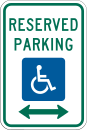
Handicapped parking
3 questions from the Mississippi practice test
1. How close may a vehicle be parked to a fire hydrant in Mississippi?
- It may not be within 5 feet of the hydrant
- It may not be within 10 feet of the hydrant
- It may not be within 20 feet of the hydrant
- The manual sets no distance for hydrants
Show answer
It may not be within 10 feet of the hydrant. The prohibited-parking list places a ten-foot buffer around a fire hydrant. Parking closer can obstruct emergency access even when the vehicle is otherwise beside a public roadway. Twenty feet is used elsewhere in the list for a fire-station driveway and for a crosswalk at an intersection, so it is not the hydrant figure. Before leaving the vehicle, identify nearby emergency equipment and measure clearance conservatively.
2. How close to the curb must a parallel parked vehicle be in Mississippi?
- Within 3 feet
- Any distance if the wheels are straight
- Within 24 inches
- Within 12 inches
Show answer
Within 12 inches. For vehicles parked parallel, the tires should be within 12 inches of the curb. After parking, the manual says to put the gear in park or low, set the parking brake firmly, and turn off the ignition, and to use extreme care when exiting from the street side. On a hill, it adds a wheel rule: turn the wheels sharply right when facing downhill or uphill with no curb, and sharply left when facing uphill with a curb. Three feet, 24 inches, or any distance with straight wheels does not meet the 12 inch rule.
3. How close to the nearest rail of a railroad crossing may a Mississippi driver park?
- No closer than 50 feet
- No closer than 5 feet
- No closer than 100 feet
- No closer than 15 feet
Show answer
No closer than 15 feet. Mississippi prohibits parking within 15 feet of the nearest rail of any railroad crossing. Fifty feet may sound familiar because certain vehicles must stop within 50 to 10 feet of the rail, but that is a stopping rule, not a parking distance. Five feet is dangerously close, and 100 feet is not in the list. Parking too close to the tracks can put the vehicle in a train's path.
Practice this topic
Lock it in with parking questions from the free Mississippi practice test. Every answer comes with a plain English explanation.
Source: the Mississippi Driver's Manual, Parking. This lesson is a plain English summary, not the law itself; where it differs, the manual and the statute govern. Last checked 2026-09-27.