
Test 5 of 10 · 20 questions · Free 2026
MS Permit Practice Test 5
Jump to the test ↓A fixed 20 question set from the Mississippi bank with answers and plain English explanations.
Question 1 of 20 · 0 right so far
All 20 questions in test 5
Every question below comes from the Mississippi question bank on this page. Open a question to see the correct answer and the explanation. Nothing here is hidden behind a signup.
1. According to the Mississippi manual, if your reactions slow down only a half-second at 55 mph, how much farther will your vehicle travel before stopping?
- An extra 5 feet
- No extra distance
- An extra 200 feet
- An extra 44 feet
Show answer
An extra 44 feet. Mississippi's manual warns that alcohol slows reflexes and reaction time, and that even two beers can markedly decrease them. If your reactions slow down by only a half-second while traveling 55 miles per hour, your vehicle will travel an extra 44 feet before stopping. Five feet and no extra distance ignore how fast a car covers ground at highway speed, and 200 feet overstates the half-second figure. That additional distance could be the difference between life and death, which is why the manual says not to drive after drinking.
Study this in the handbook: DUI and Implied Consent
2. After moving to Mississippi, how soon must a resident obtain a Mississippi license plate?
- Within 60 days
- Within 10 days
- Within 30 days
- By the next annual vehicle inspection
Show answer
Within 30 days. A person who moves to Mississippi must obtain a Mississippi license plate within 30 days. The 60 day period in the manual applies to obtaining a Mississippi driver’s license, so confusing the two deadlines can lead to a late vehicle registration. The plate belongs on the rear of the vehicle and must remain readable, including its tag light at night. Mark the 30 day vehicle deadline separately from the 60 day driver licensing deadline when relocating.
Study this in the handbook: Required Equipment, Tags and Tint
3. How can a Mississippi driver reach the Highway Patrol from a cell phone to report a traffic emergency?
- Dial the operator
- Dial 311
- Text 511
- Dial *HP, which is *47, toll free
Show answer
Dial *HP, which is *47, toll free. To report an emergency traffic situation on an interstate or highway in Mississippi, dial *HP, which is *47, on a cellular phone to be connected toll free to a Mississippi Highway Patrol dispatcher. Be prepared to state your emergency and give the location, such as the highway or mile marker where help is needed. The manual says to report only actual emergencies to *HP. Dialing the operator, 311, or texting 511 is not the number the manual gives.
Study this in the handbook: Emergency Vehicles
4. What examination is required if an out-of-state license has been expired for more than thirty days?
- No examination under any circumstance
- Only a motorcycle skills examination
- Only a vision screening
- A computerized examination
Show answer
A computerized examination. When an out-of-state license has been expired for more than thirty days, the applicant must take the Computerized Exam. A vision screening is still part of the licensing process, but it is not the additional examination triggered by this expiration condition. The manual does not make the applicant wait without testing or substitute a motorcycle skills exam. Watch the qualifier carefully: this rule concerns an out-of-state license, and its threshold is thirty days, not the longer periods used for other license situations. Check the expiration date before applying.
Study this in the handbook: Who Needs a License and New Residents
5. What movement is prohibited by a NO U-TURN sign?
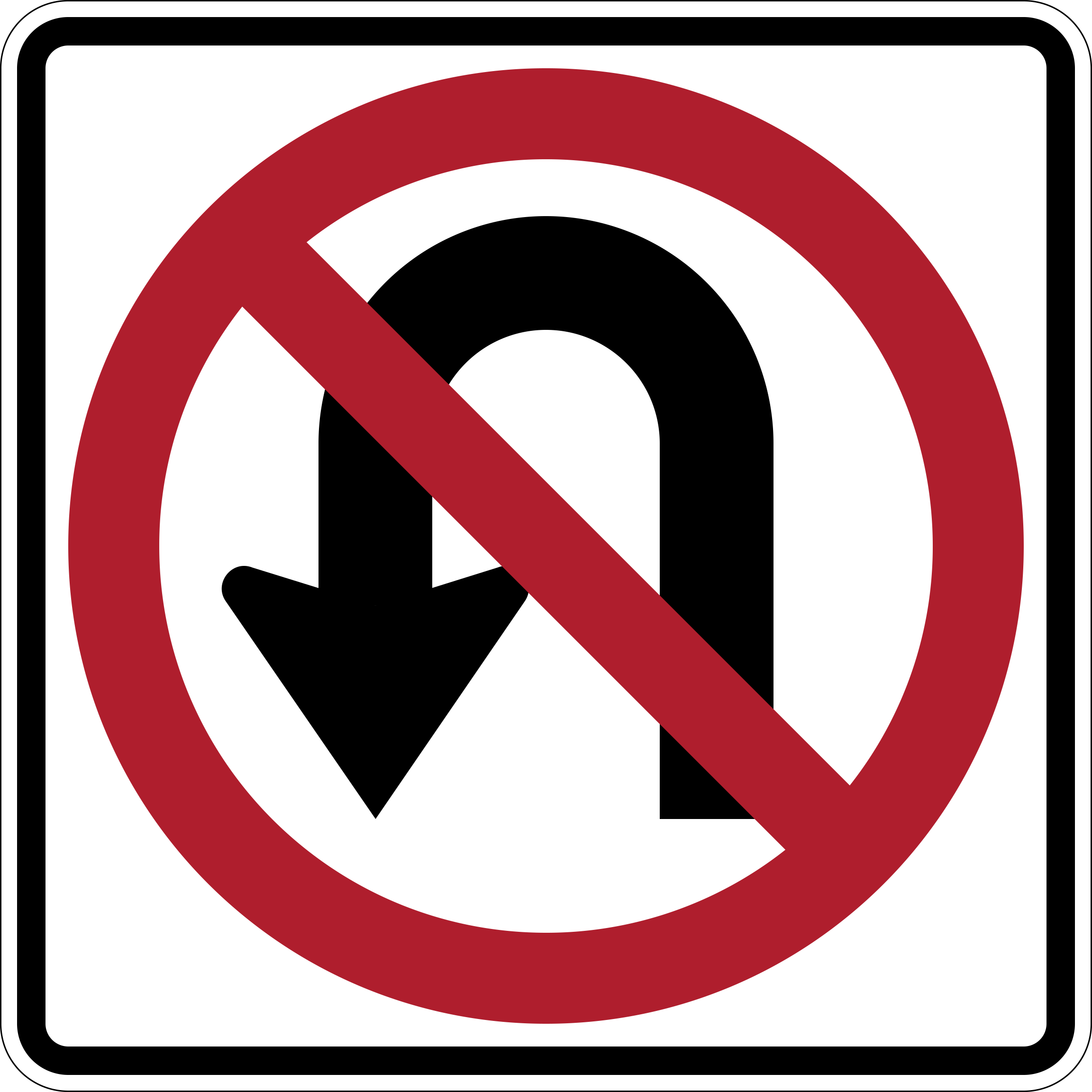
- Turning around in an intersection, the center of a street, or a highway median
- Making a left turn from a marked turn lane
- Passing a slow vehicle on a divided highway
- Turning right after yielding at a green signal
Show answer
Turning around in an intersection, the center of a street, or a highway median. The sign prohibits turning around in the listed locations: an intersection, the center of a street, or a highway median. It is not a general ban on every left turn, a passing restriction, or a rule against ordinary right turns at a green signal. Read the pictured U-turn movement rather than broadening it to unrelated maneuvers. If you need to change direction, continue until you reach a place where the turn is permitted and visibility, traffic, and pavement markings support it. The location list is the memory cue for this sign.
Study this in the handbook: Regulatory and Warning Signs
6. A Mississippi teen without a permit drives with a licensed parent in the passenger seat. Is this legal?
- Yes, if the parent is over 21
- Yes, on rural roads only
- No, driving without a valid license or learner's permit is illegal even with a parent
- Yes, during daylight hours
Show answer
No, driving without a valid license or learner's permit is illegal even with a parent. Mississippi requires a valid Driver's License or Learner's Permit to drive any motor vehicle on streets or highways, except road and farm equipment. The manual states that driving without one is illegal even when a parent or licensed driver is along. A supervising adult makes permit driving legal, but only for someone who already holds the permit. Road type and time of day do not create an exception.
Study this in the handbook: Who Needs a License and New Residents
7. What do Mississippi traffic signs use a yellow color to communicate?
- Motorist services
- General warning
- Directional guidance
- Regulation only
Show answer
General warning. Yellow is used for a general warning. It alerts the driver to a condition that may require extra attention, such as a curve, crossing, or other roadway hazard. Blue is associated with motorist services, green provides directional guidance and permitted movement, and white or black commonly communicates regulation. Color gives an early cue, but the sign shape, symbol, and wording provide the specific message. When yellow appears, scan farther ahead and adjust speed or lane position before reaching the condition being announced.
Study this in the handbook: Sign Shapes and Colors
8. At a four-way stop, what happens when multiple vehicles arrive at the same time?
- The vehicle on the left has the right-of-way
- The vehicle on the right has the right-of-way
- The largest vehicle goes first
- The driver who stopped most loudly goes first
Show answer
The vehicle on the right has the right-of-way. At a four-way stop, arrival order normally determines priority. When multiple vehicles reach the stop at the same time, the vehicle on the right has the right-of-way. Vehicle size and noise have no role in the manual's rule. Do not slam on the brakes to claim first arrival; approach under control, identify the vehicle to your right, and yield when that rule assigns it priority.
Study this in the handbook: Right of Way at Intersections
9. For a driver age 21 or older operating a noncommercial vehicle in Mississippi, what is the lowest BAC covered by the general alcohol per se threshold?
- 0.08% or more
- 0.02% or more
- 0.05% or more
- 0.10% or more
Show answer
0.08% or more. For an adult driver, the threshold described by the manual is a blood alcohol content of .08 percent or more. The .02 percent figure belongs to the under-21 rule, so it is not the adult threshold. A lower number such as .05 percent is not the figure stated here, and .10 percent would allow too much alcohol before the rule applied. Treat the listed limit as a legal boundary, not a safe-drinking target.
Study this in the handbook: DUI and Implied Consent
10. What should a driver do when an emergency vehicle with flashing lights or a siren approaches?
- Pull to the extreme right shoulder when possible
- Stop in the left lane so the emergency vehicle can pass right
- Maintain speed because the emergency vehicle has to go around
- Turn into the nearest driveway without checking traffic
Show answer
Pull to the extreme right shoulder when possible. An ambulance, fire engine, or police car using the listed warning signals has the right-of-way. When possible, the driver should pull to the extreme right shoulder until it passes. Stopping in the left lane places the vehicle in the emergency vehicle's path, and maintaining speed ignores the required yield. At an intersection, proceed through if needed and then pull right. The cue is to create a clear path on the right while staying alert for pedestrians, cross traffic, and the emergency vehicle's actual movement.
Study this in the handbook: Emergency Vehicles
11. What maximum speed does the Mississippi table list for passenger automobiles on interstates?
- 55 mph
- 70 mph
- 65 mph
- 50 mph
Show answer
70 mph. The passenger-automobile table assigns interstates a 70 mph maximum. The 65 mph figure belongs to four-lane state and U.S. highways, while 55 mph applies to two-lane state and U.S. highways. Natchez Trace Parkway is listed at 50 mph. These are table values for roadway categories, and the surrounding guidance still requires slower travel when conditions are not ideal or a lower sign is posted.
Study this in the handbook: Mississippi Speed Limits
12. On a divided highway with at least two lanes in each direction, who may continue past a stopped school bus?
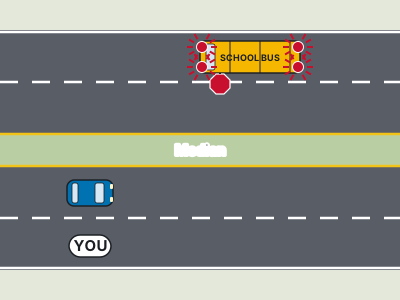
- Traffic traveling behind the bus in the same direction
- Traffic moving in the opposite direction on its separated side
- Every vehicle if the bus is stopped near a median
- Only motorcycles traveling in the opposite direction
Show answer
Traffic moving in the opposite direction on its separated side. The divided highway exception is narrow. A driver traveling opposite the stopped school bus may continue on that driver's side when the highway has four or more lanes and at least two lanes move in each direction. Vehicles traveling in the same direction as the bus must still stop and wait for the children and bus warning devices. A median alone does not release same-direction traffic. Identify your direction of travel and the number of separated lanes before deciding whether to stop.
13. Which practice does the manual recommend during a long drive to help prevent going to sleep at the wheel?
- Follow one vehicle closely for long periods
- Fix your gaze on one point ahead for the entire trip
- Keep your eyes moving instead of staring
- Turn the interior heater to its highest setting
Show answer
Keep your eyes moving instead of staring. For long-distance driving, the manual advises keeping your eyes moving so you do not go to sleep at the wheel. Staring at one point can encourage inattention, and following the same vehicle for a long time may make you too relaxed and cost you concentration. The guidance also suggests keeping the interior cool, not heating it to the highest setting. Treat changing visual attention as one fatigue-management cue, and take the listed breaks rather than trying to push through serious drowsiness.
Study this in the handbook: Seat Belts, Child Seats and Distractions
14. What penalty does Mississippi list for a second offense within five years of passing a stopped school bus?
- A warning
- A $25 fine
- A fine of $750 to $1,500 or up to one year in jail or both, plus a 90 day license suspension
- A lifetime revocation
Show answer
A fine of $750 to $1,500 or up to one year in jail or both, plus a 90 day license suspension. Mississippi law makes passing a school bus that has stopped to load or unload children a serious offense. For a second or subsequent offense within five years, the penalty is a fine of not less than $750 and not more than $1,500, or imprisonment for not more than one year, or both, plus suspension of the driver's license and driving privileges for 90 days. A first offense carries a fine of not less than $350 and not more than $750, or imprisonment for not more than one year, or both. A warning, a $25 fine, or lifetime revocation does not match the stated penalties.
15. What does a green arrow permit when a driver is in the proper lane?
- A U-turn from any lane at the intersection
- A turn only after yielding to a green light facing opposing traffic
- Straight travel only, regardless of the arrow direction
- A turn in the direction shown by the arrow as a protected turn
Show answer
A turn in the direction shown by the arrow as a protected turn. A green arrow permits movement in the arrow's direction from the proper lane and gives the driver a protected turn because opposing traffic has a red light. The choice “A turn only after yielding to a green light facing opposing traffic” describes the unprotected situation associated with a flashing yellow arrow or certain solid-green left turns. Straight-only travel disregards the displayed direction, and a U-turn is not created by a turn arrow. Confirm that your lane matches the arrow before moving, while still watching for pedestrians and complying with intersection rules.
Study this in the handbook: Traffic Signals and Arrows
16. What roadway condition is represented by this winding-arrow sign?

- A high-speed lane reserved for emergency vehicles
- A straight roadway with a temporary lane closure
- A route where vehicles must reverse direction
- A series of curves requiring a lower, steady speed
Show answer
A series of curves requiring a lower, steady speed. The winding-road symbol warns that several bends are ahead rather than one isolated change in direction. Because visibility and vehicle balance can change from bend to bend, hold a controlled speed instead of accelerating between curves. The lane-closure choice would be associated with construction warnings, and the emergency-lane choice describes no part of this symbol. Read the roadway beyond the first curve, keep both hands ready for steering, and leave extra space from vehicles ahead.
Study this in the handbook: Regulatory and Warning Signs
17. How far from the approach to a traffic control device, such as a stop sign or signal, must you park in Mississippi?
- At least 30 feet
- At least 10 feet
- At least 50 feet
- There is no minimum
Show answer
At least 30 feet. Mississippi forbids parking within 30 feet of the approach to any traffic control device, such as a stop sign or signal. Ten feet is the fire hydrant distance, and 50 feet is not in the Mississippi parking list. There is a minimum, so the claim that there is no minimum is wrong. The same prohibited parking list bans parking on a sidewalk, on a crosswalk, on any bridge or elevated structure, and within 20 feet of a crosswalk at an intersection.
Study this in the handbook: Parking Rules
18. What must a driver do at a STOP sign before entering an intersection?
- Slow down only if cross traffic is visible
- Come to a complete stop and yield to traffic close enough to be a hazard
- Stop beyond the intersection
- Yield without stopping
Show answer
Come to a complete stop and yield to traffic close enough to be a hazard. A STOP sign requires a complete stop before entering the intersection, followed by yielding to traffic close enough to be a hazard. Slowing without stopping and yielding without stopping both fail to meet the sign's command. Stopping beyond the intersection puts the vehicle into the conflict area and may block a crosswalk. Stop at the line or before the intersection, check for pedestrians and traffic, and proceed only after the required yield is complete. The octagonal shape is reserved for this stop message.
Study this in the handbook: Regulatory and Warning Signs
19. A flashing hand appears at a pedestrian crossing. What should a pedestrian do?
- Remain at the curb if they have not started crossing
- Enter the roadway immediately before the signal changes
- Run diagonally to beat approaching vehicles
- Ignore the display when the crosswalk is painted
Show answer
Remain at the curb if they have not started crossing. The pedestrian crossing guidance says a flashing sign means pedestrians must not leave the curb. Someone who already began crossing should continue, but a person still waiting must remain out of the roadway. The choice “Enter the roadway immediately before the signal changes” reverses that instruction by encouraging a late start. A painted crosswalk does not cancel the signal, and running diagonally does not solve the timing problem. The practical cue is simple: flashing means no new entry, so wait for the next indication that permits crossing and then check traffic.
Study this in the handbook: Traffic Signals and Arrows
20. You passed Mississippi's computerized exam but waited to finish the licensing process. When would you have to take the computerized exam again?
- After 90 days
- After 6 months
- After two years
- Never; a passing score never expires
Show answer
After two years. A computerized exam score is good for two years. Applicants who wait longer than that must retake the exam. The 90 day and six month choices would expire the score far sooner than the manual says, and a passing score does not last forever. Providing the 50 hour affidavit before the two years pass lets the applicant avoid retaking the exam.
Study this in the handbook: Learner's Permits and the Regular License
QualitySpace is expanding to Mississippi
We are a California-based independent insurance brokerage working on licensing in more states. We cannot help with Mississippi insurance yet. Leave your email and we will let you know when we can.
Every question is written from the official Mississippi Driver's Manual. Need paper? Printable MS practice test with answer key.
Last verified 2026-10-05. How we check every question · Study all 210 as flashcards
Frequently asked questions
How many questions are on this Mississippi practice test?
This fixed set has 20 questions. It is test 5 of 10 from the 210 question Mississippi bank.
How does this fixed test relate to the full Mississippi bank?
Each numbered test is a fixed set of questions in a fixed order, so you can retake the same test later and compare. Every test mixes road signs and the other topics in about the same proportion as the full bank. Tests 1 to 10 together cover 200 of the 210 questions in the Mississippi bank, each once. The full practice page mixes the whole bank at random.
Last verified 2026-10-05. See the Mississippi DMV facts page for sourced state details.
Return to the full Mississippi practice test · Study road signs