
Test 3 of 10 · 20 questions · Free 2026
MS Permit Practice Test 3
Jump to the test ↓A fixed 20 question set from the Mississippi bank with answers and plain English explanations.
Question 1 of 20 · 0 right so far
All 20 questions in test 3
Every question below comes from the Mississippi question bank on this page. Open a question to see the correct answer and the explanation. Nothing here is hidden behind a signup.
1. How close to a crosswalk at an intersection may a vehicle park in Mississippi?
- No closer than 20 feet
- No closer than 5 feet
- Right up to the crosswalk line
- No closer than 75 feet
Show answer
No closer than 20 feet. Parking is not allowed within 20 feet of a crosswalk at an intersection in Mississippi, and parking on the crosswalk itself is also banned. Five feet and right up to the line are both inside the 20 foot zone. Seventy five feet is the posted distance for a fire station entrance, not a crosswalk. Keep this list separate from the 30 foot distance for traffic control devices and the 10 foot distance for a fire hydrant, since the manual lists each one as its own rule.
Study this in the handbook: Parking Rules
2. What minimum speed does Mississippi list for passenger cars on interstates and four-lane state and U.S. highways?
- 30 mph
- 45 mph
- 55 mph
- 40 mph
Show answer
40 mph. The passenger automobile table lists a 40 mph minimum for interstates (maximum 70) and for four-lane state and U.S. highways (maximum 65). Two-lane state and U.S. highways have a 55 mph maximum and no listed minimum. Thirty mph is too low, 45 mph is the truck limit in inclement weather or bad visibility, and 55 mph is a maximum for two-lane highways, not a minimum.
Study this in the handbook: Mississippi Speed Limits
3. How can bad weather, a slick road, tiredness, or intoxication affect stopping distance?
- The distance is unchanged if the driver uses high beams
- The distance becomes exactly half the chart value
- The distance can be drastically different from the ideal-condition chart
- The distance disappears once the driver pumps the brakes
Show answer
The distance can be drastically different from the ideal-condition chart. The manual warns that bad weather, a slick road, tiredness, or intoxication can make stopping distances drastically different from the chart. The half-distance claim invents a number, while high beams address seeing rather than tire grip or reaction ability. Pumping the brakes cannot erase the space needed to perceive a hazard and stop. Use the chart only as an ideal baseline, then create extra room when any listed condition reduces traction, alertness, or predictable braking performance.
Study this in the handbook: Following Distance and Stopping
4. What roadway activity does an orange traffic sign warn about?
- A pedestrian crossing ahead
- Public recreation and scenic travel
- Construction or maintenance work
- A required stop at an intersection
Show answer
Construction or maintenance work. Orange is the manual's color for construction or maintenance warnings, so it alerts drivers to temporary work activity or related conditions. Brown is used for public recreation and scenic guidance, while railroad warnings are associated with the round shape and cross-buck message. A required stop is conveyed by a red stop sign, not by the general orange category. Reduce speed, watch for changed lanes or workers, and follow any temporary directions shown on the sign.
Study this in the handbook: Sign Shapes and Colors
5. Where does the Mississippi manual say to place your hands on the steering wheel?
- Left hand at 9 o'clock and right hand at 3 o'clock
- Both hands at 12 o'clock
- Left hand at 10 and right hand at 2
- One hand at 6 o'clock
Show answer
Left hand at 9 o'clock and right hand at 3 o'clock. The left hand should be on the wheel at 9 o'clock, as on the face of a clock, and the right hand at 3 o'clock. The manual's safe driving basics also say to keep both hands on the steering wheel with at least one third of the wheel between the hands. Both hands at 12 o'clock and one hand at 6 o'clock leave too little of the wheel between the hands, and 10 and 2 is not the position this manual describes. Keep the grip steady and avoid texting, which the manual says is not allowed while driving.
Study this in the handbook: Seat Belts, Child Seats and Distractions
6. Who has priority when a driver enters a roundabout?
- Oncoming traffic already inside the circle
- The vehicle entering at the greatest speed
- The vehicle that signals first at the entrance
- The largest vehicle approaching the circle
Show answer
Oncoming traffic already inside the circle. Drivers entering a roundabout must yield to oncoming traffic already inside the circle. The entering vehicle does not gain priority by approaching faster, signaling earlier, or being larger. Reduce speed before the entry, look toward circulating traffic, and wait for a safe opening. Once inside, travel toward the right and follow the intended exit without cutting across another vehicle. Treat the circular roadway as already occupied by traffic that has priority over the entrance.
Study this in the handbook: Right of Way at Intersections
7. What does a double solid yellow center line mean?
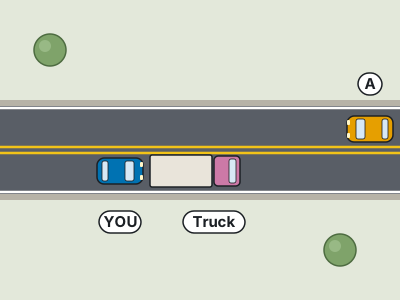
- Only trucks may cross to pass
- Passing is allowed after sounding the horn
- Passing from either side is prohibited
- The line separates lanes moving in the same direction
Show answer
Passing from either side is prohibited. A double solid yellow line separates traffic moving in opposite directions, and the manual says passing from either side of it is prohibited. Crossing it puts the vehicle into opposing traffic, even when the slower vehicle ahead appears easy to overtake. Sounding the horn or driving a truck does not create an exception. Stay in your lane until the marking and road conditions permit a legal maneuver. Read the center line before considering a pass, then wait for a broken line on your side and a clear view.
Study this in the handbook: Pavement Markings and Lanes
8. How does the manual classify a first-offense DUI?
- As a felony
- As a misdemeanor
- As a civil violation
- As a warning with no offense classification
Show answer
As a misdemeanor. The first-offense DUI row is labeled a misdemeanor in the penalty table. A felony classification appears for a third or subsequent offense within five years, so the choice “As a felony” jumps to a later repeat-offense category. The civil-violation choice understates the legal classification, and a warning is not an offense classification listed by the manual. When reviewing DUI penalties, start with the offense number and the time window before comparing fines, custody, or license consequences. The label misdemeanor is the classification requested here.
Study this in the handbook: DUI and Implied Consent
9. A pedestrian is crossing within a crosswalk, but the painted markings are absent. Who has the right-of-way?
- The pedestrian still has the right-of-way
- The vehicle turning right has priority
- The vehicle traveling fastest has priority
- The pedestrian must yield unless a crossing guard is present
Show answer
The pedestrian still has the right-of-way. Mississippi treats a pedestrian in an unmarked crosswalk as having the same right-of-way as one in a marked crosswalk. The lack of paint does not release a driver from yielding. Turning vehicles do not automatically outrank people on foot, and neither speed nor a crossing guard changes the basic rule. Approach intersections carefully, keep the vehicle under control, and be prepared to stop for the pedestrian.
Study this in the handbook: School Buses and Pedestrians
10. If you see a WRONG WAY sign facing you, what should you do?
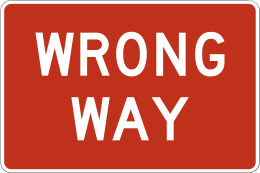
- Stop in the lane and wait for the sign to change
- Continue to the next intersection and make a normal turn
- Move faster so opposing traffic can pass behind you
- Leave the roadway and turn around as soon as possible
Show answer
Leave the roadway and turn around as soon as possible. The WRONG WAY sign means the vehicle is traveling opposite the direction of other cars in that lane, creating a head-on collision danger. The manual directs the driver to leave the roadway and turn around as soon as possible. Continuing to the next intersection leaves the vehicle exposed to opposing traffic, while speeding increases the danger. Waiting in the lane also leaves the car in the conflict path. Treat the sign as an immediate warning to exit the opposing flow safely and correct the direction.
Study this in the handbook: Regulatory and Warning Signs
11. What does a TWO-WAY TRAFFIC warning sign indicate?
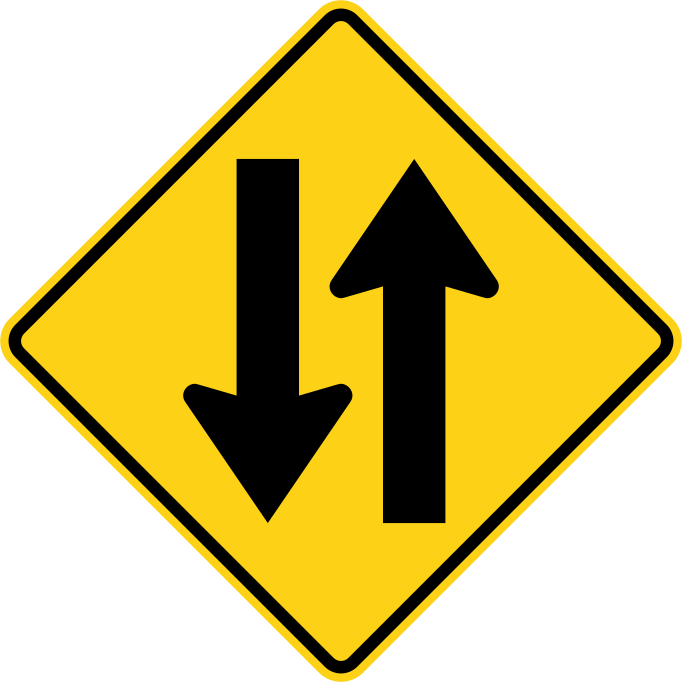
- A median will separate all opposing traffic
- Passing is permitted on both sides of a divided highway
- The road is becoming one-way in the arrow's direction
- Traffic will travel in both directions ahead
Show answer
Traffic will travel in both directions ahead. The two-way traffic warning means opposing traffic will share the roadway ahead. It does not promise passing permission, announce a one-way street, or indicate that a median will separate the directions. Reduce speed as needed, keep to your side, and watch carefully for vehicles approaching from ahead. The manual pairs it with the warning that a divided highway ends, so expect a changed traffic pattern before the opposing lane becomes active. The paired arrows are the recognition cue: two directions now share one road.
12. A new Mississippi resident has held a driver's license from another state. How long must that out-of-state license have been held to qualify for a Class R license on that basis?
- At least six months
- At least 30 days
- At least two years
- At least five years
Show answer
At least six months. One path to a Mississippi Class R license is having held an out-of-state driver's license for at least six months. Thirty days is too short, and two or five years are not the Mississippi standard. The other paths are being 16 with a one year permit, or being 17 or older. Written and vision exams, the affidavit, and the physical requirements still apply.
Study this in the handbook: Learner's Permits and the Regular License
13. How early may an eligible Mississippi driver renew a license before its expiration date?
- Up to thirty days early
- Up to three months early
- Only during the expiration month
- Up to six months early
Show answer
Up to six months early. The renewal notice permits an eligible licensed driver to renew up to six months before the expiration date. Thirty days and three months are shorter than the stated window, while waiting for the expiration month is unnecessarily restrictive. This rule concerns renewal timing, not the period of validity printed on a newly issued credential. A useful planning cue is to begin the renewal process during the six month window and confirm current requirements with the Driver Service Bureau before visiting an office.
Study this in the handbook: Who Needs a License and New Residents
14. A 19 year old in Mississippi is stopped and tests at 0.09 BAC. How is the offense classified?
- As a Zero Tolerance DUI, because the driver is under 21
- As a regular DUI, not a Zero Tolerance DUI
- As a traffic infraction only
- It is not an offense below 0.10
Show answer
As a regular DUI, not a Zero Tolerance DUI. Zero Tolerance penalties cover drivers under 21 whose BAC is 0.02 or higher but less than 0.08. When an under 21 driver reaches 0.08 or more, the manual says the offense is treated as a regular DUI, with the adult fines, jail and suspensions. So the Zero Tolerance label does not apply at 0.09. It is not a mere infraction, and 0.10 is not a Mississippi limit.
Study this in the handbook: Zero Tolerance, Revocation and Reinstatement
15. What should you do if your car becomes disabled on a highway?
- Leave the vehicle and cross the interstate to find assistance
- Stop in the travel lane and walk along the right side
- Pull onto the extreme right shoulder and, if walking for help, face oncoming traffic on the left side
- Keep driving until the vehicle reaches a service station
Show answer
Pull onto the extreme right shoulder and, if walking for help, face oncoming traffic on the left side. Mississippi directs a disabled driver to pull over to the extreme right shoulder. If you must walk for help, use the left side of the highway so you face approaching traffic. Crossing an interstate is specifically forbidden, so the choice that sends you across it creates a serious exposure to fast moving vehicles. Do not remain in a travel lane while seeking help, since a stopped car can be struck from behind. A useful emergency cue is shoulder, face traffic, never cross: get the vehicle out of the lane, stay alert, and choose the safer path to assistance.
Study this in the handbook: Night Driving, Rain and Skids
16. How far in advance should a driver using an arm signal extend it before slowing, turning, stopping, or changing lanes?
- At least 10 feet
- At least 100 feet
- Only after beginning the maneuver
- Exactly 500 feet in every situation
Show answer
At least 100 feet. When arm signals are used, the manual directs the driver to extend the arm fully and signal continuously for at least 100 feet before slowing, turning, stopping, or changing lanes. Ten feet gives nearby road users almost no warning, and starting after the maneuver is too late. The choice “Exactly 500 feet in every situation” replaces a minimum with an unsupported fixed distance. Signal early enough for others to understand your plan, keep the signal visible, and continue it until the maneuver begins as required by the situation.
Study this in the handbook: Signals, Lanes and Passing
17. How far may forest or agricultural products extend beyond a Mississippi vehicle's rear axle?
- No more than 10 feet
- No more than 3 feet
- No more than 28 feet
- There is no limit
Show answer
No more than 28 feet. Under normal conditions the load on the rear of a vehicle transporting forest or agricultural products in their natural state can project no more than 28 feet beyond the vehicle's rear axle. Semitrailers and trailers are limited to 53 feet in length, and any tarpaulin or cover must be secured so no end or binding flaps as the truck moves.
18. Why should a driver reduce speed when water covers the roadway?
- Water always causes the engine to stall
- High speed can make the vehicle hydroplane out of control
- Slower travel prevents every possible skid
- The posted limit automatically becomes zero
Show answer
High speed can make the vehicle hydroplane out of control. The manual links excessive speed on a wet roadway with hydroplaning, in which the vehicle can lose control over the water. The engine-stall response confuses a traction problem with a mechanical failure. Slowing down is a safety measure, not a promise that every skid becomes impossible. A zero-limit claim has no basis in the passage. When rain or standing water appears, ease back to a speed suited to the surface and conditions so the tires have a better chance to maintain contact.
Study this in the handbook: Night Driving, Rain and Skids
19. When is a Mississippi Class D commercial license required?
- For personal vehicles with trailers
- For any pickup truck
- For all vehicles over 10,000 pounds
- Only when operating a vehicle commercially and the vehicle is under 26,000 pounds GVWR
Show answer
Only when operating a vehicle commercially and the vehicle is under 26,000 pounds GVWR. A Class D license is required only when you are operating a vehicle commercially and the vehicle is under 26,000 pounds GVWR. The manual adds that you do not need a commercial license to drive a pickup truck, whatever it is used for, unless you are hauling hazardous materials in an amount that requires a placard. A full CDL is required for a single vehicle over 26,000 pounds GVWR, a vehicle designed to carry more than 15 persons including the driver, or any vehicle requiring hazardous materials placards. Weight alone over 10,000 pounds is not the Class D test.
Study this in the handbook: Learner's Permits and the Regular License
20. How far must Mississippi vehicle headlights allow a driver to see a person ahead in good weather at night?
- One hundred feet
- Two hundred feet
- Five hundred feet
- One thousand feet
Show answer
Two hundred feet. In good weather at night, the manual says headlights should let the driver see a person two hundred feet ahead. Five hundred feet is the visibility distance used elsewhere for low beam requirements near another vehicle and for taillight visibility, so it is a tempting but different figure. One hundred and one thousand feet do not match this equipment standard. Use the condition in the question as the cue: good weather at night points to the headlight illumination distance, not the separate following or taillight rule.
Study this in the handbook: Required Equipment, Tags and Tint
QualitySpace is expanding to Mississippi
We are a California-based independent insurance brokerage working on licensing in more states. We cannot help with Mississippi insurance yet. Leave your email and we will let you know when we can.
Every question is written from the official Mississippi Driver's Manual. Need paper? Printable MS practice test with answer key.
Last verified 2026-10-05. How we check every question · Study all 210 as flashcards
Frequently asked questions
How many questions are on this Mississippi practice test?
This fixed set has 20 questions. It is test 3 of 10 from the 210 question Mississippi bank.
How does this fixed test relate to the full Mississippi bank?
Each numbered test is a fixed set of questions in a fixed order, so you can retake the same test later and compare. Every test mixes road signs and the other topics in about the same proportion as the full bank. Tests 1 to 10 together cover 200 of the 210 questions in the Mississippi bank, each once. The full practice page mixes the whole bank at random.
Last verified 2026-10-05. See the Mississippi DMV facts page for sourced state details.
Return to the full Mississippi practice test · Study road signs