
Test 6 of 10 · 20 questions · Free 2026
MS Permit Practice Test 6
Jump to the test ↓A fixed 20 question set from the Mississippi bank with answers and plain English explanations.
Question 1 of 20 · 0 right so far
All 20 questions in test 6
Every question below comes from the Mississippi question bank on this page. Open a question to see the correct answer and the explanation. Nothing here is hidden behind a signup.
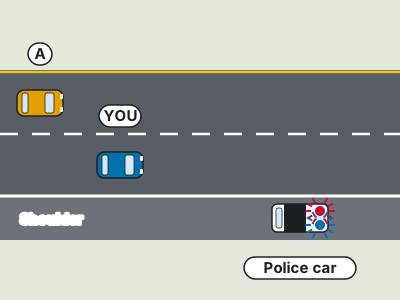
1. On a four-lane highway, what should a driver do when an emergency vehicle is parked on the roadside with lights or a siren activated?
- Move onto the shoulder beside the emergency vehicle
- Merge into the lane away from the emergency vehicle if safe
- Pass without changing position or reducing attention
- Stop in the lane next to the emergency vehicle
Show answer
Merge into the lane away from the emergency vehicle if safe. On a four-lane highway, the driver should merge into the lane away from the parked emergency vehicle when that movement is safe. If an adjacent lane is not safe, the manual says to slow down and prepare to stop if necessary. Moving onto the shoulder brings the car closer to the hazard, while stopping beside it blocks the response area. The practical cue is to scan mirrors early, create lateral space when possible, and reduce speed when a safe lane change cannot be made.
Study this in the handbook: Emergency Vehicles
2. When should a Mississippi driver reduce speed because of visibility or weather?
- When traffic is light and the roadway is straight
- Only when the road is dry and visibility is clear
- Only after reaching the posted maximum speed
- When the weather or visibility is poor
Show answer
When the weather or visibility is poor. Mississippi instructs drivers to slow down when weather or visibility is poor. Rain, fog, darkness, or blowing conditions can shorten the time available to see a hazard and respond, even when the posted limit has not changed. The choice about dry pavement and clear visibility reverses the manual’s condition. Reaching the posted maximum is not a requirement, and light traffic does not make poor visibility safe. Watch the road farther ahead, increase following space, and reduce speed early whenever the view or surface becomes harder to read.
Study this in the handbook: Mississippi Speed Limits
3. What is the only permitted use of a center lane marked TURN LANE ONLY?
- Passing slower traffic
- Preparing to turn left or right across opposing lanes
- Normal travel for several blocks
- Parking while waiting to turn
Show answer
Preparing to turn left or right across opposing lanes. A center lane marked TURN LANE ONLY may be used only while preparing to turn left or right across the opposite lanes. It is never a passing lane and is not for ordinary travel, so the choices “Passing slower traffic” and “Normal travel for several blocks” misuse its purpose. Parking there creates a different hazard and is not listed as an allowed use. Enter the lane close enough to the intended turn to complete that maneuver safely, then leave it as directed by the turn. Do not use its extra pavement as a shortcut around traffic.
Study this in the handbook: Pavement Markings and Lanes
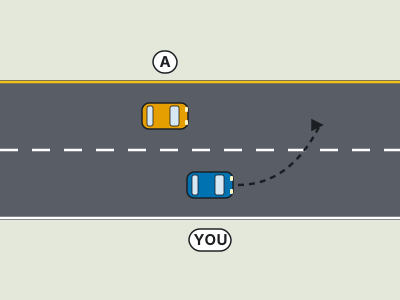
4. Before changing lanes, which checks does the Mississippi manual require?
- A glance at the vehicle ahead without signaling
- The rearview mirror only
- The speedometer and fuel gauge only
- Rearview and side mirrors plus the blind spot
Show answer
Rearview and side mirrors plus the blind spot. A safe lane change requires checking the rearview mirror, side mirrors, and blind spot, followed by a clear signal and a move only when safe. The rearview mirror alone cannot show every area beside and behind the vehicle, especially the blind spot. Dashboard gauges say nothing about an adjacent car, and looking only forward misses the traffic you are entering. Make the mirror and shoulder check a deliberate sequence each time, then switch off the turn signal after completing the lane change.
Study this in the handbook: Following Distance and Stopping
5. When should a driver use the lower headlight beam at night?
- When following another car or driving where street lights are present
- Only on an empty rural road with no nearby vehicles
- Whenever the road has no painted center line
- Only after an oncoming driver flashes headlights
Show answer
When following another car or driving where street lights are present. The manual calls for the lower beam when driving where street lights are present, when following another car, and in fog during night or day. The open-country choice describes a setting where high beam may be used, not the required dimming situations. A missing center line and another driver's signal do not determine the beam rule. Lower the beams early enough to avoid blinding others, and remember that fog can make high beams reduce visibility rather than improve it.
Study this in the handbook: Night Driving, Rain and Skids
6. What does the round railroad warning sign tell you?

- Bicycles have priority in the next lane
- A traffic circle is beginning immediately
- A railroad crossing is ahead
- The road is closed to passenger vehicles
Show answer
A railroad crossing is ahead. The round warning symbol is used for a railroad crossing ahead. It is an advance notice, so the driver has time to reduce speed, search for tracks and trains, and prepare to obey the crossing equipment. It is not a roundabout symbol, a bicycle-priority instruction, or a vehicle closure. The two railroad items may look similar, but this warning belongs before the crossing, while the actual crossing has its own controls and markings. Think round sign, railroad ahead, then make the approach with a deliberate scan and stopping margin.
Study this in the handbook: Railroad Crossings
7. What general duty applies when a driver encounters traffic signs and signals?
- Follow only the largest sign
- Ignore them when traffic is light
- Recognize and obey them
- Treat them as optional suggestions
Show answer
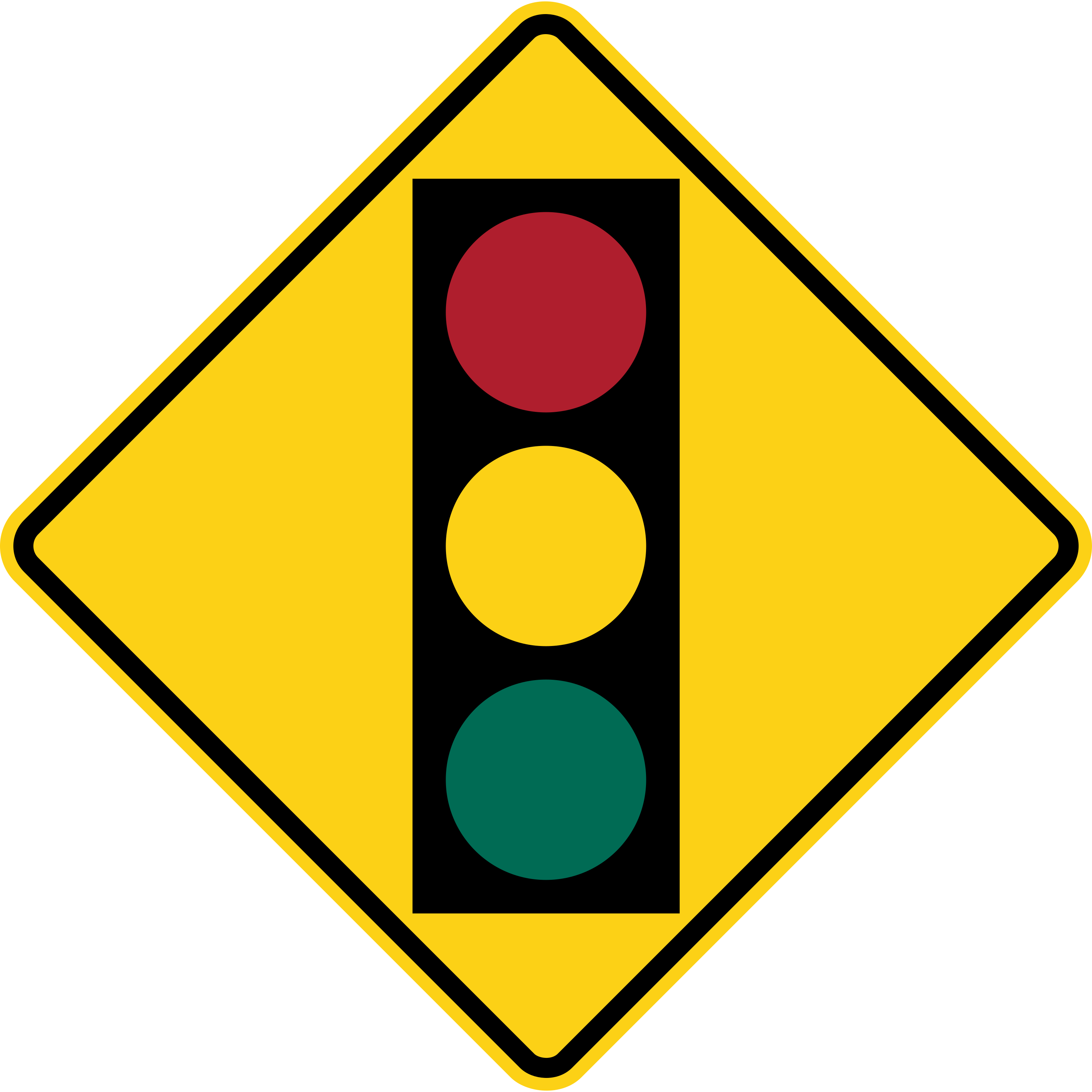
Recognize and obey them. Traffic signs and signals control movement and help prevent crashes, so drivers must recognize them and obey their instructions. The options treating signs as optional or selective would erase the traffic-control function described in the manual. A driver should scan ahead, identify the message or signal phase, and make the required speed, lane, yielding, or stopping adjustment. The pictured warning is a useful reminder that control devices may appear before the point they govern. Build the habit of reading every sign early, then following its instruction unless a traffic officer is directing movement.
Study this in the handbook: Sign Shapes and Colors
8. A Mississippi driver under 21 commits a second Zero Tolerance DUI within five years. What license suspension applies?
- 120 days
- 1 year
- 90 days
- 5 years
Show answer
1 year. A second Zero Tolerance offense within five years carries a fine of not more than $500 and a one year license suspension. One hundred twenty days is the first offense suspension, 90 days is the refusal suspension, and five years is the look back window rather than a suspension length. A third offense leads to suspension for the full sentence and a three year interlock-restricted license.
Study this in the handbook: DUI and Implied Consent
9. How much clearance should a driver leave when passing a bicycle?
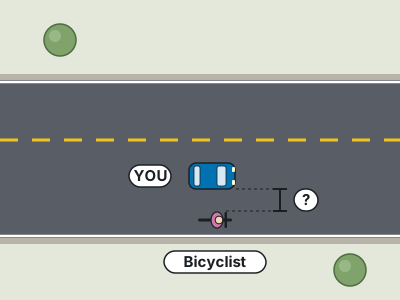
- At least three feet between the vehicle and bicycle
- One foot if the driver sounds the horn first
- Six inches when the bicycle stays near the edge
- No set space if the passing vehicle uses the next lane
Show answer
At least three feet between the vehicle and bicycle. Mississippi's rules for drivers call for leaving a safe distance of at least three feet between the vehicle and bicycle when passing. The manual adds a note: do not try to share the lane with a bicyclist when passing; reduce speed, move into the next lane, and pass in the normal manner, just as you would pass a motor vehicle. If there is oncoming traffic, slow down behind the bicyclist and pass when it is clear. A horn does not replace clearance, and a smaller gap is not made safe by the rider's position.
Study this in the handbook: Bicycles and Large Vehicles
10. What information should you provide when reporting an emergency traffic situation on a Mississippi highway?
- Your preferred route for the next trip
- The emergency and the highway or mile marker location
- Only the vehicle's license plate color
- A request for routine traffic information
Show answer
The emergency and the highway or mile marker location. The manual says a caller using *HP should be prepared to state the emergency and give the location, such as the highway and or mile marker. A travel route and plate color do not tell the dispatcher what help is needed or where to send it. Routine traffic questions are outside the instruction to report actual emergencies only. Make the call specific: describe the immediate danger first, then identify the roadway and marker as accurately as possible.
Study this in the handbook: Emergency Vehicles
11. How does the Mississippi manual define a business or residential district?
- Any area inside city limits
- Any road with a sidewalk
- A place where most of the land along the road for 300 feet or more is used for houses or businesses
- Any area with a posted 25 mph limit
Show answer
A place where most of the land along the road for 300 feet or more is used for houses or businesses. The manual defines a business or residential district as any place where most of the land along the road for 300 feet or more is used for houses or places of business. The definition matters elsewhere in the manual: outside business or residential districts you must park off the roadway, and a truck driver outside those districts must not follow within 300 feet of other trucks except when passing. City limits, a sidewalk, or a posted 25 mph limit does not define the district; land use along the road does.
12. A round yellow railroad warning sign shows which roadway symbol and message?
- A white octagon announcing a required stop
- A black cross buck with two R's, indicating tracks ahead
- A pennant marking the end of a passing restriction
- A blue rectangle directing drivers to services
Show answer
A black cross buck with two R's, indicating tracks ahead. The round yellow sign with the cross-buck and two R's is an advance warning for a railroad crossing. A white octagon is not part of this sign; the octagon shape belongs to the stop sign, which is red. A pennant marks a no-passing zone, not a railroad, and a blue rectangle carries motorist services information. The round shape is a strong recognition cue here, but drivers must still look, listen, and slow down because a stop may be necessary. Treat the sign as advance notice of tracks rather than as permission to proceed without checking.
Study this in the handbook: Railroad Crossings
13. What is the minimum age for Mississippi's Temporary Learner's Permit, which is tied to a school driver education course?
- 12
- 16
- 15
- 14
Show answer
14. The Temporary Learner's Permit is for high school students at least 14 years old who are enrolled in an approved driver education course. It is valid only while the student is enrolled, and it allows driving only a driver education vehicle with the instructor. Fifteen is the minimum for the Regular Learner's Permit, 16 is a license age, and 12 is below any Mississippi permit.
Study this in the handbook: Learner's Permits and the Regular License
14. A Mississippi driver takes the breath test and the result is at or over the legal limit. How long is the officer's receipt good as a temporary permit?
- 45 days
- 90 days
- 30 days
- It is not valid for driving
Show answer
30 days. When the test shows a BAC at or above the driver's limit (0.08 for 21 and older, 0.02 for under 21), the officer takes the license and gives a receipt that works as a temporary permit for only 30 days. The 45 day receipt applies to drivers who refuse the test, and 90 days is the refusal suspension. The receipt does allow driving for its short life.
Study this in the handbook: DUI and Implied Consent
15. What does the Mississippi manual say about wearing dark glasses to cope with night glare?
- Dark glasses are recommended at night
- Dark glasses are required after dark
- Never try to compensate for glare by wearing darkened glasses
- Dark glasses are fine if polarized
Show answer
Never try to compensate for glare by wearing darkened glasses. The manual says never to attempt to compensate for night glare by wearing darkened glasses, because at night or on dark days such glasses will only further reduce your vision. If you meet a vehicle at night with bright or blinding headlights, the safest response is to dim your own lights and keep your eyes on the right side of the road. If an oncoming vehicle has one headlight missing, drive to the far right of your lane. The manual offers no exception for polarized lenses and does not recommend or require dark glasses after dark.
Study this in the handbook: Night Driving, Rain and Skids
16. What must support a Mississippi title application?
- Only a photo ID
- A notarized letter from the seller
- Nothing beyond the fee
- A bill of sale and two years of tag receipts
Show answer
A bill of sale and two years of tag receipts. Every vehicle must have a certificate of title, and title applications must be supported by a bill of sale and two years' tag receipts. All licensed motor vehicle dealers and county tax collectors are qualified by law to accept title applications. Mississippi residents' vehicles must also carry a Mississippi license plate, and nothing may obscure the letters or numerals on the tag.
Study this in the handbook: Required Equipment, Tags and Tint
17. What share of accidents do drivers cause, according to the Mississippi manual?
- 85 percent
- 50 percent
- 10 percent
- Nearly 100 percent, with none from equipment or weather
Show answer
85 percent. The Mississippi manual opens its safe driving basics with the statement that drivers cause 85 percent of all accidents, which is why that section focuses on driver attitude, attention and habits. It tells drivers to keep both hands on the steering wheel, with at least one third of the wheel between the hands, and it says texting while driving is not allowed. Fifty and ten percent understate the figure, and nearly all overstates it.
Study this in the handbook: Seat Belts, Child Seats and Distractions
18. How close to the curb must a parallel parked vehicle be in Mississippi?
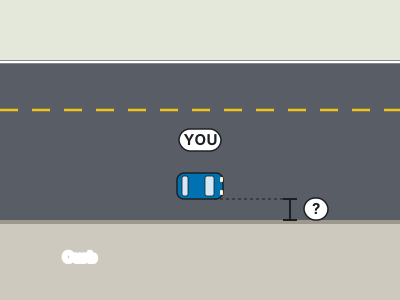
- Within 3 feet
- Any distance if the wheels are straight
- Within 24 inches
- Within 12 inches
Show answer
Within 12 inches. For vehicles parked parallel, the tires should be within 12 inches of the curb. After parking, the manual says to put the gear in park or low, set the parking brake firmly, and turn off the ignition, and to use extreme care when exiting from the street side. On a hill, it adds a wheel rule: turn the wheels sharply right when facing downhill or uphill with no curb, and sharply left when facing uphill with a curb. Three feet, 24 inches, or any distance with straight wheels does not meet the 12 inch rule.
Study this in the handbook: Parking Rules
19. A yellow diamond sign is used for which kind of message?
- A mandatory speed rule printed for ideal conditions
- A warning about an existing or possible roadway hazard
- A guide to fuel, lodging, or other motorist services
- A route marker identifying a state highway
Show answer
A warning about an existing or possible roadway hazard. The yellow diamond is the standard warning shape for an existing or possible hazard on or beside the roadway. It asks the driver to anticipate a change and adjust attention or speed. A speed rule belongs to a regulatory sign, services use blue guidance signs, and route identification uses route markers. Read the symbol or message inside the diamond and prepare before reaching the condition it describes.
Study this in the handbook: Sign Shapes and Colors
20. What light transmittance must Mississippi window tint allow?
- 28 percent or greater, with a $5 compliance certificate and decal
- 50 percent
- 5 percent
- 70 percent
Show answer
28 percent or greater, with a $5 compliance certificate and decal. All windows must have a light transmittance of 28 percent or greater to be legal. Any Mississippi registered vehicle with after-market tint film must have its windows inspected at an official Window Tint Inspection Station. The compliance certificate and decal cost $5, the decal goes in the lower left corner of the windshield, and the certificate is kept on the dashboard or inside the dash compartment. Fifty and seventy percent are not the stated threshold, and five percent would be far too dark.
Study this in the handbook: Required Equipment, Tags and Tint
QualitySpace is expanding to Mississippi
We are a California-based independent insurance brokerage working on licensing in more states. We cannot help with Mississippi insurance yet. Leave your email and we will let you know when we can.
Every question is written from the official Mississippi Driver's Manual. Need paper? Printable MS practice test with answer key.
Last verified 2026-10-05. How we check every question · Study all 210 as flashcards
Frequently asked questions
How many questions are on this Mississippi practice test?
This fixed set has 20 questions. It is test 6 of 10 from the 210 question Mississippi bank.
How does this fixed test relate to the full Mississippi bank?
Each numbered test is a fixed set of questions in a fixed order, so you can retake the same test later and compare. Every test mixes road signs and the other topics in about the same proportion as the full bank. Tests 1 to 10 together cover 200 of the 210 questions in the Mississippi bank, each once. The full practice page mixes the whole bank at random.
Last verified 2026-10-05. See the Mississippi DMV facts page for sourced state details.
Return to the full Mississippi practice test · Study road signs