
Test 4 of 10 · 20 questions · Free 2026
MS Permit Practice Test 4
Jump to the test ↓A fixed 20 question set from the Mississippi bank with answers and plain English explanations.
Question 1 of 20 · 0 right so far
All 20 questions in test 4
Every question below comes from the Mississippi question bank on this page. Open a question to see the correct answer and the explanation. Nothing here is hidden behind a signup.
1. A Mississippi teen receives a Learner's Permit at age 15 and a half. At what age does the teen become eligible for a Regular Driver's License?
- 16
- 16 and a half
- 17
- 18
Show answer
16 and a half. Because the Learner's Permit must be held for a full year, a permit issued at 15 and a half leads to eligibility at 16 and a half. Turning 16 is not enough on its own; the year must pass first. Seventeen is when a new applicant can skip the permit year entirely, and 18 is not the threshold for this license. The manual answers this exact question in its license section.
Study this in the handbook: Learner's Permits and the Regular License
2. How close to the nearest rail of a railroad crossing may a Mississippi driver park?
- No closer than 50 feet
- No closer than 5 feet
- No closer than 100 feet
- No closer than 15 feet
Show answer
No closer than 15 feet. Mississippi prohibits parking within 15 feet of the nearest rail of any railroad crossing. Fifty feet may sound familiar because certain vehicles must stop within 50 to 10 feet of the rail, but that is a stopping rule, not a parking distance. Five feet is dangerously close, and 100 feet is not in the list. Parking too close to the tracks can put the vehicle in a train's path.
Study this in the handbook: Parking Rules
3. Which of these can lead Mississippi's Commissioner of Public Safety to suspend a license without a preliminary hearing?
- Failing to pay child support
- Changing jobs
- Buying a new car
- Moving to a new county
Show answer
Failing to pay child support. The manual lists reasons the Commissioner may suspend a license without a preliminary hearing, and failing to pay child support is one of them. Others include a crash causing death, injury or serious damage, habitual reckless driving, frequent serious violations, a DUI in another state, and fraudulent use of a license. Changing jobs, buying a car, or moving within the state are not grounds for suspension. Reinstatement after a child support suspension costs $25.
Study this in the handbook: Zero Tolerance, Revocation and Reinstatement
4. How many reckless driving charges within 12 months require a one year license revocation in Mississippi?
- Two
- Five
- Three
- One
Show answer
Three. Three reckless driving charges within a twelve month period are on Mississippi's list of offenses that require a one year revocation. One or two charges do not trigger this mandatory revocation on their own, though the Commissioner can suspend habitually reckless or negligent drivers. Five is more than the threshold. The same list includes hit and run, vehicular manslaughter, and felonies committed with a vehicle.
Study this in the handbook: Zero Tolerance, Revocation and Reinstatement
5. How far from a school bus must you stop when its red lights flash or its stop sign is extended?
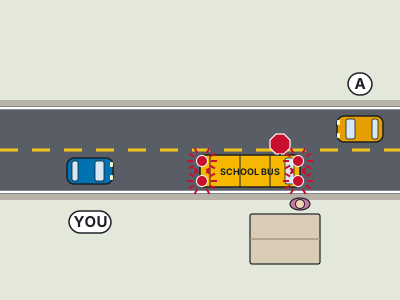
- At least ten feet away
- At least five feet away
- At least twenty-five feet away
- Only close enough to see the driver's mirror
Show answer
At least ten feet away. Mississippi requires a complete stop at least ten feet from a school bus when its red lights are flashing or its stop sign is extended. Five feet gives children and the bus too little clearance, and twenty-five feet is not the distance stated in this rule. The mirror-based response supplies no measurable stopping point. Look for the combination of complete stop and ten-foot minimum, then remain stopped until the children are clear and the bus has resumed motion with its warning devices ended.
Study this in the handbook: School Buses and Pedestrians
6. Under Mississippi's Zero Tolerance rule, which BAC range applies to a driver under 21?
- 0.05% or higher but less than 0.10%
- Any detectable alcohol, including 0.00%
- 0.02% or higher but less than 0.08%
- 0.08% or higher only
Show answer
0.02% or higher but less than 0.08%. The under-21 Zero Tolerance range starts at .02 percent and ends before .08 percent. The manual separately says that .08 percent or higher is classified as a regular DUI, so the choice “0.08% or higher only” skips the Zero Tolerance category. Zero does not mean any detectable amount automatically creates this charge. Remember both endpoints: .02 starts the range, while .08 changes the classification.
Study this in the handbook: Zero Tolerance, Revocation and Reinstatement
7. What is prohibited when passing through a railroad crossing with lowered gates?
- Waiting until the gates rise and the lights stop flashing
- Driving around the gates
- Checking for a second train after the first
- Following a traffic officer's order to proceed
Show answer
Driving around the gates. The manual expressly says it is against the law to drive around lowered railroad gates. Waiting for the gates to rise and the lights to stop flashing is part of the required safe procedure. Checking for another train is an important caution, and a traffic officer's instruction is to be followed. Never try to beat a train or bypass its warning equipment. The visible gate is a firm stop cue, even if the crossing appears empty from your approach.
Study this in the handbook: Railroad Crossings
8. How does the manual classify a third or subsequent DUI offense within five years?
- As a felony
- As a misdemeanor
- As a civil violation
- As a first offense if no crash caused injury
Show answer
As a felony. A third or subsequent DUI within five years is labeled a felony in the manual. The misdemeanor choices belong to the first and second offense rows, while a civil violation is not the classification shown in the table. The absence of an injury does not turn a repeat offense into a first offense. Count qualifying DUI offenses within the stated five-year period, then use the row that matches that count. That sequence keeps the classification separate from the additional fine, custody, and license consequences listed elsewhere in the same table.
Study this in the handbook: DUI and Implied Consent
9. What is the correct entry and travel direction at a Mississippi roundabout?
- Enter from the left and travel against circulating traffic
- Enter before circulating traffic and travel clockwise
- Stop in the circle until every approach is empty
- Yield to traffic already inside, then enter and travel toward the right
Show answer
Yield to traffic already inside, then enter and travel toward the right. A driver entering a roundabout must yield to traffic already inside the circle. Once the way is safe, the driver enters and exits by traveling toward the right, which keeps circulation in the required direction. Entering ahead of circulating vehicles risks a collision, while stopping inside the circle can disrupt traffic. Slow before the entry, scan for approaching vehicles, and merge only after yielding.
Study this in the handbook: Right of Way at Intersections
10. What does a Mississippi vehicle need in addition to headlights for rear visibility?
- A blue taillight visible 100 feet behind
- A red taillight visible 500 feet behind
- A white taillight visible 200 feet behind
- Two red spotlights visible 1,000 feet behind
Show answer
A red taillight visible 500 feet behind. The taillight must be red and visible five hundred feet behind the vehicle. The color is part of the requirement, so a white or blue light fails even if it could be seen at some distance. The manual does not require rear spotlights for this purpose. Do not substitute the two hundred foot headlight illumination figure for the rear light standard. A practical walk-around check is to verify the taillight is red, working, and visible from behind before driving after dark.
Study this in the handbook: Required Equipment, Tags and Tint
11. Under Mississippi equipment rules, what braking systems must a vehicle have?
- A foot brake and a parking brake
- Two parking brakes and no foot brake
- Only an electronic anti-lock system
- A hand brake used only on hills
Show answer
A foot brake and a parking brake. The vehicle must have two separate braking functions: a foot brake and a parking brake. The manual also gives performance distances at twenty miles per hour, but the equipment question first turns on the presence of both systems. An anti-lock system does not replace the required foot and parking brakes, and a hill-only hand brake is not the stated standard. When checking a vehicle, confirm that the service brake and parking brake operate independently and that each can stop the vehicle within its specified distance.
Study this in the handbook: Required Equipment, Tags and Tint
12. What maximum speed does Mississippi set for trucks and truck-trailer combinations in inclement weather or bad visibility?
- 55 mph
- 45 mph
- 35 mph
- 70 mph
Show answer
45 mph. The truck and truck-trailer table lists 70 mph on interstates, 55 mph on all other highways, and 45 mph in inclement weather or bad visibility. So 70 and 55 are the normal limits, not the bad weather limit, and 35 mph is not in the table. The truck category includes loaded half-ton trucks and all heavier trucks, loaded or not.
Study this in the handbook: Mississippi Speed Limits
13. What minimum liability coverage must a Mississippi policy provide for two people injured or killed?
- At least $10,000
- At least $5,000
- At least $20,000
- At least $50,000
Show answer
At least $50,000. The Mississippi Insurance Department states that on January 1, 2006, the minimum liability requirements increased to $25,000 per person, $50,000 per accident for bodily injury, and $25,000 per accident for property damage. The question asks about two people injured or killed, so the per accident bodily injury limit of $50,000 applies. The driver manual still prints the older $10,000 and $20,000 figures, but those limits are no longer current law. Keep the per person, per accident, and property damage categories separate when checking a policy.
14. Which mufflers are illegal in Mississippi?
- Straight, gutted, Hollywood, glass packed or any muffler allowing excessive noise or smoke
- Only mufflers on vehicles built before 1970
- Factory mufflers on trucks
- None, mufflers are unregulated
Show answer
Straight, gutted, Hollywood, glass packed or any muffler allowing excessive noise or smoke. Straight, gutted, Hollywood, glass packed or any other types of mufflers which allow excessive noise or smoke are illegal in Mississippi. The manual says the muffler on your vehicle must be in good working order and must operate constantly, and it lists the muffler among the equipment items along with brakes, lights, horn, tires and windshield. The rule is not limited to older vehicles, and factory mufflers in good working order are not on the illegal list.
Study this in the handbook: Required Equipment, Tags and Tint
15. What type of guidance does a brown traffic sign provide?
- Construction or maintenance warning
- Motorist services guidance
- Public recreation and scenic guidance
- A mandatory stop at every intersection
Show answer
Public recreation and scenic guidance. Brown signs provide public recreation and scenic guidance. They point drivers toward recreational destinations or scenic information, rather than giving a construction warning, service indication, or stop command. Orange identifies construction or maintenance work, blue guides motorists to services, and the octagonal shape belongs exclusively to stop signs. Use the brown color as an early clue, then read the destination or symbol so you can choose a safe lane and prepare for the entrance. A guidance sign informs route decisions, but it does not cancel speed limits, yielding duties, or other traffic controls along the way.
Study this in the handbook: Sign Shapes and Colors
16. At an intersection with a stop sign, where must a driver make the required stop?
- Only beside the stop sign post
- After the front tires cross into the intersection
- At the crosswalk, before entering the intersection
- At least one car length beyond the crosswalk
Show answer
At the crosswalk, before entering the intersection. A stop sign requires a complete stop at the crosswalk when one is present. The driver must then yield to any vehicle or pedestrian in the intersection and may proceed only when the way is completely clear. Stopping beyond the crosswalk can place the vehicle in the path of pedestrians or cross traffic. Approach at a controlled speed, stop before the marked crossing, scan both directions, and keep the vehicle stopped until the intersection is safe to enter.
Study this in the handbook: Right of Way at Intersections
17. What speed applies when passing a school during recess or while children are arriving at or leaving school?
- 25 miles per hour
- 15 miles per hour
- 35 miles per hour
- 45 miles per hour
Show answer
15 miles per hour. The school zone warning lists fifteen miles per hour when passing a school during recess or while children are arriving at or leaving school during opening and closing hours. The manual also states that the maximum speed for any vehicle in a school zone is 15 mph, so twenty-five and thirty-five are both too fast. Forty-five miles per hour is the separate maximum listed for a school bus. Watch for the school zone sign and reduce speed before reaching the area where children may be present.
Study this in the handbook: Regulatory and Warning Signs
18. How far away must a vehicle horn be audible under Mississippi equipment rules?
- 50 feet
- 100 feet
- 500 feet
- 200 feet
Show answer
200 feet. The horn must be audible from 200 feet away. That distance helps make the warning useful to people and drivers who are not immediately beside the vehicle. The 100-foot option cuts the required range in half, while 500 feet greatly overstates the rule. Remember this as a visibility and warning-equipment standard, separate from the situations in which a driver should choose to sound the horn. A compliant horn must be capable of being heard at the specified distance, even though traffic noise and weather can affect what someone actually hears.
Study this in the handbook: Required Equipment, Tags and Tint
19. What does the access lane or ramp merge warning sign indicate?

- The lane beside you will disappear immediately at the sign
- Your lane is reserved for buses until the next intersection
- All merging is prohibited on the roadway ahead
- An access lane or ramp will merge into the roadway from the right
Show answer
An access lane or ramp will merge into the roadway from the right. This warning identifies an access lane or ramp merging into the roadway from the right. Give yourself time to observe entering traffic, adjust speed, and preserve a safe gap instead of making a sudden move. The sign does not reserve a lane for buses, prohibit every merge, or promise that the neighboring lane ends exactly at the sign. Check mirrors and blind spots before changing position. The important cue is traffic joining the roadway, which calls for awareness and space.
20. At this octagonal sign, what action is required before entering the intersection?

- Stop only when another vehicle has already entered
- Reduce speed but continue if no pedestrian is visible
- Come to a complete stop, then yield to nearby traffic that could be a hazard
- Yield without stopping whenever the roadway looks clear
Show answer
Come to a complete stop, then yield to nearby traffic that could be a hazard. Mississippi reserves the eight-sided shape for STOP signs. The driver must stop completely before entering the intersection, then yield to traffic close enough to create a hazard. A clear-looking roadway does not remove the stopping duty, and merely reducing speed is not enough. The option that waits for another vehicle also reverses the rule because the sign controls your approach regardless of who else is present. Use the shape as the fast visual cue: an octagon means full stop first, followed by a careful check of every relevant approach.
Study this in the handbook: Regulatory and Warning Signs
QualitySpace is expanding to Mississippi
We are a California-based independent insurance brokerage working on licensing in more states. We cannot help with Mississippi insurance yet. Leave your email and we will let you know when we can.
Every question is written from the official Mississippi Driver's Manual. Need paper? Printable MS practice test with answer key.
Last verified 2026-10-05. How we check every question · Study all 210 as flashcards
Frequently asked questions
How many questions are on this Mississippi practice test?
This fixed set has 20 questions. It is test 4 of 10 from the 210 question Mississippi bank.
How does this fixed test relate to the full Mississippi bank?
Each numbered test is a fixed set of questions in a fixed order, so you can retake the same test later and compare. Every test mixes road signs and the other topics in about the same proportion as the full bank. Tests 1 to 10 together cover 200 of the 210 questions in the Mississippi bank, each once. The full practice page mixes the whole bank at random.
Last verified 2026-10-05. See the Mississippi DMV facts page for sourced state details.
Return to the full Mississippi practice test · Study road signs