
Test 2 of 10 · 20 questions · Free 2026
MS Permit Practice Test 2
Jump to the test ↓A fixed 20 question set from the Mississippi bank with answers and plain English explanations.
Question 1 of 20 · 0 right so far
All 20 questions in test 2
Every question below comes from the Mississippi question bank on this page. Open a question to see the correct answer and the explanation. Nothing here is hidden behind a signup.
1. At a two-way stop, two vehicles arrive together after cross traffic has cleared. Who has priority?
- The vehicle intending to travel straight across
- The vehicle intending to turn across the traffic lane
- The vehicle closest to the stop sign, regardless of direction
- Neither vehicle until a police officer arrives
Show answer
The vehicle intending to travel straight across. When two vehicles arrive at a two-way stop together, the one intending to travel straight across has the right-of-way. A vehicle turning across the traffic lane must wait and yield. The rule applies after the stop and once cross traffic has cleared; it does not erase the duty to check the intersection. The turning driver should remain stopped until the straight-moving vehicle has passed safely.
Study this in the handbook: Right of Way at Intersections
2. What does a ONE WAY arrow sign tell drivers?
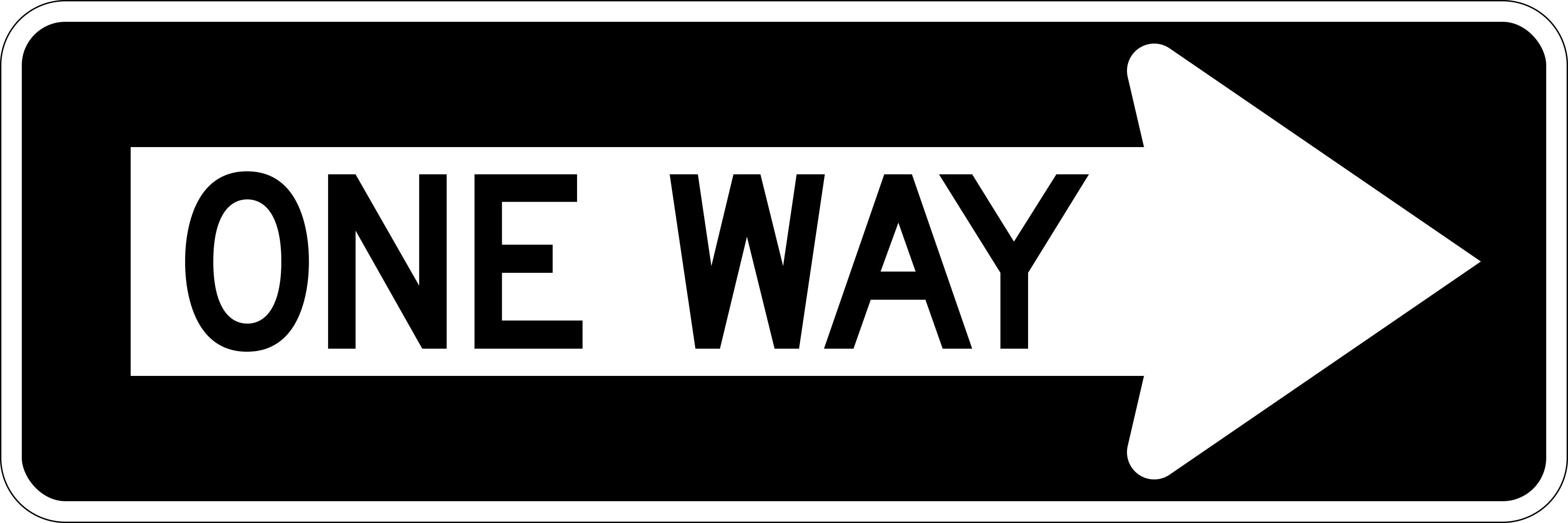
- They must use the center lane for passing
- They may turn either way at the next signal
- They may travel only in the direction of the arrow
- They may reverse direction when traffic is light
Show answer
They may travel only in the direction of the arrow. The one-way display restricts travel to the direction shown by its arrow. It does not authorize a choice between left and right at the next signal, create a passing lane, or allow a driver to reverse course when traffic is sparse. An arrow is the immediate orientation cue: compare your intended movement with its direction before entering or continuing along the street. If you find yourself in the wrong lane, keep going until it is safe to turn off and return to the correct street rather than making a sudden correction.
Study this in the handbook: Regulatory and Warning Signs
3. What does the speed limit sign indicate?
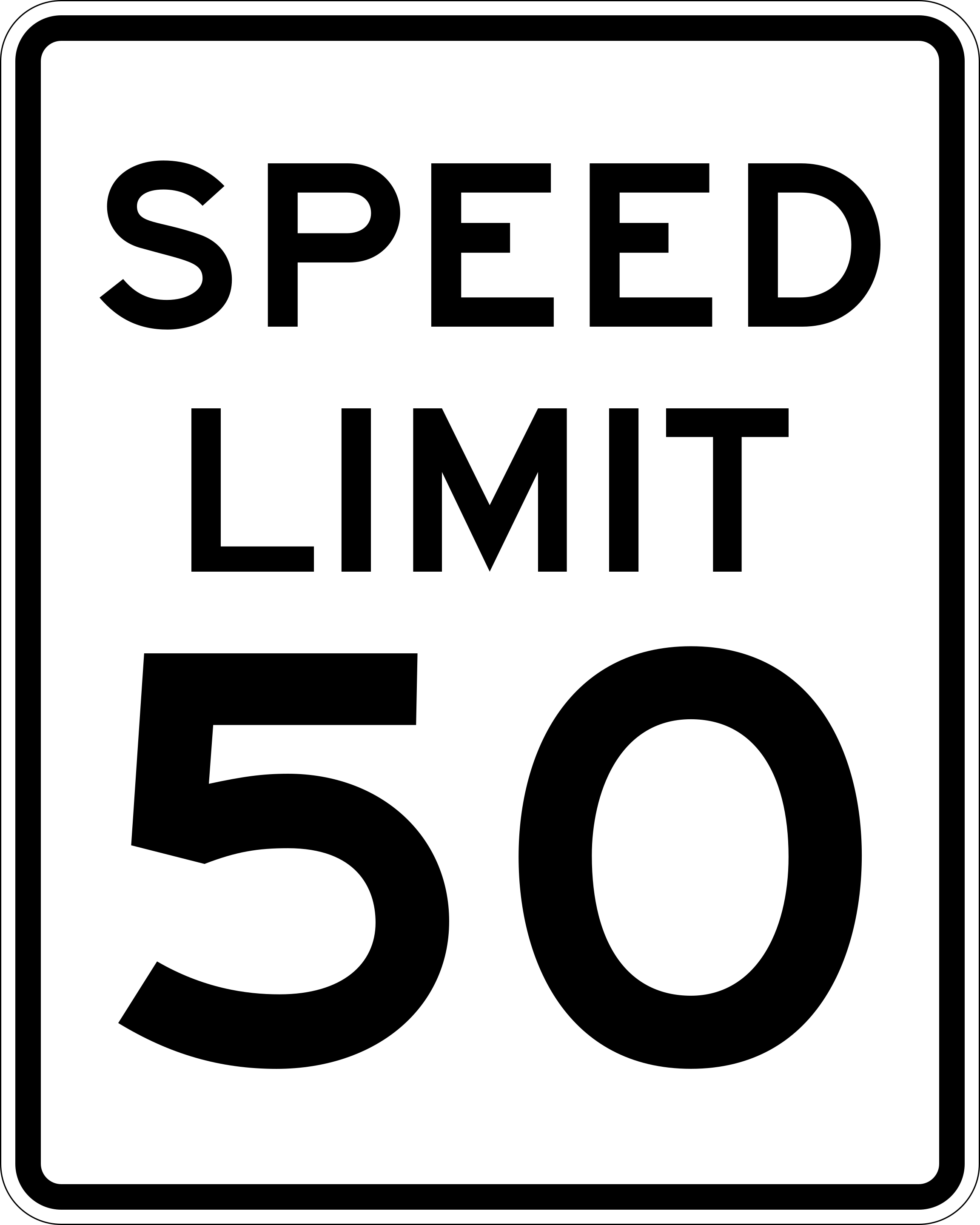
- A suggested speed that may be exceeded when traffic is light
- A minimum speed required in every weather condition
- The maximum speed allowed under ideal driving conditions
- The maximum speed permitted only for commercial vehicles
Show answer
The maximum speed allowed under ideal driving conditions. The manual describes the speed limit sign as the maximum speed allowed under ideal driving conditions. That wording does not turn the number into a required minimum, a suggestion that can be exceeded, or a truck-only restriction. Rain, darkness, congestion, or poor pavement can make a lower speed necessary even when the posted number is higher. Use the sign as an upper boundary, then adjust below it when conditions demand. A simple cue is maximum under ideal conditions, not permission to hold the number regardless of what the road is doing.
Study this in the handbook: Regulatory and Warning Signs
4. A Mississippi driver is convicted of a first offense DUI and had also refused the breath test. What happens to the penalty?
- The refusal cancels the DUI charge
- Nothing extra; the DUI penalty covers it
- The fine is cut in half
- A 90 day license suspension is added
Show answer
A 90 day license suspension is added. The manual gives this as an example of additional penalties: with a first offense DUI or first offense Zero Tolerance DUI conviction and a refused breath or chemical test, a 90 day license suspension is added to the original penalty. Refusing does not cancel the DUI, it is not absorbed into the DUI penalty, and it does not reduce the fine. Penalties also rise if a DUI happens while already suspended for DUI.
Study this in the handbook: DUI and Implied Consent
5. For how long must the Mississippi Commissioner of Public Safety revoke a license after a conviction for manslaughter from a driving accident?
- One year
- 90 days
- Six months
- Permanently
Show answer
One year. Mississippi requires revocation for one year for a conviction of manslaughter or negligent homicide from a driving accident. The same one year revocation applies to any felony using a motor vehicle, failing to stop and render aid after a crash, perjury about vehicle ownership or operation, and three reckless driving charges within 12 months. Ninety days and six months are too short, and the manual does not set a permanent revocation for these offenses.
Study this in the handbook: Zero Tolerance, Revocation and Reinstatement
6. Within how many feet of a bridge, railroad crossing, or intersection does Mississippi forbid passing?
- 50 feet
- 100 feet
- 500 feet
- 1,000 feet
Show answer
100 feet. Mississippi says not to pass on hills or curves, or within 100 feet of bridges, viaducts, overpasses, railroad crossings, crosswalks, intersections, or any place where the view is obstructed. Fifty feet is too short, while 500 and 1,000 feet are not the distance in the rule. The manual also says to pass only in good weather, never in rain or sleet, and never by driving on the shoulder.
Study this in the handbook: Signals, Lanes and Passing
7. Under Mississippi law, when must the driver in a crash immediately notify law enforcement?
- Only when the crash occurs on an interstate
- Only when every vehicle involved is disabled
- When it causes injury, death, or apparent property damage of $500 or more
- When damage is below $500 and no one is injured
Show answer
When it causes injury, death, or apparent property damage of $500 or more. Section 63-3-411 requires the driver of a vehicle in a crash that causes injury to or death of any person, or total property damage to an apparent extent of $500 or more, to give notice immediately by the quickest means of communication. Inside a city the notice goes to the local police department; outside one it goes to the nearest sheriff's office or highway patrol station. The rule is not limited to interstates or to disabled vehicles, and a crash with no injury and less than $500 in damage does not meet the threshold.
Study this in the handbook: Accidents, Breakdowns and Insurance
8. Other than a farm tractor, what is the maximum total outside width of a vehicle and its load on Mississippi roads?
- Eight and one half feet
- Six feet
- Ten feet
- Twelve feet
Show answer
Eight and one half feet. The total outside width of any vehicle, including the load it carries, cannot exceed eight and one half feet. The manual sets a separate ten foot width limit only for a farm tractor, which is why the stem sets tractors aside. No vehicle may exceed a total height of thirteen and one half feet, and above twelve and one half feet the driver or owner is responsible for damage caused by the excess height. Farm machinery is exempt from size limits in daylight within 50 miles of its point of origin.
9. What must a driver do when railroad crossing lights begin flashing?
- Cross after shifting into a lower gear
- Speed across before the gates begin to lower
- Stop only if the driver can see the train
- Stop and remain stopped until the lights stop and it is safe
Show answer
Stop and remain stopped until the lights stop and it is safe. Flashing railroad crossing lights mean a train is coming. Drivers must always stop when the lights begin to flash and remain stopped until the lights stop flashing and the crossing can be entered safely. Waiting to see the train is unsafe because its approach may be hidden, and racing the gates creates a collision risk. Do not drive around a lowered gate. Stop in the required area, watch for a second train, and proceed only after every warning has cleared.
Study this in the handbook: Railroad Crossings
10. What right-of-way does an ambulance, fire engine, or police car have when showing emergency lights or using a siren?
- It must yield to a vehicle already waiting at a red light
- It has priority only when traveling on an interstate
- It has the right-of-way in any street traffic situation
- It may proceed only after a funeral procession passes
Show answer
It has the right-of-way in any street traffic situation. Mississippi gives an ambulance, fire engine, or police car with flashing red or blue lights, or a bell or siren, the right-of-way in any street traffic situation. Interstate-only priority narrows the rule incorrectly. A red light does not make ordinary traffic more important than an approaching emergency vehicle, and funeral processions are discussed separately as a courtesy. Yield promptly and safely, watching your position at intersections so the emergency vehicle has a clear path.
Study this in the handbook: School Buses and Pedestrians
11. Before a Mississippi applicant can get a Regular Driver's License, how many hours of supervised driving must a parent, teacher, or guardian certify in an affidavit?
- At least 20 hours
- At least 50 hours
- At least 100 hours
- No supervised hours are required
Show answer
At least 50 hours. Mississippi requires an affidavit in which a parent, teacher, or guardian certifies watching the applicant drive for at least 50 hours and attests to safe, proper operation of the vehicle. Twenty hours is too few, 100 hours is not the Mississippi figure, and the requirement is not optional. The affidavit sits alongside the written and vision exams and the physical requirements, and it can also let an applicant skip retaking the computerized exam within two years.
Study this in the handbook: Application and the Driver Examination
12. When must a driver yield to pedestrians at a crosswalk?
- Only when a crossing guard is present
- Always, even when the crosswalk is not marked
- Only at a traffic signal showing WALK
- Only when pedestrians are walking from the driver's right
Show answer
Always, even when the crosswalk is not marked. Mississippi requires drivers to yield to pedestrians in crosswalks whether the lines are painted or not. That protection does not depend on a crossing guard, a particular signal, or the pedestrian's approach direction. The choices “Only when a crossing guard is present” and “Only at a traffic signal showing WALK” add conditions the manual does not require, while the choice “Only when pedestrians are walking from the driver's right” would ignore people crossing from the opposite side. Approach every crosswalk slowly enough to stop, check both sides and the curb area, and keep the vehicle under control until the pedestrian is safely clear.
Study this in the handbook: Pavement Markings and Lanes
13. Which sign shape is used for school crossing signs and warnings of school zones ahead?
- Pentagon
- Octagon
- Pennant
- Round
Show answer
Pentagon. The pentagon is assigned to school crossing signs and warnings of school zones ahead. An octagon is reserved for a stop sign, a pennant warns of a no-passing zone, and a round sign warns that a railroad crossing is ahead. Shape recognition can help before the wording is fully readable, especially where children may be present. Once a pentagonal school warning appears, stay alert for pedestrians and be ready to respond to the conditions around the school area.
Study this in the handbook: Sign Shapes and Colors
14. What does red on a Mississippi traffic device generally indicate?
- Directional guidance and permitted movement
- Motorist services guidance
- Construction or maintenance warning
- Stop or prohibition
Show answer
Stop or prohibition. Red is used for stopping or prohibition on Mississippi traffic devices. That signal can require a driver to stop or warn that a movement is forbidden, depending on the device and its message. Blue points toward motorist services, orange identifies construction or maintenance warnings, and green provides directional guidance or indicates permitted movement. Treat red as an immediate instruction to look for the associated control and obey it before proceeding. The useful cue is the color itself, but read the symbol or words too, since the exact command comes from the complete traffic device.
Study this in the handbook: Sign Shapes and Colors
15. This right-angle warning arrow tells a driver to expect what?

- A pedestrian-only crossing with no roadway change
- A sharp turn ahead that requires careful speed control
- A mandatory U-turn at the next intersection
- A railroad crossing controlled by a gate
Show answer
A sharp turn ahead that requires careful speed control. The right-angle arrow warns of a sharp turn ahead, where the roadway changes direction abruptly. It is not a command to make a U-turn, and it does not identify a pedestrian crossing or a railroad gate. Release speed before the turn, scan beyond the sign, and follow the curve without drifting across the lane line. The useful cue is the word sharp, which calls for earlier speed control than a gentle bend. Keep the vehicle balanced through the turn rather than braking suddenly within it.
Study this in the handbook: Regulatory and Warning Signs
16. Within what distance of an oncoming vehicle, or of a vehicle you are following, does Mississippi law require low beams?
- 1,000 feet oncoming and 300 feet following
- 500 feet in both cases
- 200 feet in both cases
- Only when the other driver flashes you
Show answer
500 feet in both cases. Mississippi requires low beams within 500 feet of an oncoming vehicle and within 500 feet of a vehicle you are following. The 1,000 and 300 foot pair does not match the Mississippi rule, and 200 feet is too close. Waiting for another driver to flash you is not the rule. High beams are for open country without other cars near, and low beams are also the right choice in fog.
Study this in the handbook: Night Driving, Rain and Skids
17. What is the required stopping distance for the Mississippi foot brake when traveling 20 miles per hour?
- Twenty feet
- Seventy feet
- Fifty-five feet
- Thirty feet
Show answer
Thirty feet. At twenty miles per hour, the foot brake must be strong enough to stop the vehicle within thirty feet. The fifty-five foot figure applies to the parking brake at the same speed, so choosing it confuses the two systems. Twenty and seventy feet are not the listed standards. This test point pairs the brake type with the speed and distance, so keep the two figures together: foot brake, thirty feet; parking brake, fifty-five feet. Those are equipment performance requirements, not estimates for every road condition.
Study this in the handbook: Required Equipment, Tags and Tint
18. If you must park along a Mississippi highway outside a business or residential district, from how far away should your vehicle be visible?
- At least 50 feet in one direction
- At least 1,000 feet ahead only
- At least 200 feet in both directions
- Visibility does not matter if flashers are on
Show answer
At least 200 feet in both directions. Outside business or residential districts you must park off the roadway. If you have to stop along a highway, pull all the way off, leave at least 20 feet for other vehicles to pass if possible, and park where you can be seen from at least 200 feet in both directions. Fifty feet in one direction is too little, and 1,000 feet is not the rule. At night, leave parking lights or flashers on as well.
Study this in the handbook: Parking Rules
19. When weather or visibility is poor on a Mississippi highway, how should a driver respond to the posted speed limit?
- Treat the posted number as mandatory regardless of conditions
- Use the interstate maximum speed unless a police officer is present
- Increase speed to spend less time in the poor conditions
- Slow down according to the weather or visibility and the situation
Show answer
Slow down according to the weather or visibility and the situation. Mississippi's listed speed limits assume ideal road and weather conditions. Rain, fog, darkness, curves, congestion, or limited sight distance can require a lower speed even when the sign has not changed. The choice “Treat the posted number as mandatory regardless of conditions” turns an ideal-condition maximum into an unconditional target, which is unsafe. The choice “Increase speed to spend less time in the poor conditions” reverses the needed response, and the interstate reference in the choice “Use the interstate maximum speed unless a police officer is present” cannot override conditions. A useful cue is to ask whether you can stop and see as well as you could on a clear, dry road; if not, reduce speed.
Study this in the handbook: Mississippi Speed Limits
20. Which payment methods does the Mississippi manual say Driver Service Bureau offices accept?
- Cash, credit cards, and debit cards
- Checks only, mailed in advance
- Cashier's checks and money orders only
- Personal checks and gift cards
Show answer
Cash, credit cards, and debit cards. The manual says offices accept cash, credit cards, and debit cards. The other choices narrow payment to instruments the statement does not list, and personal checks are especially inconsistent with the accompanying fee guidance. This is a payment-method rule rather than a question about the amount charged for a permit or license. Before visiting, identify whether a card is Visa or MasterCard because the manual gives that card restriction, and remember that prices and laws may change between publications.
QualitySpace is expanding to Mississippi
We are a California-based independent insurance brokerage working on licensing in more states. We cannot help with Mississippi insurance yet. Leave your email and we will let you know when we can.
Every question is written from the official Mississippi Driver's Manual. Need paper? Printable MS practice test with answer key.
Last verified 2026-10-05. How we check every question · Study all 210 as flashcards
Frequently asked questions
How many questions are on this Mississippi practice test?
This fixed set has 20 questions. It is test 2 of 10 from the 210 question Mississippi bank.
How does this fixed test relate to the full Mississippi bank?
Each numbered test is a fixed set of questions in a fixed order, so you can retake the same test later and compare. Every test mixes road signs and the other topics in about the same proportion as the full bank. Tests 1 to 10 together cover 200 of the 210 questions in the Mississippi bank, each once. The full practice page mixes the whole bank at random.
Last verified 2026-10-05. See the Mississippi DMV facts page for sourced state details.
Return to the full Mississippi practice test · Study road signs