
Test 8 of 10 · 20 questions · Free 2026
WV Permit Practice Test 8
Jump to the test ↓A fixed 20 question set from the West Virginia bank with answers and plain English explanations. The real WV exam is 25 questions, 76 percent to pass; take the full length version on the main practice page.
Question 1 of 20 · 0 right so far
All 20 questions in test 8
Every question below comes from the West Virginia question bank on this page. Open a question to see the correct answer and the explanation. Nothing here is hidden behind a signup.
1. Where should drivers use extreme care to avoid colliding with a pedestrian?
- Only at gas stations
- Only on empty rural roads
- In school zones, bus stops, playgrounds, and parks
- Only in a vehicle inspection lane
Show answer
In school zones, bus stops, playgrounds, and parks. Pedestrian collisions are especially dangerous in places where people may enter the roadway unexpectedly. The handbook names school zones, bus stops, playgrounds, and parks as locations requiring extreme care. These areas can have children, people crossing between vehicles, or limited sight distance. The choice naming only rural roads misses the listed hazards, while a gas station or inspection lane is not the handbook's specific warning. Reduce speed, scan both sides, and be ready to stop whenever a pedestrian may move into your path.
Study this in the handbook: Right of way and pedestrians
2. What should a driver do when a posted speed limit is lower than a statutory designated speed?
- Choose whichever limit feels comfortable
- Use the statutory number instead
- Follow the posted lower limit
- Add the two limits together
Show answer
Follow the posted lower limit. Designated speeds apply only when they are not otherwise posted and when they remain reasonable and prudent for conditions. A posted lower limit therefore controls the driver's speed. Substituting the statutory number would ignore the sign, and personal comfort is not a legal speed standard. Adding two limits is not a traffic rule. The handbook's wording also leaves room for conditions to demand a slower speed than either number, such as poor visibility or a narrow road. Check the sign, obey the lower instruction, and slow further when safety requires it.
Study this in the handbook: Basic speed law and school zones
3. Who may be in the room during a West Virginia knowledge test?
- The applicant and one support person
- The applicant and a DMV employee who reads every question
- Any applicant who has a phone turned off
- Only the applicant taking the test
Show answer
Only the applicant taking the test. The handbook limits the exam room to the applicant who is taking the test. That means a friend, parent, or other support person cannot sit in the room as a companion. The choice “The applicant and one support person” adds a support person, but the rule does not create that exception. A DMV employee may administer the test, yet the employee is not a second applicant or a personal helper. Before entering, leave phones and other electronics outside and expect to take the examination alone. This distinction is especially useful when a young applicant arrives with a parent, because the parent may provide consent for a permit without joining the testing room.
Study this in the handbook: Vision, knowledge and road tests
4. What should a driver expect when entering an interstate construction zone?
- Lanes may close and traffic may slow or stop
- All lanes will remain open at the normal speed
- Only the shoulder may be closed, so lane changes are unnecessary
- Construction zones permit drivers to ignore posted controls
Show answer
Lanes may close and traffic may slow or stop. Interstate construction zones can change the normal path of travel. A lane may close, and traffic may slow or stop, so the driver needs to watch signs, special speed limits, and flaggers. Assuming every lane stays open encourages a last-second maneuver. The shoulder-only choice understates the risk because the travel lanes themselves may be affected. Posted controls still apply inside the work area. Scan ahead, move into an open lane early, and leave extra space around equipment and workers.
Study this in the handbook: Entering, exiting and driving on interstates
5. At an intersection, what movement does a NO LEFT TURN sign prohibit?
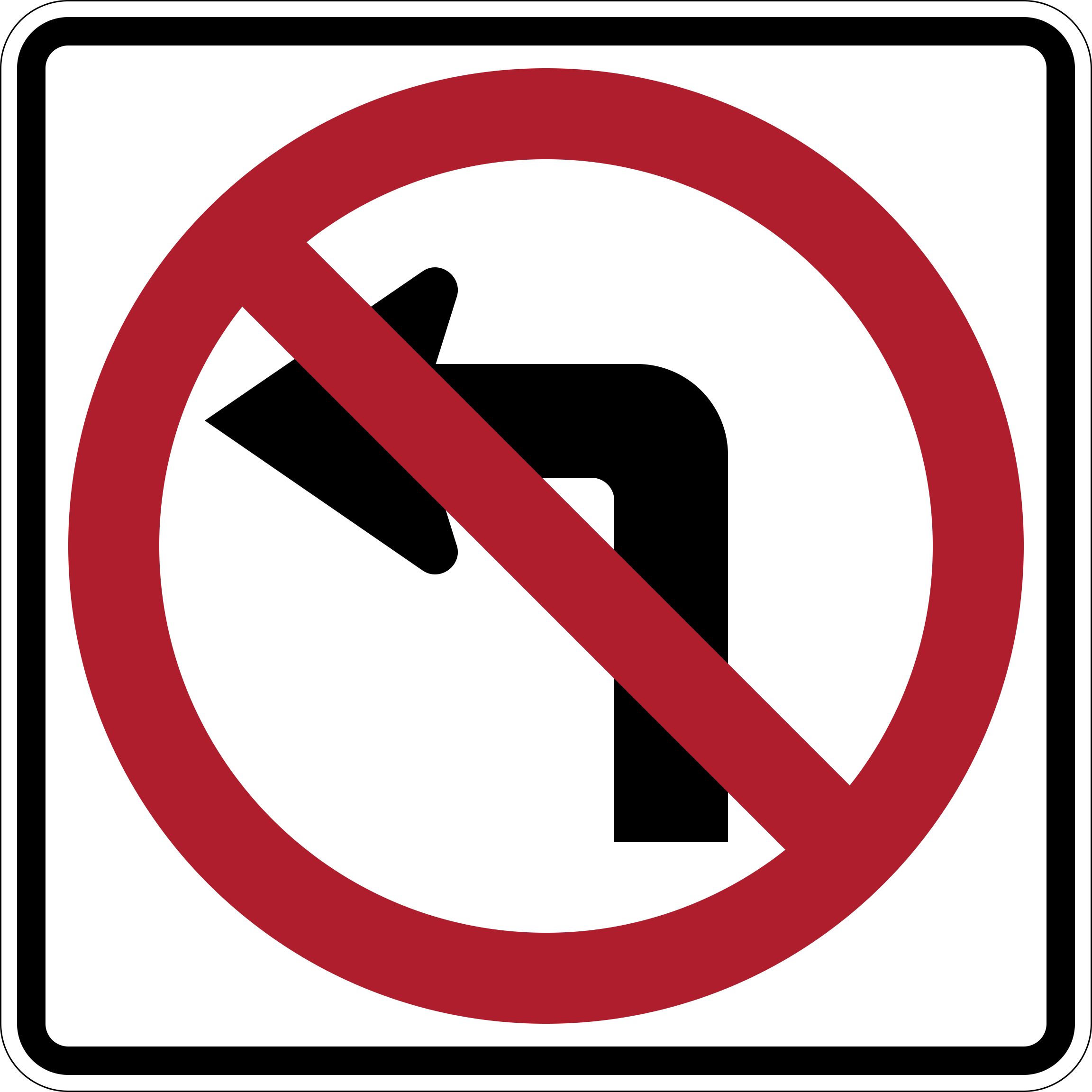
- Continuing straight
- Turning right
- Turning left
- Changing lanes after the intersection
Show answer
Turning left. The pictured left-turn movement is the one restricted at the intersection. A driver may not substitute a right turn, straight movement, or a later lane change for the prohibited action. Check for another lawful route and obey any separate signal or pavement marking that controls the remaining movements. The red diagonal bar over the directional arrow helps distinguish this sign from a no U-turn sign.
Study this in the handbook: Sign shapes, colors and pavement markings
6. What is the West Virginia penalty for letting someone else use your driver's license?
- A 90 day suspension
- A $25 fine and no suspension
- A 30 day suspension
- A one year revocation
Show answer
A 90 day suspension. Letting someone else use your license, using another person's license, lending identity documents to get a license, or displaying a fictitious license all carry a 90 day suspension. A small fine with no suspension understates it. Thirty days is shorter than the stated penalty, and a one year revocation is not the listed penalty. Giving false information on a license application is also illegal.
Study this in the handbook: Points, citations and suspensions
7. At how many points is a West Virginia driver's license subject to suspension?
- 12 points
- 6 points
- 8 points
- 18 points
Show answer
12 points. A West Virginia license is subject to suspension when the driver accumulates 12 points. Six points brings only a letter of caution. Eight points is the value of a single fleeing from an officer conviction on the point scale, not the suspension level. Eighteen points is not a threshold in the handbook. Since points last two years, the 12 point total is counted from the points still on the record.
Study this in the handbook: Points, citations and suspensions
8. On a West Virginia interstate, which lane should you normally drive in?
- The left lane, so you can keep up with fast traffic
- The right hand lane, unless you are passing another vehicle
- The center lane at all times
- Whichever lane has the least traffic
Show answer
The right hand lane, unless you are passing another vehicle. Interstate traffic flows best when slower vehicles keep right and the left lanes are used for passing. The handbook says to always drive in the right hand lane unless you are passing another vehicle, and it warns that driving much slower than other traffic creates a hazard because other drivers may be forced to change lanes abruptly. Camping in the left or center lane blocks passing traffic, and choosing a lane by traffic volume alone ignores the rule. Move left to pass, then return to the right.
Study this in the handbook: Entering, exiting and driving on interstates
9. How should following distance change when driving in darkness or rain?
- Increase it to at least four seconds
- Reduce it to two seconds to keep traffic moving
- Keep the same three-second gap regardless of visibility
- Use one car length because headlights show the road
Show answer
Increase it to at least four seconds. The handbook raises the minimum following interval to at least four seconds when it is dark or raining. Reduced visibility and changing pavement conditions make it harder to detect a hazard and bring the vehicle to a stop, so the extra space creates time for recognition and braking. The ordinary three-to-four second rule is not a reason to shorten the gap in poor conditions. A one-car-length measure varies with speed and gives no reliable time margin. If ice or snow is present, the handbook calls for at least six seconds.
Study this in the handbook: U-turns, backing, parking and following distance
10. At a West Virginia stop sign or red light, must you come to a complete stop when you are only turning right?
- Only at night
- No, a rolling stop is allowed when no cross traffic is visible
- Only when a police officer is present
- Yes, a complete stop is required regardless of traffic, even for a right turn
Show answer
Yes, a complete stop is required regardless of traffic, even for a right turn. The handbook lists impatience as a bad habit that causes crashes, and the example it gives is the rolling stop. Regardless of traffic, you must come to a complete stop at a stop sign or red light, even when you are only turning right. Pressure from vehicles behind you and an empty cross street can tempt you to slow down instead of stopping, but the absence of visible traffic is not the test; the law requires the full stop. Stop behind the line or crosswalk, look both ways, and then make the turn.
Study this in the handbook: Headlights and light conditions
11. A school bus is receiving students with its red lights flashing on a regular highway. What must traffic do?
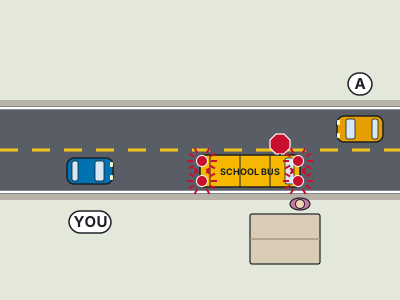
- Oncoming traffic may pass at 15 mph
- Only traffic behind the bus must stop
- Traffic in both directions must stop before reaching the bus
- Traffic may proceed once the bus doors close
Show answer
Traffic in both directions must stop before reaching the bus. The handbook requires traffic in both directions to stop before reaching a school bus that is receiving or discharging students with red lights flashing. The limited exception applies only to traffic approaching a bus on the other side of the median on an Interstate Highway. Closing the doors does not end the requirement, and a low speed does not replace stopping. Remain stopped until the bus moves, the driver signals you onward, or the visual signals are no longer active.
Study this in the handbook: Right of way and pedestrians
12. What color pattern is common for ordinary traffic signs, and what pattern signals an especially important message?
- White with black letters; red with white letters
- Blue with yellow letters; green with white letters
- Orange with blue letters; purple with white letters
- Black with red letters; brown with yellow letters
Show answer
White with black letters; red with white letters. The handbook describes most signs as white with black lettering. It also identifies red signs with white letters as the treatment used when the message is very important, and adds that a red outline with a diagonal bar always means no. Color helps drivers recognize the sign quickly, but it does not remove the need to read the wording or symbol. Orange is the basic color for construction and maintenance devices, not the ordinary regulatory pattern. Slow enough to read the sign safely, identify both color and shape, and follow the instruction before entering the controlled area.
Study this in the handbook: Sign shapes, colors and pavement markings
13. If smoke comes from under the hood, what should the driver do first?
- Get off the roadway and turn off the ignition
- Open the radiator cap immediately
- Pour water over the engine while moving
- Continue driving until the smoke disappears
Show answer
Get off the roadway and turn off the ignition. Smoke under the hood calls for immediate separation from traffic and removal of the ignition source. The handbook directs the driver to get off the roadway and turn off the ignition. Opening a hot radiator cap can cause serious burns, and water is unsafe on a gasoline fire because burning gasoline can float and spread. Continuing to drive allows the problem to worsen. Once stopped safely, use dirt or sand if appropriate and move at least 100 feet away if the fire becomes uncontrollable.
Study this in the handbook: Blowouts, fires and other vehicle emergencies
14. What happens when a driver refuses the designated Breathalyzer after a DUI arrest?
- The driver must wait 24 hours before testing
- Only the vehicle registration is renewed
- The driver receives a warning with no license action
- The driving privilege is revoked for one year and up to life
Show answer
The driving privilege is revoked for one year and up to life. Under implied consent, a driver is treated as having agreed to the designated Breathalyzer after a DUI arrest. Refusing it can revoke the privilege to operate a motor vehicle for one year and up to life. The registration-only response ignores the license consequence, and a warning does not match the stated penalty. Waiting a day is not the remedy described by the handbook. The useful cue is the event that activates the rule: this consequence follows a refusal after arrest, not merely noticing alcohol on a driver's breath during an ordinary stop.
Study this in the handbook: Alcohol, BAC limits and zero tolerance
15. In West Virginia, what happens when the driver who passed a stopped school bus cannot be identified?
- No one can be charged
- The vehicle's owner or lessee is guilty of a misdemeanor and subject to fines
- The bus driver is fined
- The vehicle is impounded for 60 days
Show answer
The vehicle's owner or lessee is guilty of a misdemeanor and subject to fines. West Virginia does not let a school bus violation go unpunished when the driver cannot be named. If the identity of the driver of a vehicle that passes a stopped school bus cannot be ascertained, the owner or lessee of the vehicle is guilty of a misdemeanor and, upon conviction, subject to fines. An identified driver faces at least a 60 day suspension and a $500 fine or up to six months in jail. Lending a vehicle carries that responsibility.
Study this in the handbook: Right of way and pedestrians
16. Which pair of actions requires a driver to use a turn signal beforehand?
- Braking for a yellow light or stopping at a stop sign
- Changing lanes or turning at an intersection
- Driving below the speed limit or entering a school zone
- Approaching a railroad crossing or crossing a bridge
Show answer
Changing lanes or turning at an intersection. The handbook specifically lists changing lanes and turning at an intersection among the maneuvers that require a turn signal beforehand, along with entering or leaving an interstate, pulling away from the curb, and pulling over to the side of the road. Signaling gives other road users time to understand where your vehicle intends to go. Braking at a light, driving below the limit, and approaching a railroad crossing may require careful driving, but those choices do not identify the listed pair. Signal at least 100 feet before a turn, check traffic, and then complete the maneuver smoothly.
Study this in the handbook: The road skills test and basic control
17. How should a driver respond to an aggressive motorist?
- Compete with the driver to establish control of the road
- Follow closely to prevent the driver from getting ahead
- Avoid becoming involved in competition with that driver
- Use the horn continuously until the driver stops
Show answer
Avoid becoming involved in competition with that driver. An aggressive motorist may try to turn ordinary traffic into a contest. The handbook describes the arrogant or aggressive driver as someone who competes with the vehicle as an extension of the ego, with little or no respect for traffic laws or the rights of others, and it tells drivers not to become involved in competition with that person. Competing, following closely, or sounding the horn continuously can intensify the encounter and distract from steering and traffic conditions. Keep your distance and let the other vehicle move away when possible, while maintaining a safe, lawful path.
Study this in the handbook: Headlights and light conditions
18. Before turning, changing lanes, or pulling away from the curb in West Virginia, what must you always do?
- Sound your horn
- Signal your intention
- Flash your high beams
- Come to a complete stop
Show answer
Signal your intention. The handbook's rule is simple: always signal your intention before turning, changing lanes, or driving away from the curb. Signaling tells other drivers that you intend to turn or change lanes. Horns and high beams are not substitutes for a signal, and a full stop is not required before every lane change. Signal early enough for others to react, since the road test guidance warns against signaling too early or too late, and cancel the signal once the move is complete.
Study this in the handbook: Turn signals and full stops
19. What roadway condition does the skidding-car warning identify?

- The road is designed for racing
- This section is more slippery when wet
- Loose gravel is guaranteed ahead
- A bridge has a low clearance
Show answer
This section is more slippery when wet. The warning identifies a section that becomes more slippery than other roads when wet. Slow down before reaching it and keep steering and braking smooth. The symbol does not invite racing, guarantee loose gravel, or describe bridge clearance. Increase following space because a wet surface reduces available traction, and avoid abrupt inputs that could make the vehicle slide. Let the tires regain grip gradually.
20. When does West Virginia's rule to pull off at the first safe turnout for faster traffic apply?
- On every interstate, at all times
- Only when five or more vehicles are behind you
- Only at night
- On a road with one lane in each direction when overtaking traffic has no clear lane to pass
Show answer
On a road with one lane in each direction when overtaking traffic has no clear lane to pass. The turnout rule applies when you must drive slower than the designated speed on a road with one lane in each direction and overtaking traffic has no clear passing lane. Interstates have extra lanes, so the rule is not about them. The handbook sets no vehicle count and no time of day for this rule. Slower drivers should also keep as close as possible to the right edge of the road.
Study this in the handbook: The road skills test and basic control
QualitySpace is expanding to West Virginia
We are a California-based independent insurance brokerage working on licensing in more states. We cannot help with West Virginia insurance yet. Leave your email and we will let you know when we can.
Every question is written from the official West Virginia Driver's Licensing Handbook. Need paper? Printable WV practice test with answer key.
Last verified 2026-10-05. How we check every question · Study all 209 as flashcards
Frequently asked questions
How many questions are on this West Virginia practice test?
This fixed set has 20 questions. It is test 8 of 10 from the 209 question West Virginia bank. The real WV exam asks 25 questions and you need 19 correct.
What is the passing score for the real West Virginia test?
19 out of the 25 questions correctly to pass (76%) That figure comes from the official West Virginia source cited on the DMV facts page.
How does this fixed test relate to the full West Virginia bank?
Each numbered test is a fixed set of questions in a fixed order, so you can retake the same test later and compare. Every test mixes road signs and the other topics in about the same proportion as the full bank. Tests 1 to 10 together cover 200 of the 209 questions in the West Virginia bank, each once. The full practice page mixes the whole bank at random.
Last verified 2026-10-05. See the West Virginia DMV facts page for sourced state details.
Return to the full West Virginia practice test · Study road signs