
Test 3 of 10 · 20 questions · Free 2026
WV Permit Practice Test 3
Jump to the test ↓A fixed 20 question set from the West Virginia bank with answers and plain English explanations. The real WV exam is 25 questions, 76 percent to pass; take the full length version on the main practice page.
Question 1 of 20 · 0 right so far
All 20 questions in test 3
Every question below comes from the West Virginia question bank on this page. Open a question to see the correct answer and the explanation. Nothing here is hidden behind a signup.
1. The West Virginia DMV sends you a notice asking for proof of insurance mid-year. Why?
- The DMV may verify insurance at any time during the registration year, and you must submit proof of coverage
- Only vehicles over 10 years old are checked
- Notices go out only after a crash
- The notice is a billing error
Show answer
The DMV may verify insurance at any time during the registration year, and you must submit proof of coverage. Proof of West Virginia liability insurance is required when you obtain or renew a registration, and coverage must be maintained for the full registration year. The DMV may conduct a verification of insurance at any time during that year, and if you are issued a notice you are required to submit proof of coverage. The check is not tied to vehicle age or a crash. Ignoring the notice leads to suspension of the license and registration plus reinstatement fees.
Study this in the handbook: Crash reports, insurance and phone use
2. When must a Level 2 GDL holder drive with a supervising adult?
- Between 5:00 a.m. and 10:00 a.m.
- Only during school hours
- Between 10:00 p.m. and 5:00 a.m.
- Only after midnight on weekends
Show answer
Between 10:00 p.m. and 5:00 a.m.. A Level 2 holder must drive with a supervising licensed adult who is at least 21 between 10:00 p.m. and 5:00 a.m. The daytime window is the period when solo driving is generally allowed, so the choice “Between 5:00 a.m. and 10:00 a.m.” reverses the rule. School hours and weekends do not define the handbook's overnight requirement. The listed exceptions for work, school, religious activity, or an emergency can change the result, but they do not erase the ordinary curfew. When checking a planned trip, compare its start and end time with the overnight window first.
Study this in the handbook: Graduated Driver's License levels
3. If two vehicles reach an uncontrolled intersection at the same time, which driver should yield?
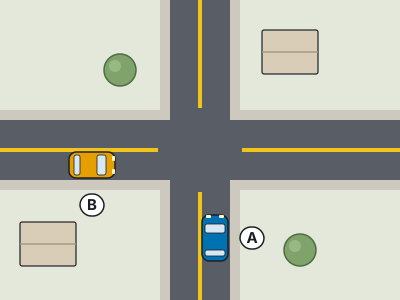
- The driver on the left yields to the driver on the right
- The driver on the right yields to the driver on the left
- The larger vehicle always proceeds first
- The vehicle traveling faster proceeds first
Show answer
The driver on the left yields to the driver on the right. At an uncontrolled intersection or four-way stop, equal arrival creates a tie that the handbook resolves by giving priority to the driver on the right. The driver on the left must yield. Vehicle size and speed do not replace this positioning rule, and neither driver should force the issue if the other person acts unpredictably. Slow before the intersection, identify who arrived first, and be ready to yield even when you believe priority is yours. Courtesy remains more important than proving a point in the middle of traffic.
Study this in the handbook: Right of way and pedestrians
4. When entering an interstate, what must a driver do if no gap is available in traffic?
- Use the shoulder beyond the acceleration lane and stop as a last resort
- Stop in the acceleration lane and wait indefinitely
- Force a sharp merge into the traffic stream
- Reverse down the entrance ramp
Show answer
Use the shoulder beyond the acceleration lane and stop as a last resort. The entrance ramp guidance treats a missing gap as an unusual situation. If no gap is available, the driver may need to use the shoulder beyond the acceleration lane and stop, but only as a last resort because entering traffic from a stop is hazardous. Stopping in the acceleration lane blocks other merging vehicles. A forced merge or reversing down the ramp creates additional danger and ignores the traffic flow. First check traffic, signal, adjust speed, and seek a safe opening. Use the shoulder only when those normal steps cannot work.
5. What must a driver do when a vehicle is approaching a yield-controlled intersection?
- Accelerate to enter before other traffic
- Slow down and yield to vehicles already in or approaching the intersection
- Stop in the intersection and wait
- Ignore traffic if the driver has signaled
Show answer
Slow down and yield to vehicles already in or approaching the intersection. A yield sign calls for reduced speed and a careful check of traffic, with priority given to vehicles already in the intersection and those approaching it. Accelerating defeats the purpose of the sign, while stopping in the middle of the intersection creates an obstruction for the very traffic you are supposed to let through. A turn signal from the driver does not cancel the duty to yield. The practical sequence is to slow before reaching the intersection, look for vehicles in it and approaching it, yield, and proceed only when the path is clear.
Study this in the handbook: Right of way and pedestrians
6. If the brake pedal keeps going down toward the floor, what problem may the vehicle have?
- Overinflated tires only
- A fully charged battery
- A leak in the braking system
- A properly adjusted parking brake
Show answer
A leak in the braking system. Before driving, press the brake pedal and count to ten. The handbook says that if the pedal keeps going down, the vehicle may have a leak in the braking system. That condition requires attention before the trip because braking may fail when pressure is needed. A charged battery and tire pressure do not explain a sinking brake pedal, and a properly adjusted parking brake is a separate check. Treat a soft or falling pedal as a safety defect, not as a minor comfort issue.
Study this in the handbook: Blowouts, fires and other vehicle emergencies
7. What is the maximum speed for an interstate in West Virginia unless another speed is posted?
- 55 mph
- 70 mph
- 65 mph
- 75 mph
Show answer
70 mph. West Virginia lists 70 mph as the maximum interstate speed unless a different limit is posted. The 55 mph figure belongs to open county highways and also appears as the minimum interstate speed in ordinary conditions, so it is an especially tempting mix-up. A 65 mph or 75 mph answer is not the designated interstate maximum stated here. Always check posted signs and reduce speed when weather, traffic, or roadway conditions make the maximum unreasonable or imprudent. The sign and the conditions work together.
Study this in the handbook: Basic speed law and school zones
8. How much water does the West Virginia handbook say can float some smaller vehicles?
- As little as six inches
- At least two feet
- At least one foot
- Only water above the hood
Show answer
As little as six inches. Flooded roadways are extremely hazardous, and the handbook says never to attempt to drive across one. As little as six inches of water can float some smaller vehicles, while two feet of water will carry most vehicles away. Once a vehicle floats off the roadway into deeper water it may roll uncontrollably while filling with water, trapping everyone inside. Depth is hard to judge from the driver's seat, so turn around instead of testing it.
Study this in the handbook: Headlights and light conditions
9. For a driver age 21 or older operating a noncommercial vehicle in West Virginia, what is the lowest BAC covered by the general alcohol per se threshold?
- Any reading for every driver
- More than 0.05 percent only
- 0.10 percent or more
- 0.08 percent or more
Show answer
0.08 percent or more. For the handbook's general BAC presumption, a reading of 0.08 percent or more means the driver is presumed to be under the influence. The 0.05 to below 0.08 range has a different role as relevant evidence of impairment, so it should not be substituted for the stated presumption threshold. A 0.10 threshold would allow a higher level than the rule describes. Zero tolerance language applies to drivers under 21 and is addressed separately. The number must be read together with the driver's age and the legal category being tested.
Study this in the handbook: Alcohol, BAC limits and zero tolerance
10. What is the recommended response when you are driving slower than normal traffic and faster vehicles cannot pass safely?
- Speed up above the posted limit
- Drive in the center of the lane to block passing
- Stop immediately in the travel lane
- Move as close as possible to the right edge and use the first safe turnout
Show answer
Move as close as possible to the right edge and use the first safe turnout. A slower driver should make room for traffic rather than create a moving obstruction. The handbook says to stay close to the right edge and pull off at the first safe turnout when a one-lane-each-way road leaves overtaking traffic without a clear passing lane. Blocking the center is the opposite of that courtesy. Stopping in the travel lane adds a hazard, while exceeding the limit is not required. Watch the road behind you, plan ahead for a turnout, and reenter only when the maneuver can be completed safely.
Study this in the handbook: Basic speed law and school zones
11. In the West Virginia handbook's example, a person drinking more than one drink per hour has a last drink at 11:30 p.m. What is the BAC at 4 a.m.?
- Back to zero
- Below 0.02 percent
- Still above 0.06 percent
- Exactly 0.05 percent
Show answer
Still above 0.06 percent. The handbook explains that drinking more than one drink per hour lets BAC build up, and that BAC keeps rising after the last drink. In its example, the person who stopped at 11:30 p.m. is still above 0.06 percent at 4 a.m., a level that can lead to a DUI arrest. The idea that a few hours bring BAC back to zero or near zero is exactly what the example disproves. The handbook gives no exact 0.05 figure for this example.
Study this in the handbook: Alcohol, BAC limits and zero tolerance
12. A West Virginia driver has completed every Level 1 instruction permit requirement. Between what ages can the driver get a Level 2 intermediate license?
- Between 15 and 16
- Between 17 and 21
- Between 16 and 18
- Between 18 and 21
Show answer
Between 16 and 18. The Level 2 GDL intermediate license is for drivers between the ages of 16 and 18 who have completed all Level 1 permit requirements and meet the other Level 2 conditions, including a road skills test. Fifteen is too young for Level 2. Seventeen to 21 and 18 to 21 describe older drivers; at 18 a driver is past the graduated stages, and 21 is the age of the supervising adult, not a Level 2 limit.
Study this in the handbook: Graduated Driver's License levels
13. What does the West Virginia handbook call the habit of checking only the rear view mirror before changing lanes or pulling away from the curb?
- Impatience
- Good defensive driving
- Inattention
- Laziness, a bad driving habit
Show answer
Laziness, a bad driving habit. The handbook groups bad driving habits under laziness, impatience, inattention, arrogance and aggressiveness. Laziness is looking only in the rear view mirror instead of turning your head to check behind you before changing lanes, driving away from the curb, or opening a door on the traffic side, and it includes failing to signal. Always turn your head and look before acting, and signal your intention before turning or changing lanes.
Study this in the handbook: Bad driving habits
14. What is the exit gore on a West Virginia interstate, and may you stop in it?
- A lane reserved for trucks
- A paved rest area beside the ramp where stopping is allowed
- The acceleration lane for entering traffic
- The triangular area between the through lane and the exit ramp; do not stop there
Show answer
The triangular area between the through lane and the exit ramp; do not stop there. The West Virginia handbook defines the exit gore as the triangular area between the through lane and the exit ramp, and says do not stop in it, because another driver may try to cross the gore after missing the exit and strike your vehicle. The same section says interstate shoulders are only for disabled vehicles and that no parking is permitted on them. The gore is not a rest area, an acceleration lane, or a truck lane.
Study this in the handbook: Entering, exiting and driving on interstates
15. What is the X-shaped railroad crossing sign called?
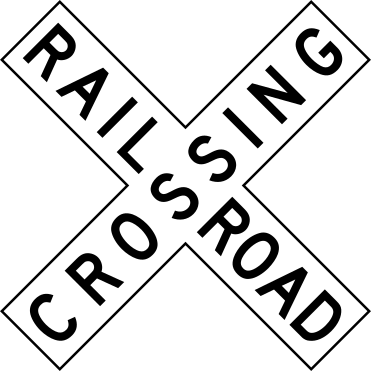
- A pennant
- A crossbuck
- A lane-use arrow
- A school-zone marker
Show answer
A crossbuck. The X-shaped railroad sign is called a crossbuck. A pennant marks the beginning of a no-passing zone, while a lane-use arrow directs traffic and a school marker identifies school activity. At a crossing, the crossbuck is a strong reminder that trains have priority. Slow, look in both directions, and be prepared to stop before entering the tracks. Never assume an empty crossing is risk-free.
16. According to the West Virginia handbook, what happens when a driver relaxes, leans back, and lets attention wander?
- Fuel economy improves
- The vehicle may also wander
- Reaction time improves
- Nothing, as long as speed is steady
Show answer
The vehicle may also wander. The handbook's inattention section says a good driver sits up straight, keeps a firm grip on the steering wheel, knows where they are, and pays attention to developing traffic problems. If you relax, lean back, release your grip on the wheel and allow your attention to wander, your vehicle may also wander. Posture and grip are part of attention, and steady speed does not protect a drifting vehicle.
Study this in the handbook: Drowsy driving, fatigue and emotions
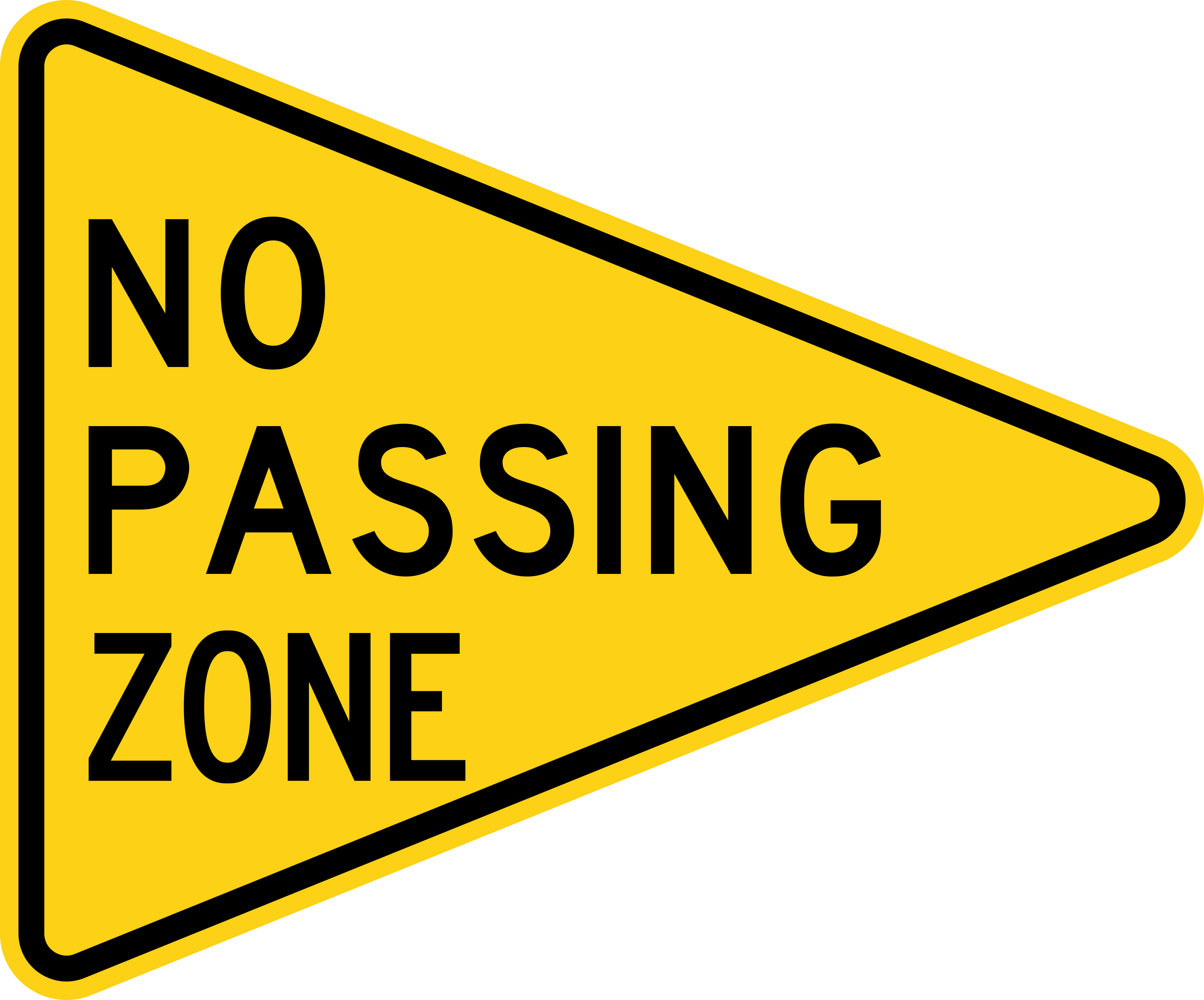
17. What does a pennant-shaped traffic sign mark in West Virginia?
- A school zone crossing
- The end of a no-passing zone
- An upcoming railroad crossing
- The beginning of a no-passing zone
Show answer
The beginning of a no-passing zone. The pennant shape identifies the point where a no-passing zone begins. That means the roadway ahead has a restriction on overtaking, even if the pavement appears open. The choice “The end of a no-passing zone” reverses the sign's meaning by calling it the end of the restriction. Railroad warnings use a different round or diamond design, while school warnings use a pentagon. A useful visual cue is the flag-like outline: treat it as the start of a passing prohibition and look for the roadway conditions that make passing unsafe.
Study this in the handbook: Sign shapes, colors and pavement markings
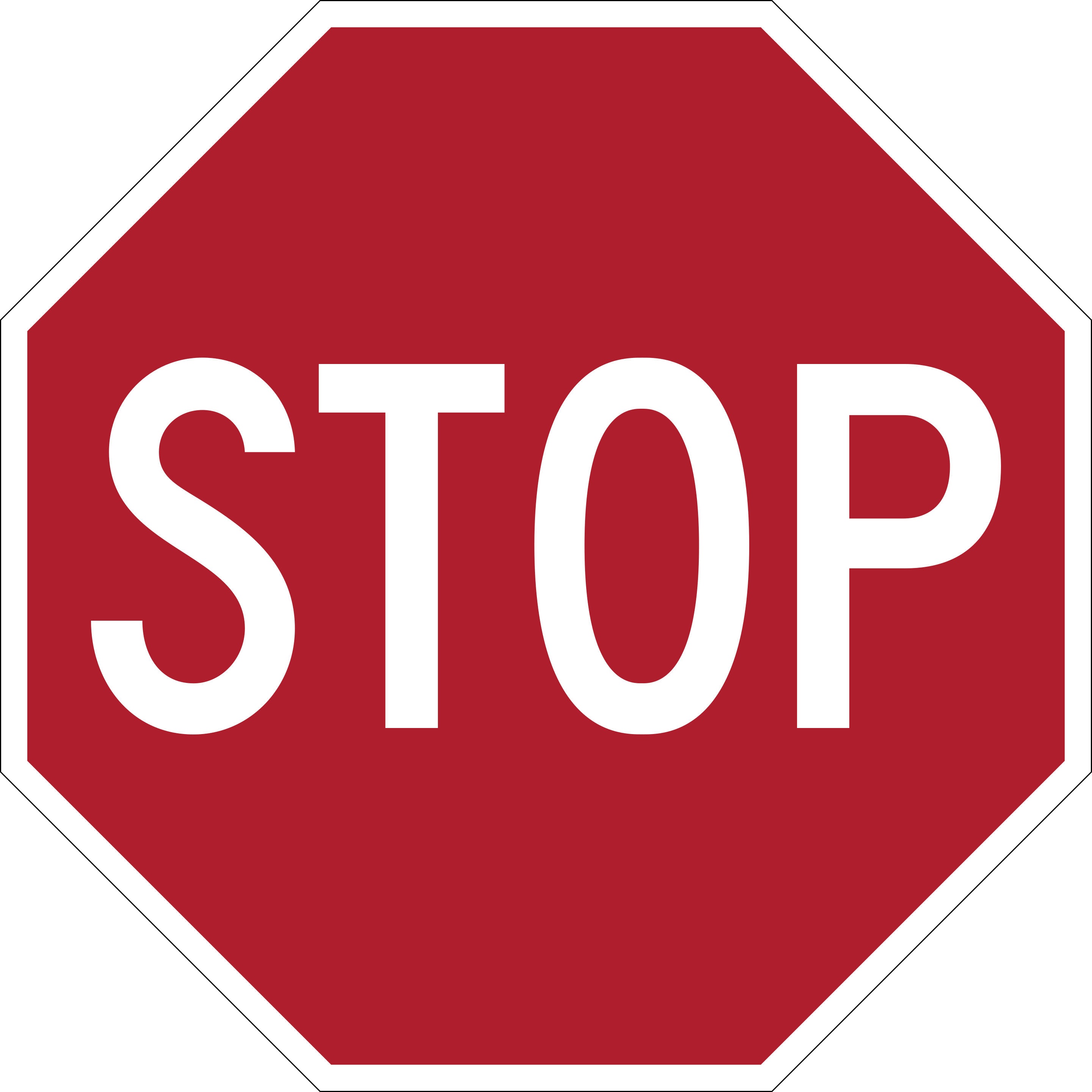
18. Why must a driver recognize a traffic sign even when its words are hard to read?
- Traffic signs are advisory and may always be ignored
- The sign's shape and color still help identify the needed response
- Only the sign's location matters after dark
- Drivers should wait for another vehicle to explain it
Show answer
The sign's shape and color still help identify the needed response. West Virginia explains that sign shape and color remain useful when fading light, fog, rain, snow, or darkness hide the lettering. The handbook gives examples: an eight-sided octagon is reserved for stop signs, and a pennant marks the start of a no-passing zone. Recognizing the shape lets a driver prepare the right response before the words are readable. Traffic signs are not optional, and waiting for another vehicle to explain the sign leaves too little time to react. Reduce speed, read the shape and color, and respond accordingly.
Study this in the handbook: Sign shapes, colors and pavement markings
19. A green left arrow is illuminated at an intersection. What movement does the signal authorize?
- Straight travel only
- Any turn, including a U-turn
- The left turn shown by the arrow
- A left turn only after yielding to every opposing vehicle
Show answer
The left turn shown by the arrow. A green arrow authorizes drivers facing it to enter the intersection and make the movement shown. For a left arrow, that is the protected left turn, and opposing traffic is usually stopped. The choice “A left turn only after yielding to every opposing vehicle” applies the ordinary circular green rule to a protected arrow and therefore adds a condition the arrow normally removes. The signal does not authorize every possible turn or convert the lane into a straight-through lane. Follow any separate sign or pavement marking that restricts the movement.
20. What is the standard validity period for a West Virginia driver's license under the Drive for Five program?
- Five years
- One year
- Four years
- Until age 25
Show answer
Five years. Once a driver is in the regular Drive for Five cycle, the license is valid for five years. The one-year and four-year choices shorten the standard period, while age 25 is an example of an expiration-year target rather than a validity duration. The handbook notes that an initial license may be issued for three to seven years while the DMV phases the driver into the cycle. Review the printed expiration date because the transition period can differ from the later five-year pattern.
Study this in the handbook: License colors, Drive for Five and renewal
QualitySpace is expanding to West Virginia
We are a California-based independent insurance brokerage working on licensing in more states. We cannot help with West Virginia insurance yet. Leave your email and we will let you know when we can.
Every question is written from the official West Virginia Driver's Licensing Handbook. Need paper? Printable WV practice test with answer key.
Last verified 2026-10-05. How we check every question · Study all 209 as flashcards
Frequently asked questions
How many questions are on this West Virginia practice test?
This fixed set has 20 questions. It is test 3 of 10 from the 209 question West Virginia bank. The real WV exam asks 25 questions and you need 19 correct.
What is the passing score for the real West Virginia test?
19 out of the 25 questions correctly to pass (76%) That figure comes from the official West Virginia source cited on the DMV facts page.
How does this fixed test relate to the full West Virginia bank?
Each numbered test is a fixed set of questions in a fixed order, so you can retake the same test later and compare. Every test mixes road signs and the other topics in about the same proportion as the full bank. Tests 1 to 10 together cover 200 of the 209 questions in the West Virginia bank, each once. The full practice page mixes the whole bank at random.
Last verified 2026-10-05. See the West Virginia DMV facts page for sourced state details.
Return to the full West Virginia practice test · Study road signs