
Test 5 of 10 · 20 questions · Free 2026
WV Permit Practice Test 5
Jump to the test ↓A fixed 20 question set from the West Virginia bank with answers and plain English explanations. The real WV exam is 25 questions, 76 percent to pass; take the full length version on the main practice page.
Question 1 of 20 · 0 right so far
All 20 questions in test 5
Every question below comes from the West Virginia question bank on this page. Open a question to see the correct answer and the explanation. Nothing here is hidden behind a signup.
1. Which report is specifically listed as an allowed use of an electronic communications device?
- Composing an email while moving through traffic
- Sending a personal text to arrange dinner
- Watching a video while stopped at a light
- Reporting a fire, traffic crash, serious road hazard, or emergency to authorities
Show answer
Reporting a fire, traffic crash, serious road hazard, or emergency to authorities. The handbook lists reporting a fire, traffic crash, serious road hazard, or emergency to the appropriate authorities as an allowed use. That exception is tied to communicating an urgent public safety event, not to ordinary personal messages or entertainment. A red light does not turn video viewing into emergency reporting, and composing email while moving remains unrelated to the listed purpose. If a report is necessary, focus on the roadway and communicate only the information needed to reach the proper authorities. The emergency purpose is the key boundary.
Study this in the handbook: Crash reports, insurance and phone use
2. What does a ONE WAY sign tell a driver about the cross street?
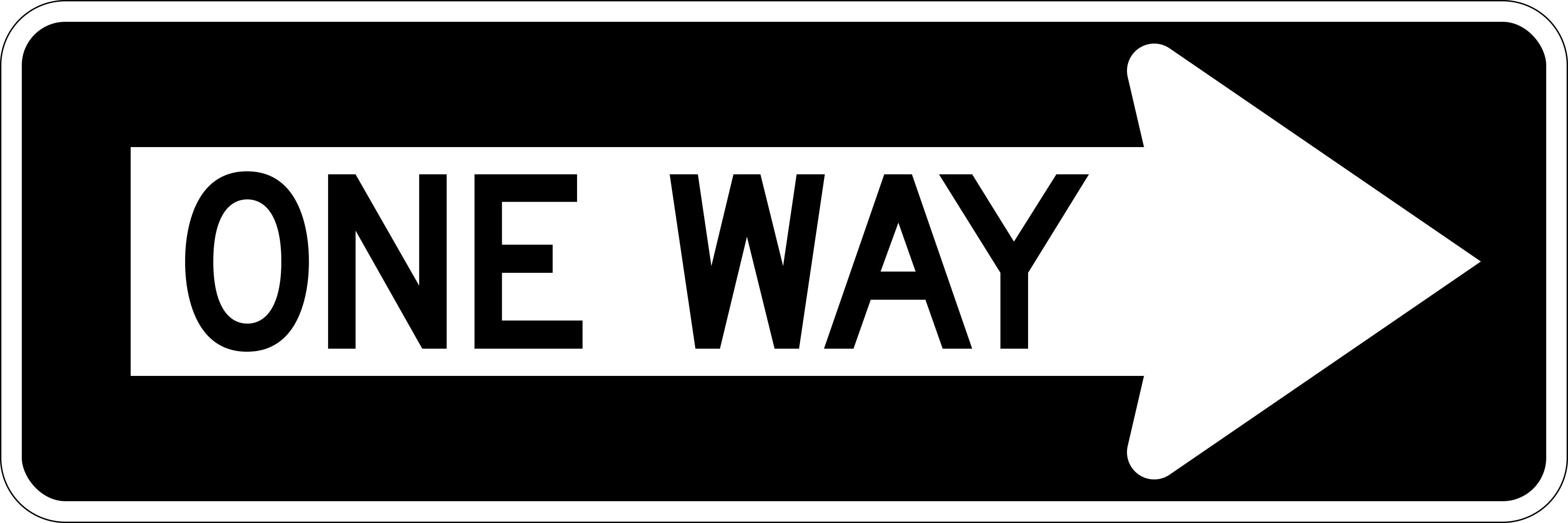
- Vehicles may travel either way until dark
- Traffic must stop in both directions
- The street is reserved for buses
- Traffic runs in one direction only
Show answer
Traffic runs in one direction only. A ONE WAY sign identifies a cross street where traffic is organized to travel in one direction. It does not turn the road into a bus-only facility, remove the need to obey control devices, or permit drivers to choose either direction. Check the arrow and lane arrangement before turning, then enter only if your movement follows the displayed flow safely.
Study this in the handbook: Sign shapes, colors and pavement markings
3. What is the driver being warned about by this signal symbol?
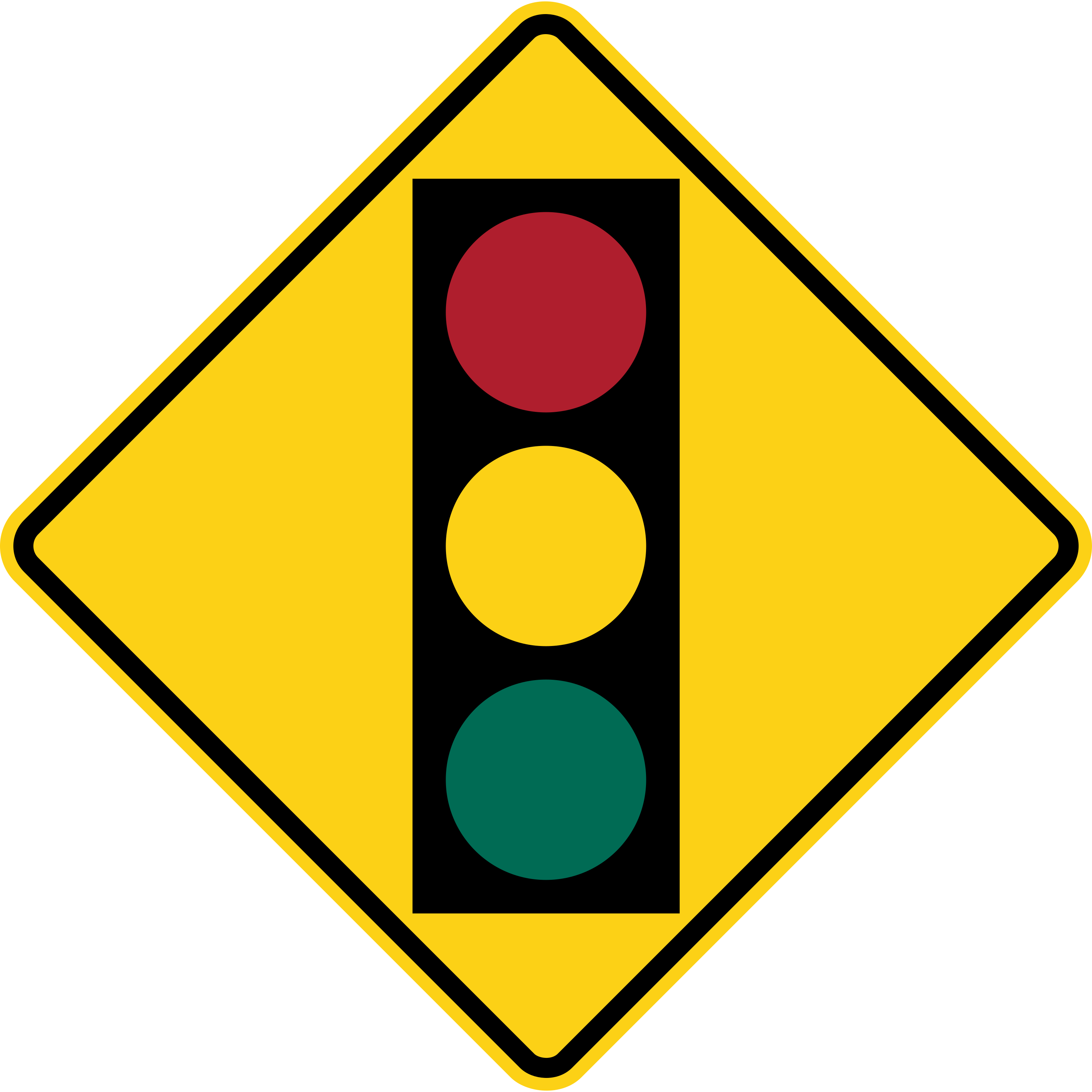
- A traffic signal ahead
- A broken streetlight
- A vehicle inspection station
- A railroad train already blocking the road
Show answer
A traffic signal ahead. The symbol warns that a traffic signal is ahead. It does not report a broken streetlight, announce an inspection station, or prove that a train is already blocking the roadway. Begin checking your speed and traffic position early so you can approach the intersection smoothly. Once the signal comes into view, obey its color and any lane markings or signs that further control the movement.
4. What can happen when a driver fails to comply with a court action and its penalty fees?
- The DMV will suspend the driver's license until compliance is proven and fees are paid
- The DMV will erase the court action from the driving record
- The driver will automatically receive a replacement license
- The penalty applies only if the ticket was a traffic ticket
Show answer
The DMV will suspend the driver's license until compliance is proven and fees are paid. West Virginia suspends the driver's license when the court reports a failure to appear or comply, and the suspension remains until proof of compliance and all penalty fees are provided. The rule covers any type of ticket, court order, or decision, not only traffic tickets. The DMV does not erase the matter or issue a replacement credential automatically. Handle citations promptly, keep proof of payment or compliance, and confirm the record is cleared before assuming the driving privilege is restored.
Study this in the handbook: Points, citations and suspensions
5. What should a driver do after completing a turn?
- Turn on the hazard flashers while moving
- Leave the signal on for the next mile
- Switch off the turn signal
- Sound the horn twice
Show answer
Switch off the turn signal. The handbook directs drivers to switch off a turn signal after completing the maneuver. Leaving it on can mislead other road users into expecting another turn or lane change. Hazard flashers and the horn serve different purposes and do not cancel an active direction indicator. As soon as the vehicle is straight and the turn is finished, check the dashboard indicator and cancel it. This small follow-through keeps the signal from sending a false message at the next driveway, intersection, or lane change.
Study this in the handbook: Turn signals and full stops
6. What should you do after moving right for an emergency vehicle?
- Keep your foot on the brake while stopped
- Release the brake and wave the vehicle around you
- Turn on high beams and follow it through traffic
- Move back into the lane before it has passed
Show answer
Keep your foot on the brake while stopped. Keeping your foot on the brake communicates that you are stopped, which helps the emergency driver read your position quickly. The handbook also says to remain stopped until the emergency vehicle has passed and to watch for other emergency vehicles. Waving, following, or moving back early creates uncertainty and can place your vehicle in the path of a second responder. Once the roadway is clear, check all directions and reenter only when doing so will not interfere with the response.
Study this in the handbook: Right of way and pedestrians
7. Unless conditions are bad or a lower limit is posted, how slowly may a driver travel on an interstate?
- The driver must stay below 45 mph
- The driver should not drive slower than 55 mph
- The driver may choose any speed without regard to traffic
- The driver must always travel exactly 70 mph
Show answer
The driver should not drive slower than 55 mph. The handbook says an interstate driver should not travel below 55 mph unless weather or road conditions are bad or a lower speed is posted. That is a minimum-speed guidance rule under the stated conditions, not a command to drive exactly 70 mph. The 45 mph choice changes the figure, and the unrestricted choice ignores the hazard created by being much slower than surrounding traffic. Adjust for conditions, remain legal, and use the right-hand lane unless passing.
Study this in the handbook: Entering, exiting and driving on interstates
8. What is the safest response if a vehicle fire gets out of control?
- Remain beside the vehicle to direct traffic
- Move at least 100 feet away from the vehicle
- Open the fuel door to release pressure
- Stand nearby and throw water toward the gas tank
Show answer
Move at least 100 feet away from the vehicle. An uncontrolled vehicle fire can become an explosion hazard, so the handbook directs people to move at least 100 feet away. Remaining beside the car exposes you to flames, smoke, and flying debris while offering no reliable protection. Opening a fuel door is not an emergency remedy and can add danger. Water is also a poor response to burning gasoline because fuel can float and spread the fire. Get everyone away, keep others clear, and let trained responders handle the vehicle once you have reached a safe distance.
Study this in the handbook: Blowouts, fires and other vehicle emergencies
9. How far along a street or highway does a West Virginia school zone extend from school grounds?
- 100 feet
- 50 feet
- 125 feet
- 250 feet
Show answer
125 feet. The handbook defines the school zone as school property plus an abutting street or highway extending 125 feet from the school grounds. The 100-foot choice is a plausible distance, but it is not the measurement used in this definition. Treat the zone as more than the immediate driveway or entrance area. When approaching school property, look for children, buses, crossing activity, and signs before deciding how quickly to travel. The distance describes the legal zone, while the posted school-zone speed and present conditions govern the safe speed.
Study this in the handbook: Basic speed law and school zones
10. What does West Virginia's zero tolerance rule mean for a driver under 21?
- Only a BAC of 0.08 percent or more matters
- Any measurable alcohol can cause the driver to lose the license
- The rule applies only when a crash occurs
- A driver under 21 may drink if accompanied by an adult
Show answer
Any measurable alcohol can cause the driver to lose the license. West Virginia's under-21 rule is stricter than the adult presumption discussed elsewhere in the handbook. If any measurable alcohol is found in the system of a driver under 21, the driver can lose the license. The 0.08 choice overlooks the zero tolerance standard, and adult supervision does not create an exception. The rule also does not wait for a collision. The safest operational cue is simple: an under-21 driver should have no measurable alcohol before driving, regardless of how the driver feels or how little was consumed.
Study this in the handbook: Alcohol, BAC limits and zero tolerance
11. When should a driver increase the following gap to at least six seconds?
- Only when the road is dry
- Whenever driving below 25 mph
- Only when following a motorcycle
- When there is ice or snow
Show answer
When there is ice or snow. The handbook gives the six second following distance for ice or snow. Poor traction increases the distance needed to slow and stop, so a normal three to four second cushion is not enough. Driving below a particular speed does not automatically trigger the six second rule, and following a motorcycle is not the stated condition. Dry pavement generally offers better traction rather than requiring the longest gap. Choose a fixed object, count after the vehicle ahead passes it, and add space whenever winter conditions make braking less predictable.
Study this in the handbook: U-turns, backing, parking and following distance
12. What is the recommended response to a tire blowout?
- Accelerate until the tire begins rolling smoothly again
- Brake hard and turn sharply toward the shoulder
- Hold the wheel firmly, steer straight, and ease off the accelerator
- Release the steering wheel so the vehicle can find its path
Show answer
Hold the wheel firmly, steer straight, and ease off the accelerator. A blowout can throw a vehicle out of control, so the handbook advises holding the steering wheel tightly, steering straight ahead, and easing up on the accelerator. Do not brake until the vehicle is under control; then pull completely off the road into a safe area. Hard braking or a sharp turn can worsen the loss of control, while acceleration adds energy to an unstable vehicle. Keep the vehicle pointed straight, regain control gradually, and use emergency flashers if reaching the shoulder immediately is impossible.
Study this in the handbook: Blowouts, fires and other vehicle emergencies
13. What effect can fatigue have on a driver's ability to operate a vehicle?
- It improves concentration after several hours of driving
- It dulls the mind and slows reaction time
- It affects only passengers, not the person driving
- It can be corrected reliably by opening a window
Show answer
It dulls the mind and slows reaction time. The handbook identifies lack of sleep and driving too long as causes of fatigue, and explains that being tired dulls the mind and slows reaction time. A driver who notices fatigue should pull off and rest when alone, or change drivers when another licensed driver is available. Opening a window, turning on the radio, or singing may reduce monotony, but those actions are not reliable substitutes for rest. Long trips call for a ten-minute break outside the vehicle at least every two hours.
Study this in the handbook: Drowsy driving, fatigue and emotions
14. What does an upside-down triangular traffic sign require a driver to do?
- Yield the right-of-way to crossing or merging traffic
- Stop at the sign even when the roadway is empty
- Begin a no-passing zone immediately
- Follow a railroad crossing signal ahead
Show answer
Yield the right-of-way to crossing or merging traffic. The upside-down triangle is the yield shape. The handbook says it requires you to yield the right-of-way to cross traffic or to merging traffic, and its right-of-way section tells drivers at a yield sign to slow down before reaching the intersection. It is not the octagonal stop sign, so a complete stop is not automatic when no conflict exists. A pennant marks a no-passing zone, and a circular railroad sign warns about a crossing. Approach slowly enough to see the conflict area, then yield before entering another road user's path.
Study this in the handbook: Sign shapes, colors and pavement markings
15. What does a flashing yellow signal allow a driver to do at an intersection?
- Treat the signal as permission to speed through the intersection
- Proceed only after stopping and yielding like a red flasher
- Proceed through the intersection with caution
- Remain stopped until a police officer gives permission
Show answer
Proceed through the intersection with caution. A circular flashing yellow signal permits a driver to proceed through the intersection with caution. That does not mean the driver may accelerate carelessly or ignore cross traffic, pedestrians, or the roadway layout. A circular flashing red signal has the stop-sign treatment, so the choice “Proceed only after stopping and yielding like a red flasher” confuses two different signals. No officer is required for every flashing yellow light. Reduce speed enough to inspect the intersection, yield when another road user has priority, and continue only when the path is safe.
16. What do diamond shaped warning signs generally tell drivers?

- A requirement to yield to crossing or merging traffic
- The exact legal speed that must be maintained
- The route number of the highway being traveled
- A possible danger or changed condition ahead
Show answer
A possible danger or changed condition ahead. Diamond shaped signs are warning signs. The handbook says they are yellow with black letters and warn of possible danger ahead, sometimes using a symbol or written warning. A speed limit is a regulatory message, while a route number identifies a highway rather than a hazard. The yield choice names one possible instruction on a particular sign, not the general meaning of the diamond shape. Use the warning as a cue to scan ahead, adjust speed, and prepare for a changed road condition.
17. On West Virginia's point scale, how many points are assessed for 3 or more wireless communication device violations (any combination of talking and texting)?
- No points
- Three points
- Six points
- Eight points
Show answer
Three points. The point scale lists 3 or more wireless communication device violations, in any combination of talking and texting, at 3 points. No points is wrong because this row carries points. Six points is the value for school zone speeding and other serious offenses, and 8 points is for fleeing from an officer. Handheld use while driving is illegal for every driver in West Virginia unless the device is hands free.
18. How many points does West Virginia assess for following too closely?
- Three points
- Five points
- Two points
- Six points
Show answer
Two points. Following too closely is a 2 point violation on the West Virginia scale, along with improper turning, improper backing, improper signaling, and more than 3 passengers in the front seat. Three points applies to offenses such as driving too fast for conditions and failure to yield. Five points is speeding 15 to 19 mph over, and 6 points covers serious offenses such as reckless driving.
19. A 16 year old moves to West Virginia from a state without a graduated license program. How can time already spent licensed count toward the Level 1 period?
- By bringing a current driving record from the previous state
- It counts automatically with no paperwork
- It never counts; the teen starts from zero
- By having a parent sign an affidavit of driving hours
Show answer
By bringing a current driving record from the previous state. An applicant under 18 whose old license does not match West Virginia's Level 2 must take the knowledge and road skills tests as a new driver. If the applicant brings a current driving record from the previous state, the time the old license was held is credited toward the Level 1 permit period. The credit is not automatic, since the record must be provided. A parent affidavit is not the document the handbook names. After licensing, the old record becomes part of the West Virginia record.
Study this in the handbook: Graduated Driver's License levels
20. What should a driver do when approaching an intersection marked with a yield sign?
- Yield only to vehicles already stopped
- Stop for exactly five seconds before continuing
- Accelerate so other traffic must yield
- Slow down and yield to vehicles in the intersection and approaching traffic
Show answer
Slow down and yield to vehicles in the intersection and approaching traffic. A yield sign calls for a controlled approach, not a fixed wait or a race into the intersection. The handbook says to slow down and yield the right-of-way to vehicles in the intersection and to approaching traffic. The five-second choice invents a timing requirement, while accelerating defeats the sign's purpose. Yielding only to stopped vehicles would ignore moving traffic that is close enough to create a conflict. Reduce speed early, scan for gaps, and proceed once the path is safe.
Study this in the handbook: Right of way and pedestrians
QualitySpace is expanding to West Virginia
We are a California-based independent insurance brokerage working on licensing in more states. We cannot help with West Virginia insurance yet. Leave your email and we will let you know when we can.
Every question is written from the official West Virginia Driver's Licensing Handbook. Need paper? Printable WV practice test with answer key.
Last verified 2026-10-05. How we check every question · Study all 209 as flashcards
Frequently asked questions
How many questions are on this West Virginia practice test?
This fixed set has 20 questions. It is test 5 of 10 from the 209 question West Virginia bank. The real WV exam asks 25 questions and you need 19 correct.
What is the passing score for the real West Virginia test?
19 out of the 25 questions correctly to pass (76%) That figure comes from the official West Virginia source cited on the DMV facts page.
How does this fixed test relate to the full West Virginia bank?
Each numbered test is a fixed set of questions in a fixed order, so you can retake the same test later and compare. Every test mixes road signs and the other topics in about the same proportion as the full bank. Tests 1 to 10 together cover 200 of the 209 questions in the West Virginia bank, each once. The full practice page mixes the whole bank at random.
Last verified 2026-10-05. See the West Virginia DMV facts page for sourced state details.
Return to the full West Virginia practice test · Study road signs