
Test 4 of 10 · 20 questions · Free 2026
WV Permit Practice Test 4
Jump to the test ↓A fixed 20 question set from the West Virginia bank with answers and plain English explanations. The real WV exam is 25 questions, 76 percent to pass; take the full length version on the main practice page.
Question 1 of 20 · 0 right so far
All 20 questions in test 4
Every question below comes from the West Virginia question bank on this page. Open a question to see the correct answer and the explanation. Nothing here is hidden behind a signup.
1. What minimum following interval does the handbook advise in darkness or rain?
- At least six seconds in every condition
- Exactly two seconds
- At least four seconds
- No additional interval is needed if headlights are on
Show answer
At least four seconds. Reduced visibility and changing road grip call for more space than the ordinary three-to-four second rule. The handbook specifies at least four seconds when it is dark or raining. Six seconds is the special minimum given for ice or snow, so applying it to every condition overstates this particular rule. Headlights help you see and be seen but cannot shorten braking distance. Use a roadside object to count the interval and enlarge it further whenever traffic, weather, or your vehicle's condition demands.
Study this in the handbook: U-turns, backing, parking and following distance
2. What information do square and rectangular traffic signs generally provide?
- A guarantee that the lane ahead is free of hazards
- A warning that a train is approaching the crossing
- Traffic regulations and guidance about speed or direction
- A marker showing only the name of a nearby town
Show answer
Traffic regulations and guidance about speed or direction. Square and rectangular signs are used to show traffic regulations and guide a driver's speed and direction. They can communicate speed limits, lane directions, or other road rules. The circular or crossbuck railroad signs serve a different purpose, while a guide sign can identify a place without defining all traffic requirements. No sign shape guarantees that a roadway is hazard-free. Read the words and symbols, then combine the instruction with the actual traffic and road conditions around the vehicle.
Study this in the handbook: Sign shapes, colors and pavement markings
3. Which method does the handbook recommend for checking a normal following distance?
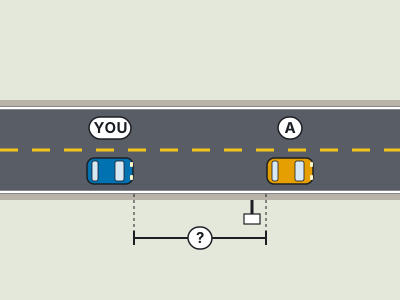
- Use a fixed object and count three to four seconds
- Keep one car length for every trip
- Match the lead vehicle's bumper distance exactly
- Wait until the lead vehicle brakes before judging space
Show answer
Use a fixed object and count three to four seconds. The handbook's practical test uses a fixed object such as a signpost, tree, overpass, or bridge abutment. Begin counting when the vehicle ahead passes it, then compare your arrival with the three-to-four second count. Reaching the object too early means the gap is too small. A car-length formula ignores speed, and matching another bumper does not measure reaction time. Braking first is an unsafe experiment. The concrete cue is to choose the object before the lead vehicle reaches it.
Study this in the handbook: U-turns, backing, parking and following distance
4. When may a driver turn right on a red signal in West Virginia?
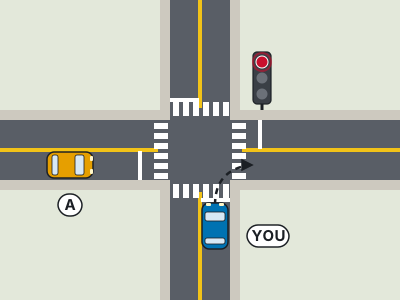
- Before stopping if the intersection appears empty
- After a complete stop, yielding to traffic and pedestrians, when no sign prohibits it
- Whenever the driver signals, even if a sign prohibits the turn
- Only after waiting for the light to turn green
Show answer
After a complete stop, yielding to traffic and pedestrians, when no sign prohibits it. A right turn on red is allowed only after a complete stop and after yielding to all other traffic and pedestrians. It is also allowed only when no posted sign prohibits the turn. An empty looking intersection does not remove the stopping duty, and a turn signal cannot override a posted restriction. Waiting for green is safer than moving illegally but is more restrictive than the handbook rule. Stop at the proper line or crosswalk, scan every direction, and move only when the path and sign control permit it.
5. What can happen when a driver refuses the designated Breathalyzer after a DUI arrest?
- The refusal changes the test result to zero
- Only the vehicle registration is affected
- The driver receives a warning but keeps the privilege automatically
- The privilege to operate a motor vehicle can be revoked from one year up to life
Show answer
The privilege to operate a motor vehicle can be revoked from one year up to life. West Virginia's implied consent rule treats a DUI-arrested driver as having consented to the designated Breathalyzer. Refusing it can lead to revocation of the privilege to operate a motor vehicle for one year and potentially up to life. The warning choice understates the consequence, while vehicle registration is not the sanction described here. Refusal also cannot turn an unknown alcohol concentration into a zero reading. The practical cue is that declining the chemical test creates its own licensing consequence apart from any later DUI prosecution.
Study this in the handbook: Implied consent, DUI penalties and interlock
6. What does the handbook call the space ahead of a vehicle that is easiest to control?
- The stopping line
- The blind spot
- The acceleration lane
- The following distance space cushion
Show answer
The following distance space cushion. The handbook calls the space ahead of the vehicle the space easiest to control and names the protective cushion around it the following distance. Maintaining that cushion gives the driver room to stop when traffic or road conditions change. A blind spot is an area the driver cannot see well, an acceleration lane is used to enter an interstate, and a stopping line marks a control point. Use a fixed roadside object to judge the gap, then enlarge it when darkness, rain, ice, or snow lengthens stopping time.
Study this in the handbook: U-turns, backing, parking and following distance
7. What does a driver do at a yield sign when other traffic is present?
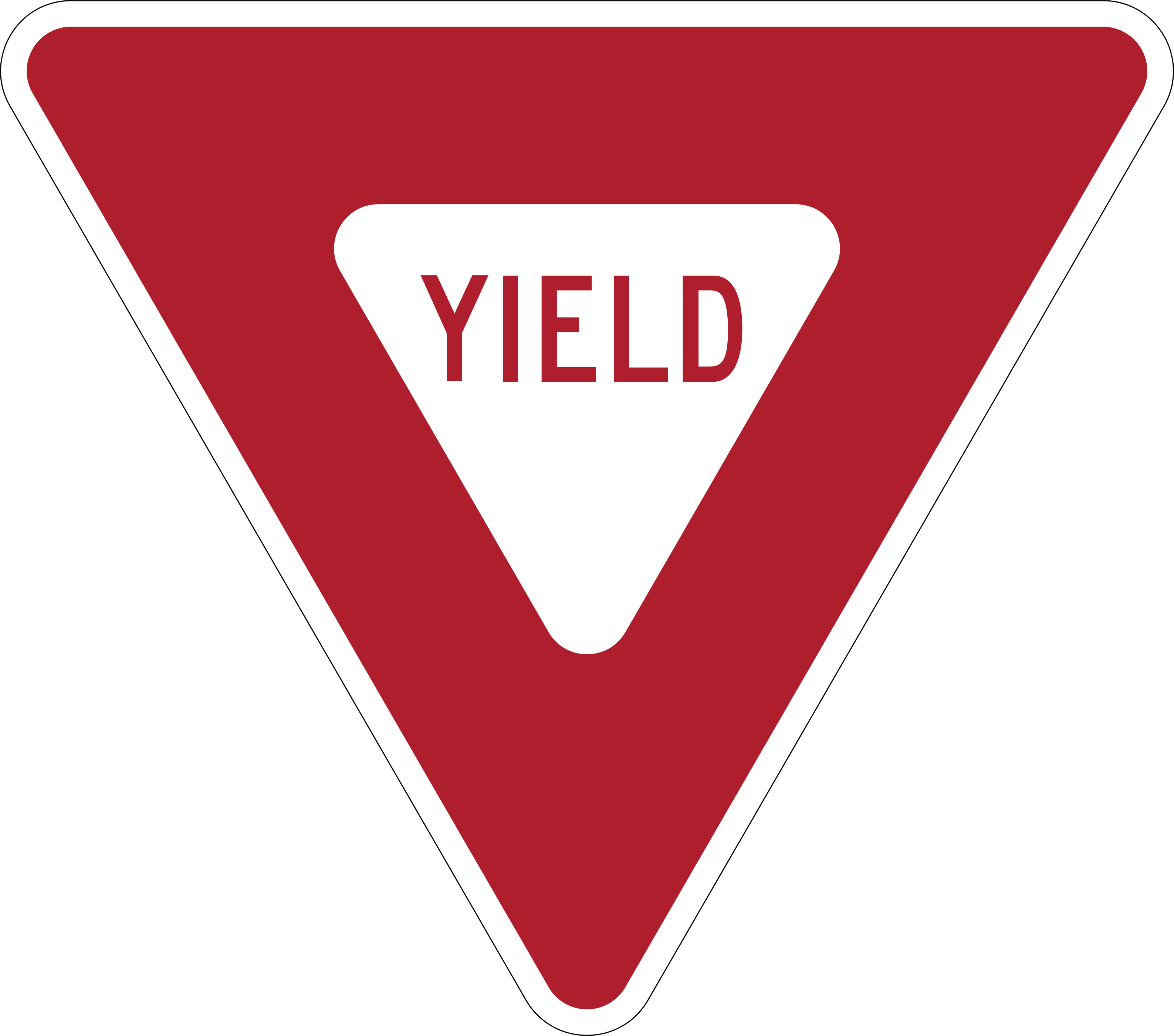
- Speed up to claim the intersection
- Stop in every case even when the road is empty
- Slow down and yield the right-of-way to cross or merging traffic
- Proceed without checking for pedestrians
Show answer
Slow down and yield the right-of-way to cross or merging traffic. The handbook says the upside down triangle requires you to yield the right-of-way to cross traffic or to merging traffic, and its right-of-way section tells drivers at a yield sign to slow down before reaching the intersection. It is not an invitation to accelerate into the gap, and it does not demand a stop when no traffic is there to yield to. Ignoring pedestrians leaves out the most vulnerable road users. Approach with the foot ready for the brake, scan both directions, and enter only after the conflicting movement has cleared.
Study this in the handbook: Sign shapes, colors and pavement markings
8. How should a driver respond to a pedestrian-crossing warning?

- Stop only if a railroad gate is nearby
- Accelerate so pedestrians cross behind the vehicle
- Honk and continue without checking
- Watch for and yield to people walking across the road
Show answer
Watch for and yield to people walking across the road. A pedestrian warning identifies a crossing or path where people may enter the roadway. Watch carefully and yield to people walking across it. Accelerating reduces the time available for everyone, and a horn does not replace yielding. A nearby railroad gate is irrelevant to the pedestrian rule. Ease off the accelerator, scan both sides, and stop when needed to let a pedestrian cross safely.
9. You are behind a large truck that is turning in West Virginia. On which side does the handbook say you must never pass it?
- Either side is fine if you signal
- Never on the left
- Never on the right during a turn
- Only on the shoulder
Show answer
Never on the right during a turn. The handbook lists passing a truck on the right during a turn among its safety don'ts, alongside never cutting off a truck in traffic to reach your exit or turn. It explains that trucks are longer, heavier, more difficult to maneuver, and require much more room to turn, and that they have larger blind spots than cars. A space that opens beside a turning truck is therefore not an invitation to squeeze through. Signaling does not make passing on the right safe, and the shoulder is not a passing lane. Wait behind the truck until the turn is finished.
Study this in the handbook: School buses, bicycles, motorcycles and trucks
10. What does a curved-arrow warning tell you about the road ahead?

- A curve or sharp turn is ahead
- The road is ending at a railroad
- A mandatory U-turn begins
- A lane is reserved for buses
Show answer
A curve or sharp turn is ahead. A curved-arrow warning indicates that the road ahead bends, possibly sharply enough to require an advisory speed. It does not mark a railroad ending, begin a mandatory U-turn, or create a bus lane. Reduce speed before entering the bend, keep the vehicle in its lane, and follow any advisory plaque beneath the warning. Smooth control is safer than hard braking mid-curve.
11. A West Virginia minor's school reports excessive unexcused absences to the DMV. What happens to the minor's license?
- Nothing, because school attendance is not a DMV matter
- It is revoked until age 21
- Only a written warning is sent to the parents
- It is restricted to work, medical, educational, and religious driving until 18
Show answer
It is restricted to work, medical, educational, and religious driving until 18. West Virginia ties a minor's license to school attendance. When the school reports nonattendance or excessive unexcused absences, the DMV restricts the license to work, medical, educational, and religious purposes until age 18, or until the student presents a reinstatement form from the school and pays the reinstatement fee. The DMV does act on these reports, so doing nothing is wrong. The restriction lasts until 18, not 21, and it is more than a warning.
Study this in the handbook: Crash reports, insurance and phone use
12. How many non-family passengers under 20 may a Level 2 holder carry during the first six months?
- One
- None
- Two
- As many as fit with seat belts
Show answer
None. During the first six months, a Level 2 holder may not carry any non-family member under age 20. One such passenger becomes the maximum during the second six-month period, which explains why the option “One” can look plausible but belongs to a later stage. Two passengers and an unrestricted seat-belt condition conflict with the graduated restriction. When planning a ride, classify each young passenger by family relationship and age before starting the vehicle. The restriction concerns non-family passengers, so it should not be paraphrased as a blanket ban on every passenger.
Study this in the handbook: Graduated Driver's License levels
13. Under West Virginia's basic speed law, what must a driver do when road conditions reduce visibility or stopping distance?
- Reduce speed to match the conditions
- Maintain the posted limit regardless of conditions
- Accelerate briefly to clear the hazard
- Use the shoulder instead of slowing
Show answer
Reduce speed to match the conditions. West Virginia expects drivers to adjust speed when weather, traffic, or the roadway makes seeing or stopping harder. A posted number is not permission to travel too fast for the circumstances. The choice to maintain the limit regardless of conditions ignores the separate basic speed rule. A practical cue is to ease off the accelerator before entering rain, fog, a narrow road, or a crowded intersection, leaving enough distance to stop smoothly. The handbook frames speed as a safety decision that depends on the situation, not merely a number on a sign.
Study this in the handbook: Basic speed law and school zones
14. Under West Virginia Code 17C-4-6, when must the driver give notice of a crash that causes injury, death, or apparent property damage of $1,000 or more?
- Within 24 hours by mail
- Within 10 days
- Within 30 days
- Immediately, by the quickest means of communication
Show answer
Immediately, by the quickest means of communication. This question is about the driver's immediate notice duty in West Virginia Code 17C-4-6: give notice immediately, by the quickest means of communication, to the local police inside a municipality, or otherwise to the county sheriff or the nearest State Police office. The written crash report is a separate duty that 17C-4-7 places on the investigating officer, who files it within 24 hours of finishing the investigation. The printed handbook says such crashes must be reported within five days, but the statute governing the driver's notice says immediately. Mailing a letter or waiting days does not meet this duty.
15. What fine range does West Virginia law set for littering 100 pounds or less on a roadway?
- Not less than $100 nor more than $2,500
- Up to $5,000
- No fine, only community service
- Exactly $25
Show answer
Not less than $100 nor more than $2,500. Under West Virginia Code 22-15A-4, dumping or throwing litter of 100 pounds or less is a misdemeanor punishable by a fine of $100 to $2,500, community service picking up litter for 8 to 100 hours, or both. Littering into state waters carries a higher range. The handbook point scale also assigns three points for littering. Older handbook figures of $50 to $1,000 no longer match the statute. Keep trash in the vehicle until you reach a proper receptacle.
16. What is the handbook's guiding principle when another driver fails to yield as required?
- Give the right-of-way to avoid a collision
- Force the other driver to stop because the rule is on your side
- Use the horn until the other driver reverses
- Proceed first whenever you entered the road legally
Show answer
Give the right-of-way to avoid a collision. West Virginia presents right-of-way as a safety responsibility, not a prize to seize. The handbook says there are rules to help determine the right-of-way, but if the other driver does not follow them, you give the right-of-way, and it adds that right-of-way is something to be given, not taken. Forcing the issue can turn a legal priority into a crash. A horn may warn but cannot replace a safe decision, and entering legally does not guarantee that every other driver will notice you. Reduce speed, create space, and let the conflict pass before resuming your route.
Study this in the handbook: Right of way and pedestrians
17. What should a driver do when approaching a highway construction zone with a flagger?
- Ignore the flagger if the lane ahead appears clear
- Obey the flagger's directions and the posted traffic controls
- Follow the vehicle ahead without watching the work-zone signs
- Keep the posted speed even when the flagger signals a stop
Show answer
Obey the flagger's directions and the posted traffic controls. Flaggers are placed in work zones to stop, slow, or guide traffic safely through the area, and the handbook tells drivers to pay attention at all times and observe both the posted signs and the directions of flagmen in and around construction zones. Their directions work together with signs, barricades, and other controls, so a driver should watch the person giving the signal and respond promptly. A clear-looking lane does not cancel a flagger's instruction, and following another vehicle blindly is also unsafe. Reduce speed early, keep attention on the work area, and proceed only when the direction permits it.
Study this in the handbook: Entering, exiting and driving on interstates
18. A work zone sign says a lane is closed ahead. When does the West Virginia handbook say to move to the open lane?
- At the last moment to keep traffic moving
- As soon as possible, not at the last minute
- Only when a flagger directs you
- After passing the first barrel
Show answer
As soon as possible, not at the last minute. If a lane is closed, signs are posted well in advance, and the handbook says to move over to the open lane as soon as possible and avoid waiting until the last minute to change lanes. Late merging forces sudden lane changes at the taper. In work zones, observe and obey special speed limits, traffic control signs and flaggers, and be ready to stop. A flagger's direction must be followed, but you should not wait for one to merge.
Study this in the handbook: Entering, exiting and driving on interstates
19. What is the first steering response recommended when a vehicle begins to skid?
- Turn the wheel opposite the direction of the skid and accelerate
- Press the brake pedal as hard as possible
- Take your foot off the gas pedal
- Release the steering wheel so the vehicle chooses its path
Show answer
Take your foot off the gas pedal. A skid requires calm control rather than a sudden braking maneuver. Removing your foot from the accelerator reduces the force that is driving the tires while you concentrate on steering. The handbook says not to use the brakes unless you are in danger of hitting something. Hard braking can worsen the loss of traction, and releasing the wheel gives up the control needed to straighten the vehicle. After easing off, steer in the direction of the skid, then guide the wheels toward the path you want.
Study this in the handbook: Blowouts, fires and other vehicle emergencies
20. What does West Virginia's Drive for Five program make easier for a license holder to remember?
- The date of the next road skills test
- The expiration date of the driver's license or identification card
- The date of the vehicle's annual inspection
- The date of the driver's first traffic citation
Show answer
The expiration date of the driver's license or identification card. Drive for Five is presented as a way to make the license expiration date easier to remember. The handbook connects expiration years with ages divisible by five, such as 25, 30, 35, and 40. It does not describe the program as a road-test calendar, an inspection reminder, or a record of citations. Check the renewal card for the actual date and fee because an initial license may be phased into the cycle for a different number of years. The program helps with the date, while the card remains the authority.
Study this in the handbook: License colors, Drive for Five and renewal
QualitySpace is expanding to West Virginia
We are a California-based independent insurance brokerage working on licensing in more states. We cannot help with West Virginia insurance yet. Leave your email and we will let you know when we can.
Every question is written from the official West Virginia Driver's Licensing Handbook. Need paper? Printable WV practice test with answer key.
Last verified 2026-10-05. How we check every question · Study all 209 as flashcards
Frequently asked questions
How many questions are on this West Virginia practice test?
This fixed set has 20 questions. It is test 4 of 10 from the 209 question West Virginia bank. The real WV exam asks 25 questions and you need 19 correct.
What is the passing score for the real West Virginia test?
19 out of the 25 questions correctly to pass (76%) That figure comes from the official West Virginia source cited on the DMV facts page.
How does this fixed test relate to the full West Virginia bank?
Each numbered test is a fixed set of questions in a fixed order, so you can retake the same test later and compare. Every test mixes road signs and the other topics in about the same proportion as the full bank. Tests 1 to 10 together cover 200 of the 209 questions in the West Virginia bank, each once. The full practice page mixes the whole bank at random.
Last verified 2026-10-05. See the West Virginia DMV facts page for sourced state details.
Return to the full West Virginia practice test · Study road signs