
Test 2 of 10 · 20 questions · Free 2026
WV Permit Practice Test 2
Jump to the test ↓A fixed 20 question set from the West Virginia bank with answers and plain English explanations. The real WV exam is 25 questions, 76 percent to pass; take the full length version on the main practice page.
Question 1 of 20 · 0 right so far

All 20 questions in test 2
Every question below comes from the West Virginia question bank on this page. Open a question to see the correct answer and the explanation. Nothing here is hidden behind a signup.
1. What should a driver do when approaching a stop sign?
- Stop completely, then yield to pedestrians and cross traffic
- Slow down and roll through if no one is visible
- Stop only after entering the intersection
- Stop only when another vehicle is waiting
Show answer
Stop completely, then yield to pedestrians and cross traffic. An eight-sided stop sign means you must stop completely and give the right-of-way to pedestrians and to all cross traffic before moving again. The handbook adds that you stop behind any marked or unmarked crosswalk, or before entering the intersection when there are no pavement markings, at a place where you can see traffic coming from all directions. Rolling through an empty intersection is still a violation, and waiting until the vehicle is already in the intersection places the stop too late. The rule does not depend on another car being present.
Study this in the handbook: Sign shapes, colors and pavement markings
2. A West Virginia teen surrenders a Level 1 GDL instruction permit and later reapplies. How long must the new Level 1 permit be held?
- 30 days, with no conviction requirement
- 180 consecutive days without a conviction
- 90 consecutive days without a conviction
- Until the 18th birthday, with no minimum
Show answer
180 consecutive days without a conviction. The Level 1 permit cannot be renewed, and a teen who surrenders it for any reason must retest and then hold the Level 1 permit for 180 consecutive days with no convictions. Thirty days has no basis here and would drop the conviction free condition. Ninety days is half of the required period. The permit does expire on the 18th birthday, but that is its outer limit, not a replacement for the 180 day minimum.
Study this in the handbook: Graduated Driver's License levels
3. A West Virginia driver is convicted of speeding 15 to 19 mph over the limit. How many points are assessed?
- Three points
- Five points
- Six points
- Two points
Show answer
Five points. Speeding 15 to 19 mph over the limit carries 5 points on the West Virginia scale. Three points applies to speeding 11 to 14 mph over, and 6 points starts at 20 mph or more over, so the exact amount over the limit matters. Two points belongs to lesser violations such as following too closely or improper signaling. Those points stay on the record for two years from the conviction date.
4. What nighttime supervision rule applies to a Level 2 GDL intermediate license holder?
- Supervision is required only from midnight to 5:00 a.m.
- No supervision is ever required after 10:00 p.m.
- A passenger under 18 may supervise during those hours
- A licensed adult age 21 or older must supervise driving from 10:00 p.m. to 5:00 a.m., subject to listed exceptions
Show answer
A licensed adult age 21 or older must supervise driving from 10:00 p.m. to 5:00 a.m., subject to listed exceptions. Level 2 permits unsupervised driving from 5:00 a.m. until 10:00 p.m., but nighttime driving from 10:00 p.m. to 5:00 a.m. generally requires a licensed adult supervisor age 21 or older. The handbook lists exceptions for lawful employment, school-sanctioned activity, religious activity, or an emergency involving prevention of injury or death. The other choices either remove supervision, lower the supervisor's age, or shorten the period. Check the reason for the trip before relying on an exception.
Study this in the handbook: Graduated Driver's License levels
5. When entering a public road from a private driveway, which traffic must you yield to?
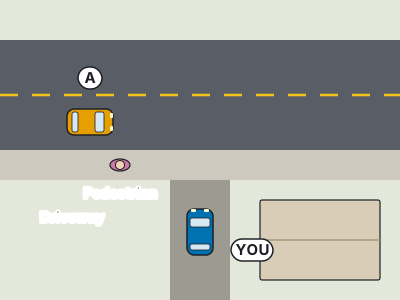
- Only vehicles approaching from the left
- Traffic already on the roadway
- Only vehicles traveling faster than you
- No traffic if you signal first
Show answer
Traffic already on the roadway. A driver leaving a driveway is joining traffic that already has a place on the public roadway. The handbook requires yielding to that existing traffic, rather than making other road users brake or swerve. Limiting the duty to vehicles from one direction or to vehicles moving quickly narrows the rule incorrectly. A turn signal communicates an intention but does not grant priority. Stop where you can see, check both directions and pedestrians, then enter only after the roadway is clear enough for a safe merge.
Study this in the handbook: Right of way and pedestrians
6. Under West Virginia State Code section 17C-15-2, when must headlights be turned on?
- Only on interstates
- Only between sunset and sunrise
- During adverse conditions
- Only when the speed limit is above 55 mph
Show answer
During adverse conditions. West Virginia ties headlight use to conditions, not just the clock. The handbook cites section 17C-15-2 of the State Code as requiring headlights during adverse conditions, and it adds that drivers in those conditions should keep an adequate following distance and a speed that allows a safe stop. Its headlight guidance also says to turn them on whenever it begins to get dark or visibility may be impaired, giving fog, smoke and extreme cloudiness as examples. Neither the road type nor the posted speed limit decides when the lights go on.
Study this in the handbook: Entering, exiting and driving on interstates
7. At what distance should headlights be dimmed when following another vehicle at night?
- Within 200 feet of the vehicle ahead
- Within 50 feet of the vehicle ahead
- Within 500 feet only when the road is wet
- Only after the vehicle ahead flashes its headlights
Show answer
Within 200 feet of the vehicle ahead. When following another vehicle at night, West Virginia's handbook says to dim the headlights within 200 feet. The handbook lists this alongside dimming within 500 feet of an approaching vehicle and dimming on well lit streets. The 500-foot figure applies to an approaching vehicle, not a vehicle traveling ahead in the same direction. Waiting for the other driver to signal creates unnecessary glare, and 50 feet leaves the adjustment too late. Watch the road ahead, make the change before reaching the stated distance, and use low beams on well-lit streets as directed.
Study this in the handbook: Headlights and light conditions
8. What do yellow pavement lines separate in West Virginia?
- Traffic lanes moving in opposite directions
- Traffic lanes moving in the same direction only
- Parking spaces from the sidewalk
- Bicycle lanes from bus stops
Show answer
Traffic lanes moving in opposite directions. Yellow pavement lines separate traffic moving in opposite directions. They help a driver distinguish an opposing lane from a lane traveling the same way. White lines are used for same-direction traffic, so the choice “Traffic lanes moving in the same direction only” reverses the handbook's color rule. Parking and bicycle lane functions are not the general meaning assigned to yellow lines in this passage. Check the line color before passing or crossing it, then apply any solid or broken-line restriction that the marking adds to the basic separation.
Study this in the handbook: Sign shapes, colors and pavement markings
9. If an interstate lane is closed in a construction zone, when should a driver move to the open lane?
- After passing the work zone
- At the last instant before the barrier
- Only after stopping on the shoulder
- As soon as possible after the closure is announced
Show answer
As soon as possible after the closure is announced. In an interstate construction zone, the handbook says signs will be posted well in advance when a lane is closed and drivers should move over to the open lane as soon as possible. Waiting until the last moment can force abrupt braking or merging and may cause a crash. Stopping on the shoulder is not the normal solution, and a driver cannot wait until past the work area. Read the advance signs, signal, check the adjacent lane, and merge smoothly while there is room.
Study this in the handbook: Entering, exiting and driving on interstates
10. Why may an advisory speed sign accompany a sharp-turn warning?

- The turn is too sharp for regular highway speed
- The intersection requires a complete stop every time
- The lane is about to become a railroad track
- The road is entering a one-way street
Show answer
The turn is too sharp for regular highway speed. A sharp turn may be too demanding for regular highway speed, so an advisory speed can be posted to help drivers approach with control. The warning does not automatically require a complete stop, transform the lane into a railroad track, or create a one-way street. Brake before the turn, enter at a manageable speed, and maintain the proper lane through the bend.
11. What does a lane-ending warning tell you about the road ahead?

- The shoulder becomes a passing lane
- A new lane will open on the right
- A lane will be ending
- The center divider is being removed
Show answer
A lane will be ending. A lane-ending warning tells you that one travel lane will disappear ahead. It is not an announcement that a new lane will open, that the shoulder may be used for passing, or that the center divider is being removed. Check traffic early, signal, and merge when a safe gap is available. Avoid waiting until the taper forces a sudden movement beside another vehicle.
12. What does the handbook say about the speed limit on most roads?
- It is never posted
- It is posted in most cases
- It is always 55 mph
- It is always 70 mph
Show answer
It is posted in most cases. The handbook says most road speed limits are posted. That makes the roadside sign the first thing to check, rather than assuming every road uses the open-county or interstate number. The 55 mph and 70 mph choices describe particular designated limits, not a universal rule for all roads. Even a posted number is not permission to drive too fast for conditions, because West Virginia also requires a speed that is reasonable and prudent. Scan ahead for a changed limit and adjust before entering the new zone.
Study this in the handbook: Basic speed law and school zones
13. How does the West Virginia handbook distinguish the arrogant or aggressive driver from the impatient driver?
- The aggressive driver drives slowly to block others
- They are the same thing
- The impatient driver is simply in a hurry, while the arrogant or aggressive driver is purposely in a hurry and competes with the vehicle
- The impatient driver ignores all traffic laws
Show answer
The impatient driver is simply in a hurry, while the arrogant or aggressive driver is purposely in a hurry and competes with the vehicle. While the impatient driver is simply in a hurry, the arrogant or aggressive driver is purposely in a hurry. Such a driver competes with the vehicle because it is an extension of the ego and has little or no respect for traffic laws or the rights of others. The handbook lists impatience, arrogance, and aggressiveness among the bad driving habits and asks any driver who displays them to evaluate and adjust their behavior. Neither type is described as driving slowly to block others, and the two are not treated as the same thing.
Study this in the handbook: Bad driving habits
14. When is West Virginia's Interlock Program mandatory for a DUI offender?
- When the driver has been revoked for two or more DUI or related offenses within ten years
- After any single DUI arrest, even without revocation
- Only for drivers under 21
- Never; it is always voluntary
Show answer
When the driver has been revoked for two or more DUI or related offenses within ten years. The Interlock Program is an option for some offenders but becomes mandatory when a driver has been revoked for two or more DUI or related offenses within a ten year period. An arrest alone is not the trigger, and the rule is not limited to drivers under 21. Calling it always voluntary ignores the mandatory case. The interlock device attaches to the ignition and prevents an intoxicated person from starting the car.
Study this in the handbook: Implied consent, DUI penalties and interlock
15. What jail sentence does the West Virginia handbook give for driving while the license is revoked for DUI?
- None; it is a civil fine only
- Up to 10 days
- A mandatory 30 days to 6 months
- A mandatory 1 to 5 years
Show answer
A mandatory 30 days to 6 months. The handbook sets a mandatory minimum jail sentence of 30 days to six months for driving while the license is revoked on a DUI, and it adds that the law requires the driving privilege to be revoked for six months. A civil fine alone ignores the mandatory jail. Ten days understates the minimum, and one to five years is not the term the handbook gives. Driving on a non DUI suspension or revocation is also treated as a serious matter that may cause a 90 day suspension.
Study this in the handbook: Points, citations and suspensions
16. How far before a planned turn should a driver signal?
- At least one mile
- Exactly 10 feet
- Only after entering the intersection
- At least 100 feet
Show answer
At least 100 feet. West Virginia advises signaling at least 100 feet before turning. That advance notice gives drivers and pedestrians time to understand your intended path and respond. Waiting until the intersection is not enough warning, and one mile can mislead road users about which access point you intend to use. The ten-foot option is too late for normal traffic. Check mirrors and the blind spot, activate the signal early, and cancel it after the maneuver so the indicator does not create a false message.
Study this in the handbook: Turn signals and full stops
17. At about what speed can partial hydroplaning occur on a standard passenger vehicle?
- About 15 mph
- About 35 mph
- About 55 mph only
- About 70 mph
Show answer
About 35 mph. The handbook places partial hydroplaning in a standard passenger vehicle at about 35 mph. That figure does not mean the road is safe below it or that every wet surface behaves identically. At higher speeds, the manual describes tires riding more completely on water, which makes control even more difficult. The 55 mph and 70 mph options therefore describe faster and more hazardous travel, not the specific partial hydroplaning figure. During heavy rain or standing water, slow down, keep tires properly inflated, and maintain usable tread.
Study this in the handbook: Headlights and light conditions
18. After being awake for 18 hours, how does the handbook compare driving ability?
- It improves because alertness is prolonged
- It is the same as after a full night of sleep
- It is comparable to driving under the influence of drugs or alcohol
- It is comparable only to driving in light rain
Show answer
It is comparable to driving under the influence of drugs or alcohol. The handbook compares driving skills after 18 hours awake with those of someone under the influence of drugs or alcohol. Extended wakefulness can impair judgment, attention, and reaction even when the driver feels able to continue. A full night of sleep would not describe the condition, and staying awake longer does not improve alertness. Light rain is a separate road hazard, not the comparison used here. Treat a long period without sleep as a serious impairment warning and stop to rest before attempting to drive.
Study this in the handbook: Implied consent, DUI penalties and interlock
19. What should a driver know when fading light or weather makes sign lettering difficult to see?
- That the driver should stop in the travel lane
- That every sign may be ignored until lettering is readable
- That only a police officer can identify the sign
- How to recognize and respond to the sign from its shape and color
Show answer
How to recognize and respond to the sign from its shape and color. The handbook expects applicants to recognize signs even when fading light, fog, rain, snow, or darkness obscures the lettering. Shape and color provide the first usable clues, allowing a driver to anticipate the sign's category and respond cautiously. The choice “That every sign may be ignored until lettering is readable” wrongly treats unreadable text as permission to ignore a sign. Waiting for an officer or stopping in the travel lane creates unnecessary danger. Reduce speed if visibility is poor, identify the outline and color, and continue looking for the symbol or wording as you approach.
Study this in the handbook: Sign shapes, colors and pavement markings
20. What does a red diagonal bar on a regulatory sign communicate?
- Railroad crossing ahead
- Complete stop at every intersection
- School zone ahead
- No or prohibited
Show answer
No or prohibited. A red outline with a diagonal bar through a sign means “NO,” or that the pictured action is prohibited. The marking does not automatically mean a complete stop, which is conveyed by the octagonal stop sign. A school zone uses a pentagon warning sign, while a railroad crossing has its own warning shapes and signals. Read the symbol inside the red bar to identify the movement that is forbidden. The practical cue is the diagonal bar: it changes the pictured action from something permitted into something the driver must not do.
Study this in the handbook: Sign shapes, colors and pavement markings
QualitySpace is expanding to West Virginia
We are a California-based independent insurance brokerage working on licensing in more states. We cannot help with West Virginia insurance yet. Leave your email and we will let you know when we can.
Every question is written from the official West Virginia Driver's Licensing Handbook. Need paper? Printable WV practice test with answer key.
Last verified 2026-10-05. How we check every question · Study all 209 as flashcards
Frequently asked questions
How many questions are on this West Virginia practice test?
This fixed set has 20 questions. It is test 2 of 10 from the 209 question West Virginia bank. The real WV exam asks 25 questions and you need 19 correct.
What is the passing score for the real West Virginia test?
19 out of the 25 questions correctly to pass (76%) That figure comes from the official West Virginia source cited on the DMV facts page.
How does this fixed test relate to the full West Virginia bank?
Each numbered test is a fixed set of questions in a fixed order, so you can retake the same test later and compare. Every test mixes road signs and the other topics in about the same proportion as the full bank. Tests 1 to 10 together cover 200 of the 209 questions in the West Virginia bank, each once. The full practice page mixes the whole bank at random.
Last verified 2026-10-05. See the West Virginia DMV facts page for sourced state details.
Return to the full West Virginia practice test · Study road signs