
Test 1 of 10 · 20 questions · Free 2026
WV Permit Practice Test 1
Jump to the test ↓A fixed 20 question set from the West Virginia bank with answers and plain English explanations. The real WV exam is 25 questions, 76 percent to pass; take the full length version on the main practice page.
Question 1 of 20 · 0 right so far
All 20 questions in test 1
Every question below comes from the West Virginia question bank on this page. Open a question to see the correct answer and the explanation. Nothing here is hidden behind a signup.
1. What is the safest response when there is no room to pass a bicyclist because traffic is approaching?
- Follow within one car length until the cyclist moves aside
- Pass immediately by moving onto the shoulder
- Sound the horn and squeeze between the bicycle and traffic
- Wait until the approaching traffic has gone by
Show answer
Wait until the approaching traffic has gone by. The handbook tells drivers to wait when an oncoming vehicle leaves no room to pass a bicyclist. That pause protects the cyclist from being crowded and gives the driver a clear, safer path once opposing traffic has gone by. The shoulder may contain hazards and is not an automatic passing lane. A horn does not create space, and close following increases pressure without solving the conflict. Slow down, remain patient, and pass only after leaving plenty of room between the vehicle and bicycle.
Study this in the handbook: School buses, bicycles, motorcycles and trucks
2. What do white pavement lines generally separate?
- Only railroad tracks from road lanes
- Traffic lanes moving in opposite directions
- Traffic lanes moving in the same direction
- Pedestrian areas from all vehicle traffic
Show answer
Traffic lanes moving in the same direction. White pavement lines separate traffic lanes moving in the same direction. That basic color rule distinguishes them from yellow lines, which separate opposing traffic. The opposite-direction option therefore assigns the wrong meaning to the marking. Railroad tracks and pedestrian areas may have their own signs or markings, but they are not what white lane lines generally identify. Read the line pattern as well as its color because a solid white line can restrict a lane change even when both lanes travel the same way.
Study this in the handbook: Sign shapes, colors and pavement markings
3. If a lane closes in an interstate construction zone, when should a driver move into the open lane?
- At the last possible moment beside the barricade
- As soon as possible after the advance signs provide notice
- Only after entering the closed lane completely
- After stopping in the closed lane to wait for a gap
Show answer
As soon as possible after the advance signs provide notice. The handbook says that when a lane is closed in a construction zone, signs will be posted well in advance, and drivers should move over to the open lane as soon as possible. It adds a direct warning to avoid waiting until the last minute to change lanes, because a late move forces a sudden merge beside the barricades. Entering the closed lane is not a required step, and stopping there to wait for a gap leaves the vehicle sitting in a lane that is shut. Read the advance signs, reduce speed, signal early, and merge smoothly when a safe opening appears.
Study this in the handbook: Breakdowns, fog and work zones on interstates
4. What BAC range is relevant evidence that a driver's ability to drive is impaired in West Virginia?
- More than 0.01 percent and less than 0.03 percent
- More than 0.05 percent and less than 0.08 percent
- Exactly 0.08 percent only
- More than 0.10 percent and less than 0.12 percent
Show answer
More than 0.05 percent and less than 0.08 percent. The handbook identifies a BAC above 0.05 percent and below 0.08 percent as relevant evidence for presuming impaired driving ability. The range is not limited to exactly 0.08, and it does not begin at 0.01. A BAC of 0.08 percent or more is addressed separately as a presumption of driving under the influence. Keep the two thresholds distinct: the lower range can support an impairment presumption, while 0.08 or more triggers the DUI presumption described in the same section. Do not treat the lower range as permission to drive.
Study this in the handbook: Alcohol, BAC limits and zero tolerance
5. What does a lane-direction sign at a divided highway opening remind you?
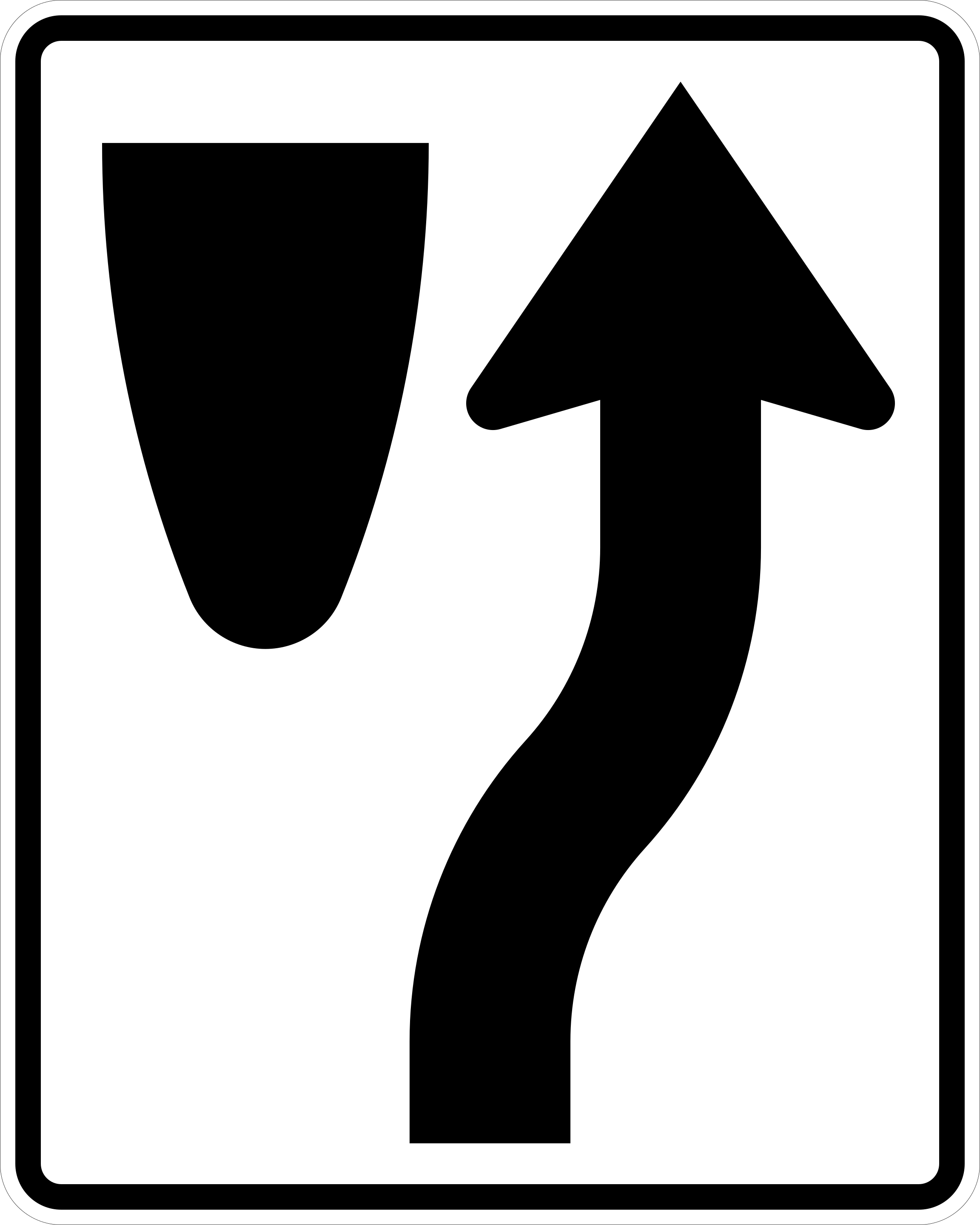
- Which side of the divider you belong on
- That both sides of the divider are interchangeable
- That the median is a passing lane
- That traffic may cross the divider at any time
Show answer
Which side of the divider you belong on. Lane-direction signs placed at divider openings help a driver remain on the proper side of a divided highway. The median is not an extra passing lane, and the two sides cannot be used interchangeably. Crossing the divider whenever convenient creates a conflict with opposing or crossing traffic. Follow the arrow, stay within the roadway assigned to your direction, and use an authorized opening when changing routes.
Study this in the handbook: Sign shapes, colors and pavement markings
6. According to the West Virginia handbook, when should a driver yield even if a right-of-way rule appears to favor proceeding?
- Only after the other driver waves you through
- Whenever yielding is needed to avoid a conflict
- Never, because right-of-way cannot be surrendered
- Only when the vehicle behind you is far away
Show answer
Whenever yielding is needed to avoid a conflict. The West Virginia handbook says courtesy is a key to safe driving and safety comes before right-of-way. At times you must yield the right-of-way to others: there are rules to help determine the right-of-way, but if the other driver does not follow these rules, give the right-of-way. It adds that in every situation, right-of-way is something to be given, not taken. A wave from the other driver or the position of the vehicle behind you does not decide it.
Study this in the handbook: Right of way and pedestrians
7. What does a round yellow and black railroad sign provide?

- A warning that the road becomes one way
- Permission to pass a stopped train
- Advance warning of a railroad crossing
- Directions to a highway rest area
Show answer
Advance warning of a railroad crossing. The round yellow and black sign gives advance warning that a railroad crossing is ahead. It does not grant permission to pass a train, announce a one-way road, or direct a driver to a rest area. Use the extra distance to reduce speed, inspect both directions, and identify whether lights, bells, gates, or multiple tracks affect the crossing before proceeding.
Study this in the handbook: Sign shapes, colors and pavement markings
8. What does the West Virginia handbook say tempts impatient drivers to only slow down for a stop sign?
- A green light at the next intersection
- Wet pavement
- Pressure from following vehicles and the absence of cross traffic
- A flashing yellow signal
Show answer
Pressure from following vehicles and the absence of cross traffic. The handbook's impatience section warns that pressure from following vehicles and the absence of cross traffic may tempt you to only slow down for a stop sign. Neither excuse changes the law: regardless of traffic you must come to a complete stop at a stop sign or red light, even for a right turn. The impatient driver who rolls through, speeds from stop to stop and weaves in traffic raises the chance of a crash for everyone nearby.
Study this in the handbook: Bad driving habits
9. What does a pentagon-shaped school sign identify?

- A school zone or school-zone crossing
- A railroad crossing
- A hospital entrance
- A no-passing zone
Show answer
A school zone or school-zone crossing. The pentagon shape warns of a school zone or a school-zone crossing. It does not identify railroad tracks, a hospital entrance, or the beginning of a no-passing zone. In West Virginia, the school-zone maximum is 15 mph when children are present or when specified. Slow before the marked area, watch for people walking, and follow any posted control. Expect children to move unpredictably.
Study this in the handbook: Sign shapes, colors and pavement markings
10. When poor weather or darkness hides sign lettering, what should a driver still be able to do?
- Recognize the sign and respond to its meaning
- Ignore the sign until the lettering becomes readable
- Treat every sign as a speed limit sign
- Stop in the travel lane to study the sign
Show answer
Recognize the sign and respond to its meaning. West Virginia emphasizes that a driver should use a sign's shape and color when letters are difficult to see. Fog, rain, snow, fading light, or darkness can obscure wording, but the visual design still supplies an important warning or instruction. Ignoring the sign delays the needed response, and treating every sign as a speed limit invents a rule that may not exist. Stopping in a live lane creates a new hazard. Slow appropriately, identify the sign from a safe position, and follow its message.
Study this in the handbook: Sign shapes, colors and pavement markings
11. How soon must a new West Virginia resident apply for a West Virginia driver's license after establishing residency?
- Only when the out-of-state license expires
- Within 10 days
- Within 60 days
- Within 30 days
Show answer
Within 30 days. A new resident who wants to drive in West Virginia must apply within 30 days after establishing residency. Waiting until an out-of-state license expires can miss the state's deadline, and the 10-day and 60-day choices substitute numbers not stated in this rule. The handbook separately explains that a valid, nonexpired out-of-state license may be transferred after the applicant completes the required steps. Mark the residency date, gather the documents, and begin the transfer process before the 30-day window closes.
Study this in the handbook: Who needs a license, new residents and address changes
12. An ambulance approaches with its siren sounding and warning lights flashing. What must you do?
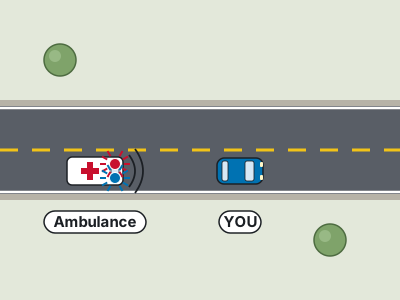
- Stop in the intersection so the ambulance can go around
- Pull to the right edge, clear the intersection, and stop
- Continue at the speed limit until the ambulance passes
- Move left and maintain speed beside the emergency vehicle
Show answer
Pull to the right edge, clear the intersection, and stop. West Virginia directs drivers to yield to an ambulance, fire vehicle, or police vehicle using a siren and flashing warning lights. Pulling right, getting clear of the intersection, and stopping creates a predictable path for the responding vehicle. Stopping in the intersection can block its route, while continuing or moving left keeps the conflict active. Keep your foot on the brake so the emergency driver can see that you are stationary, then watch for additional emergency vehicles before moving.
Study this in the handbook: Right of way and pedestrians
13. What is a useful general rule about the signs a driver will encounter?
- Sign shapes and colors provide no useful information
- Every road sign contains a paragraph explaining the rule
- Only signs shown in the handbook have legal meaning
- Most signs are self-explanatory, but drivers should still observe their shapes and colors
Show answer
Most signs are self-explanatory, but drivers should still observe their shapes and colors. The handbook notes that many signs are self-explanatory and that shapes and colors help indicate their message. That makes observation useful even when a driver has not memorized every individual sign. The paragraph choice is wrong because signs often communicate with short words or symbols. A sign does not lose meaning simply because it is absent from the handbook, and shapes and colors are not random. Slow down when a warning sign appears and read the entire message before acting.
Study this in the handbook: Sign shapes, colors and pavement markings
14. According to the West Virginia handbook, what is the first response when a vehicle runs off the paved road?
- Brake hard and jerk the wheel left
- Turn sharply back onto the pavement immediately
- Grip the steering wheel tightly and ease off the accelerator
- Accelerate toward the center of the highway
Show answer
Grip the steering wheel tightly and ease off the accelerator. When wheels leave the pavement, the handbook says to grip the steering wheel tightly, stay on the shoulder, and ease off the accelerator. Braking should be gentle, with speed reduced gradually while the driver checks traffic. Jerking back onto the pavement right away skips those steps; the handbook turns the wheels sharply onto the pavement only after speed is reduced and traffic is checked, then turns them the other way so the vehicle does not head across the highway. Acceleration increases the loss of control. Keep the vehicle stable first, then return to the pavement only after reducing speed and confirming that the path is clear.
Study this in the handbook: Blowouts, fires and other vehicle emergencies
15. What may repeated convictions do to a West Virginia driver’s privilege?
- Erase earlier violations from the driving record
- Build a point record that can lead to suspension
- Guarantee a permanent license with no review
- Allow unrestricted driving after every conviction
Show answer
Build a point record that can lead to suspension. The handbook warns that repeated convictions may build a point record leading to suspension of the driving privilege. The rule describes a cumulative consequence, so a driver should not treat each conviction as an isolated event. It does not promise that earlier violations disappear, and it does not guarantee permanent licensing or unrestricted driving. Keep the practical cue in mind: repeated violations can add points until the privilege is suspended. The exact suspension process can depend on the point record and applicable law, but the handbook clearly identifies suspension as the possible result of accumulating convictions.
Study this in the handbook: Points, citations and suspensions
16. Yellow pavement lines generally separate lanes of traffic moving in which relationship?
- Vehicles from marked parking spaces
- The same direction
- Only bicycles from cars
- Opposite directions
Show answer
Opposite directions. Yellow lines mark the division between opposing traffic streams. This helps a driver recognize that vehicles beyond the line may be approaching head-on, unlike lanes separated by white lines. The marking does not identify a bicycle facility or a parking boundary. Before crossing any center marking, check its pattern and the applicable passing or turning rule. Treat the yellow line as a warning to evaluate opposing traffic, sight distance, and the legality of the intended movement before steering across it.
Study this in the handbook: Sign shapes, colors and pavement markings
17. Why does West Virginia's handbook tell drivers to reduce speed when conditions limit visibility or stopping distance?
- A faster vehicle has less time to identify hazards and react safely
- Higher speed always improves traction on wet pavement
- Reduced speed is required only when an officer is present
- Visibility changes have no effect if the posted limit is obeyed
Show answer
A faster vehicle has less time to identify hazards and react safely. Speed changes the time available to notice a hazard, judge another vehicle, and correct a mistake. When rain, darkness, traffic, or a roadway problem limits what you can see or how quickly you can stop, slow down below the posted maximum as needed. The choice about improved wet traction reverses the safety concern, since water can reduce grip. A posted limit is not permission to maintain that speed in every condition. Use a simple cue: less sight distance or more stopping distance calls for less speed.
Study this in the handbook: Basic speed law and school zones
18. How long do points stay on a West Virginia driving record?
- One year from the violation date
- Three years from the conviction date
- Two years from the conviction date
- Five years from the conviction date
Show answer
Two years from the conviction date. West Virginia points remain on the driving record for two years, counted from the conviction date. One year is too short, and the clock starts at conviction, not at the date of the violation. Three and five years are longer than the stated period. While points are on the record they count toward the 6 point caution letter and the 12 point suspension level.
Study this in the handbook: Points, citations and suspensions
19. How many points does West Virginia's point scale assign for speeding in a school zone?
- Six points
- Three points
- Five points
- Eight points
Show answer
Six points. The West Virginia point scale lists speeding in a school zone at 6 points, the same as reckless driving, hit and run, and speeding 20 mph or more over the limit. Three points is the value for speeding 11 to 14 mph over and for many ordinary violations. Five points is for speeding 15 to 19 mph over. Eight points is reserved for fleeing from an officer.
20. Under West Virginia's Level 2 intermediate license rules, whose seat belt use is the young driver responsible for?
- Only the driver's own belt
- Only passengers in the front seat
- All occupants of the vehicle
- Only passengers under 18
Show answer
All occupants of the vehicle. A Level 2 intermediate license holder must require all occupants to follow the seat belt law, the same duty Level 1 permit drivers carry. Buckling only yourself, or only the front seat, falls short of that rule. The duty is not limited to passengers under 18. The same passage also bars the Level 2 driver from having any measurable alcohol in their system.
Study this in the handbook: Graduated Driver's License levels
QualitySpace is expanding to West Virginia
We are a California-based independent insurance brokerage working on licensing in more states. We cannot help with West Virginia insurance yet. Leave your email and we will let you know when we can.
Every question is written from the official West Virginia Driver's Licensing Handbook. Need paper? Printable WV practice test with answer key.
Last verified 2026-10-05. How we check every question · Study all 209 as flashcards
Frequently asked questions
How many questions are on this West Virginia practice test?
This fixed set has 20 questions. It is test 1 of 10 from the 209 question West Virginia bank. The real WV exam asks 25 questions and you need 19 correct.
What is the passing score for the real West Virginia test?
19 out of the 25 questions correctly to pass (76%) That figure comes from the official West Virginia source cited on the DMV facts page.
How does this fixed test relate to the full West Virginia bank?
Each numbered test is a fixed set of questions in a fixed order, so you can retake the same test later and compare. Every test mixes road signs and the other topics in about the same proportion as the full bank. Tests 1 to 10 together cover 200 of the 209 questions in the West Virginia bank, each once. The full practice page mixes the whole bank at random.
Last verified 2026-10-05. See the West Virginia DMV facts page for sourced state details.
Return to the full West Virginia practice test · Study road signs