
Test 7 of 10 · 20 questions · Free 2026
WV Permit Practice Test 7
Jump to the test ↓A fixed 20 question set from the West Virginia bank with answers and plain English explanations. The real WV exam is 25 questions, 76 percent to pass; take the full length version on the main practice page.
Question 1 of 20 · 0 right so far
All 20 questions in test 7
Every question below comes from the West Virginia question bank on this page. Open a question to see the correct answer and the explanation. Nothing here is hidden behind a signup.
1. When does a Level 1 GDL instruction permit expire under the handbook's stated schedule?
- On the applicant's 18th birthday
- On the applicant's 16th birthday
- Five years after issuance
- At the end of the calendar year
Show answer
On the applicant's 18th birthday. The Level 1 GDL instruction permit expires on the applicant's 18th birthday, although the handbook allows a 30-day grace period to provide time for the road skills examination. The 16th birthday is associated with eligibility for the next graduated stage, not expiration of the first permit. A five-year term and a calendar-year deadline are not the stated schedule. Track the birthday rather than counting a fixed number of months from issuance, and remember that the grace period is limited to completing the road skills process.
Study this in the handbook: Graduated Driver's License levels
2. In West Virginia, is an insurance card shown on your phone valid proof of insurance?
- No, only a paper certificate is accepted
- Yes, an image on a wireless device is valid proof
- Only if it is also printed within 24 hours
- Only during a vehicle inspection
Show answer
Yes, an image on a wireless device is valid proof. West Virginia accepts an image displayed on a wireless communication device as valid proof of insurance, alongside the paper certificate that must otherwise be carried in the vehicle with the registration card. A paper only rule is therefore wrong, and the handbook adds no printing deadline. In the event of a crash you must present proof to any investigating officer, and you must also show it at the time of any vehicle inspection, so the duty is not limited to inspections. The DMV may also ask for proof at any time during the registration year.
Study this in the handbook: Crash reports, insurance and phone use
3. What is the minimum age for a West Virginia Level 3 GDL license?
- 17
- 16
- 18
- 21
Show answer
17. A West Virginia driver can move to the Level 3 GDL at 17, after 12 months of conviction free driving on a Level 2 license and all other requirements. Sixteen is the earliest age for Level 2, not Level 3. Eighteen is when the Level 2 restrictions end anyway for a driver who chooses to stay at Level 2. Twenty one is the age of a supervising adult and the change to the horizontal license format.
Study this in the handbook: Graduated Driver's License levels
4. What should a driver do when a vehicle is following too closely?
- Brake hard to punish the following driver
- Tap the brakes gently, slow down, and let the vehicle pass if needed
- Speed up until the other vehicle disappears
- Move left and block the passing lane
Show answer
Tap the brakes gently, slow down, and let the vehicle pass if needed. The handbook recommends a calm sequence for a tailgater: tap the brakes gently to flash the brake lights, slow down to encourage a pass, and pull over if other measures fail. Hard braking creates a new collision risk, and accelerating can invite the following driver to continue at an unsafe distance. Blocking a lane escalates the conflict rather than creating space. The practical cue is to increase the gap in front of your vehicle while giving the other driver a safe opportunity to go around. Keep your attention on escape space, not on proving a point.
Study this in the handbook: Headlights and light conditions
5. What should a driver do on an Interstate when a lane is closed in a construction zone?
- Use the median crossover to avoid the work area
- Maintain normal speed because construction signs are only advisory
- Obey the special signs, speed limits, and flagger directions
- Stop on the shoulder until all construction equipment leaves
Show answer
Obey the special signs, speed limits, and flagger directions. Interstate construction zones may close lanes and cause traffic to slow or stop. Drivers must observe special speed limits, traffic-control signs, and flaggers, then merge to the open lane when directed. The normal speed choice ignores the changed roadway and leaves less time to react around workers and equipment. Median crossovers are not a general detour, and the shoulder is not a waiting area for ordinary construction delays. Treat the work zone as an active safety area, scan ahead, and make each adjustment early.
Study this in the handbook: Breakdowns, fog and work zones on interstates
6. When may an authorized emergency vehicle exceed the posted speed limit?
- Whenever its driver is running late
- While on emergency duty with signal equipment operating and without endangering others
- Only when another officer gives a hand signal
- Only on an interstate highway
Show answer
While on emergency duty with signal equipment operating and without endangering others. An authorized emergency vehicle may exceed the posted limit while on emergency duty, with its emergency signal equipment operating, and only when other road users are not endangered. The rule is conditional, so ordinary lateness or a preferred road type is not enough. A separate officer's hand signal is not listed as the trigger. The driver should read all three conditions together: emergency duty, operating signals, and safe treatment of other road users. Even with legal authority to exceed the limit, the vehicle operator still has a duty to avoid creating a hazard.
Study this in the handbook: Basic speed law and school zones
7. During a West Virginia road test lane change, what must you do after completing the lane change?
- Cancel the turn signal and check traffic
- Speed up by 10 mph
- Sound the horn
- Stop briefly in the new lane
Show answer
Cancel the turn signal and check traffic. The road test lane change begins with traffic checks: look in the mirrors and check the blind spot by looking over your shoulder with a head check, use the correct turn signal, and change lanes smoothly when it is safe. After completing the lane change, cancel your turn signal and check traffic. A signal left flashing misleads other drivers, and neither a horn, a burst of speed, nor a stop in the new lane is part of the maneuver.
Study this in the handbook: The road skills test and basic control
8. What do square and rectangular signs tell drivers about speed and direction?
- The condition of the vehicle ahead
- Only scenic viewpoints
- The current weather forecast
- Traffic regulations and guidance
Show answer
Traffic regulations and guidance. Rectangular and square signs carry regulatory or guide information that helps organize movement. They can tell you about speed limits, prohibited turns, lane direction, or other traffic laws. A scenic viewpoint may have its own guide sign, but that is not the defining purpose of this group. A sign cannot forecast weather or report another vehicle's condition. Read the words and symbols before reaching the sign, then make the required adjustment smoothly and leave room for other road users.
Study this in the handbook: Sign shapes, colors and pavement markings
9. You need to turn around while driving on a West Virginia interstate. What does the handbook say to do?
- Make a U-turn through the median crossover
- Never make a U-turn; go to the next exit and turn around before re-entering
- Back up on the shoulder to the last exit
- Stop in the left lane and turn across the median
Show answer
Never make a U-turn; go to the next exit and turn around before re-entering. The West Virginia handbook says you should never make a U-turn on an interstate. Go to the next exit to turn around before re-entering the interstate. It adds that the gravel or paved crossovers in the medians of some highways are to be used only by police and emergency vehicles. Backing along the shoulder is not the handbook's method, and shoulders on interstates are to be used only for disabled vehicles, so stopping in a travel lane to turn is also wrong.
Study this in the handbook: Entering, exiting and driving on interstates
10. What is the minimum license suspension for passing a stopped school bus?
- At least 10 days
- At least 60 days
- At least one year
- No suspension for a first offense
Show answer
At least 60 days. The handbook lists a minimum of 60 days of driver’s license suspension for passing a stopped school bus. It also lists a minimum fine of $500 or confinement in jail for not more than six months for the first offense. Ten days understates the suspension, and one year is not the minimum figure given. The claim that a first offense brings no suspension is also wrong. When red bus lights are flashing, stop and wait until the bus resumes motion, the driver signals you to proceed, or the visual signals stop.
Study this in the handbook: School buses, bicycles, motorcycles and trucks
11. Where should you stop when yielding to an emergency vehicle using a siren and flashing lights?
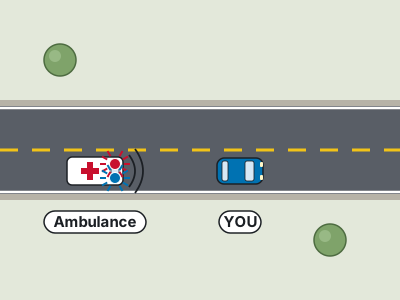
- On the shoulder only after the emergency vehicle stops
- At the left edge of the road, inside the intersection
- In the nearest travel lane without braking
- At the right edge of the road, outside the intersection
Show answer
At the right edge of the road, outside the intersection. The safest response is a deliberate three-part action: yield, move right, and stop clear of the intersection. That positioning gives the emergency vehicle a usable corridor and keeps cross traffic from trapping it. The left edge is opposite the handbook's direction, and stopping in the intersection leaves the most complicated conflict point occupied. Waiting for the emergency vehicle to stop is also backwards because your move should create room before it reaches you. Expect another emergency vehicle before reentering traffic.
Study this in the handbook: Right of way and pedestrians
12. Why should a driver leave space ahead when being followed too closely?
- It allows the driver to ignore vehicles entering from the side
- It forces the following driver to pass on the shoulder
- The space ahead is easiest to control and provides room to stop
- It guarantees the following driver will stop immediately
Show answer
The space ahead is easiest to control and provides room to stop. The driver cannot control the impatient vehicle behind, but can control the space in front. The handbook calls the space ahead of your vehicle the space easiest to control, names that cushion the following distance, and says to allow enough of it to stop when necessary. Keeping that space gives room to slow gradually if traffic ahead stops. It does not force a shoulder pass or guarantee what the other driver will do, and side traffic still requires attention. For the tailgater itself, the handbook says to tap the brakes gently, slow down to encourage a pass, and pull over if all else fails.
Study this in the handbook: U-turns, backing, parking and following distance
13. What general category does a yellow diamond winding-road symbol belong to?

- A regulatory order to turn immediately
- A guide sign showing a town distance
- A warning of possible danger ahead
- A service sign for a fuel station
Show answer
A warning of possible danger ahead. Yellow diamond signs with symbols warn about possible danger ahead, including changing road alignment such as a winding section. They are not guide signs, regulatory orders, or service signs. Use the warning as an early cue to reduce speed and scan for the next bend. Keep a steady path through the series rather than treating each curve as an isolated surprise.
14. What hazard does a merge warning identify?

- Traffic may be moving into your lane
- Your lane is reserved for stopped vehicles
- The road is becoming a one-way street
- A railroad gate is closing immediately
Show answer
Traffic may be moving into your lane. A merge warning means another stream of traffic may move into your lane. Adjust speed or lane position carefully to avoid a conflict, while checking mirrors and blind spots. The sign does not reserve your lane for stopped vehicles, change the roadway into a one-way street, or announce a closing railroad gate. Leave room for the joining vehicle and maintain a controlled following distance.
15. A 16 year old in West Virginia commits a DUI offense. How long is the license revoked?
- Exactly 30 days
- Until age 18 or the statutory period, whichever is shorter
- Until age 21, in every case
- Until age 18 or the statutory revocation period, whichever is longer
Show answer
Until age 18 or the statutory revocation period, whichever is longer. For a driver under 18, a DUI revokes the license until age 18 or for the statutory revocation period, whichever is longer, and until all other requirements are met. A flat 30 days ignores the age rule. Choosing the shorter period reverses the handbook. Age 21 is the legal drinking age and the zero tolerance cutoff, not the revocation end point. Reinstatement also requires the Safety and Treatment program.
Study this in the handbook: Alcohol, BAC limits and zero tolerance
16. How many seconds of following distance should a driver allow in normal conditions?
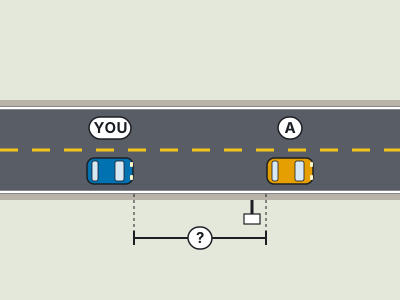
- One second in every situation
- Three to four seconds
- Exactly two seconds regardless of weather
- Ten seconds on every road
Show answer
Three to four seconds. West Virginia recommends the three-to-four-second rule for ordinary following distance. Choose a fixed object, begin counting when the vehicle ahead passes it, and make sure you do not reach that object before finishing the count. One second leaves little room to react, and a fixed two-second gap ignores the handbook's longer normal interval. Ten seconds is not the general rule. Increase the cushion to at least four seconds in darkness or rain and at least six seconds on ice or snow, because stopping takes longer.
Study this in the handbook: U-turns, backing, parking and following distance
17. How should a driver respond to a circular flashing red signal?
- Wait for a green arrow even when the intersection is clear
- Treat it like a flashing yellow and continue without stopping
- Treat it like a stop sign, then yield before proceeding
- Stop only if a pedestrian is already in the roadway
Show answer
Treat it like a stop sign, then yield before proceeding. A circular flashing red signal has the same meaning as a stop sign. The driver must come to a complete stop and yield to all other traffic and pedestrians before proceeding. A flashing yellow signal permits cautious movement, so treating red as yellow would skip the required stop. A green arrow is not required after every red flasher, and the duty does not depend on seeing a pedestrian. Use the familiar stop sign sequence: stop fully, scan the intersection, yield, and continue when safe.
18. What principle should guide a driver when another road user may have priority?
- Safety comes before right-of-way, and the driver should yield when needed
- Right-of-way should be taken whenever a driver reaches the intersection first
- A driver may force the issue if the traffic signal is green
- Only pedestrians can receive the right-of-way
Show answer
Safety comes before right-of-way, and the driver should yield when needed. The handbook treats right-of-way as something to give when safety requires it, not as permission to force another road user out of the way. The choice “Right-of-way should be taken whenever a driver reaches the intersection first” turns arrival order into an absolute rule, and a green signal does not justify ignoring a person or vehicle still clearing the path. The pedestrian-only statement is also too limited because drivers may need to yield to other vehicles and emergency responders. Slow down, assess the conflict, and choose the safe yield even when priority seems favorable.
Study this in the handbook: Right of way and pedestrians
19. What following distance method does the handbook recommend for normal driving?
- Keep two seconds in all weather and road conditions
- Stay exactly one car length behind at every speed
- Use a three-to-four second gap behind the vehicle ahead
- Follow closely enough to prevent another vehicle from merging
Show answer
Use a three-to-four second gap behind the vehicle ahead. The handbook recommends the three-to-four second rule for maintaining a useful space cushion. Pick a fixed object such as a signpost, begin counting after the vehicle ahead passes it, and check whether your vehicle reaches that object before the count is complete. A one-car-length rule changes meaning as speed changes, so it is not dependable. The two-second choice is too short for the handbook's general method. Darkness or rain calls for at least four seconds, while ice or snow calls for at least six.
Study this in the handbook: U-turns, backing, parking and following distance
20. How should a driver identify a sign when fog, rain, snow, or darkness obscure its lettering?
- Assume every obscured sign prohibits passing
- Ignore the sign until the lettering becomes clear
- Use the sign's color but disregard its shape
- Use the sign's shape and respond accordingly
Show answer
Use the sign's shape and respond accordingly. The handbook says drivers should still recognize and respond to a sign when fading light, fog, rain, snow, or darkness makes its letters difficult to see. Shape and color provide useful information before every word can be read, but the driver should use the whole visual design rather than discard one part. Ignoring the sign delays the needed response, and assuming every unclear sign prohibits passing invents a rule the sign may not carry. Slow enough to identify the sign safely, then follow the message it communicates.
Study this in the handbook: Sign shapes, colors and pavement markings
QualitySpace is expanding to West Virginia
We are a California-based independent insurance brokerage working on licensing in more states. We cannot help with West Virginia insurance yet. Leave your email and we will let you know when we can.
Every question is written from the official West Virginia Driver's Licensing Handbook. Need paper? Printable WV practice test with answer key.
Last verified 2026-10-05. How we check every question · Study all 209 as flashcards
Frequently asked questions
How many questions are on this West Virginia practice test?
This fixed set has 20 questions. It is test 7 of 10 from the 209 question West Virginia bank. The real WV exam asks 25 questions and you need 19 correct.
What is the passing score for the real West Virginia test?
19 out of the 25 questions correctly to pass (76%) That figure comes from the official West Virginia source cited on the DMV facts page.
How does this fixed test relate to the full West Virginia bank?
Each numbered test is a fixed set of questions in a fixed order, so you can retake the same test later and compare. Every test mixes road signs and the other topics in about the same proportion as the full bank. Tests 1 to 10 together cover 200 of the 209 questions in the West Virginia bank, each once. The full practice page mixes the whole bank at random.
Last verified 2026-10-05. See the West Virginia DMV facts page for sourced state details.
Return to the full West Virginia practice test · Study road signs