
Test 11 of 25 · 20 questions · Free 2026
WV Permit Practice Test 11
Jump to the test ↓A fixed 20 question set from the West Virginia bank with answers and plain English explanations. The real WV exam is 25 questions, 76 percent to pass; take the full length version on the main practice page.
Question 1 of 20 · 0 right so far
All 20 questions in test 11
Every question below comes from the West Virginia question bank on this page. Open a question to see the correct answer and the explanation. Nothing here is hidden behind a signup.
1. What must a West Virginia driver carry whenever driving?
- A birth certificate
- A vehicle title certificate
- A copy of the insurance policy only
- A West Virginia driver's license
Show answer
A West Virginia driver's license. West Virginia requires a licensed driver to carry the driver's license while driving, so it is available on demand during any stop. The option stating "A vehicle title certificate" misses that point, because a title proves vehicle ownership, not that the person behind the wheel is licensed to drive. Keep the card in the wallet you take on every trip, not in a drawer at home.
Study this in the handbook: Who needs a license, new residents and address changes
2. A teen surrenders a Level 1 instruction permit. What happens to that permit?
- It renews automatically for another term
- It stays valid until the eighteenth birthday
- It is nonrenewable and the process must be redone
- It converts directly into a Level 2 license
Show answer
It is nonrenewable and the process must be redone. A Level 1 instruction permit is nonrenewable. If it is surrendered for any reason, the applicant must complete the examination process again, hold the new permit for 180 consecutive conviction-free days, and resubmit proof of identity, Social Security number, and West Virginia residency. The surrendered permit does not renew on its own and does not stay valid until the eighteenth birthday after surrender. It also cannot convert directly into a Level 2 license, because the Level 1 stage must be completed again before advancement is possible.
Study this in the handbook: Graduated Driver's License levels
3. A driver under age 18 is convicted of DUI. How long does the license revocation last?
- Until the driver finishes the current school year
- For a flat period of thirty days after conviction
- Until the driver's twenty-first birthday arrives
- Until age 18 or the statutory period, whichever is longer
Show answer
Until age 18 or the statutory period, whichever is longer. For a driver under 18, a DUI offense brings revocation until the driver reaches 18 or until the applicable statutory revocation or suspension period ends, whichever takes longer. Tying the penalty to a school year has no basis in the rule and could end it far too early. A flat thirty days also ignores cases where the statutory period runs beyond the birthday. Waiting until the twenty-first birthday overshoots the stated test. Two clocks matter here, the age clock and the legal penalty clock, and the later one controls.
Study this in the handbook: Alcohol, BAC limits and zero tolerance
4. What should a pedestrian do at night to be more visible to drivers?
- Wear white or light-colored clothing or carry a light
- Wear dark clothing so headlights do not distract the driver
- Walk in the roadway with traffic to stay visible
- Rely on a vehicle's headlights without changing anything
Show answer
Wear white or light-colored clothing or carry a light. At night, a pedestrian should wear white or light-colored clothing or carry a light. Those choices help a driver detect the person sooner in limited visibility. Dark clothing reduces contrast, and walking in the roadway creates a separate traffic hazard rather than solving visibility. A pedestrian should not rely only on a vehicle's headlights to reveal them, because the driver may see the person too late to react safely.
Study this in the handbook: Right of way and pedestrians
5. A vehicle is coming toward you in your lane. What should you do?
- Turn into the empty lane the other vehicle just left
- Speed up quickly to pass before it reaches you
- Move right, slow down, and warn that driver
- Stop in the middle of your lane and wait
Show answer
Move right, slow down, and warn that driver. When an oncoming vehicle enters your lane, move to the right and slow down while sounding the horn and flashing the headlights to get that driver's attention. Turning into the lane the other vehicle left is dangerous because that driver may realize the error and swing back into it. Speeding up shortens the time both drivers have to recover. Stopping in the middle leaves you directly in the path of the approaching vehicle. Creating space on your right and reducing speed gives the other driver room to correct the mistake.
Study this in the handbook: Blowouts, fires and other vehicle emergencies
6. You are driving alone and become too tired to drive safely. What should you do?
- Open a window and keep driving for hours
- Turn the radio up and continue the trip
- Pull off the road and rest
- Change places with an unlicensed passenger
Show answer
Pull off the road and rest. A driver traveling alone who becomes tired should pull off the road and rest. Fresh air from an open window and louder radio music may feel helpful for a moment, but neither replaces sleep and both can mask how impaired fatigue has made your reactions. Handing the wheel to an unlicensed passenger trades one unsafe driver for another and breaks licensing law. Choose a safe place away from traffic, stop, and resume only when alert enough to notice hazards, judge speeds, and react without delay.
Study this in the handbook: Drowsy driving, fatigue and emotions
7. In very dense fog, what route choice may be better than staying on the interstate?
- Stay in the left lane at highway speed
- Leave the interstate and use slower roads
- Follow the nearest truck closely for guidance
- Stop in a travel lane with lights flashing
Show answer
Leave the interstate and use slower roads. When fog is very dense, it may be better to leave the interstate and use slower roads to reach the destination. Staying at highway speed in the left lane preserves the danger the handbook warns about. Following a truck closely removes sight distance, and stopping in a travel lane exposes the vehicle to high-speed traffic that may not see it. The safer route choice is the slower road, or waiting until visibility improves.
Study this in the handbook: Entering, exiting and driving on interstates
8. Where does a removed through lane on an interstate usually disappear?
- At a fork or an exit
- At a rest area entrance ramp
- At a toll booth collection lane
- In the middle of a long bridge
Show answer
At a fork or an exit. Where a through lane is removed on an interstate, the change usually occurs at a fork or an exit, signaled below the overhead guide sign. The option stating "At a rest area entrance ramp" misses that point, because a rest area entrance does not consume a through lane the way a fork or exit does. Expect lane drops where the road splits or peels off, not on straight open stretches.
Study this in the handbook: Entering, exiting and driving on interstates
9. Where should the hands sit on the wheel for maximum control in West Virginia guidance?
- Left hand near 8 o'clock, right hand near 4 o'clock
- Left hand near 10 o'clock, right hand near 2 o'clock
- Both hands together near 12 o'clock at the top
- Left hand near 6 o'clock, right hand resting down
Show answer
Left hand near 8 o'clock, right hand near 4 o'clock. The left hand should sit approximately at 8 o'clock and the right hand at 4 o'clock, giving maximum control and reducing air bag risk to the hands. The option stating "Left hand near 10 o'clock, right hand near 2 o'clock" misses that point, because ten and two was older teaching; the stated positions are lower on the wheel rim. Picture hands low on the clock face, balanced on either side of the bottom half.
Study this in the handbook: The road skills test and basic control
10. How does the fatal crash rate for night driving compare with day driving?
- About the same as for day driving overall
- Half as great as for day driving overall
- Ten times greater than for day driving
- Three times greater than for day driving
Show answer
Three times greater than for day driving. Although fewer miles are driven at night, the fatal crash rate for night driving is three times greater than the rate for day driving. About the same would understate the difference, and half as great reverses it. Ten times greater is far above the handbook's figure. The comparison is a rate, not the total number of crashes, so the correct relationship is three times the daytime rate.
Study this in the handbook: Headlights and light conditions
11. Steering fails and the vehicle heads toward a pedestrian. How should braking change?
- Apply brakes gently after the vehicle slows alone
- Apply brakes quickly, using maximum pressure
- Release brakes to regain steering control first
- Pump brakes slowly while sounding the horn
Show answer
Apply brakes quickly, using maximum pressure. If a vehicle with failed steering starts off the road or toward a pedestrian or another vehicle, apply brakes quickly using maximum pressure to stop before impact. The option stating "Apply brakes gently after the vehicle slows alone" misses that point, because gentle braking after coasting wastes the short distance left before a person is struck. When a failed steering path points at people, stopping power outranks preserving direction.
Study this in the handbook: Blowouts, fires and other vehicle emergencies
12. What traffic danger increases during holiday periods?
- The number of unmarked police cars on patrol
- The number of closed interstate rest areas
- The number of drunk drivers on the roadway
- The number of trucks carrying holiday freight
Show answer
The number of drunk drivers on the roadway. Holiday periods produce an increase in the number of drunk drivers on the roadway. The handbook does not identify unmarked police cars, closed rest areas, or holiday freight as the danger in this passage. A driver should account for the increased impaired-driving risk along with heavier travel and hurried motorists. The answer concerns who may be driving, not a change in patrol staffing, facilities, or cargo.
Study this in the handbook: Drowsy driving, fatigue and emotions
13. Which small actions can reduce the monotony of a long drive?
- Window down, radio on, or singing along
- Seat reclined, cruise set, and eyes relaxed
- Phone in hand, radio off, and windows sealed
- Heater high, lights dimmed, and seat lowered
Show answer
Window down, radio on, or singing along. Rolling your window down, turning your radio on, or singing can reduce the monotony of driving, though real rest remains the cure for true fatigue. The option stating "Seat reclined, cruise set, and eyes relaxed" misses that point, because a reclined seat and relaxed eyes deepen drowsiness instead of reducing monotony. Use air and music against boredom on short stretches, and rest against real sleepiness.
Study this in the handbook: Drowsy driving, fatigue and emotions
14. What does a broken yellow line indicate when passing conditions are safe?
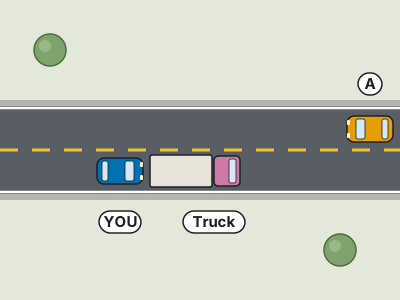
- The lane is reserved for stopped emergency vehicles
- Passing is prohibited in every circumstance
- Traffic in both lanes travels the same direction
- Passing may be permitted after checking traffic and sight distance
Show answer
Passing may be permitted after checking traffic and sight distance. A broken yellow line separates opposing traffic and may permit passing when the roadway, visibility, and other conditions make the maneuver safe and lawful. A solid restriction is different, so treating every yellow line as an automatic ban loses the distinction made by the marking pattern. The line does not indicate same-direction lanes or an emergency stopping area. Check ahead for vehicles, curves, hills, and signs before crossing, and return to the proper lane with ample space.
Study this in the handbook: Sign shapes, colors and pavement markings
15. On what basis are points assigned to moving violations in West Virginia?
- The seriousness of the violation
- The age of the vehicle driven
- The county where the driver lives
- The time of day of the offense
Show answer
The seriousness of the violation. Points are assigned to various in-state and out-of-state moving traffic violations depending on the seriousness of the violation, so graver offenses carry more points. The option stating "The age of the vehicle driven" misses that point, because vehicle age plays no role in scoring how dangerous the driving behavior was. Rank the behavior, not the car: reckless acts earn heavier point values.
Study this in the handbook: Points, citations and suspensions
16. For whom are designated mobility parking areas reserved?
- People who work within one block of the space
- People driving vehicles with automatic transmissions
- People whose condition limits walking reasonable distances
- People who arrive before the lot fills each morning
Show answer
People whose condition limits walking reasonable distances. Designated mobility parking areas are reserved for people whose condition limits their ability to walk reasonable distances. Working nearby, driving an automatic vehicle, and arriving early do not establish that walking limitation. The handbook identifies the person's mobility condition as the reason for the reserved space, not the person's job, vehicle transmission, or arrival time. A proper placard or plate is also required when the space is used.
17. A large truck ahead needs to back up. What should other drivers give it?
- A quick honk to tell it to hurry
- Extra space and extra time for backing
- A close following position to guide it
- The right lane so it can back across traffic
Show answer
Extra space and extra time for backing. Backing a large truck takes more room and more time than backing a car, because the driver has large blind areas behind the trailer. Other drivers should give the truck extra space and extra time to finish the maneuver. A honk meant to hurry the driver can startle or rush a difficult move. Following closely puts your vehicle where the truck driver may not see it. Holding back and waiting until the truck is settled keeps you out of its path and gives the driver room to correct the angle.
Study this in the handbook: School buses, bicycles, motorcycles and trucks
18. On bright winter days, what may reduce glare from snow and chrome?
- High beam headlights may be advisable
- Sunglasses may be advisable
- Wearing a hat with a wide brim at noon
- Turning on high beams to outshine the glare
Show answer
Sunglasses may be advisable. Bright days can attack a driver eyes from the road itself. On bright days of summer or winter, sunglasses may be advisable to reduce glare from glass and chrome on other vehicles and glare bouncing off snow. High beams do nothing for light entering your own eyes and can blind other drivers, while a hat brim helps only at one sun angle and cannot shade reflections from vehicles ahead. Keep sunglasses within reach in winter, because a snowfield at midday can be as blinding as a summer windshield, and slow down when the view washes white.
Study this in the handbook: Headlights and light conditions
19. What roadway condition does this two-arrow warning identify?

- The lane is reserved for emergency vehicles
- You are entering a divided highway
- Passing is allowed in both directions
- You are on a two-way road
Show answer
You are on a two-way road. The opposing arrows indicate that the road carries traffic in two directions. That does not announce a divided highway, guarantee passing permission, or reserve a lane for emergency vehicles. Keep a safe position in your lane, watch for oncoming traffic, and pass only where separate markings and visibility make the maneuver lawful. The arrows are a cue to expect vehicles approaching from ahead.
20. What does the West Virginia DMV do when a driver reaches 6 points?
- Suspends the license for 30 days
- Sends a letter of caution
- Requires a new road skills test
- Revokes the license for one year
Show answer
Sends a letter of caution. At 6 points or more the DMV sends a letter of caution urging the driver to be careful and obey traffic laws. Suspension is not triggered until 12 points. The handbook does not require a road test or a revocation at 6 points. A driver with 6 points can remove 3 by completing an approved eight hour defensive driving class once every 12 months.
Study this in the handbook: Points, citations and suspensions
Every question is written from the official West Virginia Driver's Licensing Handbook. Need paper? Printable WV practice test with answer key.
Last verified 2026-10-05. How we check every question · Study all 500 as flashcards
Frequently asked questions
How many questions are on this West Virginia practice test?
This fixed set has 20 questions. It is test 11 of 25 from the 500 question West Virginia bank. The real WV exam asks 25 questions and you need 19 correct.
What is the passing score for the real West Virginia test?
19 out of the 25 questions correctly to pass (76%) That figure comes from the official West Virginia source cited on the DMV facts page.
How does this fixed test relate to the full West Virginia bank?
Each numbered test is a fixed set of questions in a fixed order, so you can retake the same test later and compare. Every test mixes road signs and the other topics in about the same proportion as the full bank. Tests 1 to 25 together cover every question in the West Virginia bank once. The full practice page mixes the whole bank at random.
Last verified 2026-10-05. See the West Virginia DMV facts page for sourced state details.
Return to the full West Virginia practice test · Study road signs