
Test 12 of 25 · 20 questions · Free 2026
WV Permit Practice Test 12
Jump to the test ↓A fixed 20 question set from the West Virginia bank with answers and plain English explanations. The real WV exam is 25 questions, 76 percent to pass; take the full length version on the main practice page.
Question 1 of 20 · 0 right so far
All 20 questions in test 12
Every question below comes from the West Virginia question bank on this page. Open a question to see the correct answer and the explanation. Nothing here is hidden behind a signup.
1. How does implied consent protect a driver who has not been drinking?
- The test erases any traffic stop from the record
- The test proves the driver obeyed every traffic law that day
- The test removes points already on the driving record
- The test gives a medically accepted alcohol measure
Show answer
The test gives a medically accepted alcohol measure. For a sober driver, an alcohol test is evidence that works in the driver favor. The test provides a medically accepted measure of alcohol concentration, so a driver who has not been drinking can show that fact instead of arguing about odor or appearance at the roadside. The test does not erase the stop from a record, certify every other traffic law was obeyed that day, or remove points earned earlier. Its value is narrow and strong: it measures alcohol. Agreeing to testing gives a clear result that can end suspicion based on a mistake.
Study this in the handbook: Alcohol, BAC limits and zero tolerance
2. Which activity is listed as an exception to the Level 2 overnight supervision rule?
- A recreational drive with no special purpose
- A routine shopping trip
- A private social visit
- A school-sanctioned activity
Show answer
A school-sanctioned activity. A school-sanctioned activity is one of the listed exceptions to the Level 2 rule requiring a supervising licensed adult age 21 or older between 10:00 p.m. and 5:00 a.m. Lawful employment, religious activity, and an emergency involving prevention of injury or death are also listed. A routine shopping trip, private social visit, and recreational drive with no special purpose do not appear among the exceptions. The activity must fit one of the specific categories in the handbook.
Study this in the handbook: Graduated Driver's License levels
3. A driver is convicted in another state of an offense that is grounds for suspension or revocation there. What may West Virginia do?
- Suspend or revoke the driver's West Virginia license
- Take no action because the offense happened elsewhere
- Require the other state to retry the case in West Virginia
- Reduce the offense to a warning on the home record
Show answer
Suspend or revoke the driver's West Virginia license. A serious conviction does not stop at the state line. When such a conviction is reported from elsewhere, West Virginia may suspend or revoke the home license as well. Ignoring the offense because it happened elsewhere misunderstands how states share driver records, and West Virginia does not retry the other state case or soften it into a warning by itself. A driver who picks up a major violation on a trip should expect consequences at home and should resolve the foreign case promptly with legal guidance.
Study this in the handbook: Points, citations and suspensions
4. On a long trip, where should a driver spend a ten-minute rest break?
- Standing beside the vehicle in the travel lane
- Seated in the vehicle with the engine running
- In the driver's seat with eyes closed briefly
- Outside the vehicle, walking around briefly
Show answer
Outside the vehicle, walking around briefly. A rest break on a long trip should be spent outside the vehicle. Walking around, or getting a cup of coffee or a soft drink, loosens stiff muscles and restores alertness better than sitting in the same seat. Staying in the driver's seat with the engine running keeps the body in the same tired position. Closing your eyes in that seat is not a substitute for a proper stop and rest. Standing in the travel lane beside the vehicle puts you in the path of traffic, so step well clear of the road while you stretch.
Study this in the handbook: Drowsy driving, fatigue and emotions
5. Why is a WRONG WAY sign an urgent warning?
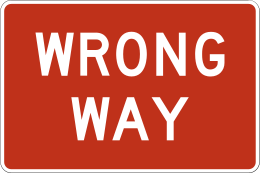
- The lane may lead into opposing traffic
- The pavement is about to become gravel
- A truck inspection station is ahead
- The road is entering a school zone
Show answer
The lane may lead into opposing traffic. A WRONG WAY sign indicates that the selected path can place a driver against traffic moving in the lawful direction. Gravel, truck inspections, and school zones are separate conditions that require different signs. Do not continue to test whether the road is usable. Reduce risk by moving out of the travel path when safe, stopping if necessary, and seeking a legal route back to the proper side.
Study this in the handbook: Sign shapes, colors and pavement markings
6. What is an initial action recommended if the brakes fail?
- Shift immediately into reverse at highway speed
- Turn the ignition off before trying to slow
- Pull the parking brake fully and hold it locked
- Pump the brake pedal quickly
Show answer
Pump the brake pedal quickly. The emergency section lists quickly pumping the brake pedal as the first response to brake failure. The driver should then shift to a lower gear, look for a place to slow and stop off the roadway, and use the horn and lights to warn others. Locking the parking brake can make the rear wheels skid, so the handbook says to apply it carefully and hold the release. Turning off the ignition or selecting reverse can create additional control problems and is not the prescribed opening move.
Study this in the handbook: Blowouts, fires and other vehicle emergencies
7. Your vehicle stalls in a flooded roadway. What should you do?
- Stay inside and wait for the water to recede
- Try restarting until the battery is drained
- Leave it immediately and seek higher ground
- Push it alone through the deepest section
Show answer
Leave it immediately and seek higher ground. If a vehicle stalls in a flooded roadway, leave it immediately and seek higher ground, because rising water can trap occupants inside. The option stating "Stay inside and wait for the water to recede" misses that point, because waiting inside a stalled car gambles against rising water that floats and fills vehicles. Wet feet beat a floating car: get out early while doors still open easily.
Study this in the handbook: Headlights and light conditions
8. When do safety techniques begin for a defensive driver?
- When the vehicle reaches highway speed
- The moment you step into the vehicle
- When traffic becomes heavy around you
- When a hazard appears directly ahead
Show answer
The moment you step into the vehicle. Safety techniques begin the moment you step into the vehicle, long before the first turn, merge, or hazard of the trip appears. The option stating "When the vehicle reaches highway speed" misses that point, because waiting for highway speed skips seat, mirror, and scanning habits that prevent early mistakes. Your safety routine starts at the door handle, not at the first intersection.
Study this in the handbook: Drowsy driving, fatigue and emotions
9. Which traits produce bad driving habits, in the handbook's list?
- Tiredness, hunger, sadness, caution, and strict rule following
- Impatience, youth, loud music, old vehicles, and night driving
- Laziness, impatience, inattention, arrogance, and aggressiveness
- Arrogance, short trips, new roads, passengers, and rain showers
Show answer
Laziness, impatience, inattention, arrogance, and aggressiveness. Bad driving habits result from laziness, impatience, inattention, arrogance, and aggressiveness, each of which a driver must evaluate and adjust. The option stating "Tiredness, hunger, sadness, caution, and strict rule following" misses that point, because caution and rule following prevent bad habits rather than producing them behind the wheel. Name the trait honestly when a habit slips; each listed trait has a safe opposite.
Study this in the handbook: Drowsy driving, fatigue and emotions
10. A vehicle without a placard or plate parks in a designated mobility area. What is its status?
- Parked legally for up to fifteen minutes
- Parked legally if the driver stays inside
- Parked illegally in the designated area
- Parked legally during evening hours only
Show answer
Parked illegally in the designated area. It is illegal to park a vehicle without a mobility impaired parking placard or license plate in a designated area. The rule does not create a fifteen-minute allowance, and remaining inside the vehicle does not replace the required display. Evening hours do not change the restriction either. A vehicle must display the qualifying placard or plate before using the reserved space, even for a brief stop.
11. Across what areas must a driver never back?
- An empty private driveway apron slowly
- Other traffic lanes or through an intersection
- A parking space marked for reverse entry
- The shoulder of a quiet residential street
Show answer
Other traffic lanes or through an intersection. Never back across other traffic lanes or through an intersection, where cross traffic cannot predict a vehicle moving backward into its path. The option stating "An empty private driveway apron slowly" misses that point, because a private driveway apron backing move is ordinary and controlled, unlike crossing live lanes. If the rear path crosses traffic or a junction, drive around the block instead.
Study this in the handbook: U-turns, backing, parking and following distance
12. How often should you use a turn signal when changing lanes or turning?
- Every time you make a change of lane or direction
- Only on highways where traffic moves above 45 mph
- When another driver is visible directly behind you
- After starting the turn if traffic is approaching
Show answer
Every time you make a change of lane or direction. Signaling works best as an automatic habit tied to every change, whether a full turn at a corner or a single lane shift on a quiet street. Other road users assume you will keep traveling straight, so the indicator is their early notice that your path is about to differ. Limiting signals to moments with a driver visible directly behind you overlooks traffic ahead, beside you, and pedestrians waiting to cross. Waiting until after starting the turn gives that audience almost no time to adjust. Build the routine: mirror, signal, then move.
Study this in the handbook: The road skills test and basic control
13. Within what distance of an intersection is passing prohibited?
- Within 50 feet of an intersection
- Within 200 feet of an intersection
- Within 100 feet of an intersection
- Within 500 feet of an intersection
Show answer
Within 100 feet of an intersection. Passing is prohibited within 100 feet of an intersection. The restriction applies even when the driver thinks the crossing looks clear, because a vehicle can enter from a side road or change direction unexpectedly. The 50-, 200-, and 500-foot choices change the distance stated in the handbook. A driver should wait until the vehicle is beyond the 100-foot area before passing, while still checking traffic and pavement markings for any other restriction.
14. After starting on snow, how can a driver judge how slippery the road is?
- Brake hard from highway speed to test the surface
- Apply brakes gently while driving slowly to feel grip
- Turn the wheel sharply at an empty corner
- Accelerate quickly and listen for tire noise
Show answer
Apply brakes gently while driving slowly to feel grip. After starting on snow or ice, get the feel of the road by applying the brakes while driving slowly to determine how slippery the surface is. The option stating "Brake hard from highway speed to test the surface" misses that point, because braking hard from speed turns a grip check into the skid the check was meant to prevent. Test grip gently at walking pace before trusting the road at travel speed.
Study this in the handbook: Weather, road, vehicle and traffic conditions
15. Where must a West Virginia vehicle be checked for state inspection?
- Any repair shop with a certified mechanic on duty
- A DMV regional office with an available examiner
- A station displaying an official state inspection sign
- A dealership service department for that vehicle brand
Show answer
A station displaying an official state inspection sign. Your vehicle must be checked at an inspection station displaying an official state inspection station sign, where the required safety check is performed. The option stating "Any repair shop with a certified mechanic on duty" misses that point, because any repair shop may fix cars, but only officially signed stations perform the state inspection. Look for the official inspection station sign before trusting a sticker from a shop.
Study this in the handbook: Weather, road, vehicle and traffic conditions
16. If you find yourself stranded in your vehicle, what can make a world of difference?
- Being prepared for the emergency
- Waiting silently without signaling anyone
- Driving on until the vehicle stops completely
- Removing the battery cables to save power
Show answer
Being prepared for the emergency. A stranding turns into a manageable wait or a dangerous night depending on what was done before it happened. In a case where you find yourself stranded, being prepared can make a world of difference, which is why an emergency kit, warm layers, light, and a way to call or signal for help belong in the vehicle. Waiting silently hides you from help, driving until the vehicle dies can leave you in a worse and darker place, and disconnecting the battery removes lights and hazard flashers you may need. Prepare in the driveway, not on the shoulder.
Study this in the handbook: At a crash scene
17. Why should a defensive driver stay aware of heavy trucks and buses present?
- They cause passing problems and slow traffic on hills
- They set legal speeds for surrounding traffic nearby
- They require following drivers to use high beams on hills
- They make passing unnecessary on two lane roads
Show answer
They cause passing problems and slow traffic on hills. Heavy trucks and buses change the flow around them. They can cause problems in passing and slow traffic on hills and grades, so a defensive driver keeps track of how many are in the traffic stream and plans around them early. Large vehicles do not set legal speeds for cars, do not call for high beams behind them, and certainly do not remove the need to pass carefully on two lane roads. Expect a line to bunch behind a truck climbing a grade, leave a longer sight distance for any pass, and never assume the big vehicle can hurry or stop for your schedule.
Study this in the handbook: Drowsy driving, fatigue and emotions
18. Besides mobility impaired citizens, who may use a designated parking space?
- Any driver traveling with an elderly passenger once
- Those who routinely transport mobility impaired persons
- Any driver who parks for under fifteen minutes
- Employees of businesses near the designated space
Show answer
Those who routinely transport mobility impaired persons. Citizens who routinely transport mobility impaired persons may also use a designated parking space, when displaying the proper placard or plate for that privilege. The option stating "Any driver traveling with an elderly passenger once" misses that point, because one ride with an elderly passenger does not create routine transport status or display rights. Regularly driving a mobility impaired person can qualify the vehicle when properly marked.
19. A pedestrian is walking along a road with no sidewalk. Where should the pedestrian walk?
- On the right side, facing traffic from behind.
- In the center of the roadway, facing either direction.
- On the right shoulder, facing the same direction as traffic.
- On the left shoulder, facing oncoming traffic when possible.
Show answer
On the left shoulder, facing oncoming traffic when possible.. With no sidewalk, the handbook directs a pedestrian to use the left side facing oncoming traffic and to walk on the shoulder if possible. That position lets the pedestrian see vehicles approaching. Putting the pedestrian on the right side would leave traffic approaching from behind. Walking in the center of the roadway uses the travel path instead of the shoulder. Using the right shoulder in the direction of traffic also turns the pedestrian away from approaching vehicles, even though it mentions a shoulder. The rule combines the left side, a view of oncoming traffic, and the shoulder when available.
Study this in the handbook: Right of way and pedestrians
20. What following distance should a driver keep behind a motorcycle?
- Keep about one second in dry daylight
- Keep a safe minimum of three to four seconds
- Keep exactly three seconds in all conditions
- Keep a fixed distance of three to four car lengths
Show answer
Keep a safe minimum of three to four seconds. Behind a motorcycle, keep a safe minimum following distance of three to four seconds, then increase it at night or in adverse weather. One second is below that minimum, while keeping exactly three seconds in every condition ignores the instruction to add time when visibility or road conditions worsen. The passage gives a time-based rule, not a fixed three-to-four car-length measurement. Use a fixed object: when the motorcycle passes it, count three to four seconds before your vehicle reaches the same point. That time cushion matters because motorcycles can stop more quickly than vehicles.
Study this in the handbook: Headlights and light conditions
Every question is written from the official West Virginia Driver's Licensing Handbook. Need paper? Printable WV practice test with answer key.
Last verified 2026-10-05. How we check every question · Study all 500 as flashcards
Frequently asked questions
How many questions are on this West Virginia practice test?
This fixed set has 20 questions. It is test 12 of 25 from the 500 question West Virginia bank. The real WV exam asks 25 questions and you need 19 correct.
What is the passing score for the real West Virginia test?
19 out of the 25 questions correctly to pass (76%) That figure comes from the official West Virginia source cited on the DMV facts page.
How does this fixed test relate to the full West Virginia bank?
Each numbered test is a fixed set of questions in a fixed order, so you can retake the same test later and compare. Every test mixes road signs and the other topics in about the same proportion as the full bank. Tests 1 to 25 together cover every question in the West Virginia bank once. The full practice page mixes the whole bank at random.
Last verified 2026-10-05. See the West Virginia DMV facts page for sourced state details.
Return to the full West Virginia practice test · Study road signs