
Test 4 of 10 · 20 questions · Free 2026
NH Permit Practice Test 4
Jump to the test ↓A fixed 20 question set from the New Hampshire bank with answers and plain English explanations. The real NH exam is 40 questions, 80 percent to pass; take the full length version on the main practice page.
Question 1 of 20 · 0 right so far
All 20 questions in test 4
Every question below comes from the New Hampshire question bank on this page. Open a question to see the correct answer and the explanation. Nothing here is hidden behind a signup.
1. About how far does the New Hampshire manual say it can take to stop at 50 mph on dry pavement with good brakes?
- About 50 feet
- About 300 feet
- About 100 feet
- About 158 feet
Show answer
About 158 feet. The manual gives one concrete braking figure: at 50 mph on dry pavement with good brakes, it can take about 158 feet to stop. That is braking distance alone, before adding the time needed to perceive a hazard and react. Fifty and one hundred feet are far too short for that speed, and 300 feet is nearly double the figure the manual gives. Because braking distance grows much faster than speed, a small increase in speed adds a large amount of stopping distance, so leave generous space ahead.
Study this in the handbook: Signals, headlights, horn and stopping distance
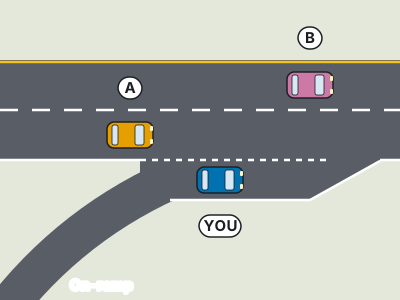
2. When entering a multi-lane highway in New Hampshire, what is the acceleration lane for?
- Stopping to wait for a large gap
- Reaching the speed of other vehicles before pulling onto the roadway
- Reading the exit signs
- Passing slower traffic on the right
Show answer
Reaching the speed of other vehicles before pulling onto the roadway. Use the acceleration lane to reach the speed of other vehicles before pulling onto the roadway, then identify a gap in traffic and merge with the flow. Stopping at the end of the ramp leaves you trying to enter fast traffic from a standstill, and the ramp is never a passing lane. Drivers already on the highway have the right of way, and the manual asks them to allow space for entering vehicles by moving over a lane or adjusting speed.
Study this in the handbook: Signals, headlights, horn and stopping distance
3. What is the minimum speed on a New Hampshire interstate highway in good conditions?
- 35 mph
- 45 mph
- 55 mph
- There is no minimum
Show answer
45 mph. The minimum speed you may drive on an interstate highway is 45 mph, unless road and weather conditions are so bad that this speed is unsafe. Drivers who go far slower than the normal flow create a hazard by blocking those behind them, causing other drivers to jump from lane to lane or take chances passing. Thirty five and fifty five are not the interstate minimum, and the manual does set a floor, so there is a minimum.
Study this in the handbook: Speed limits
4. A New Hampshire traffic signal is flashing yellow. What should the driver be prepared for?
- Come to a complete stop and wait for green
- Stop, then go as at a stop sign
- Proceed at normal speed because cross traffic must stop
- Slow down, proceed with caution, and be prepared to stop for any traffic entering the intersection
Show answer
Slow down, proceed with caution, and be prepared to stop for any traffic entering the intersection. A flashing yellow traffic light means slow down and proceed with caution, and the manual adds that drivers should be prepared to stop for any traffic flow entering the intersection. It is not a stop signal, so waiting for green or treating it like a stop sign is wrong, but holding normal speed on the assumption that cross traffic will stop is dangerous. Flashing red is the signal that requires a complete stop before proceeding.
Study this in the handbook: Traffic signals and officers
5. How should a New Hampshire driver treat vehicles with their headlights on that are following a hearse?
- Allow them to pass as a group
- Merge into the gap between them
- Sound the horn so the line moves faster
- Pass them on the left
Show answer
Allow them to pass as a group. Funeral processions are on the manual's list of road users to yield to. Drivers should allow vehicles that have their headlights on while following a hearse to pass as a group, which means not cutting into the line or passing it. Merging into a gap splits the group, passing it on the left ignores the duty to yield, and sounding the horn to hurry the line is not part of yielding. Give the procession the time it needs and continue only after the group has gone by.
Study this in the handbook: Yielding the right of way
6. Where does the New Hampshire manual say a driver's hands should be on the steering wheel?
- One hand at the top of the wheel
- At 10 and 2 o'clock
- At 12 and 6 o'clock
- At 9 and 3 o'clock, or 8 and 4 o'clock
Show answer
At 9 and 3 o'clock, or 8 and 4 o'clock. Hands belong at the 9 o'clock and 3 o'clock positions or the 8 o'clock and 4 o'clock positions, with knuckles and thumbs on the outside of the wheel. The 10 and 2 position, the 12 and 6 position, and a single hand at the top are not the positions this manual gives. The manual pairs hand position with steering method: hand to hand steering is used for slight steering, and hand over hand for greater steering inputs.
Study this in the handbook: Yielding the right of way
7. What penalty does New Hampshire list for failing to clear snow and ice off a vehicle before driving?
- A $25 fine
- $250 to $500 for a first offense, with higher penalties for repeat offenses
- A warning only
- License revocation
Show answer
$250 to $500 for a first offense, with higher penalties for repeat offenses. Since 2002 New Hampshire drivers have been legally required to clear snow and ice off their vehicles before getting on the road, and penalties for the offense can be $250 to $500 for a first offense with increased penalties for subsequent offenses. A $25 fine, a warning only, or license revocation does not match the stated penalty. Before driving in winter, clear the vehicle completely, including the windows and lights, so that snow and ice do not come off the vehicle on the road.
Study this in the handbook: Vehicle checks, seating and restraints
8. How long does the New Hampshire manual say a child may be left unattended in a vehicle?
- Never, for any length of time
- Up to 10 minutes with a window open
- Up to 5 minutes in cool weather
- As long as the engine and air conditioning are running
Show answer
Never, for any length of time. In warm weather a vehicle begins to heat up immediately after it is turned off, and it takes only minutes to reach dangerous temperatures. The manual passes on the National Highway Traffic Safety Administration advice never to leave a child in a vehicle unattended for any length of time. An open window or cool day does not create a safe interval. Check the whole vehicle, especially the back seat, before locking it, and keep keys and fobs out of children's reach.
Study this in the handbook: Vision, fatigue, emotions and hot vehicles
9. On a long trip, how often does the New Hampshire manual say to plan a stop to fight fatigue?
- Every 30 minutes
- At least every 2 hours
- Every 4 hours
- Only when you feel sleepy
Show answer
At least every 2 hours. The fatigue advice is specific: during long trips, plan to stop at least every 2 hours to stretch or get a cup of coffee or a soft drink. Waiting until you feel sleepy runs against the manual, which says to stop before getting too tired. The other tools are getting 7 to 9 hours of sleep, taking a 15 to 20 minute nap at the next exit or rest area, avoiding late night driving, and arranging for a travel companion to drive.
Study this in the handbook: Vision, fatigue, emotions and hot vehicles
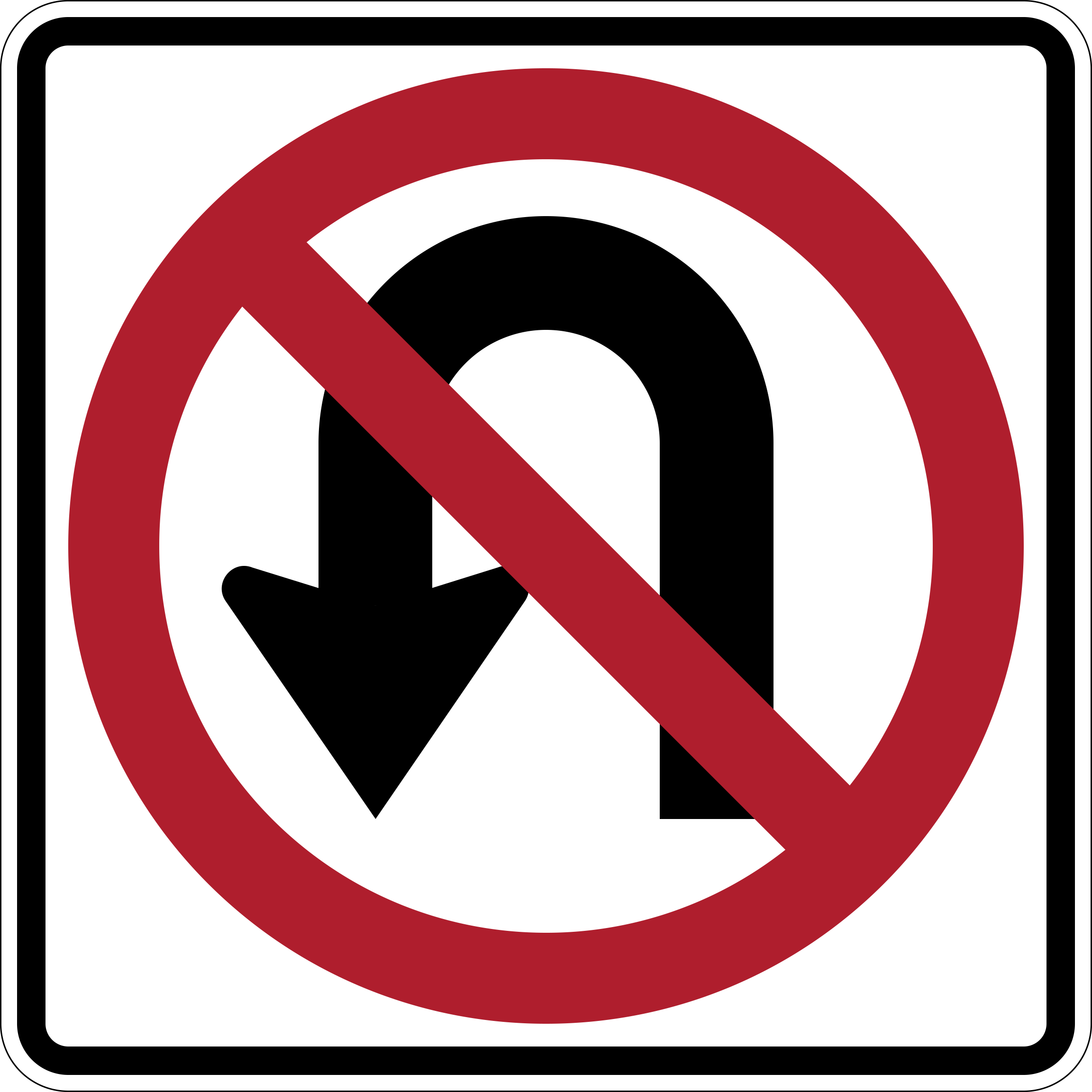
10. What does the red circle and slash over the U-shaped arrow on this sign mean in New Hampshire?
- U-turns are allowed after yielding
- U-turns are required to reverse direction
- U-turns are prohibited at that location
- The road ahead curves back on itself
Show answer
U-turns are prohibited at that location. Some regulatory signs have a red circle with a red slash over a symbol, which prohibits the action shown, and No U-Turn is one of the manual's listed prohibition signs. The slash cancels the movement, so the sign neither requires nor permits a U-turn, and it is not a curve warning, which would be a yellow diamond. The manual warns that U-turns can be extremely dangerous and are not legal everywhere, so a driver who must reverse direction should first check for signs prohibiting them.
Study this in the handbook: Regulatory, guide, work zone and railroad signs
11. A person with a walking disability photographs a car parked illegally in an accessible space. What must go with the photo?
- A sworn statement to the local police department
- A ticket written by the person who took the photo
- A form mailed to the Division of Motor Vehicles
- Nothing, the photo alone is enough
Show answer
A sworn statement to the local police department. New Hampshire law permits persons with walking disabilities or their drivers to submit a photo of a vehicle parked illegally in an accessible parking space or access aisle. The photo must come with a sworn statement to the local police department, so it is not enough on its own. The person submits the photo rather than writing a ticket, and it goes to local police rather than the DMV. Parking in these spaces or in the striped access aisle carries a fine.
Study this in the handbook: Parking rules and distances
12. Before making a U-turn in New Hampshire, what should a driver check first?
- Whether the speed limit is under 35 mph
- Whether the road has at least four lanes
- Whether any signs indicate that U-turns are prohibited
- Whether the shoulder is paved
Show answer
Whether any signs indicate that U-turns are prohibited. U-turns can be extremely dangerous and are not legal everywhere, so a driver who must reverse direction should first check for signs indicating that U-turns are prohibited. The manual's method is to pull over to the right shoulder using the turn signal, wait for the road to be clear, signal again, and turn into the nearest lane going the opposite direction. Lane count, speed limit and shoulder surface are not the tests the manual gives.
Study this in the handbook: Toll lanes, turns, U-turns and intersections
13. Your vehicle breaks down in New Hampshire and you have no phone. What does the manual say to tie to the door handle or antenna?
- A yellow cloth
- Any dark cloth
- A white cloth, or red in a snowstorm
- Nothing, wave at passing cars
Show answer
A white cloth, or red in a snowstorm. Once stopped, use a cell phone or other device to notify authorities that the vehicle has broken down. If none is available, raise the hood and tie a white cloth, or a red one in a snowstorm, to the driver's door handle or the antenna, which alerts drivers that help is needed. If possible stay with the vehicle until help arrives, unless it sits in a hazardous location, in which case get everyone out and well away from traffic. A yellow or dark cloth, or simply waving at cars, is not the manual's signal.
Study this in the handbook: Brake failure, blowouts and breakdowns
14. Why does the New Hampshire manual say a driver should never drink alcohol while taking other drugs?
- Alcohol cancels the benefit of most medicines
- The drugs could multiply the effects of alcohol or add effects of their own
- It is only a concern with illegal drugs
- Mixing them makes a breath test inaccurate
Show answer
The drugs could multiply the effects of alcohol or add effects of their own. Combining alcohol with other drugs is singled out because the drugs could multiply the effects of alcohol or have additional effects of their own that severely impair the ability to drive. The warning applies to prescription and over-the-counter drugs as well as illegal ones, since many legal medicines affect reflexes, judgment, vision and alertness in ways similar to alcohol. The concern is impairment on the road, not whether a medicine still works or how a breath test reads.
Study this in the handbook: How alcohol and drugs affect driving
15. How often does a New Hampshire driver's license expire?
- Every 4 years on the issue date
- Every 8 years on the applicant's birthday
- Every 5 years on the applicant's birthday
- Every 10 years on the issue date
Show answer
Every 5 years on the applicant's birthday. New Hampshire licenses expire on the applicant's birthday every 5 years. A reminder is mailed to the last known address about two months before expiration, but renewal is the driver's responsibility, and no reminder is sent if the address changed without notice to the DMV or the license is under suspension. Drivers who will be temporarily out of state may renew up to six months early. Youth Operator licenses follow a different rule and expire on the 21st birthday.
Study this in the handbook: Youth Operator license, restrictions and renewal
16. For a first offense under New Hampshire's Youth Operator Under 20 law, how long may a license be suspended?
- A minimum of 45 days but not more than 90 days
- Exactly 30 days
- A minimum of 90 days but not more than 180 days
- A minimum of 20 days but not more than 40 days
Show answer
A minimum of 20 days but not more than 40 days. Under RSA 263:14 the Director of Motor Vehicles may suspend or revoke the license of a driver under 20 after a hearing for certain motor vehicle offenses. The first offense period is a minimum of 20 days but not more than 40 days. The 45 to 90 day range applies to a second offense, and 90 to 180 days applies to a third or later offense, which also requires an in-person driver attitude program before reinstatement. Convictions for DUI, reckless operation, or speeding more than 30 mph over the limit bring additional penalties.
Study this in the handbook: Suspensions, points and habitual offenders
17. How can a New Hampshire driver change or revoke an organ donor designation?
- Only at the next license renewal
- Only by writing to New England Donor Services
- By submitting a Record Change Request form in person at any DMV office
- By calling the DMV and giving verbal consent
Show answer
By submitting a Record Change Request form in person at any DMV office. Every license or non-driver ID application gives the applicant the chance to designate consent to be an organ and tissue donor, and the choice can be revoked or changed at any time by submitting a Record Change Request form in person at any DMV office. You do not have to wait for renewal, and a phone call or a letter to the donor organization does not update the DMV record. The DMV shares the designation with New England Donor Services so the decision can be honored.
Study this in the handbook: Driver education and practice driving
18. Who must accompany a person who is practice driving in New Hampshire?
- A parent, legal guardian, or a licensed responsible adult who is 25 or older
- Any licensed driver who is at least 18
- Any adult who holds a valid non-driver ID
- A licensed driver of any age seated anywhere in the vehicle
Show answer
A parent, legal guardian, or a licensed responsible adult who is 25 or older. Because the state issues no learner permit, the supervising adult carries the responsibility. The learner must be accompanied by a parent, legal guardian, or a responsible adult who is 25 years of age or older and who is a licensed driver. An 18 year old licensed driver is too young to supervise, and a non-driver ID holder is not a licensed driver at all. The same 25 or older standard applies to out-of-state teens driving in New Hampshire without a license.
Study this in the handbook: Driver education and practice driving
19. This yellow curved arrow sign warns of a Right Curve. When should a New Hampshire driver reduce speed for it?

- Before entering the curve, to a speed that allows slight constant acceleration through it
- In the middle of the curve
- Only if another vehicle is ahead
- Only when the road is wet
Show answer
Before entering the curve, to a speed that allows slight constant acceleration through it. Right Curve is one of the manual's warning signs, and its section on curves says to always reduce speed prior to entering the curve to a safe speed, meaning one that allows the driver to apply slight and constant acceleration through the curve. Reduce more when traction is poor, when following other vehicles, or when the end of the curve cannot be seen. Hard braking after entering a curve could cause the tires to lose traction.
Study this in the handbook: Lane changes, passing, backing and road conditions
20. In New Hampshire's list of standard sign colors, what does a yellow sign indicate?
- It marks road repair work
- It gives driver services information
- It is a law or rule of the road
- It is a general warning
Show answer
It is a general warning. The manual's standard colors give a quick read on any sign. Yellow means general warning, and warning signs alert a driver to slow down because of a curve or intersection ahead, to be prepared to stop if necessary, or to a hazard or special situation on the roadway ahead. Orange is road repair work warning, blue is driver services, and white is a law or rule of the road. Red means prohibition and green gives direction or guidance. Reading the color first tells you the kind of message before you can read the words.
Study this in the handbook: Sign shapes, colors and warning signs
QualitySpace is expanding to New Hampshire
We are a California-based independent insurance brokerage working on licensing in more states. We cannot help with New Hampshire insurance yet. Leave your email and we will let you know when we can.
Every question is written from the official New Hampshire Driver's Manual. Need paper? Printable NH practice test with answer key.
Last verified 2026-10-05. How we check every question · Study all 208 as flashcards
Frequently asked questions
How many questions are on this New Hampshire practice test?
This fixed set has 20 questions. It is test 4 of 10 from the 208 question New Hampshire bank. The real NH exam asks 40 questions and you need 32 correct.
What is the passing score for the real New Hampshire test?
All knowledge exams require a passing grade of 80% That figure comes from the official New Hampshire source cited on the DMV facts page.
How does this fixed test relate to the full New Hampshire bank?
Each numbered test is a fixed set of questions in a fixed order, so you can retake the same test later and compare. Every test mixes road signs and the other topics in about the same proportion as the full bank. Tests 1 to 10 together cover 200 of the 208 questions in the New Hampshire bank, each once. The full practice page mixes the whole bank at random.
Last verified 2026-10-05. See the New Hampshire DMV facts page for sourced state details.
Return to the full New Hampshire practice test · Study road signs