
Test 10 of 10 · 20 questions · Free 2026
NH Permit Practice Test 10
Jump to the test ↓A fixed 20 question set from the New Hampshire bank with answers and plain English explanations. The real NH exam is 40 questions, 80 percent to pass; take the full length version on the main practice page.
Question 1 of 20 · 0 right so far
All 20 questions in test 10
Every question below comes from the New Hampshire question bank on this page. Open a question to see the correct answer and the explanation. Nothing here is hidden behind a signup.
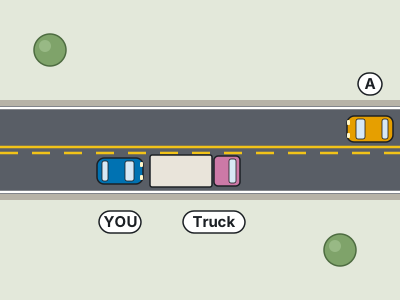
1. A New Hampshire road has a broken yellow line next to a solid yellow line, and the broken line is on your side. May you pass?
- No, the solid line applies to both directions
- Yes, when it is safe, because the line on your side is broken
- Only if the vehicle ahead signals you around
- Only at night
Show answer
Yes, when it is safe, because the line on your side is broken. With double white or yellow lines, drivers must not pass if the line on the driver's side is solid. If the line on the driver's side is broken, they may pass when safe to do so. The solid line governs the other direction, not yours. Safe still means no oncoming traffic, a clear view not blocked by a curve or hill, no intersection, and no railroad crossing or bridge ahead. A wave from the driver ahead never makes a pass legal.
Study this in the handbook: Pavement markings
2. Your brakes stop working while driving in New Hampshire. How does the manual say to use the parking brake?
- Apply it slowly to avoid locking the rear wheels and be ready to release it if the vehicle skids
- Do not use it while moving
- Yank it as hard as possible
- Apply it only after turning off the engine
Show answer
Apply it slowly to avoid locking the rear wheels and be ready to release it if the vehicle skids. In a brake failure, engage the parking brake by pulling the handle or pushing the foot pedal slowly to avoid locking the rear wheels and causing a skid, and be ready to release it if the vehicle starts to skid. Only if engaging the parking brake does not work does the manual say to turn off the engine and look for a safe place to slow to a stop off the roadway. Yanking the brake risks locking the rear wheels, and the parking brake comes before shutting off the engine, not after.
Study this in the handbook: Brake failure, blowouts and breakdowns
3. Which sign shape gives advance warning of a railroad crossing in New Hampshire?
- A rectangle
- An octagon
- A pentagon
- A circle
Show answer
A circle. The manual's standard shapes assign the circle to advance warning of a railroad crossing, while the crossbuck X marks the crossing itself. The octagon means stop, the pentagon marks a school zone or crossing, and a rectangle carries traffic regulations or directions. The round warning sign with the X symbol and black RR letters appears along the road before the tracks and tells the driver to slow down or stop and look and listen for a train before proceeding.
Study this in the handbook: Sign shapes, colors and warning signs
4. When exiting a parallel parking space in New Hampshire, when should the driver move forward into the traffic lane?
- As soon as the front bumper clears the vehicle ahead
- When the door post of the vehicle clears the rear bumper of the vehicle parked ahead
- Immediately after signaling
- After backing into the vehicle behind
Show answer
When the door post of the vehicle clears the rear bumper of the vehicle parked ahead. Leaving a parallel space starts with checking traffic in all directions with mirrors and head checks, backing as far as possible toward the vehicle behind, then signaling and moving forward slowly while steering into the lane. Make sure the front bumper will clear the vehicle ahead, correcting in reverse if it will not, and move into the lane when the door post of the vehicle clears the rear bumper of the vehicle parked ahead. Signaling alone does not make the path clear.
Study this in the handbook: Parking rules and distances
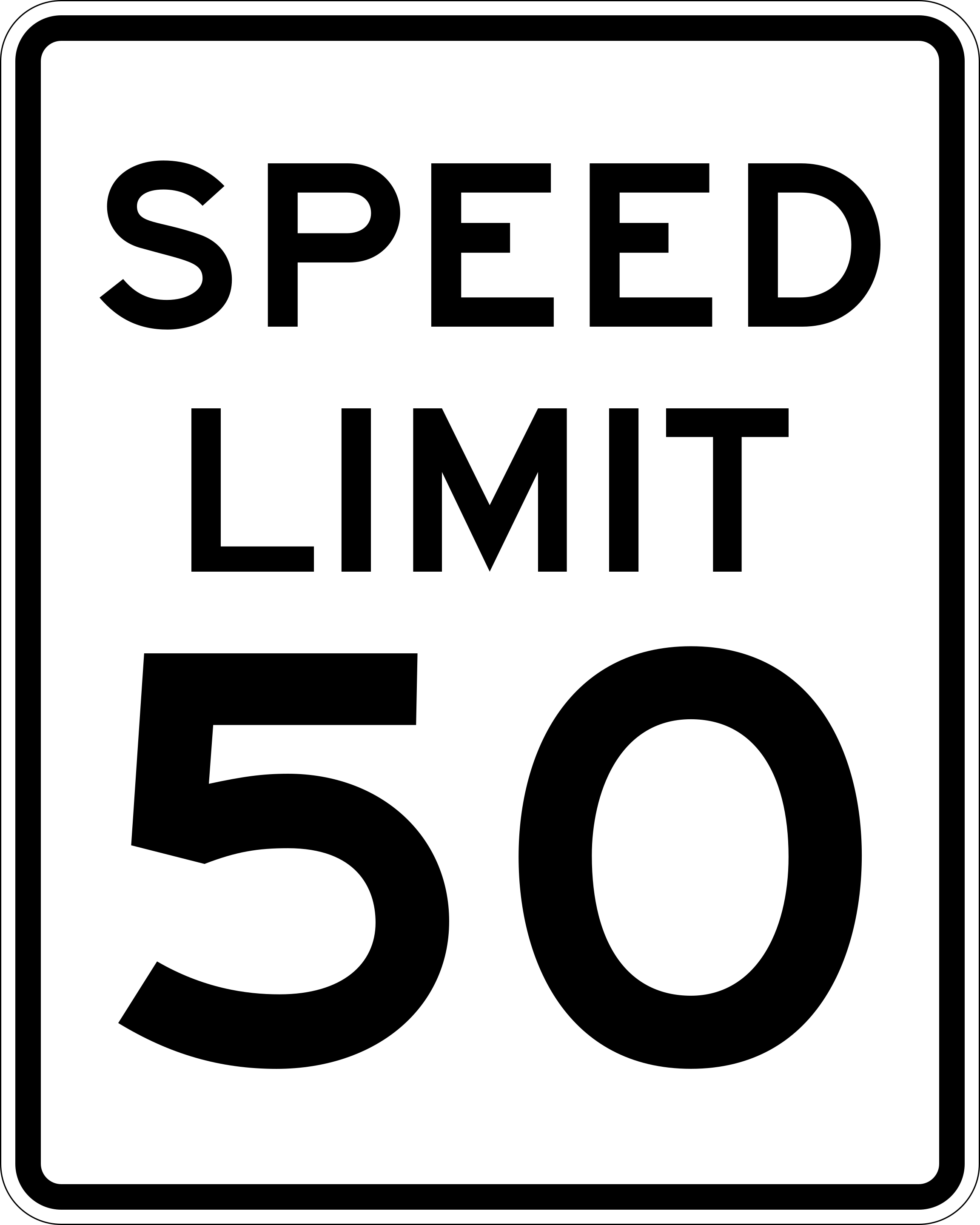
5. What does this black and white SPEED LIMIT sign indicate in New Hampshire?
- A recommended speed for curves
- The minimum speed for the road
- The maximum legal speed allowed in ideal conditions
- A speed that applies only at night
Show answer
The maximum legal speed allowed in ideal conditions. Speed limit signs are black and white and indicate the maximum legal speed allowed in ideal conditions. They are regulatory signs, so the number is a legal ceiling, and the manual adds that safe speed is determined by road conditions, visibility, traffic and the vehicle, which can require driving slower. The sign is not a curve advisory, not a minimum, and not a night only limit. When there is no sign, the statutory limits apply, such as 30 mph in a business or urban residence district.
Study this in the handbook: Regulatory, guide, work zone and railroad signs
6. How much extra following distance does the New Hampshire manual recommend on an unfamiliar road at night?
- At least one additional second
- At least five additional seconds
- No change from daytime
- At least two additional seconds
Show answer
At least two additional seconds. Night driving limits how far you can see to the reach of the headlights, so the manual adds time to the four second following distance. Add at least one additional second for night driving conditions, and at least two additional seconds when driving on unfamiliar roadways at night. One second is the ordinary night increase, five is more than the manual asks, and keeping the daytime gap ignores the shorter view. Search well ahead of the beams for dark shapes such as pedestrians or animals.
Study this in the handbook: Rural roads and night driving
7. This yellow sign shows a skidding car. What does the New Hampshire manual call it, and what should you do?

- Curvy Road Ahead; hold speed through the curves
- Sharp Curve Ahead; brake hard in the curve
- Slippery When Wet; reduce speed because tires do not grip as well and stopping takes longer
- Added Lane; move right
Show answer
Slippery When Wet; reduce speed because tires do not grip as well and stopping takes longer. The skidding car symbol is the Slippery When Wet warning sign, shown among the manual's examples of warning signs. The manual's advice for slippery roads is to reduce speed at the first sign of rain, snow, sleet or ice, because tires do not grip as well, it takes longer to stop, and it is harder to turn without skidding. Holding speed ignores that advice, and hard braking after entering a curve could cause the tires to lose traction. Slowing before the slick section is the safest response.
Study this in the handbook: Lane changes, passing, backing and road conditions
8. Under ideal conditions, how much distance does a loaded truck traveling at 55 mph need to come to a complete stop?
- At least 335 feet
- About 158 feet
- About 100 feet
- About 250 feet
Show answer
At least 335 feet. The manual says a loaded truck with good tires and properly adjusted brakes at 55 mph needs a minimum of 335 feet to stop, which is more than one and a half times a car's stopping distance. The 158 foot figure is the braking distance for a car at 50 mph on dry pavement, and 100 feet is far too short. Two hundred fifty feet is below the stated minimum. This is why you should never cut in front of a large vehicle.
Study this in the handbook: Motorcycles, large trucks and slow vehicles
9. You are on an entrance ramp to a New Hampshire interstate. Who has the right of way?
- Drivers already on the interstate
- You, because your turn signal is on
- Whichever vehicle is larger
- You, if you reach the end of the ramp first
Show answer
Drivers already on the interstate. Drivers on an entrance or acceleration ramp yield to drivers already on a limited access or interstate highway. The manual says to use the acceleration lane to reach the speed of other vehicles before pulling onto the roadway, identify a gap in traffic, and merge with the traffic flow. A turn signal announces your plan but does not give you the right of way. Vehicle size does not decide who goes first, and reaching the end of the ramp first does not change the rule.
Study this in the handbook: Yielding the right of way
10. On the New Hampshire knowledge test, what happens once a tester has answered more than 8 questions incorrectly?
- The tester may keep going and needs 32 correct overall
- The test automatically ends
- The tester gets 10 extra questions
- The examiner reviews the missed questions with the tester
Show answer
The test automatically ends. The knowledge test is scored as you go. Once more than 8 questions have been answered incorrectly, the touch screen test ends automatically, and the applicant is given an appointment to retest no sooner than ten days from the failed test. There is no bonus set of questions and no examiner walkthrough. Since 8 misses is the ceiling on a 40 question test, study every section of the manual rather than counting on a strong finish.
Study this in the handbook: The vision, knowledge and road tests
11. Which New Hampshire applicants must complete an approved driver education program before applying for a license?
- Only applicants who failed the road test once
- Only applicants under 16
- Every applicant of any age
- All applicants who are 16 or 17 years old
Show answer
All applicants who are 16 or 17 years old. State law RSA 263:19 requires everyone who is 16 or 17 years of age and wants a driver's license to have first completed an approved driver education program. The requirement is tied to those two ages, so an adult applicant is not required to take the course and an applicant under 16 cannot yet apply for a license at all. Failing a test does not trigger the requirement. More than 13,000 students go through the program each year at state approved driving schools.
Study this in the handbook: Driver education and practice driving
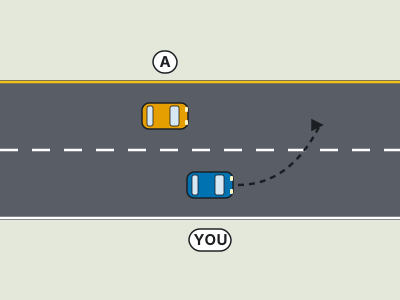
12. Before changing lanes, what does the New Hampshire manual say to check besides the mirrors?
- All blind spots, using head checks
- Only the speedometer
- Only the rearview camera
- The lane two lanes over
Show answer
All blind spots, using head checks. Before changing lanes a driver should check the vehicle's mirrors, check all blind spots, which are the areas around the vehicle that cannot be seen in the mirrors, by using head checks, then identify a gap in traffic, signal, look again in the direction of the lane change, adjust speed and steer into the lane. Even properly adjusted mirrors do not eliminate blind spots, and a blind spot monitor is a backup, not a substitute for looking over your shoulder.
Study this in the handbook: Lane changes, passing, backing and road conditions
13. When does New Hampshire law require headlights to be on, besides the period from half an hour after sunset to half an hour before sunrise?
- Whenever the wipers are on for any reason
- Only when visibility drops below 500 feet
- Only on divided highways at dusk
- Whenever rain, snow, or fog keeps persons and vehicles from being clearly seen 1000 feet ahead
Show answer
Whenever rain, snow, or fog keeps persons and vehicles from being clearly seen 1000 feet ahead. New Hampshire law requires every motor vehicle to display at least two lighted front lamps from half an hour after sunset to half an hour before sunrise, and whenever rain, snow or fog interferes with the view of the road so that persons and vehicles are not clearly discernible at a distance of 1000 feet ahead. A motorcycle needs one lamp. The threshold is 1000 feet, not 500, and it is about visibility, not wipers or road type, although low beams are the right choice in fog.
Study this in the handbook: Speed limits
14. A New Hampshire resident with a valid New Hampshire license enlists in the U.S. armed forces for three years. What does the manual say about renewing that license?
- Renewal is frozen until the driver is discharged
- The driver is entitled to renew it at no cost
- The driver must retake the knowledge test to renew
- The driver must pay double the renewal fee from out of state
Show answer
The driver is entitled to renew it at no cost. A member of the United States armed forces who, at induction, call to active duty, or enlistment for two or more years, was a New Hampshire resident holding a valid New Hampshire license is entitled to renew the driver's license at no cost. A three year enlistment meets the two year threshold. Nothing in the manual freezes renewal until discharge, requires a new knowledge test, or charges extra. Service members still need to renew, since licenses expire every 5 years on the birthday.
Study this in the handbook: Youth Operator license, restrictions and renewal
15. A fire truck has stopped to answer a fire alarm in New Hampshire. Where may you not drive or park?
- Only within 50 feet of the fire truck
- Within the block where the fire truck has stopped
- Only on the same side of the street as the truck
- Only within 15 feet of a fire hydrant
Show answer
Within the block where the fire truck has stopped. Once a fire truck has stopped to answer an alarm, drivers must not drive or park anywhere within that whole block. Fifty feet or one side of the street is far smaller than a full block. The 15 foot hydrant rule applies every day, not only at a fire. A separate rule says not to follow a fire truck closer than 500 feet when it is sounding a siren or operating flashing lights.
Study this in the handbook: Emergency vehicles, Sherrill's Law and traffic stops
16. Under New Hampshire's implied consent rule, what has every driver agreed to by operating a motor vehicle?
- Automatic license surrender after any crash
- A vehicle search at any traffic stop
- Testing of blood, breath, urine, or a combination if arrested for an alcohol or drug offense
- A yearly medical exam
Show answer
Testing of blood, breath, urine, or a combination if arrested for an alcohol or drug offense. Any person who operates a motor vehicle in New Hampshire is considered to have given consent to having their blood, breath, urine, or any combination tested if arrested for an alcohol or drug offense. That is what implied consent means: the agreement was made by driving, not by signing anything at the roadside. It is not a general search permission and has nothing to do with crashes or medical exams. Refusing the test may itself result in loss of driving privileges.
Study this in the handbook: Suspensions, points and habitual offenders
17. Which vehicle is listed as an exception to New Hampshire's rule that riders under 18 be restrained?
- A family car on a trip of less than 5 miles
- A pickup truck with only a front bench seat
- A school bus weighing more than 10,000 pounds
- Any car traveling under 25 mph
Show answer
A school bus weighing more than 10,000 pounds. The restraint rule for anyone under 18 has a short list of exceptions: a vehicle regularly used to transport passengers for hire, a school bus over 10,000 pounds or a lighter school bus built without belts, an antique vehicle built without restraints, a motorcycle, and a child whose individual education plan says restraints are not safe. Short trips, low speeds, and bench seat pickups are not exceptions. Everyone under 18 in an ordinary car or truck must be belted or in a child seat.
Study this in the handbook: Vehicle checks, seating and restraints
18. How can a New Hampshire driver tell whether a truck driver can see their vehicle?
- If the truck's brake lights are on
- If the truck sounds its horn
- If the truck is in the right lane
- If the truck driver's face cannot be seen in the truck's side view mirror, the truck driver cannot see you
Show answer
If the truck driver's face cannot be seen in the truck's side view mirror, the truck driver cannot see you. Large trucks and buses have big No-Zones on both sides, much larger than a car's blind spot, with a large blind area on the right starting behind the cab and running the length of the truck. The test is simple: if the truck driver's face cannot be seen in the side view mirror, the truck driver cannot see the other vehicle. Brake lights, a horn, or the truck's lane do not tell you whether the driver can see you. Avoid driving alongside a large vehicle any longer than necessary, and pass or drop back so you stay visible.
Study this in the handbook: Motorcycles, large trucks and slow vehicles
19. A visitor holds a license card from another state, but their driving privileges are suspended. May they drive in New Hampshire?
- Yes, as long as the license card has not expired
- Yes, if a licensed adult 25 or older rides along
- No, not under any circumstances
- Yes, for up to 60 days after arriving
Show answer
No, not under any circumstances. The manual is absolute: under no circumstances may a person drive in New Hampshire while their driving privileges are suspended or revoked, even if they possess a license from another state. Holding an unexpired card does not restore suspended privileges. The licensed adult 25 or older is part of the practice driving rule for unlicensed learners, and it never applies to someone under suspension. Sixty days is the time a new resident has to get a New Hampshire license, not a grace period for suspended drivers.
Study this in the handbook: Driver education and practice driving
20. A person carrying a white cane is about to cross a New Hampshire street. What does the law require of drivers?
- Come to a complete stop, and never honk the horn or yell at the person
- Sound the horn to signal it is safe to cross
- Slow down and go around
- Flash the headlights
Show answer
Come to a complete stop, and never honk the horn or yell at the person. New Hampshire law requires drivers to come to a complete stop whenever a person carrying a white cane, the international symbol of blindness, or using a harnessed guide dog is attempting to cross a roadway. The visually impaired person listens to determine that vehicles have stopped before stepping out, so a horn or a shout only confuses them. Stop, use extra caution when proceeding, and remember the manual's separate warning against honking near blind pedestrians at any time.
Study this in the handbook: Pedestrians and bicyclists
QualitySpace is expanding to New Hampshire
We are a California-based independent insurance brokerage working on licensing in more states. We cannot help with New Hampshire insurance yet. Leave your email and we will let you know when we can.
Every question is written from the official New Hampshire Driver's Manual. Need paper? Printable NH practice test with answer key.
Last verified 2026-10-05. How we check every question · Study all 208 as flashcards
Frequently asked questions
How many questions are on this New Hampshire practice test?
This fixed set has 20 questions. It is test 10 of 10 from the 208 question New Hampshire bank. The real NH exam asks 40 questions and you need 32 correct.
What is the passing score for the real New Hampshire test?
All knowledge exams require a passing grade of 80% That figure comes from the official New Hampshire source cited on the DMV facts page.
How does this fixed test relate to the full New Hampshire bank?
Each numbered test is a fixed set of questions in a fixed order, so you can retake the same test later and compare. Every test mixes road signs and the other topics in about the same proportion as the full bank. Tests 1 to 10 together cover 200 of the 208 questions in the New Hampshire bank, each once. The full practice page mixes the whole bank at random.
Last verified 2026-10-05. See the New Hampshire DMV facts page for sourced state details.
Return to the full New Hampshire practice test · Study road signs