
Test 9 of 10 · 20 questions · Free 2026
NH Permit Practice Test 9
Jump to the test ↓A fixed 20 question set from the New Hampshire bank with answers and plain English explanations. The real NH exam is 40 questions, 80 percent to pass; take the full length version on the main practice page.
Question 1 of 20 · 0 right so far
All 20 questions in test 9
Every question below comes from the New Hampshire question bank on this page. Open a question to see the correct answer and the explanation. Nothing here is hidden behind a signup.
1. Under RSA 265:79-c, which activity with a hand-held device is prohibited while driving in New Hampshire?
- Listening to the radio
- Talking to a passenger
- Inputting information into a GPS or navigation device
- Adjusting the climate controls
Show answer
Inputting information into a GPS or navigation device. The hand-held device law covers more than texting. While driving or temporarily halted in traffic, no person may use a hand-held mobile electronic device to read, compose, view or post a message, initiate or conduct a conversation, access the Internet, input information into a global positioning system or navigation device, or manually type data into any portable electronic device. Radio, conversation with a passenger, and climate controls are not electronic device use under the statute, although any distraction can still be dangerous.
Study this in the handbook: Hand-held devices and distraction
2. How many questions are on the New Hampshire automated knowledge test, and how long do testers have?
- 40 questions in 40 minutes
- 25 questions in 30 minutes
- 50 questions in 60 minutes
- 40 questions with no time limit
Show answer
40 questions in 40 minutes. The automated knowledge test has 40 multiple choice questions on the rules of the road and general driving conditions, and testers have 40 minutes to finish. It runs on a touch screen with four possible answers per question, so no computer experience is needed. There is a time limit, and the test does not run to 50 questions. One more detail matters on test day: if more than 8 questions are answered incorrectly, the test ends automatically.
Study this in the handbook: The vision, knowledge and road tests
3. What does a steady red arrow mean for New Hampshire drivers and for pedestrians facing it?
- Drivers may turn after stopping, and pedestrians may cross
- Only pedestrians may proceed
- Drivers may not enter unless other indications shown at the same time permit it, and pedestrians facing it shall not enter the roadway
- The arrow direction is closed to trucks only
Show answer
Drivers may not enter unless other indications shown at the same time permit it, and pedestrians facing it shall not enter the roadway. A red arrow means drivers may not enter the intersection unless permitted by other indications shown at the same time, such as a green light for a different movement. The manual adds that, unless otherwise directed by a pedestrian signal, pedestrians facing a steady red arrow signal shall not enter the roadway. It is not a stop and then turn signal like a flashing red, and it applies to every vehicle, not only trucks.
Study this in the handbook: Traffic signals and officers
4. Why does the New Hampshire manual say to use low beams in fog, rain, or snow?
- Light from the high beams may cause glare and make it harder to see ahead
- Low beams are brighter in bad weather
- High beams drain the battery faster
- It is only a courtesy to other drivers
Show answer
Light from the high beams may cause glare and make it harder to see ahead. In fog, rain or snow, use the low beams. The manual explains that light from the high beams may cause glare and make it more difficult to see ahead, so the brighter setting does not help in those conditions. Some vehicles have fog lights that may be useful in fog, snow or rain. The reason given is your own view of the road, not battery use or courtesy alone, although dimming for all approaching traffic is also expected.
Study this in the handbook: Rural roads and night driving
5. An orange and red triangle is displayed on the back of a farm tractor ahead of you. What speed does it tell you to expect?
- Less than 15 mph
- Less than 35 mph
- Less than 45 mph
- Less than 25 mph
Show answer
Less than 25 mph. The fluorescent or reflective orange and red triangle marks a slow moving vehicle, such as an animal drawn vehicle, farm equipment, or construction equipment, and it means the vehicle is traveling less than 25 mph. Fifteen, 35, and 45 mph are not the figures tied to the emblem. Closing speed builds fast at highway speeds, so slow early and pass only when it is safe. Farm machinery operators often cannot hear approaching vehicles.
Study this in the handbook: Motorcycles, large trucks and slow vehicles
6. A New Hampshire road ahead is covered by a large body of standing water. What does the manual say to do?
- Drive through slowly in low gear
- Follow a larger vehicle through
- Find another route rather than driving through it
- Drive through fast so the engine does not stall
Show answer
Find another route rather than driving through it. The advice for flooded roadways is short: do not drive through large bodies of standing water on a road, and if there is a flooded roadway, find another route to travel. The manual does not offer a technique for getting through, so low gear, following a larger vehicle, and driving fast are not substitutes for choosing a different road. Treat a flooded stretch as closed to your vehicle and plan the detour instead.
Study this in the handbook: Rural roads and night driving
7. In the New Hampshire manual's standard sign colors, what does a brown sign indicate?
- Tourist and recreation guidance
- Incident management
- Road repair work warning
- Driver services
Show answer
Tourist and recreation guidance. The color chart pairs each color with a message. Brown means tourist and recreation guidance. Orange is road repair work warning, pink is incident management, and blue is driver services. Green gives direction or guidance, white marks a law or rule of the road, yellow is general warning, red is prohibition, and purple identifies E-ZPass. Reading the color tells you the kind of message before you read the words, so a brown sign points toward a recreation or tourist destination.
Study this in the handbook: Sign shapes, colors and warning signs
8. How far in advance should a New Hampshire driver signal before changing lanes or exiting on the highway?
- At least 100 feet
- At least 200 feet
- At least 500 feet
- At least 1,000 feet
Show answer
At least 500 feet. The manual gives two signaling distances. Drivers should signal at least 100 feet before a turn, and on the highway they should signal at least 500 feet before changing lanes or exiting the roadway. The manual also says to use the signal sooner when it is raining, snowy or foggy, to allow for greater stopping distances by other vehicles. Signals are required for lane changes, turns, entering or leaving a highway, and pulling away from a curb.
Study this in the handbook: Speed limits
9. This yellow sign shows arrows splitting around a center island. Which warning sign in the New Hampshire manual is it?

- Y-Intersection Ahead
- Divided Highway Ends
- Added Lane
- Divided Highway Begins
Show answer
Divided Highway Begins. Divided Highway Begins is the manual's name for the sign whose arrows split around a median. It warns that opposing traffic will be separated by a divider ahead, so keep to the right of the median and expect a matching Divided Highway Ends sign later, where two way traffic resumes. Added Lane and Y-Intersection Ahead are different warnings in the same list. On a divided highway, a missed exit means driving to the next exit, never stopping or backing up.
Study this in the handbook: Sign shapes, colors and warning signs
10. After moving to New Hampshire, how long does a new resident have to obtain a New Hampshire driver's license?
- Up to 60 days
- Up to 90 days
- Up to one year
- Up to 30 days
Show answer
Up to 60 days. New residents have up to 60 days after moving into the state to obtain a New Hampshire driver's license. Thirty days is shorter than the law allows, while 90 days and a full year would leave the driver operating on an out-of-state license past the deadline. When you apply, the one license concept requires you to surrender every valid license issued by another jurisdiction, and the application will not be accepted while your privileges are suspended or revoked anywhere else.
Study this in the handbook: Driver education and practice driving
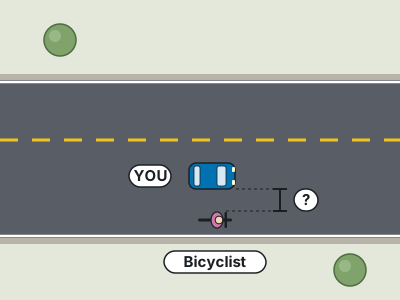
11. How much clearance must a New Hampshire driver leave when passing a bicyclist at 30 mph or less, and how does it change at higher speeds?
- At least 2 feet at every speed
- At least 3 feet, plus one additional foot for every 10 mph above 30
- A full lane at every speed
- At least 5 feet at every speed
Show answer
At least 3 feet, plus one additional foot for every 10 mph above 30. Bicycles are vehicles on the roadway, and drivers must exercise due care by leaving a reasonable and prudent distance. The distance is presumed reasonable if it is at least 3 feet when the vehicle is traveling at 30 miles per hour or less, with one additional foot of clearance required for every 10 miles per hour above 30. At 50 mph that means 5 feet. Slow down when approaching or passing, and never sound the horn close to a bicyclist unless a crash is likely.
Study this in the handbook: Pedestrians and bicyclists
12. A motorcycle ahead in New Hampshire has its turn signal flashing. Why does the manual say to be sure the rider is actually turning before turning in front of it?
- Motorcycle signals are decorative
- Most motorcycles do not have automatic cancel for turn signals
- Motorcycles cannot turn at intersections
- Riders often signal to say thank you
Show answer
Most motorcycles do not have automatic cancel for turn signals. Be aware that most motorcycles do not have automatic cancel for turn signals, so a blinking signal may be left over from an earlier turn. Before taking a turn in front of a motorcycle with its signal on, be sure the rider is actually turning. The manual gives the same caution for cars, whose drivers may plan to turn later or forget to cancel. Also check oncoming traffic carefully for motorcycles and judge their speed before any left turn across traffic.
Study this in the handbook: Motorcycles, large trucks and slow vehicles
13. How much space does the New Hampshire manual say should separate the driver's chest from the steering wheel?
- 10 inches
- 4 inches
- 18 inches
- 24 inches
Show answer
10 inches. Proper seat position puts about 10 inches between the driver's chest and the steering wheel. Four inches is closer than the manual advises, and 18 or 24 inches is farther than its stated figure; proper seating also matters for air bag deployment. The manual adds that the top of the wheel should be no higher than the top of the shoulders and below the chin, that the heel should stay on the floor while the foot pivots between pedals, and that the seat should not be reclined excessively.
Study this in the handbook: Vehicle checks, seating and restraints
14. Which vehicles must stop at every New Hampshire railroad crossing even when no train is in sight?
- All pickup trucks
- Buses that carry passengers and trucks carrying flammable or hazardous material
- Vehicles towing trailers
- Motorcycles
Show answer
Buses that carry passengers and trucks carrying flammable or hazardous material. The law requires buses that carry passengers and trucks carrying flammable or hazardous material to stop before any railroad crossing, even if there is no sign of a train coming. The manual warns other drivers to be ready to stop when driving behind these vehicles, and its space management section lists them among the vehicles that need extra following distance. Pickups, trailers and motorcycles have no such requirement unless a train is approaching.
Study this in the handbook: Regulatory, guide, work zone and railroad signs
15. Under New Hampshire law, who is required to wear a safety restraint in a moving vehicle?
- Every driver and passenger of any age
- Anyone under the age of 18
- Only the driver
- Only children under 7
Show answer
Anyone under the age of 18. New Hampshire is unusual: its safety restraint requirement covers anyone under the age of 18, and for older drivers and passengers belts are highly recommended rather than required. That is why the choice covering every driver and passenger of any age is wrong under the manual, even though it is the safest habit. The rule is not limited to the driver, and it does not stop at age 7; the under 7 figure belongs to the separate child passenger restraint rule. Buckling up is the single most effective protection in a crash.
Study this in the handbook: Vehicle checks, seating and restraints
16. What does this five-sided sign with two walking figures mean in New Hampshire?

- A hospital zone
- A pedestrian only street
- A playground with no vehicle access
- A school zone or school crossing
Show answer
A school zone or school crossing. The pentagon, or five sided sign, is reserved for school zones and school crossings. Seeing it means children may be crossing and that a posted school zone speed limit may apply, which in New Hampshire is 10 mph below the usual limit from 45 minutes before school opens until opening and from closing until 45 minutes after. Where a crossing guard is present, stop and yield when signaled. The shape is not used for hospitals or playgrounds.
Study this in the handbook: Sign shapes, colors and warning signs
17. What is the lowest BAC threshold for New Hampshire's under-21 alcohol driving rule?
- .08% or higher
- .05% or higher
- .04% or higher
- .02% or higher
Show answer
.02% or higher. New Hampshire applies a BAC threshold of .02% or higher to drivers under 21. The general adult threshold is .08%, so that number does not answer a question about a young driver. The .04% and .05% choices do not match the youth rule either; the law sets .08% for adults and .02% for drivers under 21. Alcohol can impair driving below a legal threshold, so do not drink before driving.
Study this in the handbook: BAC limits, under 21 rules and DUI penalties
18. How should a New Hampshire driver use the brake pedal in a vehicle equipped with ABS during an emergency stop?
- Press once and release
- Pump the pedal rapidly
- Press on the pedal and keep applying pressure; vibration and clicking are normal
- Use the parking brake instead
Show answer
Press on the pedal and keep applying pressure; vibration and clicking are normal. Vehicles with an anti-lock braking system let a driver stop without skidding and keep steering control, but only if the driver presses on the brake pedal and keeps applying pressure. ABS works only while pressure stays on the pedal. The driver may feel the pedal vibrate and hear a clicking noise, which is normal and not a reason to let up. Pumping or releasing the pedal takes that pressure away. For a vehicle without ABS, the manual says to check the owner's manual for the proper braking procedure.
Study this in the handbook: Emergency braking, swerving and skids
19. Which vehicles does a New Hampshire Class D license allow a driver to operate?
- Any combination of vehicles over 26,001 pounds
- Any single vehicle designed to seat more than 16 persons
- Only motorcycles and mopeds
- Vehicles of 26,000 pounds gross weight or less that are not towing over 10,000 pounds, hauling hazmat, or seating more than 16
Show answer
Vehicles of 26,000 pounds gross weight or less that are not towing over 10,000 pounds, hauling hazmat, or seating more than 16. Class D is the ordinary operator license. It allows a driver to operate a vehicle with a gross vehicle weight of 26,000 pounds or less, provided it is not towing a trailer over 10,000 pounds, not transporting hazardous materials, and not designed to seat more than 16 persons including the driver. Combinations over 26,001 pounds belong to Class A, vehicles seating more than 16 or placarded for hazmat fall under Class C, and motorcycles need their own license.
Study this in the handbook: Youth Operator license, restrictions and renewal
20. Which New Hampshire conviction requires SR-22 proof of insurance before driving and registration privileges are reinstated?
- A first speeding ticket
- Second offense reckless driving
- An expired inspection sticker
- A parking violation
Show answer
Second offense reckless driving. The manual lists the convictions that require a driver to show the DMV proof of insurance, an SR-22, to have driving and registration privileges reinstated: driving under the influence of alcohol or drugs, failing to stop and report when involved in a crash, homicide arising out of operating a motor vehicle, second offense reckless driving, and a just cause hearing after review of the driver's full violation record. Ordinary speeding, parking, and inspection violations are not on the list.
Study this in the handbook: Crashes, reports and financial responsibility
QualitySpace is expanding to New Hampshire
We are a California-based independent insurance brokerage working on licensing in more states. We cannot help with New Hampshire insurance yet. Leave your email and we will let you know when we can.
Every question is written from the official New Hampshire Driver's Manual. Need paper? Printable NH practice test with answer key.
Last verified 2026-10-05. How we check every question · Study all 208 as flashcards
Frequently asked questions
How many questions are on this New Hampshire practice test?
This fixed set has 20 questions. It is test 9 of 10 from the 208 question New Hampshire bank. The real NH exam asks 40 questions and you need 32 correct.
What is the passing score for the real New Hampshire test?
All knowledge exams require a passing grade of 80% That figure comes from the official New Hampshire source cited on the DMV facts page.
How does this fixed test relate to the full New Hampshire bank?
Each numbered test is a fixed set of questions in a fixed order, so you can retake the same test later and compare. Every test mixes road signs and the other topics in about the same proportion as the full bank. Tests 1 to 10 together cover 200 of the 208 questions in the New Hampshire bank, each once. The full practice page mixes the whole bank at random.
Last verified 2026-10-05. See the New Hampshire DMV facts page for sourced state details.
Return to the full New Hampshire practice test · Study road signs