
Test 7 of 10 · 20 questions · Free 2026
NH Permit Practice Test 7
Jump to the test ↓A fixed 20 question set from the New Hampshire bank with answers and plain English explanations. The real NH exam is 40 questions, 80 percent to pass; take the full length version on the main practice page.
Question 1 of 20 · 0 right so far
All 20 questions in test 7
Every question below comes from the New Hampshire question bank on this page. Open a question to see the correct answer and the explanation. Nothing here is hidden behind a signup.
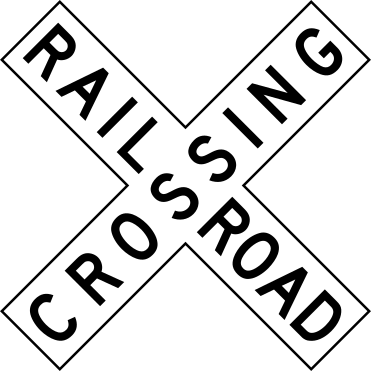
1. Where is this white X-shaped crossbuck sign placed according to the New Hampshire manual?
- Well before the crossing as advance warning
- At the railroad crossing itself, to indicate where the crossing is
- At the end of a no passing zone
- Only at crossings with gates
Show answer
At the railroad crossing itself, to indicate where the crossing is. The manual assigns the X shape a specific meaning: a crossbuck indicates where a railroad crossing is. It marks the crossing itself, while the round warning sign with the X symbol and black RR letters is the advance warning placed along the road before the crossing. That advance sign cautions the driver to slow down or stop and to look and listen for a train. When a train or railroad vehicle is approaching, stop behind the stop line or not less than 15 feet nor more than 50 feet from the nearest rail.
Study this in the handbook: Sign shapes, colors and warning signs
2. Which sign shape does the New Hampshire manual say is used for traffic regulations or directions to drivers?
- A diamond
- A pentagon
- A rectangle
- A circle
Show answer
A rectangle. The manual's standard shapes give each sign family a job. A rectangle carries traffic regulations or directions to drivers. A diamond warns of special hazards ahead, with pictures or words describing the hazard, a pentagon marks a school zone or school crossing, and a circle gives advance warning of a railroad crossing. The octagon means stop, the downward pointing triangle means yield, and the pennant warns of a no passing zone ahead. Knowing the shapes lets a driver classify a sign quickly, before the words can be read.
Study this in the handbook: Sign shapes, colors and warning signs
3. A police vehicle with lights on pulls in behind you in New Hampshire at night. Besides stopping and staying in the vehicle, what does the manual tell you to turn on?
- The high beams
- The hazard flashers and the interior lights
- The radio
- The windshield wipers
Show answer
The hazard flashers and the interior lights. During a traffic stop, come to a complete stop and place the vehicle in park, remain in the vehicle unless asked to get out, turn off the engine, and turn on the hazard flashers and, at night, the interior lights so the officer can see that everything is in order inside. Keep the safety belt fastened, put your hands on the steering wheel, limit movements, and when asked for documents say where they are and reach slowly with one hand still on the wheel. If the car is unmarked, make sure its blue lights are activated.
Study this in the handbook: Emergency vehicles, Sherrill's Law and traffic stops
4. Why does the New Hampshire manual say to avoid driving next to other vehicles for long periods?
- Your vehicle may be in their blind spot, and it reduces the space needed to avoid a collision
- It uses more fuel
- It is illegal on multi-lane roads
- It blocks their view of signs
Show answer
Your vehicle may be in their blind spot, and it reduces the space needed to avoid a collision. Space on the sides of the vehicle is what lets a driver move right or left to avoid trouble. The manual says to avoid driving next to other vehicles for long periods of time, because your vehicle may be in their blind spot and it reduces the space needed to avoid a collision. It also advises against crowding the center line, keeping as much space as possible from oncoming traffic, and making room for vehicles entering a limited access road by moving over a lane or adjusting speed.
Study this in the handbook: Visual search and following distance
5. According to the New Hampshire manual, what happens to stopping distance when a vehicle's speed is doubled?
- It increases 4 times
- It increases 3 times
- It stays the same if the brakes are good
- It doubles
Show answer
It increases 4 times. Total stopping distance is the distance traveled from the moment a driver realizes a stop is needed until the vehicle actually stops, and the manual lists speed first among the things that affect it: the faster a vehicle is traveling, the more time and distance it needs. The manual states that the stopping distance of a vehicle increases 4 times when the speed of the vehicle is doubled. It does not simply double, and good brakes do not keep it the same.
Study this in the handbook: Signals, headlights, horn and stopping distance
6. Which driver is exempt from obtaining a New Hampshire driver's license?
- A new resident who moved to the state 90 days ago
- A resident whose license expired last month
- A member of the US military stationed in New Hampshire who holds a valid home state license
- A driver whose privileges are suspended in another state
Show answer
A member of the US military stationed in New Hampshire who holds a valid home state license. The manual lists three groups exempt from getting a New Hampshire license: non-residents with a valid home state license, members of the US military stationed here who hold a valid license from their home state, and foreign tourists with a valid license from their home country. A person who has lived in the state for 90 days has passed the 60 day deadline, an expired license is not valid, and a suspended driver may not drive in New Hampshire under any circumstances.
Study this in the handbook: Driver education and practice driving
7. Why does the New Hampshire manual say the crosshatched access aisle next to an accessible parking space must stay clear?
- It is reserved for motorcycles
- It is a fire lane
- A van with a lift or ramp needs the entire aisle, which can be up to 8 feet wide, to deploy and maneuver a wheelchair
- It is used for shopping cart return
Show answer
A van with a lift or ramp needs the entire aisle, which can be up to 8 feet wide, to deploy and maneuver a wheelchair. Access aisles are the crosshatched areas parallel and adjacent to an accessible parking space, marked with yellow or white diagonal stripes. They give a person with a walking disability room to open the door fully and maneuver. Exiting or entering a van with a lift or ramp requires the entire access aisle, which can be up to 8 feet wide, to engage the lift and move a wheelchair on or off. Parking in the aisle carries a fine that increases for each subsequent offense.
Study this in the handbook: Parking rules and distances
8. What is a New Hampshire shared center lane marked with two-way left turn arrows reserved for?
- Passing slower vehicles
- Through traffic during rush hour
- Parking while waiting for a driveway
- Left turns from either direction, not through traffic or passing
Show answer
Left turns from either direction, not through traffic or passing. The shared center lane sign and markings tell a driver where a lane is reserved for the use of left turning vehicles from either direction. The lane is not to be used for through traffic or for passing other vehicles, and parking in it is not one of its uses. Enter it only to make a left turn, and watch for drivers from the opposite direction who may be using the same lane for their own left turns.
Study this in the handbook: Regulatory, guide, work zone and railroad signs
9. When is a right turn on a solid red light allowed in New Hampshire?
- Never
- Only if there is no sign prohibiting a right turn on red, after stopping
- Whenever cross traffic is clear, without stopping
- Only between 1 a.m. and 4 a.m.
Show answer
Only if there is no sign prohibiting a right turn on red, after stopping. A solid red light means stop prior to entering the intersection and wait behind the stop line, crosswalk, or intersection until the light turns green. The manual's exception is that drivers may make a right turn on a red signal only if there is no sign prohibiting a right turn on red. The stop still comes first, and the turn is made only after yielding. There is no time of day condition, and the turn is not banned outright.
Study this in the handbook: Traffic signals and officers
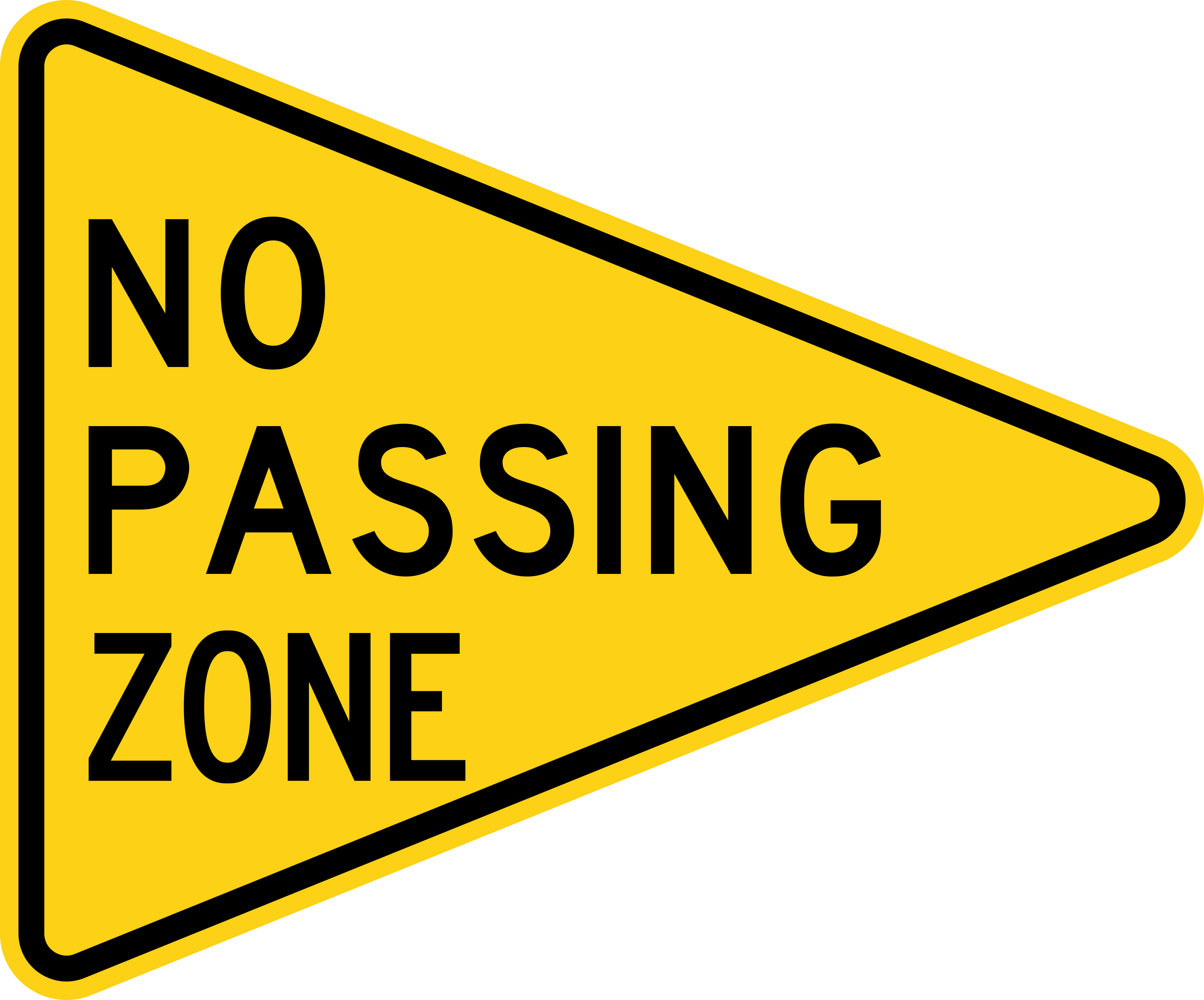
10. On which side of the road is this pennant-shaped NO PASSING ZONE sign found, and what does it mean?
- On the right side, marking where passing may resume
- On the left side, warning of a no passing zone ahead
- Overhead, marking a passing lane
- On the left side, marking the end of a no passing zone
Show answer
On the left side, warning of a no passing zone ahead. The pennant, a sideways triangle, is the no passing sign. The manual says it is found on the left side of the road and gives the driver warning of no passing zones ahead. It marks the beginning of the restriction, not the end, and it is never used to invite passing. The pavement usually confirms it with a solid yellow line on your side. Passing is also barred near curves, hills, intersections, and before railroad crossings and bridges.
Study this in the handbook: Sign shapes, colors and warning signs
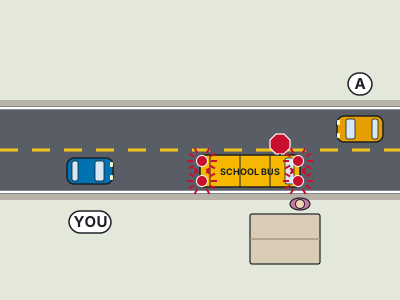
11. How far from a stopped New Hampshire school bus with flashing red lights must drivers stop?
- At least 100 feet
- At least 10 feet
- At least 50 feet
- At least 25 feet in any direction
Show answer
At least 25 feet in any direction. Drivers must stop at least 25 feet in any direction for a school bus that is stopped with its red lights flashing or its stop arm extended, at all times, unless the roadway is separated by a physical barrier. Ten feet is too close, and 50 and 100 feet are larger than the law requires. Remain stopped until the bus resumes motion or the flashing red lights cease to operate, then proceed slowly while always watching for children.
Study this in the handbook: Roundabouts and school buses
12. Where does the New Hampshire manual say a driver must never pass?
- On a multi-lane road with a broken white line
- On a straight rural road with a broken yellow line
- When the vehicle ahead is a slow moving farm tractor
- Before a highway railroad crossing or bridge
Show answer
Before a highway railroad crossing or bridge. Pass only where signs or road markings permit it and only when conditions are favorable. The manual says not to attempt to pass when an oncoming vehicle is approaching, when the view is blocked by a curve or a hill, at intersections, or before a highway railroad crossing or bridge. Broken white and broken yellow lines are the markings that allow passing when safe, and a farm tractor may be passed with caution once it is safe to do so.
Study this in the handbook: Lane changes, passing, backing and road conditions
13. From what part of the lane should a New Hampshire driver make a right turn?
- The center of the lane
- The left portion of the lane to widen the turn
- The right-most portion of the lane, without swinging wide to the left first
- Any part of the lane if signaling
Show answer
The right-most portion of the lane, without swinging wide to the left first. Right turns should always be made from the right-most portion of the lane, and the manual says to avoid swinging wide to the left before making the turn. The center of the lane and the left portion are not the starting points it describes, and a turn signal does not change where the turn begins. Left turns are the mirror image, made from the left-most portion of the lane after yielding to oncoming traffic. Before any turn, search all corners, signal, and look through the turn to the farthest point on the intended path.
Study this in the handbook: Toll lanes, turns, U-turns and intersections
14. What does the New Hampshire manual say about reaching a narrow or single lane bridge on a rural road?
- Both vehicles may cross at once if they slow down
- The heavier vehicle always crosses first
- Take turns crossing, and generally the first driver to the bridge has the right of way
- The vehicle heading uphill must back up
Show answer
Take turns crossing, and generally the first driver to the bridge has the right of way. Rural roads can include narrow and single lane bridges, and the manual tells drivers to look for the warning signs that identify them and to take turns crossing. Generally the first driver to reach the bridge has the right of way. Weight and grade are not the deciding factors, and two vehicles cannot share a single lane bridge. Open bridge gratings and steel bridges are another rural hazard because they reduce traction, so slow down and keep a firm grip.
Study this in the handbook: Rural roads and night driving
15. What is the maximum engine power of a motor-driven cycle under New Hampshire licensing?
- No more than 5 brake horsepower
- No more than 10 brake horsepower
- No more than 50 cubic centimeters
- No more than 2 brake horsepower
Show answer
No more than 5 brake horsepower. The motor-driven cycle license allows the operator to operate a bicycle with a motor attached which has no more than 5 brake horsepower. The manual defines this class by horsepower, not by engine displacement, so the 50 cubic centimeter figure is not the New Hampshire test. Ten horsepower would exceed the class, and two would be well under it. Anything more powerful falls under the motorcycle license, which also covers motor driven cycles and mopeds.
Study this in the handbook: Youth Operator license, restrictions and renewal
16. When does a New Hampshire Youth Operator license expire?
- On the holder's 21st birthday
- Five years after issue
- On the holder's 25th birthday
- On the holder's 18th birthday
Show answer
On the holder's 21st birthday. Any person 16 years of age or older and under 21 is issued a Youth Operator license. It is printed vertically, and it expires on the holder's 21st birthday rather than on the ordinary schedule, under which New Hampshire licenses expire on the applicant's birthday every 5 years. Turning 18 removes the special under 18 restrictions but does not end the license. Some of the youth restrictions, such as the 1 a.m. to 4 a.m. driving ban, apply only until age 18.
Study this in the handbook: Youth Operator license, restrictions and renewal
17. Who may be in the vehicle during a New Hampshire road test?
- Anyone the applicant chooses, as long as they stay silent
- The applicant, the examiner, and one parent
- The applicant, the examiner, and the driving instructor
- Only the applicant and the authorized DMV licensing examiner
Show answer
Only the applicant and the authorized DMV licensing examiner. During the road test no person except the applicant and the authorized Division of Motor Vehicles licensing examiner may be present in the vehicle, so a parent, an instructor, or a friend may not ride along. The examiner gives clear instructions but cannot coach, and questions are answered before or after the test unless a direction needs clarifying. The test takes about 20 minutes and grades vehicle handling in traffic, driving habits, and working knowledge of signs and rules.
Study this in the handbook: Driver education and practice driving
18. A driver violates New Hampshire's Sherrill's Law twice within 12 months. What applies to the second violation?
- An increased fine plus penalty assessment
- The same fine as the first offense
- A written warning only
- Automatic revocation for 1 to 4 years
Show answer
An increased fine plus penalty assessment. Sherrill's Law requires drivers to slow down, give a wide berth where practical, and vacate blocked lanes near emergencies, traffic stops, and stopped vehicles showing warning signals. A first violation brings a fine plus penalty assessment, and a subsequent offense in a 12 month period brings an increased fine plus penalty assessment. The penalty does not stay flat or drop to a warning. A 1 to 4 year revocation is the Habitual Offender penalty, not the Sherrill's Law penalty.
Study this in the handbook: Emergency vehicles, Sherrill's Law and traffic stops
19. A New Hampshire driver holds a cell phone near their ear while the vehicle is moving. How does the law treat that?
- It is legal if the call lasts under one minute
- It is only a violation if an officer hears the conversation
- It is legal as long as the driver is over 18
- The driver is presumed to be engaging in a call
Show answer
The driver is presumed to be engaging in a call. The statute closes an obvious loophole. An operator who holds a cellular telephone or other device capable of voice communication in the immediate proximity of his or her ear while the vehicle is in motion is presumed to be engaging in a call. The officer does not need to prove the conversation, and the call's length does not matter. Drivers over 18 may use a hands-free device, but holding the phone to the ear is not hands-free.
Study this in the handbook: Hand-held devices and distraction
20. What is the minimum fine for a first offense DUI conviction in New Hampshire?
- $250
- $500
- $100
- $1,000
Show answer
$500. A first conviction for driving under the influence of drugs or liquor, or driving with excess alcohol concentration, is a Class B misdemeanor with a fine of not less than $500. The driver may also lose driving privileges for 9 months to 2 years and must complete an approved impaired driver education program before privileges are restored. Second and subsequent convictions bring higher fines, longer suspensions, and stronger penalties, and a DUI conviction also requires SR-22 proof of insurance for reinstatement.
Study this in the handbook: BAC limits, under 21 rules and DUI penalties
QualitySpace is expanding to New Hampshire
We are a California-based independent insurance brokerage working on licensing in more states. We cannot help with New Hampshire insurance yet. Leave your email and we will let you know when we can.
Every question is written from the official New Hampshire Driver's Manual. Need paper? Printable NH practice test with answer key.
Last verified 2026-10-05. How we check every question · Study all 208 as flashcards
Frequently asked questions
How many questions are on this New Hampshire practice test?
This fixed set has 20 questions. It is test 7 of 10 from the 208 question New Hampshire bank. The real NH exam asks 40 questions and you need 32 correct.
What is the passing score for the real New Hampshire test?
All knowledge exams require a passing grade of 80% That figure comes from the official New Hampshire source cited on the DMV facts page.
How does this fixed test relate to the full New Hampshire bank?
Each numbered test is a fixed set of questions in a fixed order, so you can retake the same test later and compare. Every test mixes road signs and the other topics in about the same proportion as the full bank. Tests 1 to 10 together cover 200 of the 208 questions in the New Hampshire bank, each once. The full practice page mixes the whole bank at random.
Last verified 2026-10-05. See the New Hampshire DMV facts page for sourced state details.
Return to the full New Hampshire practice test · Study road signs