
Test 6 of 10 · 20 questions · Free 2026
NH Permit Practice Test 6
Jump to the test ↓A fixed 20 question set from the New Hampshire bank with answers and plain English explanations. The real NH exam is 40 questions, 80 percent to pass; take the full length version on the main practice page.
Question 1 of 20 · 0 right so far

All 20 questions in test 6
Every question below comes from the New Hampshire question bank on this page. Open a question to see the correct answer and the explanation. Nothing here is hidden behind a signup.
1. This yellow winding arrow sign appears on a New Hampshire road. Which listed warning sign is it?
- Curvy Road Ahead
- Right Curve
- Sharp Curve Ahead
- Side Road Ahead
Show answer
Curvy Road Ahead. The snaking arrow is Curvy Road Ahead, warning of a series of curves rather than a single bend. Because the road keeps changing direction, choose a speed you can hold through the whole stretch and reduce it further when the end of a curve cannot be seen or traction is poor. Right Curve marks one gentle bend, Sharp Curve Ahead marks one tight turn, and Side Road Ahead warns of a road joining from the side.
Study this in the handbook: Sign shapes, colors and warning signs
2. Which device use is generally permitted for New Hampshire drivers age 18 or older?
- Using a Bluetooth or other hands-free device to send or receive information
- Holding a phone to the ear on a rural road
- Typing an address into a phone while stopped in traffic
- Reading a text at a red light
Show answer
Using a Bluetooth or other hands-free device to send or receive information. Drivers age 18 or older may use one hand to transmit on a non-cellular two way radio, use a Bluetooth enabled or other hands-free device, or a similar device integrated into the vehicle to send or receive information, or perform an action required by an ignition interlock device. Even for adults the hands-free device may not require diverting attention from the road ahead. Reading a text at a light, holding a phone to the ear, and typing an address while stopped in traffic are prohibited for every driver.
Study this in the handbook: Hand-held devices and distraction
3. What must the licensed driver who brings an applicant to a New Hampshire road test do during the test?
- Ride in the back seat during the test
- Remain at the test site until the road test has been completed
- Leave and return within one hour
- Wait in the DMV lobby only if the applicant is under 18
Show answer
Remain at the test site until the road test has been completed. The applicant must bring a licensed driver to drive the test vehicle to and from the testing site, and that person is required to remain at the test site until the road test has been completed. They cannot ride along, because only the applicant and the examiner may be in the vehicle, and they may not leave. The vehicle itself must be legally registered, inspected, in safe running condition, and of the proper class for the license being tested.
Study this in the handbook: Driver education and practice driving
4. When must a New Hampshire accident report be filed with the DMV, and within how many days?
- Within 10 days for any crash
- Within 30 days only if someone is injured
- Only when police request it
- Within 15 days if there is a fatality, injuries, or combined property damage over $1,000
Show answer
Within 15 days if there is a fatality, injuries, or combined property damage over $1,000. New Hampshire law requires an accident report to be filed with the Division of Motor Vehicles within fifteen days if there is a fatality, injuries, or if the combined property damage totals more than $1,000. If a police officer investigates the crash, the police report satisfies the requirement and the driver need not file separately, although they may. The Operator Accident Report, form DSMV 400, is available at DMV offices, police departments and online. When unsure whether damage exceeds $1,000, file anyway.
Study this in the handbook: Crashes, reports and financial responsibility
5. When exiting a New Hampshire highway, what should a driver do about speed on the main roadway and in the deceleration lane?
- Maintain speed on the main roadway, then slow to exiting speed in the deceleration lane
- Slow down on the main roadway well before the exit
- Speed up in the deceleration lane to clear traffic
- Stop at the start of the deceleration lane
Show answer
Maintain speed on the main roadway, then slow to exiting speed in the deceleration lane. The manual's exit steps are to move early to the lane closest to the exit to avoid a quick lane change, maintain vehicle speed while on the main roadway, check the posted speed for the deceleration lane, then signal, move into the deceleration lane and slow to exiting speed. Slowing on the main roadway surprises the traffic behind you, and speeding up in the deceleration lane defeats its purpose. If you miss the exit, continue to the next one.
Study this in the handbook: Signals, headlights, horn and stopping distance
6. Near which road users does the New Hampshire manual say a driver should not use the horn?
- Bicyclists only
- Large trucks
- Motorcyclists only
- Blind pedestrians and horses
Show answer
Blind pedestrians and horses. The horn is for communicating with other road users when it is needed, and the manual says a light tap is usually enough. It also says drivers should not use the horn when near blind pedestrians, or when approaching or near a horse, because it may frighten the horse and cause a crash. Separately, New Hampshire requires drivers to come to a complete stop for a person carrying a white cane or using a guide dog. The manual also warns against honking close to bicyclists unless a crash is likely; trucks and motorcycles are not named in this passage.
Study this in the handbook: Signals, headlights, horn and stopping distance
7. How should a New Hampshire driver approach an uncontrolled rural intersection with no stop or yield signs?
- Maintain speed because you have the right of way
- Sound the horn and proceed
- Stop and wait for another vehicle to go first
- Slow down and be prepared to stop for crossing or oncoming traffic
Show answer
Slow down and be prepared to stop for crossing or oncoming traffic. Some intersections on rural roads are not controlled by yield or stop signs, and the manual calls them very dangerous when a driver does not approach with caution. When approaching an uncontrolled rural intersection, slow down and be prepared to stop for crossing or oncoming traffic. Under the general intersection rule the vehicle on the right has the right of way, but the manual says no one should assume they automatically have it.
Study this in the handbook: Rural roads and night driving
8. Another vehicle is passing you on a New Hampshire road. What must you never do?
- Maintain a constant speed
- Stay in your lane
- Increase speed to prevent the pass
- Let the vehicle return ahead of you
Show answer
Increase speed to prevent the pass. When being passed, the manual tells drivers to stay in the lane they are traveling, maintain a constant speed so the other driver can complete the pass, and never increase speed to prevent someone from passing. Speeding up stretches out the time the passing driver spends in the oncoming lane and can force a crash. Staying in your lane and holding speed are the correct behaviors, and letting the vehicle back in ahead of you finishes the pass safely.
Study this in the handbook: Lane changes, passing, backing and road conditions
9. Of the 40 hours of additional supervised driving required for New Hampshire driver education, how many must be at night?
- 5 hours
- 10 hours
- 20 hours
- None, all may be daytime
Show answer
10 hours. The supervised driving requirement is 40 hours with a parent, guardian or other responsible adult, and 10 of those hours must be completed at night. That supervised time is in addition to the program's 30 classroom hours, 10 hours of driving with the instructor, and 6 hours of observation. Five hours would fall short of the night requirement, twenty is double it, and an all daytime log leaves the night portion out entirely. Log the night hours separately so the total and the night portion can both be verified.
Study this in the handbook: Driver education and practice driving
10. When parking across the street from a fire station driveway entrance in New Hampshire, how far away must you stay?
- 20 feet
- 30 feet
- 75 feet
- 50 feet
Show answer
75 feet. The fire station rule has two distances. On the same side of the street, do not park within 20 feet of the driveway entrance. On the opposite side, the distance grows to 75 feet. Thirty feet is the distance from a stop sign, yield sign, or traffic signal, and 50 feet is the distance from the nearest rail of a railroad crossing. These limits apply even without a posted sign.
Study this in the handbook: Parking rules and distances
11. May a New Hampshire driver under 18 make an ordinary hands-free phone call while driving?
- Yes, hands-free use is allowed at any age
- No; ordinary calls are prohibited even in hands-free mode
- Yes, but only while stopped in traffic
- Yes, if a parent is in the vehicle
Show answer
No; ordinary calls are prohibited even in hands-free mode. A New Hampshire driver under 18 may not make an ordinary phone call while driving, even in hands-free mode, and the ban also applies while temporarily stopped in traffic. The only exception the manual gives for these young drivers is reporting an emergency to the enhanced 911 system or a public safety agency. Having a parent in the vehicle does not change the rule. Hands-free devices appear in the manual's list of things that only older drivers may use.
Study this in the handbook: Youth Operator license, restrictions and renewal
12. On New Hampshire roads, what is the difference between white and yellow broken lane lines?
- White marks the road edge; yellow marks lanes
- White means no passing; yellow means passing allowed
- There is no difference
- White separates lanes moving the same direction; yellow separates lanes moving in opposite directions
Show answer
White separates lanes moving the same direction; yellow separates lanes moving in opposite directions. Single broken lines mark traffic lanes. White lines mean the lanes of traffic are moving in the same direction, and yellow lines mean the lanes are moving in opposite directions. Drivers may pass other vehicles over broken lines when it is safe to do so, whichever color they are. Edge markings are a separate single line, white on two way roads and on the right edge of one way roads, and yellow on the left edge of one way roads.
Study this in the handbook: Pavement markings
13. What color and shape are New Hampshire work zone signs?
- Yellow with black letters, always diamond
- Orange with black letters or symbols, generally diamond or rectangular
- Red and white rectangles
- Blue and white squares
Show answer
Orange with black letters or symbols, generally diamond or rectangular. Work zone signs are generally diamond or rectangular shaped and orange with black letters or symbols. These construction, maintenance or emergency operation signs alert drivers that people are working on or near the roadway and warn of workers ahead, reduced speed, detours, slow moving equipment and poor or suddenly changing road surfaces. Yellow signs are ordinary warnings, red is prohibition, and blue is driver services. Always reduce speed in a work zone even without a posted change.
Study this in the handbook: Regulatory, guide, work zone and railroad signs
14. When may a New Hampshire driver proceed after stopping for a school bus with its red lights flashing?
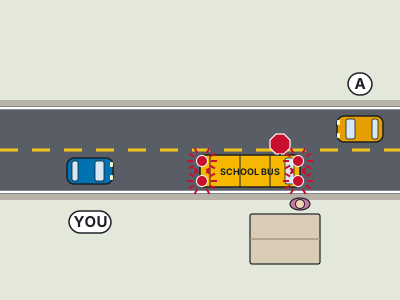
- As soon as no children are visible
- After counting five seconds
- When the bus resumes motion or the flashing red lights cease to operate
- When the driver behind honks
Show answer
When the bus resumes motion or the flashing red lights cease to operate. Drivers shall remain stopped until the school bus resumes motion or until the flashing red lights cease to operate, and then proceed slowly while always watching for children. Not seeing a child is no proof that one is not about to step out from in front of the bus, and no count or honk changes the rule. The stop must be at least 25 feet from the bus in any direction, unless a physical barrier separates the roadway.
Study this in the handbook: Roundabouts and school buses
15. A yellow edge line runs along the left side of the roadway you are on in New Hampshire. What does that tell you?
- You may pass on the left
- Two-way traffic begins ahead
- The shoulder is reserved for bicycles
- You are on a one-way road and this is its left edge
Show answer
You are on a one-way road and this is its left edge. Edge markings are the single line that marks the edge of the road. The line is white on two way roads and on the right edge of one way roads, and it is yellow on the left edge of one way roads. A yellow line on your left edge therefore confirms you are on a one way street, with no oncoming lane beyond it. It is not a passing marking or a bicycle lane, and it does not announce two way traffic.
Study this in the handbook: Regulatory, guide, work zone and railroad signs
16. An emergency vehicle approaches in New Hampshire with its siren on. What must a driver do, and what should the driver avoid?
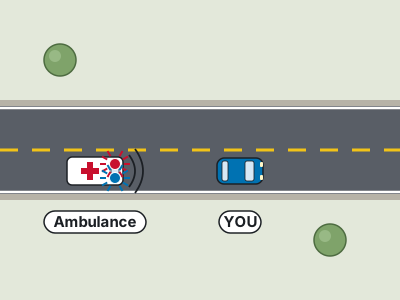
- Drive immediately to the right side of the road and stop, avoiding blocking an intersection
- Speed up to stay ahead of it
- Stop exactly where you are, even in an intersection
- Move to the left lane and slow down
Show answer
Drive immediately to the right side of the road and stop, avoiding blocking an intersection. Right of way must be given to emergency vehicles approaching from any direction when they are sounding a siren or operating flashing lights. Drivers should drive immediately to the right side of the road and stop until the emergency has passed, and they should avoid blocking an intersection when stopping. Once it has passed, signal and turn back into the roadway only when it is safe. Stopping in an intersection or moving left blocks the path the responders need.
Study this in the handbook: Emergency vehicles, Sherrill's Law and traffic stops
17. What must a New Hampshire driver do at a staffed cash-only toll lane?
- Slow to 10 mph and keep rolling
- Back up if the lane is closed
- Come to a complete stop
- Get out to pay at the booth window
Show answer
Come to a complete stop. At cash only toll lanes drivers should obey the posted speed limits within the plaza, come to a complete stop at staffed lanes, never back up or reverse direction at a toll plaza, and not get out of the vehicle. E-ZPass lanes are the ones where you keep moving without stopping. Rolling through a staffed lane at a low speed skips the required stop, and backing up when the lane is closed breaks the no reversing rule for toll plazas.
Study this in the handbook: Toll lanes, turns, U-turns and intersections
18. You miss your exit on a divided New Hampshire highway. What should you do?
- Drive to the next exit to reverse direction
- Stop and back up on the shoulder to the ramp
- Make a U-turn through the median
- Pull over and wait for a gap to turn around
Show answer
Drive to the next exit to reverse direction. If a driver misses an exit on a divided highway, the manual says to drive to the next exit to reverse direction. Drivers should never stop, back up or try to turn around on the highway. Backing along the shoulder, cutting through the median, and pulling over to wait for a gap all involve stopping, backing or turning around, which the manual rules out. The extra miles to the next exit are the price of a safe correction.
Study this in the handbook: Toll lanes, turns, U-turns and intersections
19. According to the New Hampshire manual, what is the only thing that reduces the effects of alcohol?
- Coffee
- A cold shower
- Time
- Fresh air and exercise
Show answer
Time. After drinking there is nothing that will reduce the effects of alcohol except time. Coffee, food, fresh air, exercise, or cold showers might make a person feel more alert, but they do not counter the alcohol in the bloodstream. Each ounce of alcohol takes about an hour to go through the body, so several drinks need several hours. Impairment starts with the first drink, and a person with one or more drinks in the bloodstream can be arrested for driving under the influence.
Study this in the handbook: How alcohol and drugs affect driving
20. This yellow sign shows a right-angle arrow. What warning sign in the New Hampshire manual does it match?

- Right Curve
- Sharp Curve Ahead
- T-Intersection Ahead
- Curvy Road Ahead
Show answer
Sharp Curve Ahead. A right angle arrow is the Sharp Curve Ahead warning, listed in the manual next to Advisory Speed Around Curve. The sharper bend needs more slowing than the gentle Right Curve sign, and it may be paired with an advisory speed plate. Curvy Road Ahead shows a snaking arrow for several curves, and T-Intersection Ahead shows the road ending at a cross street. Slow before the turn and steer smoothly; hard braking inside the curve can break traction.
Study this in the handbook: Sign shapes, colors and warning signs
QualitySpace is expanding to New Hampshire
We are a California-based independent insurance brokerage working on licensing in more states. We cannot help with New Hampshire insurance yet. Leave your email and we will let you know when we can.
Every question is written from the official New Hampshire Driver's Manual. Need paper? Printable NH practice test with answer key.
Last verified 2026-10-05. How we check every question · Study all 208 as flashcards
Frequently asked questions
How many questions are on this New Hampshire practice test?
This fixed set has 20 questions. It is test 6 of 10 from the 208 question New Hampshire bank. The real NH exam asks 40 questions and you need 32 correct.
What is the passing score for the real New Hampshire test?
All knowledge exams require a passing grade of 80% That figure comes from the official New Hampshire source cited on the DMV facts page.
How does this fixed test relate to the full New Hampshire bank?
Each numbered test is a fixed set of questions in a fixed order, so you can retake the same test later and compare. Every test mixes road signs and the other topics in about the same proportion as the full bank. Tests 1 to 10 together cover 200 of the 208 questions in the New Hampshire bank, each once. The full practice page mixes the whole bank at random.
Last verified 2026-10-05. See the New Hampshire DMV facts page for sourced state details.
Return to the full New Hampshire practice test · Study road signs