
Test 3 of 10 · 20 questions · Free 2026
NH Permit Practice Test 3
Jump to the test ↓A fixed 20 question set from the New Hampshire bank with answers and plain English explanations. The real NH exam is 40 questions, 80 percent to pass; take the full length version on the main practice page.
Question 1 of 20 · 0 right so far
All 20 questions in test 3
Every question below comes from the New Hampshire question bank on this page. Open a question to see the correct answer and the explanation. Nothing here is hidden behind a signup.
1. After passing a vehicle in New Hampshire, when is it safe to signal and return to your lane?
- As soon as your front bumper is ahead of the other vehicle
- When the complete front of the passed vehicle is visible in your rearview mirror
- After counting three seconds
- When the other driver flashes headlights
Show answer
When the complete front of the passed vehicle is visible in your rearview mirror. The manual's passing sequence says to continue to pass until the complete front of the passed vehicle is visible in the rearview mirror, then signal the intention to return and steer smoothly back into the lane. Pulling in as soon as your bumper is ahead cuts the other driver off, and there is no fixed count or flash signal. The manual repeats the same check for large vehicles: look for the whole front of the vehicle in the rearview mirror before pulling in front, because a loaded truck needs a longer stopping distance than a car.
Study this in the handbook: Lane changes, passing, backing and road conditions
2. How does the New Hampshire manual say a backup camera should be used?
- Together with mirrors and head checks, never as the primary tool for backing
- As the only tool needed when backing slowly
- Instead of turning your head
- Only at night
Show answer
Together with mirrors and head checks, never as the primary tool for backing. Many vehicles have backup cameras, and the technology can help drivers back up safely when used in conjunction with the mirrors and proper head checks. The manual is direct that backup cameras should never be used as the primary tool for backing safely. The same caution applies to every warning system: they are passive aids, and drivers should not become dependent on them. Check side mirrors, the rearview mirror, over the shoulders, and the camera if equipped.
Study this in the handbook: Lane changes, passing, backing and road conditions
3. A pedestrian is crossing at a New Hampshire intersection that has no painted crosswalk lines. Must the driver yield?
- No, only marked crosswalks create a duty to yield
- Only if the pedestrian is in a school zone
- Yes, drivers must yield to pedestrians crossing at intersections even without crosswalk lines
- Only when a signal shows WALK
Show answer
Yes, drivers must yield to pedestrians crossing at intersections even without crosswalk lines. Crosswalk lines are painted to show pedestrian crossing areas, but the duty to yield does not depend on paint. Drivers are required to yield to pedestrians crossing the road in marked crosswalks or at intersections even if no crosswalk lines exist at the intersection. Pedestrians also have the right of way when using a sidewalk across an alley or driveway and when visually impaired and crossing guided by a service animal or carrying a white cane with a red tip. Be prepared to yield to pedestrians at all times.
Study this in the handbook: Regulatory, guide, work zone and railroad signs
4. At a New Hampshire intersection with no white stop line but a marked crosswalk, where must a driver stop?
- In the crosswalk where cross traffic is visible
- Before entering the intersection, past the crosswalk
- Before the crosswalk
- Beside the stop sign post
Show answer
Before the crosswalk. White stop lines show drivers where to stop. If there is no white stop line but a crosswalk is present, drivers must stop before the crosswalk. If no crosswalk lines are present either, come to a full stop before entering the intersection. After the initial stop, look both ways and move forward only when it is safe to continue. Stopping in the crosswalk blocks pedestrians, and the sign post is not the reference point.
Study this in the handbook: Regulatory, guide, work zone and railroad signs
5. This yellow plus-shaped sign is posted on a rural New Hampshire road. What does it warn?

- A cross road is ahead
- A hospital is ahead
- A railroad crossing is ahead
- A four way stop is ahead
Show answer
A cross road is ahead. Cross Road Ahead is the first warning sign in the manual's list. It tells you another road crosses yours, which on rural roads may be an uncontrolled intersection with no stop or yield signs. The manual says to slow down at such intersections and be prepared to stop for crossing or oncoming traffic. Hospitals are shown on blue service signs, railroad crossings on the round RR sign, and a four way stop uses red octagons.
Study this in the handbook: Sign shapes, colors and warning signs
6. According to the New Hampshire manual, in roughly what share of fatal traffic crashes are alcohol and other impairing drugs involved?
- About 10%
- About 75%
- About 90%
- About 40%
Show answer
About 40%. The manual reports that alcohol and other impairing drugs are involved in approximately 40% of all traffic crashes in which someone is killed each year. That is a large share but not a majority, so the 75% and 90% choices overstate it and 10% understates it. The same passage warns that a blood alcohol concentration as low as .02% can affect a driver's ability, which is the level at which vision is impacted for every driver.
Study this in the handbook: How alcohol and drugs affect driving
7. According to the New Hampshire manual, a driver who has been awake for 18 hours performs like a driver with what BAC?
- About 0.05%
- About 0.08%
- About 0.02%
- About 0.10%
Show answer
About 0.05%. The manual compares drowsy driving to drunk driving with three data points. A driver who has been up for a continuous 18 hours typically performs like a person with a blood alcohol concentration of 0.05%. After 21 hours without sleep performance mimics 0.08%, and after 24 hours it mimics 0.10%. The higher figures are the wrong answers for the 18 hour mark. Unlike alcohol, there is no breathalyzer for sleep, so the choice not to drive tired rests on the driver.
Study this in the handbook: Vision, fatigue, emotions and hot vehicles
8. Does New Hampshire require drivers to carry automobile insurance?
- No, there is no mandatory insurance law, but an uninsured driver in a crash can be held responsible for all damages and lose driving privileges until a settlement
- Yes, every registered vehicle must carry liability insurance
- Yes, but only drivers under 21
- Only for vehicles over 10,000 pounds
Show answer
No, there is no mandatory insurance law, but an uninsured driver in a crash can be held responsible for all damages and lose driving privileges until a settlement. Unlike almost every other state, New Hampshire has no mandatory insurance law, so a driver may drive within the state without insurance. The risk is personal: a driver in an uninsured accident can be held responsible for all damage to the other person's property and all medical bills, and if unable to pay, the DMV must suspend driving privileges until a settlement is reached. The driver may then have to carry SR-22 insurance for several years.
Study this in the handbook: Crashes, reports and financial responsibility
9. A front tire blows out on a New Hampshire highway. How does the manual say the vehicle will react?
- It will pull away from the blown tire
- It will pull sharply in the direction of the blowout
- Nothing changes until you brake
- It will wobble but keep tracking straight
Show answer
It will pull sharply in the direction of the blowout. Tire blowout is the rapid deflation of a tire and can cause sudden loss of control. If a front tire blows out, the vehicle will pull sharply in the direction of the blowout; if a rear tire blows, the vehicle will wobble, shake and pull some in the direction of the blowout. Grip the wheel firmly, keep the vehicle straight, slow gradually by easing off the accelerator, brake gently only if necessary, and pull off the road in a safe place with the flashers on.
Study this in the handbook: Brake failure, blowouts and breakdowns
10. Under RSA 265:29, to whom must a New Hampshire driver turning left into a driveway or alley yield?
- Only vehicles already stopped
- Only vehicles behind the turning driver
- Any vehicle approaching from the opposite direction that is within the intersection or close enough to be an immediate hazard
- No one, if the turn signal is on
Show answer
Any vehicle approaching from the opposite direction that is within the intersection or close enough to be an immediate hazard. RSA 265:29 covers left turns within an intersection or into an alley, private road or driveway. The turning driver must yield to any vehicle approaching from the opposite direction that is within the intersection or so close to it as to constitute an immediate hazard. A turn signal announces the turn but does not create the right to make it. Judge the gap carefully, and check oncoming traffic for motorcycles, whose speed the manual says is sometimes difficult to judge.
Study this in the handbook: Yielding the right of way
11. Before moving after stopping at a New Hampshire intersection, in what order does the manual recommend looking?
- Right, then left
- Straight ahead only
- Into the mirrors only
- Left, then right, and then left again
Show answer
Left, then right, and then left again. Drivers should not rely on other road users to obey signals or signs, so before moving after stopping at an intersection take the extra time to check for crossing traffic and bicyclists. The manual recommends looking left, then right, and then left again before entering. Looking straight ahead, into the mirrors, or only right then left leaves out part of that sequence. When a light turns green, avoid moving immediately; make sure the path is clear and there is no crossing traffic.
Study this in the handbook: Toll lanes, turns, U-turns and intersections
12. An emergency vehicle approaches while you are already inside a New Hampshire roundabout. What should you do?
- Never stop inside; move through, exit, then pull over to the right
- Stop immediately in your lane inside the circle
- Change lanes inside the roundabout to make room
- Reverse out of the roundabout
Show answer
Never stop inside; move through, exit, then pull over to the right. When emergency vehicles are approaching, do not enter a roundabout; pull over to the right and let other vehicles clear the intersection so the emergency vehicles can move through. If you are already inside, never stop while inside the roundabout. Instead move through and exit, then pull over to the right and allow the emergency vehicles to pass. Lane changes inside the circle are to be avoided at all times, and reversing is never an option.
Study this in the handbook: Roundabouts and school buses
13. How does a posted New Hampshire school zone speed limit relate to the usual limit, and when does it apply?
- A flat 20 mph whenever school is in session
- 15 mph below the usual limit during all daylight hours
- 10 mph below the usual posted limit, from 45 minutes before school opening until opening and from closing until 45 minutes after
- 10 mph below the usual limit only when children are visible
Show answer
10 mph below the usual posted limit, from 45 minutes before school opening until opening and from closing until 45 minutes after. In a posted school zone the speed limit is 10 miles per hour below the usual posted speed limit. It applies from 45 minutes before school opening until the school opening, and from the school closing until 45 minutes after closing. The reduction is a fixed 10 mph, not 15, and not a flat number. Seeing children is not the trigger, the clock is, although drivers must always be prepared to yield to pedestrians near schools.
Study this in the handbook: Speed limits
14. Who must wear a DOT approved helmet on a motorcycle in New Hampshire?
- All riders and passengers under 18
- Every rider and passenger, whatever their age
- Only the operator, and only if under 21
- Only passengers under 12
Show answer
All riders and passengers under 18. New Hampshire requires a helmet approved by the United States Department of Transportation for all motorcycle riders and passengers under the age of 18. The manual states the requirement only for riders and passengers under 18, so the every age choice overstates it, although the manual calls a securely fastened helmet the single most important thing a rider can do to survive a crash. The rule covers passengers as well as operators, and the cutoff is 18, not 21 or 12.
Study this in the handbook: Vehicle checks, seating and restraints
15. Under New Hampshire's Youth Operator Under 20 law, which event can lead the Director to suspend or revoke a young driver's original license?
- Receiving a parking ticket
- Failing to update a vehicle registration address
- Holding a license printed vertically
- Being involved in an accident resulting in death or serious bodily injury
Show answer
Being involved in an accident resulting in death or serious bodily injury. RSA 263:14 lets the Director of Motor Vehicles suspend or revoke an original license held by a driver under 20 after a hearing. Grounds include certain motor vehicle offenses, misconduct or misuse of driving privileges, and proper evidence that the license holder was involved in an accident resulting in death or serious bodily injury. Parking tickets and registration paperwork are not listed grounds. A vertically printed license simply marks a Youth Operator and is not a violation.
Study this in the handbook: Suspensions, points and habitual offenders
16. When may an ordinary driver drive on a designated bicycle lane in New Hampshire?
- Whenever no bicyclist is in sight
- When entering or leaving an alley or driveway
- To pass a vehicle that is turning left
- To stop briefly for a delivery
Show answer
When entering or leaving an alley or driveway. Designated bicycle paths and lanes are off limits for stopping, parking, or driving. The exceptions are entering or leaving an alley or driveway, performing official duties, following a police officer's direction, or an emergency. An empty lane is not an exception, and neither is getting around a left turning car or making a quick delivery stop. Drivers must also yield when a bicycle path or bike lane intersects a road and leave at least 3 feet when passing a bicyclist at 30 mph or less.
Study this in the handbook: Pedestrians and bicyclists
17. What does this red and white downward pointing triangle tell a New Hampshire driver to do?
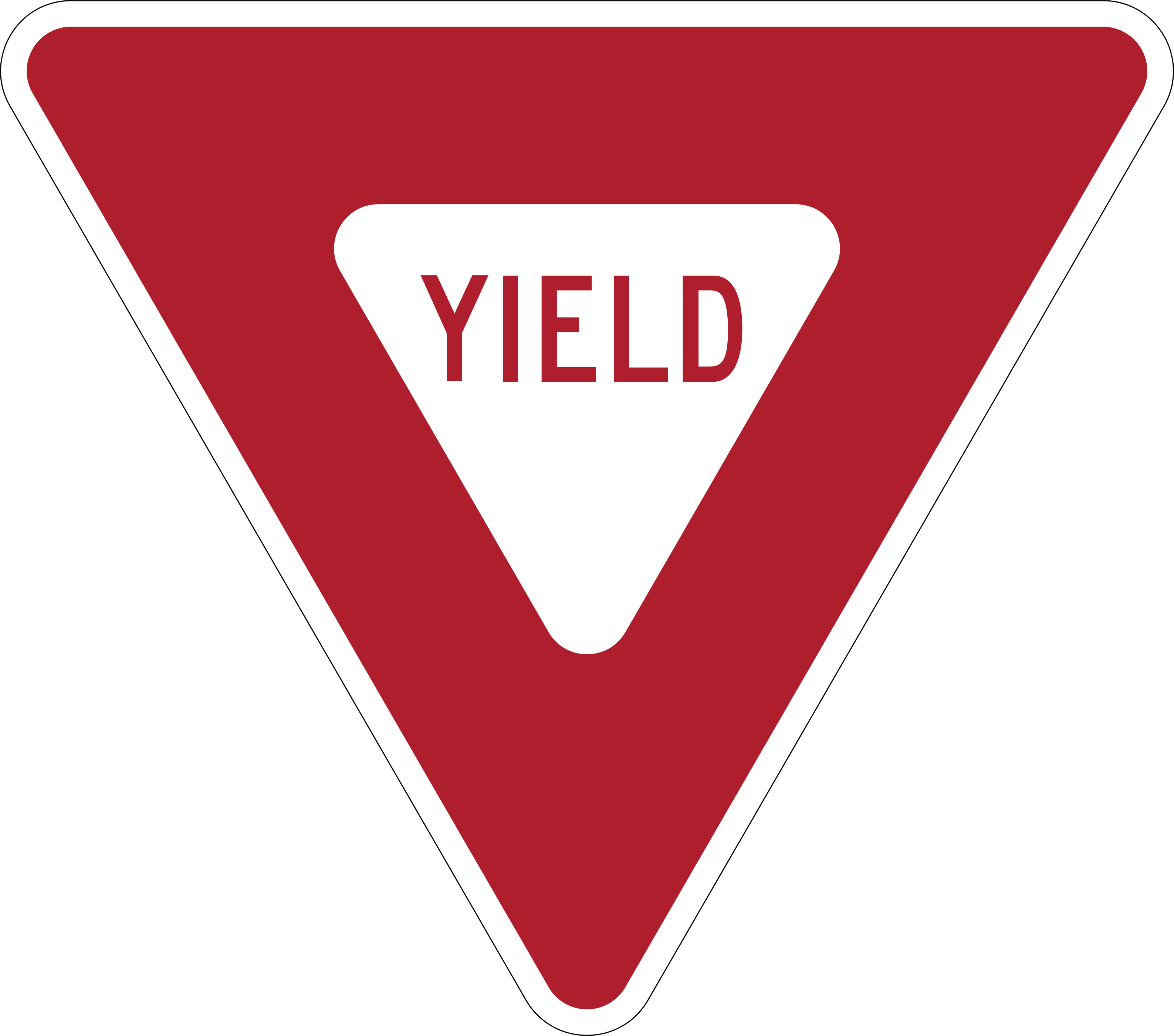
- Come to a full stop every time
- Slow down and allow traffic that has the right-of-way to cross before entering
- Stop only for pedestrians
- Speed up to merge ahead of cross traffic
Show answer
Slow down and allow traffic that has the right-of-way to cross before entering. A yield sign is a red and white downward pointing triangle with red letters, and it means the driver must slow down and allow traffic that has the right-of-way to cross before entering. Unlike a stop sign, the manual's definition does not call for a full stop every time; the duty is to slow and let traffic with the right-of-way go first. Speeding up to beat cross traffic reverses the sign, and the duty is to all traffic with the right-of-way, not only pedestrians.
Study this in the handbook: Sign shapes, colors and warning signs
18. What does this round yellow sign with an X and the letters RR tell a New Hampshire driver?

- The road ahead becomes a roundabout
- A railroad crossing is behind you
- A railroad crossing is ahead, so slow down or stop and look and listen for a train
- Trains have stopped using the crossing
Show answer
A railroad crossing is ahead, so slow down or stop and look and listen for a train. A round warning sign with an X symbol and black RR letters is placed along the road prior to a highway railroad grade crossing. It cautions the driver to slow down or stop and to look and listen for a train or railroad vehicle before proceeding. The circle shape is reserved for advance warning of a railroad crossing, so it is not a roundabout sign and does not mean the tracks are abandoned. Buses carrying passengers and hazmat trucks must stop at every crossing.
Study this in the handbook: Regulatory, guide, work zone and railroad signs
19. If a hearing finds a New Hampshire driver to be a Habitual Offender, for how long are driving privileges revoked?
- Permanently
- 6 months to 1 year
- Exactly 5 years
- 1 to 4 years
Show answer
1 to 4 years. When a driver's record contains the number of valid convictions required by law, the driver must appear for a hearing. If deemed a Habitual Offender, the Director revokes driving privileges for 1 to 4 years. The revocation is not permanent and is not a fixed five years. The five year figure belongs to a different consequence: driving after being declared a Habitual Offender is a felony punishable by up to five years in prison.
Study this in the handbook: Suspensions, points and habitual offenders
20. How often does the New Hampshire manual recommend having tire pressure checked?
- Once a week
- Once a year
- Only before long trips
- Once a month
Show answer
Once a month. Accidents due to tire maintenance are preventable. Driving on underinflated or overinflated tires, or on tires with low tread, can lead to safety problems, so the manual recommends having tire pressure checked once a month. Weekly is more than it asks, yearly is far too seldom, and waiting for a long trip ignores daily driving. Proper pressure and good tread depth also matter for hydroplaning, which the manual says is best prevented by slowing down in rain and keeping tires properly inflated.
Study this in the handbook: Vehicle checks, seating and restraints
QualitySpace is expanding to New Hampshire
We are a California-based independent insurance brokerage working on licensing in more states. We cannot help with New Hampshire insurance yet. Leave your email and we will let you know when we can.
Every question is written from the official New Hampshire Driver's Manual. Need paper? Printable NH practice test with answer key.
Last verified 2026-10-05. How we check every question · Study all 208 as flashcards
Frequently asked questions
How many questions are on this New Hampshire practice test?
This fixed set has 20 questions. It is test 3 of 10 from the 208 question New Hampshire bank. The real NH exam asks 40 questions and you need 32 correct.
What is the passing score for the real New Hampshire test?
All knowledge exams require a passing grade of 80% That figure comes from the official New Hampshire source cited on the DMV facts page.
How does this fixed test relate to the full New Hampshire bank?
Each numbered test is a fixed set of questions in a fixed order, so you can retake the same test later and compare. Every test mixes road signs and the other topics in about the same proportion as the full bank. Tests 1 to 10 together cover 200 of the 208 questions in the New Hampshire bank, each once. The full practice page mixes the whole bank at random.
Last verified 2026-10-05. See the New Hampshire DMV facts page for sourced state details.
Return to the full New Hampshire practice test · Study road signs