
Test 5 of 10 · 20 questions · Free 2026
NH Permit Practice Test 5
Jump to the test ↓A fixed 20 question set from the New Hampshire bank with answers and plain English explanations. The real NH exam is 40 questions, 80 percent to pass; take the full length version on the main practice page.
Question 1 of 20 · 0 right so far
All 20 questions in test 5
Every question below comes from the New Hampshire question bank on this page. Open a question to see the correct answer and the explanation. Nothing here is hidden behind a signup.
1. Where does the New Hampshire manual say a three-point turn should be used?
- Only when the road is too narrow for a U-turn, and only on a two-lane roadway
- At any intersection without a signal
- On any multi-lane road with light traffic
- On divided highways
Show answer
Only when the road is too narrow for a U-turn, and only on a two-lane roadway. A three point turn is reserved for a road or street that is too narrow to make a U-turn, and the manual says it should only be used on a two lane roadway. The sequence is to signal right and pull to the right side, then signal left and turn hard left across the road, reverse with a hard right while checking blind spots, and finally drive forward into the right lane of the new direction. On multi-lane roads and divided highways use the next exit or a legal U-turn instead.
Study this in the handbook: Toll lanes, turns, U-turns and intersections
2. When entering a multi-lane roundabout in New Hampshire, to which traffic must you yield?
- Traffic in both lanes of the roundabout
- Only traffic in the outside lane
- No one, entering traffic has priority
- Only traffic in the inside lane
Show answer
Traffic in both lanes of the roundabout. Multi-lane roundabout tips start with lane choice, using the signs and pavement markings to pick the lane for your exit before entering. Then yield to the traffic in both lanes in the roundabout and enter when there is an appropriate gap. Once inside, maintain lane position and avoid lane changes, and do not drive beside or try to pass any vehicle, since large trucks and trailers may need to straddle both lanes. Entering traffic never has priority.
Study this in the handbook: Roundabouts and school buses
3. What visual acuity must a New Hampshire applicant with sight in only one eye have?
- 20/40
- 20/20
- 20/70
- 20/30
Show answer
20/30. New Hampshire's vision standard is stricter for a driver who depends on a single eye: if an applicant has sight in only one eye, they must have a visual acuity of 20/30, compared with the 20/40 standard that applies with both eyes. If the vision test is not passed, the manual calls for an eye examination containing a doctor's recommendation of visual capability. Glasses or contacts needed to pass must be worn while driving.
Study this in the handbook: Driver education and practice driving
4. During which hours may a New Hampshire Youth Operator under 18 not drive?
- Between 1:00 a.m. and 4:00 a.m.
- Between 11:00 p.m. and 5:00 a.m.
- Between midnight and 6:00 a.m.
- Between 10:00 p.m. and 4:00 a.m.
Show answer
Between 1:00 a.m. and 4:00 a.m.. A Youth Operator license holder who is under 18 shall not operate a motor vehicle between the hours of 1:00 a.m. and 4:00 a.m. The windows that start at 10 p.m., 11 p.m., or midnight do not match New Hampshire's rule, which is the three hour block from 1 to 4. During the first six months the same holder may not carry more than one passenger under 25 who is not a family member unless a licensed responsible adult at least 25 is along, and may never carry more passengers than seat belts.
Study this in the handbook: Youth Operator license, restrictions and renewal
5. Snow and ice left on a car endanger other drivers on a New Hampshire road. What may the driver be found guilty of under RSA 265:79-b?
- Reckless driving, charged as a felony
- Littering, with no driving offense
- A violation under Negligent Driving
- Nothing, unless a crash actually happens
Show answer
A violation under Negligent Driving. Since 2002 New Hampshire drivers have had to clear snow and ice before driving, a rule known as Jessica's Law after a driver killed by ice from a tractor trailer. Under RSA 265:79-b, a vehicle that endangers or is likely to endanger people or property makes the driver guilty of a violation under Negligent Driving. No crash is required, because likely danger is enough. The manual does not call it littering or a felony, and the first offense penalty is $250 to $500.
Study this in the handbook: Vehicle checks, seating and restraints
6. A right turn arrow with a red slash is posted at an intersection. Which of the manual's sign shapes and colors does it use, and what does it forbid?
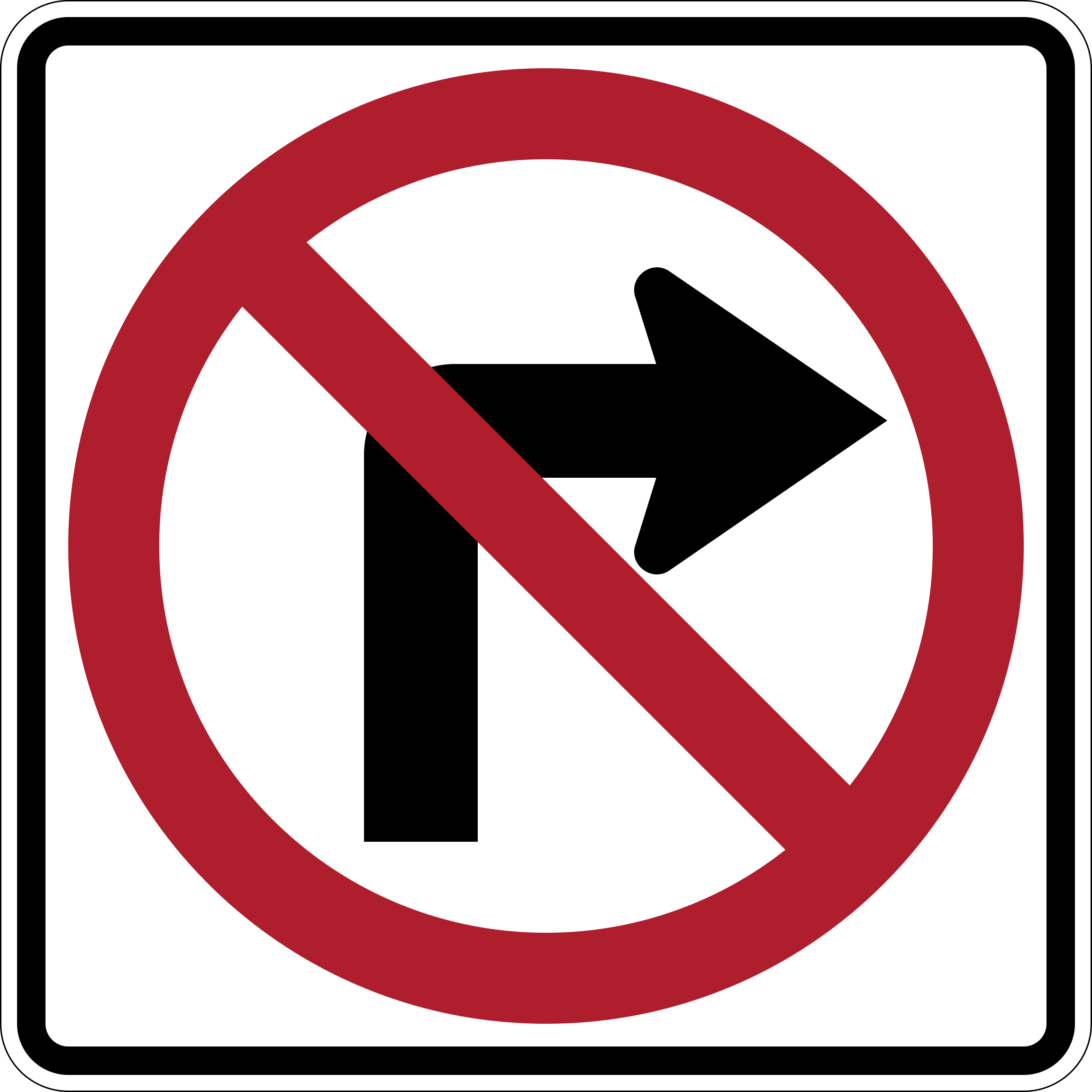
- A red prohibition symbol on a regulatory sign forbidding a right turn there
- A green guide sign recommending a left turn
- An orange work zone sign forbidding trucks
- A yellow warning diamond forbidding right turns in rain
Show answer
A red prohibition symbol on a regulatory sign forbidding a right turn there. Regulatory signs are square or rectangular, and some carry a red circle with a red slash over a symbol to prohibit an action. No Right Turn is one of the manual's named prohibition signs, and its red color means stop or do not do something. Yellow diamonds warn, green rectangles guide, and orange signs mark road work, so none of those describe this sign. The ban applies at the location where the sign is posted, so turn right at another intersection instead.
Study this in the handbook: Regulatory, guide, work zone and railroad signs
7. You are angry after an argument and about to drive. What does the New Hampshire manual recommend?
- Drive faster to get home sooner
- Play loud music to distract yourself
- Take time to calm down first, such as a short walk or nap, or have someone else drive
- Drive only on back roads until you feel better
Show answer
Take time to calm down first, such as a short walk or nap, or have someone else drive. Being overly worried, excited, afraid, angry or depressed can interfere with a driver's ability to process information. The manual's ways of dealing with emotions are to take time to calm down before getting behind the wheel, which a short walk or nap may help, to avoid stressful situations by leaving a few minutes early and planning for traffic or bad weather, and to have someone else drive. Speeding, loud music, and picking a different road all keep an impaired mind at the wheel.
Study this in the handbook: Vision, fatigue, emotions and hot vehicles
8. What is the youngest age at which a person may practice drive in New Hampshire while being taught?
- 15 years
- 16 years
- 15 and a half years
- 14 and a half years
Show answer
15 and a half years. New Hampshire does not issue learner permits. Instead the law lets a person who is at least 15 and a half years old and holds no license drive while being taught, as long as a parent, legal guardian, or a licensed responsible adult who is 25 or older is accompanying them. Fifteen and fourteen and a half are too young, and waiting until 16 is not required. The exception never applies to someone whose driving privileges are suspended or revoked in this or any other state.
Study this in the handbook: Driver education and practice driving
9. What visual acuity must a New Hampshire applicant with sight in both eyes show on the vision test?
- 20/20 in both eyes
- 20/30 in both eyes
- 20/70 in the better eye
- 20/40 in both eyes
Show answer
20/40 in both eyes. The vision test standard for an applicant with sight in both eyes is 20/40. An applicant who has sight in only one eye must meet a stricter 20/30 standard, which is why 20/30 is a tempting but wrong answer for the two eye case. Perfect 20/20 vision is not required. If you need glasses or contact lenses to reach the standard, you must wear them whenever you drive and the license will carry the B restriction for corrective lenses.
Study this in the handbook: Driver education and practice driving
10. An applicant passes the New Hampshire license tests. What does the DMV issue on the spot?
- The permanent plastic license
- A 30 day learner card
- A 60 day paper temporary driver's license
- Nothing until the permanent license arrives by mail
Show answer
A 60 day paper temporary driver's license. Applicants who pass are issued a 60 day paper temporary driver's license at the office, and the permanent license is mailed within 45 days. The plastic card is not printed on the spot, and there is no learner card because New Hampshire issues no learner permits. Keep the paper license with you while driving during that window. If a test is failed instead, the retest appointment is set no sooner than ten days later.
Study this in the handbook: Driver education and practice driving
11. What does a three-digit interstate route number with an even first digit indicate?
- A route into a city
- A scenic route
- A truck only route
- A route that goes through or around a city
Show answer
A route that goes through or around a city. Three numbered interstate routes carry their own code. Those with an odd first number are routes into a city, and those with an even first number go through or around a city, such as a beltway. The base rule for two digit routes is that even numbers run west and east and odd numbers run north and south. Nothing in the numbering marks scenic or truck routes; those are shown by separate guide and regulatory signs.
Study this in the handbook: Regulatory, guide, work zone and railroad signs
12. What must a New Hampshire driver do at a flashing red traffic light?
- Slow down and proceed without stopping
- Come to a complete stop behind the stop line, crosswalk, or intersection, then proceed after yielding
- Stop only if cross traffic is present
- Wait until the light stops flashing
Show answer
Come to a complete stop behind the stop line, crosswalk, or intersection, then proceed after yielding. A flashing red traffic light requires drivers to come to a complete stop behind a stop line, crosswalk, or intersection before proceeding through the intersection, yielding any right-of-way. The stop is required whether or not cross traffic is present, and the driver proceeds after stopping and yielding rather than waiting for the flashing to end. Slowing without stopping is the flashing yellow rule. After stopping, look in all directions and go only when it is safe.
Study this in the handbook: Traffic signals and officers
13. Why does the New Hampshire manual say to check behind the vehicle before getting in to back up?
- The backup camera must be calibrated first
- Children or small objects cannot be seen from the driver's seat
- Mirrors show the area directly behind the bumper
- It is required by law before every trip
Show answer
Children or small objects cannot be seen from the driver's seat. Before backing, all drivers should check behind the vehicle before getting in, because children or small objects cannot be seen from the driver's seat. Mirrors and head checks are used for backing, but they do not show the area immediately behind the vehicle. Backing should be slow with the vehicle much harder to steer, steering slightly in the direction the rear should move and looking to the rear until the vehicle stops completely.
Study this in the handbook: Lane changes, passing, backing and road conditions
14. On a multi-lane road in New Hampshire, which lane is intended for passing, and where may you never pass?
- Any lane; never on a paved shoulder only
- The right lane; never in the left lane
- The left-most lane; never on the shoulder, paved or not
- The center lane; never on the left
Show answer
The left-most lane; never on the shoulder, paved or not. On multi-lane roads the left-most lane is intended for passing slower vehicles, and the manual says never pass on the shoulder, whether it is paved or not. The pavement on a shoulder does not make it a lane. Before passing, estimate the time and space needed, check for oncoming traffic, check mirrors and do a head check, signal, steer smoothly into the passing lane, and continue until the complete front of the passed vehicle shows in your rearview mirror.
Study this in the handbook: Lane changes, passing, backing and road conditions
15. What does this yellow sign showing the right lane narrowing into the left lane warn of?

- A right turn is required
- The lane ends ahead and traffic must merge
- The road widens to add a lane
- The shoulder is closed
Show answer
The lane ends ahead and traffic must merge. Lane Ends is one of the manual's warning sign examples. It gives advance notice that the lane you may be in will disappear, so signal, check mirrors and blind spots with a head check, identify a gap, and adjust speed to move into the continuing lane before the pavement runs out. It does not require a turn, and it is the opposite of the Added Lane sign, which marks a lane that continues. It says nothing about the shoulder.
Study this in the handbook: Sign shapes, colors and warning signs
16. Even where no sign is posted, where is parking illegal in New Hampshire?
- On any one way street
- On any bridge or in any highway tunnel
- On any street wider than two lanes
- Within 5 feet of a mailbox
Show answer
On any bridge or in any highway tunnel. The manual lists places where parking is illegal although not marked: alongside another parked vehicle, on a sidewalk, in an intersection, on a crosswalk, on any bridge, in any highway tunnel, in front of a driveway, anywhere it blocks traffic, and where other vehicles cannot pass. A one way street, a wide street, or a mailbox does not appear on that list. The numbered limits add fire hydrants, crosswalks, stop signs, fire stations, and railroad crossings.
Study this in the handbook: Parking rules and distances
17. Which three driver abilities does the New Hampshire manual say alcohol and other impairing drugs reduce?
- Hearing, balance, and memory
- Strength, stamina, and coordination
- Speed, distance, and direction
- Judgment, vision, and reaction time
Show answer
Judgment, vision, and reaction time. The manual names three casualties of alcohol and other impairing drugs: judgment, vision, and reaction time. Judgment loss means slower and less clear decisions. Vision effects include blurring, slower focus, double vision, and poor judgment of distance, speed and the movement of other vehicles, and vision is impacted at .02 BAC for every driver. Reaction time loss slows how fast a driver processes information and responds. The other lists mix in effects the manual does not cite.
Study this in the handbook: How alcohol and drugs affect driving
18. The accelerator sticks while you are driving in New Hampshire. What is the first thing to do with the transmission?
- Shift into neutral
- Shift into park
- Shift into a lower gear
- Leave it in drive and brake harder
Show answer
Shift into neutral. For a stuck accelerator the manual says to keep your eyes on the road and shift the vehicle into neutral gear. Then brake firmly to counteract the effects of the acceleration, pull the vehicle off the road when it is safe to do so, bring it to a stop, and turn off the engine. Park and a lower gear are not the shift the manual names, and leaving the vehicle in drive while braking harder skips the neutral step it puts first. Only after the vehicle is stopped off the road does the engine get turned off.
Study this in the handbook: Brake failure, blowouts and breakdowns
19. How does a New Hampshire driver confirm a four second following distance?
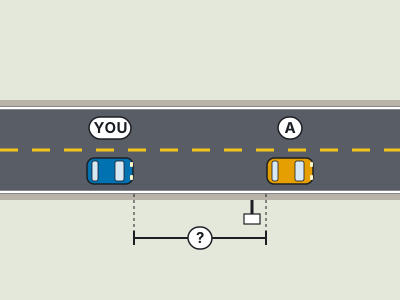
- Stay one car length back for every 10 mph
- Watch the gap in the mirror
- Keep the vehicle ahead just above the hood line
- Count from one-thousand-one to one-thousand-four after the vehicle ahead passes a fixed point and do not reach that point before finishing
Show answer
Count from one-thousand-one to one-thousand-four after the vehicle ahead passes a fixed point and do not reach that point before finishing. Watch when the rear of the vehicle ahead passes a sign, pole or other stationary point, then count the seconds it takes to reach the same point, one-thousand-one through one-thousand-four. If you pass the point before finishing the count, reduce speed and count again at another point until you are following no closer than four seconds. Car lengths and mirror guesses do not adjust for speed, which is why the manual uses time.
Study this in the handbook: Visual search and following distance
20. What does the New Hampshire manual advise a driver who wears corrective lenses to avoid at night?
- Any contact lenses
- Dark or tinted corrective lenses
- Driving with the interior light on
- Anti-reflective coatings
Show answer
Dark or tinted corrective lenses. Drivers who must wear corrective lenses should always wear them when driving and should avoid using dark or tinted corrective lenses at night. The manual explains in its reduced vision section that tinted or colored lenses reduce vision, and it repeats the point: do not wear sunglasses or colored lenses at night or on overcast days. Contact lenses and anti reflective coatings are not the concern the manual raises, and the interior light is a separate issue. The cue is the tint itself, which takes away vision a driver needs after dark.
Study this in the handbook: Vision, fatigue, emotions and hot vehicles
QualitySpace is expanding to New Hampshire
We are a California-based independent insurance brokerage working on licensing in more states. We cannot help with New Hampshire insurance yet. Leave your email and we will let you know when we can.
Every question is written from the official New Hampshire Driver's Manual. Need paper? Printable NH practice test with answer key.
Last verified 2026-10-05. How we check every question · Study all 208 as flashcards
Frequently asked questions
How many questions are on this New Hampshire practice test?
This fixed set has 20 questions. It is test 5 of 10 from the 208 question New Hampshire bank. The real NH exam asks 40 questions and you need 32 correct.
What is the passing score for the real New Hampshire test?
All knowledge exams require a passing grade of 80% That figure comes from the official New Hampshire source cited on the DMV facts page.
How does this fixed test relate to the full New Hampshire bank?
Each numbered test is a fixed set of questions in a fixed order, so you can retake the same test later and compare. Every test mixes road signs and the other topics in about the same proportion as the full bank. Tests 1 to 10 together cover 200 of the 208 questions in the New Hampshire bank, each once. The full practice page mixes the whole bank at random.
Last verified 2026-10-05. See the New Hampshire DMV facts page for sourced state details.
Return to the full New Hampshire practice test · Study road signs