
Test 2 of 10 · 20 questions · Free 2026
NH Permit Practice Test 2
Jump to the test ↓A fixed 20 question set from the New Hampshire bank with answers and plain English explanations. The real NH exam is 40 questions, 80 percent to pass; take the full length version on the main practice page.
Question 1 of 20 · 0 right so far
All 20 questions in test 2
Every question below comes from the New Hampshire question bank on this page. Open a question to see the correct answer and the explanation. Nothing here is hidden behind a signup.
1. What does the New Hampshire manual say about the consequences of collecting demerit points?
- They are identical for every driver
- Points can never lead to a loss of driving privileges
- They may vary depending on the driver's age
- Only commercial drivers receive demerit points
Show answer
They may vary depending on the driver's age. Excessive accrual of demerit points may result in loss of driving privileges, and the size of the points depends on the offense. Points are added for violations such as speeding, failing to obey traffic lights or stop signs, driving while intoxicated, and improper passing. The manual adds that the consequences may also vary depending on the driver's age, so they are not identical for everyone. Any licensed driver can collect points, not just commercial drivers.
Study this in the handbook: Suspensions, points and habitual offenders
2. How many hours of classroom instruction does New Hampshire driver education require?
- 30 hours
- 40 hours
- 10 hours
- 20 hours
Show answer
30 hours. New Hampshire driver education is built around several fixed hour counts, and the classroom portion is 30 hours with a certified driver education instructor. The 10 hour figure is the in-car practice component with the instructor, and 40 hours is the separate supervised driving requirement with a parent or other responsible adult. Keep the four numbers straight: 30 classroom, 10 instructor driving, 6 observation, and 40 supervised. Sixteen and seventeen year old applicants must finish the whole program before they can apply for a license.
Study this in the handbook: Driver education and practice driving
3. Your headlights suddenly go out at night on a New Hampshire road. What does the manual say to try?
- The high beam switch repeatedly
- Driving on the shoulder until a lit area
- Following the tail lights of the car ahead
- The turn signals or emergency flashers, then pull off the road as quickly and safely as possible
Show answer
The turn signals or emergency flashers, then pull off the road as quickly and safely as possible. For headlight failure the manual gives two steps: try the turn signals or emergency flashers, and pull off the road as quickly and safely as possible, leaving the emergency flashers on. Working the high beam switch, driving along the shoulder, and following another vehicle's tail lights are not among those steps. For a vehicle breakdown, the same flashers plus flares or reflectors 200 feet in front of and behind the vehicle give other drivers time to change lanes.
Study this in the handbook: Brake failure, blowouts and breakdowns
4. A police officer at a New Hampshire intersection is directing traffic against the traffic light. Who must you obey?
- The traffic light, because it is the legal control
- The police officer, who overrules any traffic light or sign
- Whichever allows you to proceed
- The sign, but not the light
Show answer
The police officer, who overrules any traffic light or sign. Among the basic rules of the road, the manual states that a police officer directing traffic overrules any traffic light or sign and must be obeyed. Traffic control devices include the directions given by law enforcement, highway personnel and school crossing guards, not only signals, signs and pavement markings. When an officer waves you through a red light or holds you at a green one, the officer's direction controls. Choosing the more convenient instruction is not an option.
Study this in the handbook: Traffic signals and officers
5. A vehicle's blind spot monitor shows the lane is clear. What does the New Hampshire manual say the driver should still do before changing lanes?
- Nothing further, the monitor is reliable
- Sound the horn
- Check the mirrors and look over the shoulder
- Turn on the hazard lights
Show answer
Check the mirrors and look over the shoulder. The blind spot monitor helps a driver be more aware of other traffic, and its warnings can be helpful when changing lanes, but the manual says the driver should still always check their mirrors and look over their shoulders before doing so. Like the other warning systems, it is a backup to head checks rather than a replacement. A horn or hazard lights are not part of a lane change, which needs a mirror check, a head check, a signal and a second look.
Study this in the handbook: Vehicle checks, seating and restraints
6. How close to a fire hydrant may a vehicle be parked in New Hampshire?
- No closer than 50 feet
- No closer than 5 feet
- No closer than 30 feet
- No closer than 15 feet
Show answer
No closer than 15 feet. Even without a posted sign, it is illegal to park within 15 feet of a fire hydrant. The other numbers in the manual's list belong to other places: 30 feet from a stop sign, yield sign or traffic control signal, 50 feet from the nearest rail of a railroad crossing, and 20 feet from a crosswalk at an intersection or from a fire station driveway. Five feet is far too close. The same list also bars parking in front of a driveway, so check every listed feature before leaving the vehicle at the curb.
Study this in the handbook: Parking rules and distances
7. Near a truck weigh station on a New Hampshire highway, which lane does the manual suggest avoiding if possible?
- The right lane
- The left lane
- The center lane
- Any lane next to a guardrail
Show answer
The right lane. Large vehicles move slowly on steep grades and typically use the right lane, and near weigh stations they will be trying to re-enter faster traffic. The manual therefore suggests avoiding the right lane, if possible, on hills and near weigh stations to reduce the chance of a crash with a large vehicle. The manual does not ask drivers to avoid the left or center lane there, and guardrails are not mentioned. Give trucks room to merge.
Study this in the handbook: Motorcycles, large trucks and slow vehicles
8. A marked bicycle path crosses the road you are driving on in New Hampshire. What must you do?
- Continue, because bicyclists must yield to motor vehicles
- Yield the right of way where the path crosses
- Sound the horn and proceed
- Speed up to clear the crossing quickly
Show answer
Yield the right of way where the path crosses. The manual tells drivers to yield the right of way when a bicycle path or bike lane intersects a road, and to yield to bicyclists in intersections as they would for pedestrians and other vehicles. Bicycles are vehicles with the same rights as drivers, so they are not required to give way to cars there. Honking near bicyclists can startle them into your path, and speeding up raises the danger. Slow down and let the rider clear the crossing.
Study this in the handbook: Pedestrians and bicyclists
9. A New Hampshire driver is unsure whether an over-the-counter cold medicine is safe to take before driving. What does the manual advise?
- Drink coffee to offset drowsiness
- Take half the dose and drive slowly
- Check the label for warnings and ask a doctor or pharmacist about side effects
- Assume it is safe because no prescription was needed
Show answer
Check the label for warnings and ask a doctor or pharmacist about side effects. Over-the-counter drugs for headaches, colds, hay fever, allergies or nerves can make a driver drowsy, and pep pills and diet pills can cause nervousness, dizziness and vision problems. The manual says to check the product label for warnings about its effect and, if unsure whether it is safe to take the drug and drive, to ask a doctor or pharmacist about side effects. Coffee and a half dose are guesses the manual never offers, and needing no prescription does not make a drug safe behind the wheel.
Study this in the handbook: How alcohol and drugs affect driving
10. Which behavior does the New Hampshire manual list as typical of aggressive driving?
- Driving slightly below the speed limit
- Following too closely
- Using turn signals early
- Stopping fully at stop signs
Show answer
Following too closely. Aggressive driving occurs when a person intentionally commits an action that endangers other people or property. The manual's list of typical behaviors includes speeding, following too closely, unsafe lane changes, improperly signaling, and failing to obey traffic control devices such as stop signs, yield signs, traffic signals and railroad grade crossing signals. Driving a little under the limit, signaling early, and stopping fully are the opposite of aggressive. The advice is to concentrate on driving and stay patient and courteous.
Study this in the handbook: Vision, fatigue, emotions and hot vehicles
11. What is the minimum age to obtain a New Hampshire non-driver identification card?
- 12 years
- 18 years
- There is no minimum age
- 16 years
Show answer
12 years. Non-driver identification cards may be issued to New Hampshire residents who do not hold a valid driver's license and who are at least 12 years of age. Applicants provide the same documentation needed for a driver's license, and a REAL ID compliant version is available. The card is for identification only and does not permit driving. Sixteen and eighteen are licensing ages, not the ID card minimum, and the manual does set a floor, so it is not open to every age.
Study this in the handbook: Youth Operator license, restrictions and renewal
12. This yellow sign shows a small stop sign with an arrow. What should a New Hampshire driver do when it appears?

- Prepare to stop at a stop sign ahead
- Stop immediately at this sign
- Treat this sign as a yield sign
- Speed up before the intersection
Show answer
Prepare to stop at a stop sign ahead. Stop Sign Ahead is a warning sign, and the manual says warning signs tell a driver to slow down because of a curve or intersection ahead and to be prepared to stop if necessary. The stop itself happens at the red octagon farther on, behind the stop line or crosswalk, with the wheels completely stopped. Stopping at the yellow warning sign is not required, treating it as a yield misreads it, and speeding up defeats its purpose.
Study this in the handbook: Sign shapes, colors and warning signs
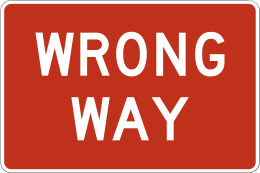
13. This WRONG WAY sign is facing you. What color category does the New Hampshire manual assign to it, and what does that color mean?
- Yellow, meaning a general warning
- Orange, meaning road repair work
- Green, meaning direction or guidance
- Red, meaning prohibition: stop or do not do something
Show answer
Red, meaning prohibition: stop or do not do something. Wrong Way is one of the manual's prohibition sign examples, and its red color carries the standard meaning of prohibition: stop or do not do something. Yellow is general warning, orange is road repair work, and green is direction or guidance. The manual pairs this color rule with shapes, so reading both the color and the words helps a driver classify a sign quickly. A red Wrong Way sign facing you is a prohibition, not a caution or a direction.
Study this in the handbook: Sign shapes, colors and warning signs
14. Under current New Hampshire law, what penalty applies to a Habitual Offender convicted of driving while the revocation order is in effect?
- Guilty of a felony, with imprisonment of not more than five years
- An additional 30 day suspension
- A fine only, with no jail time
- Mandatory driver education
Show answer
Guilty of a felony, with imprisonment of not more than five years. Driving after a Habitual Offender order is a felony under RSA 262:23, punishable by imprisonment for not more than five years. The driver manual describes a one year minimum, but the current statute text sets only the five year maximum, and any sentence of one year or less is served in a county correctional facility. The penalty is separate from and much heavier than the underlying one to four year revocation, so drivers near the threshold should treat every ticket as significant.
Study this in the handbook: Suspensions, points and habitual offenders
15. Under New Hampshire's Sherrill's Law, what must a driver do when approaching a stopped vehicle displaying warning lights, flares, or cones?
- Maintain a reduced speed and, if practical, give a wide berth or move to a non-adjacent lane, and vacate any blocked lane
- Stop behind the vehicle until it moves
- Continue at the posted speed in the same lane
- Pass on the shoulder
Show answer
Maintain a reduced speed and, if practical, give a wide berth or move to a non-adjacent lane, and vacate any blocked lane. Sherrill's Law, RSA 265:37-a, covers fires, collisions, utility work, traffic stops, and any stopped or standing vehicle displaying warning signals such as hazard lights, flares, cones or caution signs. Every driver other than an emergency responder must maintain a reduced speed and, if practical, give a wide berth to public safety personnel, people in the roadway and vehicles showing blue, red or amber lights, obey anyone directing traffic, and vacate any lane wholly or partially blocked as soon as possible. Violations bring a fine plus penalty assessment.
Study this in the handbook: Emergency vehicles, Sherrill's Law and traffic stops
16. This yellow sign shows a walking person. In the New Hampshire manual's list of warning signs, what is it?

- Share the Road with Bicycles
- Pedestrian Crossing
- School Crossing
- Added Lane
Show answer
Pedestrian Crossing. Pedestrian Crossing is one of the manual's example warning signs, listed with School Crossing, Share the Road with Bicycles, Bicycle Crossing and Slippery When Wet. The single walking figure warns that people may be crossing ahead, while the school crossing sign is the five sided pentagon with two figures. Drivers should be prepared to yield to pedestrians at all times, and the manual says pedestrians have the right of way when they are in a crosswalk or using a sidewalk across a driveway.
Study this in the handbook: Sign shapes, colors and warning signs
17. An approaching vehicle has its turn signal on. May a New Hampshire driver turn into the lane in front of it?
- Yes, the signal gives you the right of way
- Only if the other vehicle is a truck
- Yes, if you turn quickly
- No, the driver may plan to turn later or may have forgotten to cancel the signal
Show answer
No, the driver may plan to turn later or may have forgotten to cancel the signal. The manual warns drivers not to turn into a lane in front of another vehicle just because that vehicle has a turn signal active. The driver with the signal on may plan to turn after passing the intersection you are at, or may simply have forgotten to cancel the signal from an earlier turn. The point matters most with motorcycles, whose signals usually do not cancel automatically. Wait until the other vehicle actually begins to turn.
Study this in the handbook: Toll lanes, turns, U-turns and intersections
18. Where in New Hampshire is a 70 mph speed limit in effect?
- On every 4-lane divided interstate
- On the central New Hampshire turnpike
- On the portion of I-93 from mile marker 45 to the Vermont border
- On all Class V highways
Show answer
On the portion of I-93 from mile marker 45 to the Vermont border. The 70 mph limit applies only to the portion of Interstate 93 from mile marker 45 to the Vermont border. Elsewhere the interstate system, the central New Hampshire turnpike and the eastern New Hampshire turnpike are limited to 65 miles an hour where they are 4-lane divided highways or other divided highways of 4 or more lanes. Class V highways outside compact areas are 35 mph. The minimum speed on an interstate is 45 mph unless conditions make that unsafe.
Study this in the handbook: Speed limits
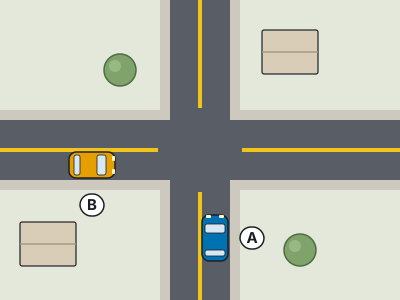
19. Under RSA 265:28, when two vehicles approach a New Hampshire intersection with no signs or officer, which driver yields?
- The driver on the right yields to the vehicle on the left
- The slower vehicle yields
- The vehicle on the wider road yields
- The driver approaching or entering on the left yields to the vehicle on the right
Show answer
The driver approaching or entering on the left yields to the vehicle on the right. RSA 265:28 states that the driver of a vehicle approaching or entering an intersection on the left shall yield the right of way to the vehicle on the right, unless an official traffic control device or a police officer directs otherwise. Speed and road width are not the test. The same idea appears at a four way stop when two drivers arrive at the same time: the driver on the right goes first. Never assume the other driver will yield.
Study this in the handbook: Yielding the right of way
20. What does the New Hampshire manual give as the average perception time for an alert driver?
- A quarter second
- Three quarters of a second to 1 second
- 2 to 3 seconds
- 5 seconds
Show answer
Three quarters of a second to 1 second. Perception time is the time and distance it takes an operator to recognize that they must stop, and the manual puts the average for an alert driver at three quarters of a second to 1 second. Reaction time, the time to move the foot from the gas to the brake, averages the same three quarters of a second to 1 second. Braking distance is added on top, which is why at 50 mph on dry pavement a stop can take about 158 feet.
Study this in the handbook: Signals, headlights, horn and stopping distance
QualitySpace is expanding to New Hampshire
We are a California-based independent insurance brokerage working on licensing in more states. We cannot help with New Hampshire insurance yet. Leave your email and we will let you know when we can.
Every question is written from the official New Hampshire Driver's Manual. Need paper? Printable NH practice test with answer key.
Last verified 2026-10-05. How we check every question · Study all 208 as flashcards
Frequently asked questions
How many questions are on this New Hampshire practice test?
This fixed set has 20 questions. It is test 2 of 10 from the 208 question New Hampshire bank. The real NH exam asks 40 questions and you need 32 correct.
What is the passing score for the real New Hampshire test?
All knowledge exams require a passing grade of 80% That figure comes from the official New Hampshire source cited on the DMV facts page.
How does this fixed test relate to the full New Hampshire bank?
Each numbered test is a fixed set of questions in a fixed order, so you can retake the same test later and compare. Every test mixes road signs and the other topics in about the same proportion as the full bank. Tests 1 to 10 together cover 200 of the 208 questions in the New Hampshire bank, each once. The full practice page mixes the whole bank at random.
Last verified 2026-10-05. See the New Hampshire DMV facts page for sourced state details.
Return to the full New Hampshire practice test · Study road signs