
Test 8 of 10 · 20 questions · Free 2026
NH Permit Practice Test 8
Jump to the test ↓A fixed 20 question set from the New Hampshire bank with answers and plain English explanations. The real NH exam is 40 questions, 80 percent to pass; take the full length version on the main practice page.
Question 1 of 20 · 0 right so far
All 20 questions in test 8
Every question below comes from the New Hampshire question bank on this page. Open a question to see the correct answer and the explanation. Nothing here is hidden behind a signup.
1. When does New Hampshire consider a load carried on a vehicle to be secure?
- When it is covered with a tarp
- When it stays below the height of the cab
- When a red flag is tied to it
- When nothing can slide, shift, fall or sift onto the roadway, or become airborne
Show answer
When nothing can slide, shift, fall or sift onto the roadway, or become airborne. Driving with an unsecured load is against the law and dangerous, and a driver who causes a crash with one may face a costly fine. The manual's test is strict: the load counts as secure only when nothing can slide, shift, fall, sift onto the roadway, or become airborne. A tarp can still let material blow out, a low load can still slide off, and a flag only marks a load. The load must be fastened, not just covered or marked.
Study this in the handbook: Vehicle checks, seating and restraints
2. A flagger in a New Hampshire work zone signals you to stop. What does the manual say?
- Drivers must follow the flagger's instructions
- Stop only if the signal is a red flag
- Wait for a police officer to confirm
- Proceed slowly if no workers are visible
Show answer
Drivers must follow the flagger's instructions. In work zones, traffic may be controlled by a person with a sign or flag who tells drivers which direction to travel, to slow down or to stop, and drivers must follow their instructions. Barriers such as drums, cones and tubes keep traffic out of hazardous areas, and temporary signals may be used. Reduce speed, be prepared to stop suddenly, do not tailgate, and remember that fines may be doubled in a work zone, which will be clearly marked before you enter it.
Study this in the handbook: Regulatory, guide, work zone and railroad signs
3. A train is approaching a New Hampshire crossing. How far from the nearest rail must a driver stop?
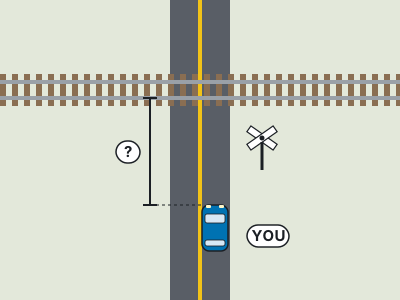
- At least 100 feet from the nearest rail
- At least 5 feet from the nearest rail
- Behind the stop line, or not less than 15 feet nor more than 50 feet from the nearest rail
- Anywhere behind the crossbuck
Show answer
Behind the stop line, or not less than 15 feet nor more than 50 feet from the nearest rail. When a train or railroad vehicle is approaching, a driver must stop behind the stop line or not less than 15 feet nor more than 50 feet from the nearest rail of the track. Five feet is too close and 100 feet is outside the window. Do not proceed until the lights stop flashing or the train has passed, and where there is more than one track wait for a clear view in both directions. Then cross quickly without stopping.
Study this in the handbook: Regulatory, guide, work zone and railroad signs
4. For how long may a first offense DUI conviction cost a New Hampshire driver their driving privileges?
- 30 to 90 days
- 5 years
- Exactly 1 year
- 9 months to 2 years
Show answer
9 months to 2 years. The manual says a driver convicted of a first offense DUI may lose driving privileges for a period of 9 months to 2 years and will be required to attend an approved impaired driver education program. Thirty to ninety days is far shorter than that range, the loss is a range rather than a fixed single year, and five years is not the first offense figure. DUI is also one of the convictions that require SR-22 proof of insurance before driving and registration privileges are reinstated.
Study this in the handbook: BAC limits, under 21 rules and DUI penalties
5. Which way should a New Hampshire driver turn the wheels when parking on a hill?
- Away from the curb in every case
- Into the curb, with the parking brake set
- It does not matter if the transmission is in park
- Straight ahead
Show answer
Into the curb, with the parking brake set. To make sure a parked vehicle cannot move, place it in park with an automatic transmission or leave it in gear with a manual, set the parking brake, and turn the wheels into the curb if the vehicle is parked on a hill. The manual gives one direction for hills, into the curb, rather than away from it or straight ahead. Leaving the transmission in park alone does not complete the steps it lists. The same section adds that the law requires turning off the engine and removing the key, and that you should never open a door into traffic.
Study this in the handbook: Parking rules and distances
6. What does a purple sign or lane marking mean in New Hampshire?
- A hospital route
- E-ZPass electronic toll collection
- An evacuation route
- A school zone
Show answer
E-ZPass electronic toll collection. On the manual's color list, purple means E-ZPass, the electronic toll collection system that lets drivers pass through designated lanes without stopping to pay a cash toll. In an E-ZPass lane, obey the posted speed limit but do not come to a stop, never back up or reverse direction, and do not get out of the vehicle. Cash only lanes are different: come to a complete stop at staffed lanes. Purple is not used for hospitals, evacuation routes, or school zones.
Study this in the handbook: Sign shapes, colors and warning signs
7. At a solid green light in New Hampshire, to whom must a driver still yield?
- Pedestrians and vehicles in the intersection
- No one, green means go
- Only emergency vehicles
- Only vehicles turning right
Show answer
Pedestrians and vehicles in the intersection. A solid green traffic light means a driver may go through the intersection and, if it is clear to do so, proceed with caution. The manual specifically says drivers must yield to pedestrians and vehicles in an intersection even on green. When the light changes, avoid moving into the intersection immediately; look left, right and left again and make sure the path is clear of crossing traffic. Emergency vehicles must be yielded to at any signal.
Study this in the handbook: Traffic signals and officers
8. Under New Hampshire law, which condition allows a person under 18 to be issued a driver's license?
- The applicant has held a job for six months
- The applicant owns the vehicle used for the test
- The applicant has completed 20 hours of driving
- A parent, guardian, or responsible adult gives written permission
Show answer
A parent, guardian, or responsible adult gives written permission. No person under 18 can be issued a license unless a parent, guardian, or, if there is none, another responsible adult gives written permission, insurance coverage is presented at the time of application, or the person under 18 is emancipated by marriage. Employment, vehicle ownership, and practice hours are not substitutes for that consent. The manual lists these consent conditions under its parental consent heading, separate from the testing requirements an applicant must also meet.
Study this in the handbook: Driver education and practice driving
9. After failing the New Hampshire knowledge or road test, how soon can an applicant retest?
- The next business day
- After a mandatory 30 day wait
- Not sooner than ten days from the failed test
- Immediately, on the same visit
Show answer
Not sooner than ten days from the failed test. If either the knowledge test or the road test is not passed, the applicant is given an appointment to retest not sooner than ten days from the failed test. Same day and next day retakes are not offered, and there is no 30 day penalty. Applicants who pass receive a 60 day paper temporary license, with the permanent card mailed within 45 days. Use the ten days to review the sections that produced the missed questions or the road test errors.
Study this in the handbook: The vision, knowledge and road tests
10. A new New Hampshire resident holds a valid out-of-state license. Which test is required to get a New Hampshire license?
- Only a vision test
- The vision, knowledge, and road tests
- Only the knowledge test
- Only the road test
Show answer
Only a vision test. Only a vision test is required for drivers new to New Hampshire who hold a valid out-of-state driver's license. The full set of vision, knowledge and road tests is required only if the out-of-state license has been expired for more than one year. Applying for a different class of license than the one currently held also requires the written and road tests for that class. Remember to surrender the out-of-state license at the counter.
Study this in the handbook: Youth Operator license, restrictions and renewal
11. A New Hampshire driver already holds a Class D license. What license is needed to operate a moped?
- A separate moped license in every case
- None, a Class A, B, C, D or motorcycle license already covers a moped
- A motorcycle endorsement only
- A motor-driven cycle license
Show answer
None, a Class A, B, C, D or motorcycle license already covers a moped. Drivers do not need a moped license if they already possess a Class A, B, C, D or motorcycle license, so a Class D holder can ride a moped without any added credential. A separate moped license exists only for people who hold none of those licenses. A motor-driven cycle license is a different credential for a bicycle with a motor of no more than 5 brake horsepower, and a motorcycle license covers motorcycles, three wheeled motorcycles, motor driven cycles and mopeds.
Study this in the handbook: Youth Operator license, restrictions and renewal
12. During the first six months of holding a New Hampshire Youth Operator license, how many non-family passengers under 25 may the driver carry without a supervising adult?
- No more than one
- Up to two
- None at all
- Up to three
Show answer
No more than one. For the first six months of holding the license, a Youth Operator under 18 may not drive with more than one passenger under 25 who is not a member of the driver's family unless a licensed, responsible adult who is at least 25 is in the vehicle. The limit is one, not zero and not two or three. Family members do not count against it. A separate youth rule, not limited to the first six months, bars carrying more passengers than there are seat belts or safety restraints.
Study this in the handbook: Youth Operator license, restrictions and renewal
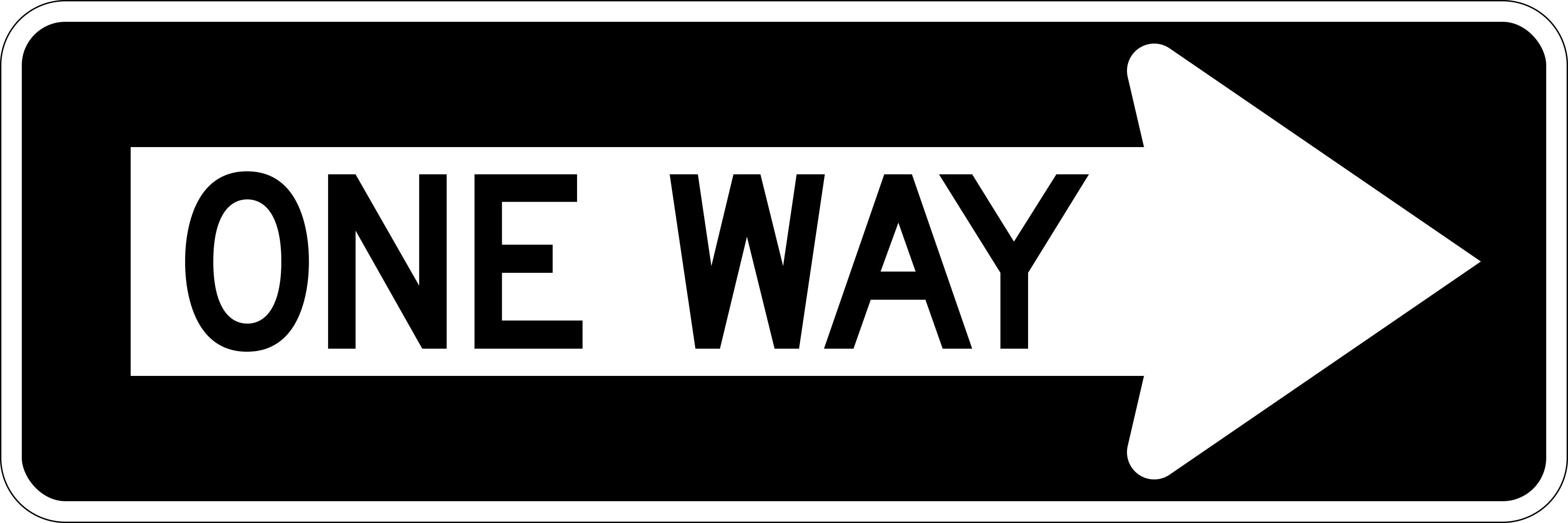
13. What does this ONE WAY sign tell a New Hampshire driver?
- The lane is reserved for turning traffic
- Traffic flows only in the direction of the arrow, so never drive the other way
- Two way traffic resumes ahead
- The road is closed beyond the sign
Show answer
Traffic flows only in the direction of the arrow, so never drive the other way. One-Way Street signs tell a driver that traffic flows only in the direction of the arrow, and the manual adds a flat rule: never drive the wrong way on a one-way street. The sign does not reserve a turn lane, does not announce two way traffic, and does not close the road. Before turning onto a street, look for the arrow so you enter with the flow. A yellow edge line on the left side of a roadway is another clue that the street is one way.
Study this in the handbook: Regulatory, guide, work zone and railroad signs
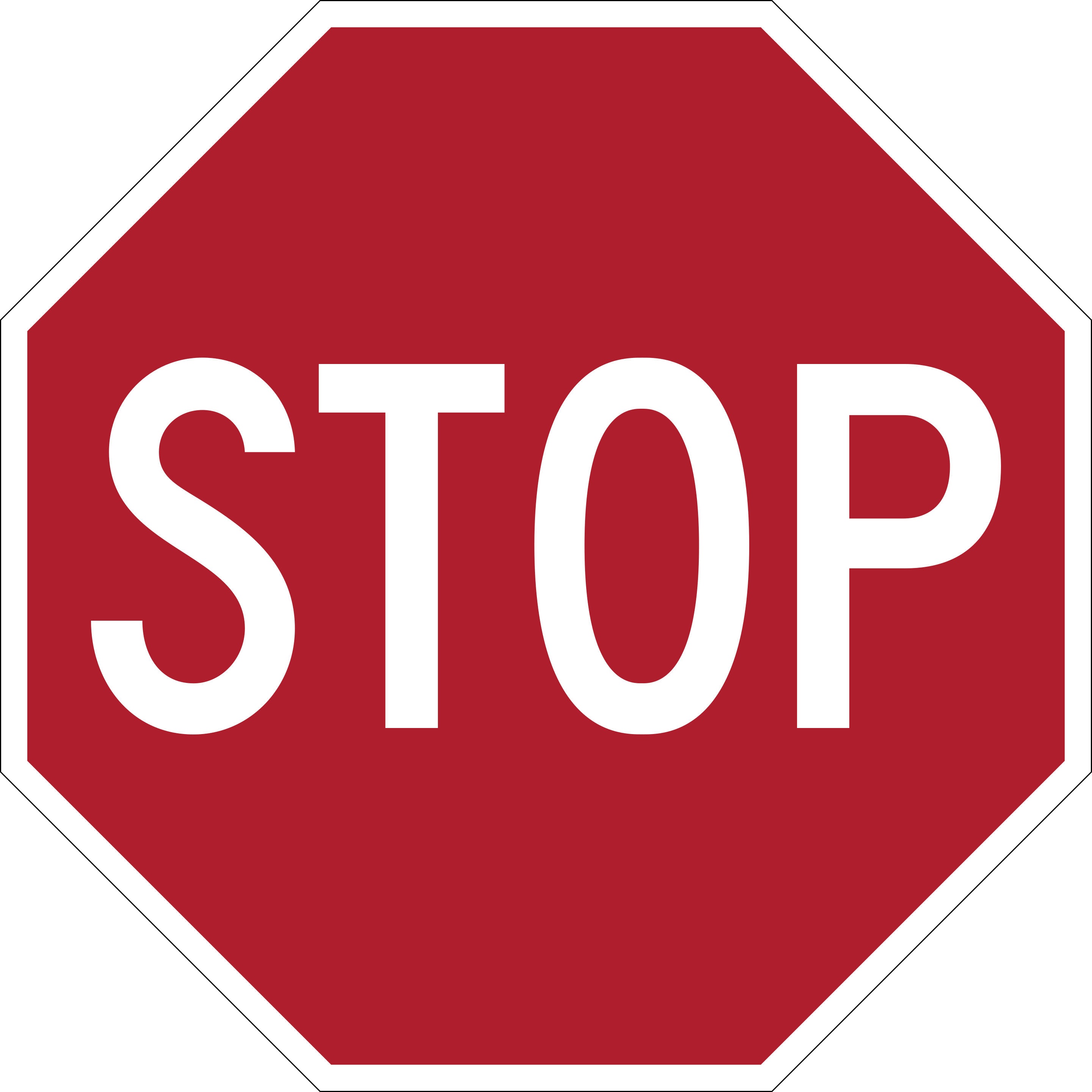
14. At this stop sign in New Hampshire, what does a full stop mean and where must it happen?
- Slow to a crawl at the sign post
- The wheels must completely stop moving, behind the stop line or crosswalk, or before entering the intersection if there is neither
- Stop with the front bumper even with the sign
- Stop only if another vehicle is approaching
Show answer
The wheels must completely stop moving, behind the stop line or crosswalk, or before entering the intersection if there is neither. The manual defines a full stop as the wheels completely stopping. The stop must happen behind the stop line or crosswalk, or, if there is no line or crosswalk, before entering the intersection. A crawl is not a stop, the sign post is not the stopping point, and the requirement does not depend on other traffic being present. After stopping, look for crossing vehicles and pedestrians in all directions and yield the right-of-way before proceeding.
Study this in the handbook: Sign shapes, colors and warning signs
15. An oncoming New Hampshire driver leaves the high beams on at night. Where should you look?
- Directly at the headlights so your eyes adjust
- At the center line
- Into the rearview mirror
- Toward the right side of the road
Show answer
Toward the right side of the road. Use high beams when there are no oncoming vehicles and dim them for all approaching traffic. If a vehicle coming the other way keeps its high beams on, look toward the right side of the road to keep from being distracted or momentarily blinded, using the fog line or the edge of the roadway as a guide. Looking into the headlights, at the center line, or into a mirror is not the manual's advice. Use low beams when following another vehicle and in fog, rain or snow.
Study this in the handbook: Rural roads and night driving
16. Why does the New Hampshire manual warn that a motorcycle can hide in a vehicle's blind spot?
- Motorcycles are usually painted dark colors
- Motorcycles travel faster than cars
- Most motorcycles are only about two feet wide
- Riders are required to stay near the curb
Show answer
Most motorcycles are only about two feet wide. Motorcyclists have the same rights and responsibilities as other drivers, but because most motorcycles are only about two feet wide they may not be easily identifiable in traffic and can be hidden in a vehicle's blind spot. It is also hard to judge how fast they are traveling. Never share a lane with a motorcycle, allow at least four seconds of following distance behind one, check carefully for motorcycles before turning left, and remember that most motorcycle turn signals do not cancel automatically.
Study this in the handbook: Motorcycles, large trucks and slow vehicles
17. When swerving to avoid a vehicle suddenly approaching from the opposite direction, which direction does the New Hampshire manual say never to swerve?
- To the right
- Toward the shoulder
- To the left
- Back into your own lane
Show answer
To the left. Swerving means quickly steering around a problem. The manual says to keep a good grip with both hands, steer in the direction you want to go while avoiding other traffic, and never swerve to the left to avoid a crash, because the left puts you into the oncoming lane the other vehicle came from. Once the problem clears, steer in the opposite direction to straighten out and regain control. Accelerating may also be needed to avoid being hit from behind or the side.
Study this in the handbook: Emergency braking, swerving and skids
18. Under New Hampshire's one license concept, what must a new resident do with licenses issued by other states?
- Keep them as backup identification
- Mail them to the issuing state within a year
- Nothing, as long as only one is carried at a time
- Surrender all valid licenses from any other jurisdiction
Show answer
Surrender all valid licenses from any other jurisdiction. RSA 263:4 requires new residents to surrender all valid driver licenses issued by any other jurisdiction when they apply for a New Hampshire license. The idea is one driver, one license, so keeping an old license as a spare or simply not carrying it does not satisfy the law. The manual also tells applicants to bring all driver licenses issued by any state to the tests. An application is refused while the driver's privileges are under suspension or revocation in another state.
Study this in the handbook: Driver education and practice driving
19. What does a green arrow allow a New Hampshire driver to do?
- Turn in the direction of the arrow after yielding to traffic and pedestrians
- Turn without checking for pedestrians
- Go straight only
- Turn in any direction
Show answer
Turn in the direction of the arrow after yielding to traffic and pedestrians. A green arrow means drivers may turn in the direction of the arrow after yielding to traffic and pedestrians. The arrow gives the turning movement a green indication, but the manual still requires yielding to anyone already in the intersection or crosswalk. It permits only the direction shown, not any turn and not straight travel unless a green light accompanies it. A yellow arrow means slow down and proceed in the arrow's direction with caution.
Study this in the handbook: Traffic signals and officers
20. You are being tailgated unsafely on a New Hampshire road. What does the manual say to do?
- Speed up to open a gap
- Tap the brakes to warn the driver
- Find a safe location to pull over and let the vehicle pass
- Stop in the lane until the driver backs off
Show answer
Find a safe location to pull over and let the vehicle pass. The manual's answer to a tailgater is to find a safe location to pull over and let the vehicle pass. Tapping the brakes, speeding up, and stopping in the lane are not in that advice, and each keeps the close follower right behind you instead of letting the vehicle go by. The same passage says following another vehicle more closely than is reasonable and prudent is a violation punishable by a fine, and it recommends a four second following distance.
Study this in the handbook: Signals, headlights, horn and stopping distance
QualitySpace is expanding to New Hampshire
We are a California-based independent insurance brokerage working on licensing in more states. We cannot help with New Hampshire insurance yet. Leave your email and we will let you know when we can.
Every question is written from the official New Hampshire Driver's Manual. Need paper? Printable NH practice test with answer key.
Last verified 2026-10-05. How we check every question · Study all 208 as flashcards
Frequently asked questions
How many questions are on this New Hampshire practice test?
This fixed set has 20 questions. It is test 8 of 10 from the 208 question New Hampshire bank. The real NH exam asks 40 questions and you need 32 correct.
What is the passing score for the real New Hampshire test?
All knowledge exams require a passing grade of 80% That figure comes from the official New Hampshire source cited on the DMV facts page.
How does this fixed test relate to the full New Hampshire bank?
Each numbered test is a fixed set of questions in a fixed order, so you can retake the same test later and compare. Every test mixes road signs and the other topics in about the same proportion as the full bank. Tests 1 to 10 together cover 200 of the 208 questions in the New Hampshire bank, each once. The full practice page mixes the whole bank at random.
Last verified 2026-10-05. See the New Hampshire DMV facts page for sourced state details.
Return to the full New Hampshire practice test · Study road signs