
Test 1 of 10 · 20 questions · Free 2026
NH Permit Practice Test 1
Jump to the test ↓A fixed 20 question set from the New Hampshire bank with answers and plain English explanations. The real NH exam is 40 questions, 80 percent to pass; take the full length version on the main practice page.
Question 1 of 20 · 0 right so far
All 20 questions in test 1
Every question below comes from the New Hampshire question bank on this page. Open a question to see the correct answer and the explanation. Nothing here is hidden behind a signup.
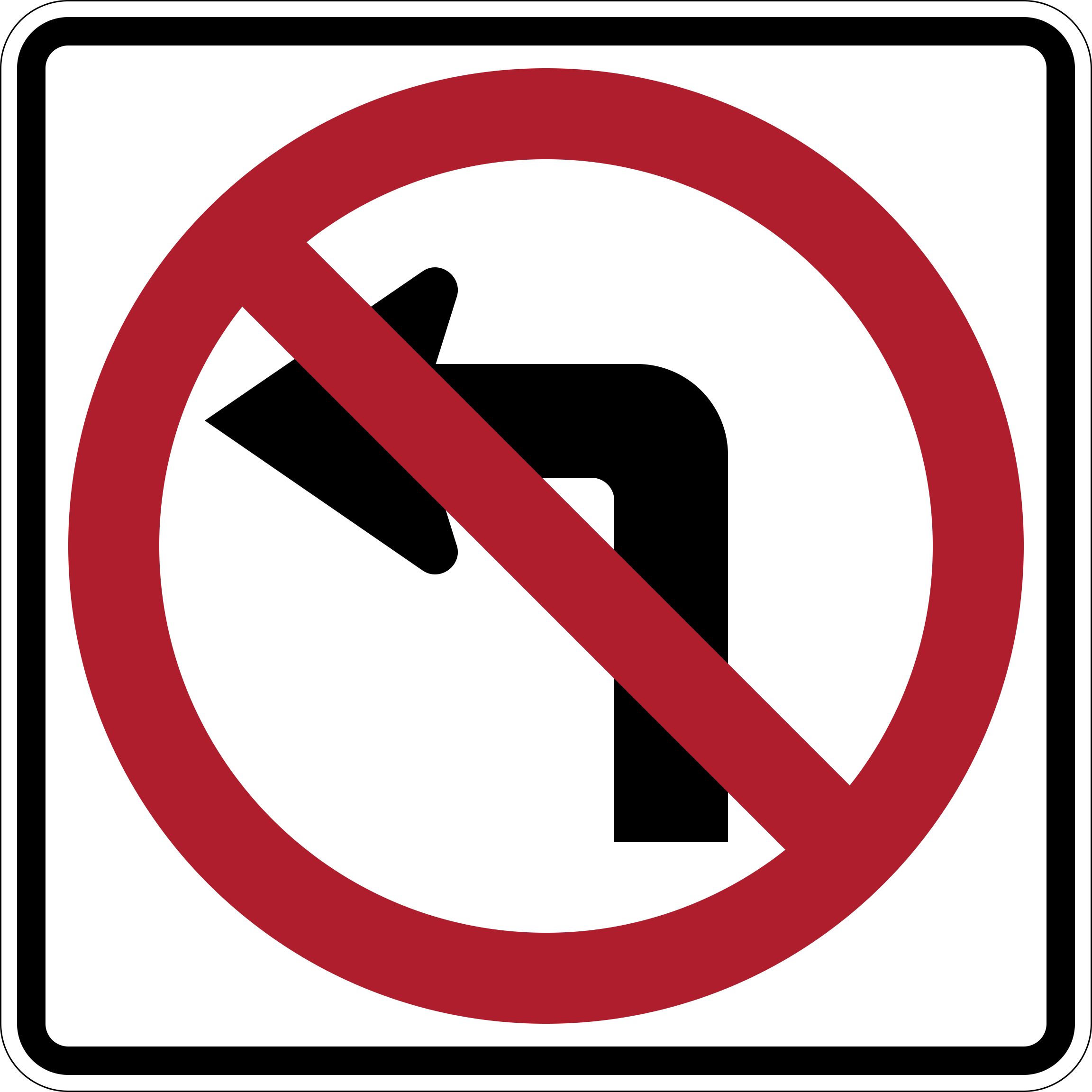
1. This sign shows a left turn arrow crossed by a red slash. What may a New Hampshire driver not do here?
- Go straight
- Turn left
- Turn right
- Change lanes
Show answer
Turn left. No Left Turn is one of the prohibition signs the manual lists alongside Do Not Enter, No Trucks, Wrong Way, No Right Turn and No U-Turn. The red slash over the left arrow bans only the movement pictured, so going straight, turning right, and changing lanes remain governed by other signs and markings. When the sign is posted, plan a different route to reach a destination on the left, such as continuing to the next intersection where a left turn is allowed.
Study this in the handbook: Sign shapes, colors and warning signs
2. What does the New Hampshire manual describe as the best way to avoid traction loss from hydroplaning?
- Slow down in the rain or when the road has pooled water
- Drive in the tire tracks of the vehicle ahead at full speed
- Brake firmly as soon as the road is wet
- Use cruise control to hold a steady speed
Show answer
Slow down in the rain or when the road has pooled water. Hydroplaning happens when the steering tires start to ride up on pooled water, like water skis. The manual says the best way to avoid traction loss from hydroplaning is to slow down in the rain or when the road is wet with pooled water or puddles. Good tread depth and proper tire pressure also help. Following in tracks at full speed, braking firmly on a wet road, and holding a set speed with cruise control are not the manual's remedy.
Study this in the handbook: Lane changes, passing, backing and road conditions
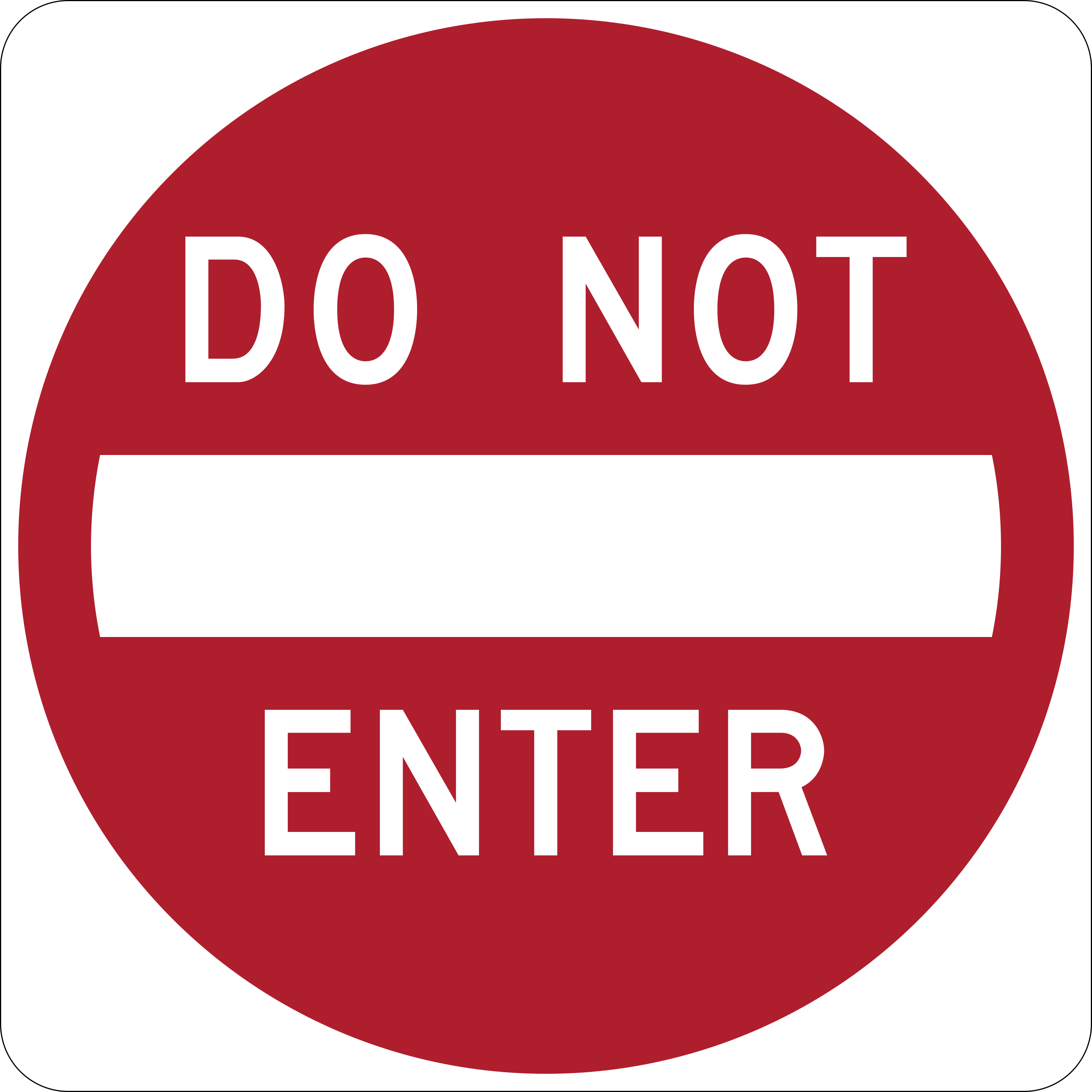
3. In the New Hampshire manual, which group of signs includes this DO NOT ENTER sign?
- Warning signs
- Guide signs
- Prohibition signs
- Route number signs
Show answer
Prohibition signs. The manual's examples of prohibition signs are the stop sign, the yield sign, Do Not Enter, No Trucks, Wrong Way, No Left Turn, No Right Turn and No U-Turn. Red is the standard color for prohibition, meaning stop or do not do something. Warning signs are diamonds in the general warning color, yellow, and green signs give direction or guidance, so neither describes this sign. Route markers are not on the prohibition list either. This sign tells a driver not to enter the road where it is posted.
Study this in the handbook: Sign shapes, colors and warning signs
4. What colors are New Hampshire guide signs, and what do they help drivers find?
- Green, brown, or blue; they direct drivers to cities, points of interest, hospitals, service stations, restaurants and hotels
- Orange; they mark detours
- Yellow; they warn of hazards
- Red and white; they list prohibited actions
Show answer
Green, brown, or blue; they direct drivers to cities, points of interest, hospitals, service stations, restaurants and hotels. Guide signs are square or rectangular and are green, brown or blue. They give information on intersecting roads, help direct drivers to cities and towns, and show points of interest along the roadway. Guide signs can also help drivers find hospitals, service stations, restaurants and hotels. Red and white signs are prohibitions, orange signs mark work zones and detours, and yellow signs are warnings. Green is direction, brown is tourist and recreation, and blue is driver services.
Study this in the handbook: Regulatory, guide, work zone and railroad signs
5. What does a solid white line between lanes prohibit in New Hampshire?
- Driving faster than 45 mph
- Stopping for pedestrians
- Using the lane for trucks
- Changing lanes or passing another vehicle
Show answer
Changing lanes or passing another vehicle. Solid white lines are a boundary: drivers are prohibited from changing lanes or passing another vehicle across them. The manual contrasts them with broken lines, over which a driver may pass other vehicles when it is safe to do so. The marking has nothing to do with speed, pedestrians or vehicle type. Stay in your lane while the line beside you is solid white, and wait until the line becomes broken before moving over.
Study this in the handbook: Pavement markings
6. This yellow merge arrow sign is posted on a New Hampshire highway. What is it warning about?

- A lane is being added that does not merge
- The highway is ending
- Merging traffic will be joining your roadway ahead
- A one way street begins
Show answer
Merging traffic will be joining your roadway ahead. Merging Traffic is in the manual's warning sign list, next to Lane Ends and Added Lane. It warns that another roadway joins yours ahead, so adjust speed or move over a lane when safe to give entering vehicles room. Added Lane is the different sign for a lane that continues without a merge. Drivers entering from an acceleration lane should reach the speed of traffic, identify a gap, and merge with the flow.
Study this in the handbook: Sign shapes, colors and warning signs
7. When may a New Hampshire driver under 21 transport liquor or alcoholic beverages in a vehicle?
- Whenever the containers are sealed
- Only when accompanied by a parent, legal guardian, or legal age spouse
- Whenever the alcohol is in the trunk
- Never, under any circumstances
Show answer
Only when accompanied by a parent, legal guardian, or legal age spouse. No driver under 21 may transport any liquor or alcoholic beverage in any part of a vehicle except when accompanied by a parent, legal guardian or legal age spouse. Sealed containers and trunk storage do not create an exception, because the rule is about who is in the car, not where the bottle is. It is also not an absolute ban, since the accompanied cases are allowed. The same section makes it illegal for an operator under 21 to have physical control of a vehicle at .02 or more.
Study this in the handbook: Vision, fatigue, emotions and hot vehicles
8. After a crash in New Hampshire, what does the manual say about injured people?
- Move them to the sidewalk right away
- Drive them to a hospital yourself
- Leave them until police arrive
- Give aid, but do not move them unless necessary, and be sure an ambulance has been called
Show answer
Give aid, but do not move them unless necessary, and be sure an ambulance has been called. The crash checklist is to stop, move the vehicle off the road if possible so traffic is not blocked, call 911 if there are injuries, and give aid to any injured people but not move them unless it is necessary, making sure an ambulance has been called. Then collect names, addresses, license numbers and states, plate numbers, vehicle make, model and year, and insurance information for everyone involved, plus names and addresses of witnesses.
Study this in the handbook: Crashes, reports and financial responsibility
9. How far behind a large truck can its rear blind spot extend?
- Up to 20 feet
- Up to 50 feet
- Up to 500 feet
- Up to 200 feet
Show answer
Up to 200 feet. Large vehicles have huge blind spots directly behind them that can extend up to 200 feet. Twenty or fifty feet understates the rear No-Zone, and 500 feet is the distance to stay behind a fire truck using its siren or lights. If you follow too closely, the truck driver cannot see you and you cannot see what is ahead. Drop back and position the car so the driver can see it in the side mirrors.
Study this in the handbook: Motorcycles, large trucks and slow vehicles
10. You are pulling out of a private road onto a New Hampshire public highway. To whom must you yield?
- No one, if you signal first
- Only vehicles approaching from your left
- Drivers already on the public highway
- Only trucks and buses
Show answer
Drivers already on the public highway. When entering a public highway from a driveway or private road, a driver yields to drivers on the public highway. Signaling does not create the right of way. Vehicles from both directions matter, not only those from the left, because a gap on one side does not make the crossing safe. The rule applies to all traffic on the highway, not only large vehicles. Pedestrians on a sidewalk across the driveway also have the right of way.
Study this in the handbook: Yielding the right of way
11. Unless posted otherwise, what is the maximum speed limit in a New Hampshire business or urban residence district?
- 25 miles per hour
- 30 miles per hour
- 20 miles per hour
- 35 miles per hour
Show answer
30 miles per hour. The maximum speed limits in New Hampshire are set by district. In any business or urban residence district as defined in RSA 259:118 the limit is 30 miles per hour. Thirty five applies in a rural residence district and on Class V highways outside the compact part of a city or town, and 45 or 55 applies in other locations. Twenty and twenty five are lower than the listed limit for these districts. Remember that limits are maximums for ideal conditions, so slow down further when weather, traffic, or visibility require it.
Study this in the handbook: Speed limits
12. What does New Hampshire law require when leaving a vehicle unattended?
- Leave the hazard lights on
- Turn off the engine and remove the key
- Leave the vehicle in neutral
- Roll the windows down
Show answer
Turn off the engine and remove the key. When parked, drivers should secure the vehicle, and the law requires drivers to turn off the engine and remove the key when leaving a vehicle unattended. The manual also says to lock the vehicle, place an automatic transmission in park or a manual in gear, set the parking brake, and turn the wheels into the curb on a hill. Neutral lets the vehicle roll, and open windows and flashing hazards do nothing to secure it.
Study this in the handbook: Parking rules and distances
13. Where does the New Hampshire manual say a pedestrian should walk when there is no sidewalk?
- In the center of the lane
- On the right side, with traffic
- On the left side of the roadway, facing oncoming traffic
- On either side, as long as they wear white
Show answer
On the left side of the roadway, facing oncoming traffic. Pedestrians must use crosswalks at intersections, look both ways before crossing, and, where there is no sidewalk, walk on the left side of the roadway facing oncoming traffic so they can see vehicles coming. They should wear white or light colored clothing or carry a light at night and never walk on interstate or limited access highways. Drivers should use extra caution near parked vehicles, when backing, and in school zones where children may step out.
Study this in the handbook: Pedestrians and bicyclists
14. In which situation does the New Hampshire manual say to increase the following distance?
- When following vehicles required to stop at railroad crossings, such as school buses
- When traffic is light
- When the road is dry and straight
- When following a motorcycle in daylight only
Show answer
When following vehicles required to stop at railroad crossings, such as school buses. Drivers should increase following distance on slippery roads, when following large vehicles like trucks, buses, recreational vehicles and vehicles pulling trailers, at night, in fog or in bad weather, and when following vehicles required to stop at railroad crossings, like transit buses, school buses or vehicles carrying hazardous materials. Those vehicles will stop at every crossing even with no train in sight. A dry straight road with light traffic is the baseline where four seconds is enough.
Study this in the handbook: Visual search and following distance
15. Which child must ride in a child passenger restraint that meets federal safety standards in New Hampshire?
- Any child under 8, whatever the child's height
- Any child under 5 or under 40 pounds
- Any child under 12 riding in the front seat
- A child who is both under 7 years old and under 57 inches tall
Show answer
A child who is both under 7 years old and under 57 inches tall. The manual sets two conditions together: a child less than 7 years old and less than 57 inches in height must be properly fastened and secured in a child passenger restraint that complies with United States Department of Transportation safety standards. Age 8 by itself is not the New Hampshire figure, and height still matters here. Five years and 40 pounds are not in the manual, and front seat position is not the test. Check both the child's age and height before deciding whether a restraint is still required.
Study this in the handbook: Vehicle checks, seating and restraints
16. A driver hurt in a reportable New Hampshire crash cannot complete the Operator Accident Report. Who may file it instead?
- Only the driver, after recovering
- Only the other driver's insurance company
- A passenger or the owner of the vehicle
- Only the hospital that treated the driver
Show answer
A passenger or the owner of the vehicle. A report must reach the DMV within 15 days when a crash causes a death, injuries, or combined property damage over $1,000, unless a police officer investigated. If the driver is injured and unable to complete it, a passenger or the owner of the vehicle may file it. Waiting for the driver to recover could miss the deadline. Insurance companies and hospitals are not named as filers. The form is the Operator Accident Report, DSMV 400.
Study this in the handbook: Crashes, reports and financial responsibility
17. How does the New Hampshire manual say a head rest should be adjusted?
- Level with the driver's shoulders
- As low as it will go
- Tilted away so it never touches the head
- So it touches the back of the driver's head, not below the ears
Show answer
So it touches the back of the driver's head, not below the ears. Head restraints exist to prevent whiplash in a crash, so the manual says to adjust them to come in contact with the back of the driver's head, but not below the ears. A rest set at shoulder level or pushed all the way down lets the head snap backward over it. Tilting it away from the head leaves a gap that defeats its purpose. Adjust the seat, mirrors, and head rest before the vehicle starts moving.
Study this in the handbook: Vehicle checks, seating and restraints
18. Why does the New Hampshire manual warn against following closely behind a large vehicle?
- Large vehicles brake more quickly than cars
- It limits how far the driver can see down the road
- It is illegal to be within 500 feet of any truck
- Trucks drift between lanes
Show answer
It limits how far the driver can see down the road. Looking ahead means looking down the road past the vehicles in front and continually checking mirrors, which is impossible when a large vehicle fills the windshield. Drivers should avoid situations that limit how far they can see, like following too close to a larger vehicle, and should adjust speed and road position when behind one. Trucks actually take longer to stop, and the 500 foot rule is about not following a fire truck that is sounding a siren or operating flashing lights.
Study this in the handbook: Visual search and following distance
19. A New Hampshire driver leaves the state without renewing and will not return before the license expires. What must the driver do?
- Notify the DMV in writing to be eligible for a 6 month temporary
- Nothing, because the license extends itself automatically
- Call any DMV office after the license expires
- Mail the license back and reapply as a new driver
Show answer
Notify the DMV in writing to be eligible for a 6 month temporary. Drivers who expect to be temporarily out of state can renew up to six months early. If they leave without renewing and will not be back before expiration, the DMV must be notified in writing for the driver to be eligible for a 6 month temporary. The license does not extend on its own, and a phone call after it expires does not meet the written notice rule. Returning the license and starting over is not what the manual describes.
Study this in the handbook: Youth Operator license, restrictions and renewal
20. An applicant fails the New Hampshire vision test. What is needed before license testing can continue?
- An eye examination with a doctor's recommendation of visual capability
- A retest in ten days with no other paperwork
- A daylight only temporary license
- Nothing; the knowledge test can be taken anyway
Show answer
An eye examination with a doctor's recommendation of visual capability. When an applicant does not pass the vision test, New Hampshire requires an eye examination that contains a doctor's recommendation of visual capability before any more license testing can be done. The ten day wait belongs to a failed knowledge or road test, not the vision test. The manual offers no daylight only temporary license in place of the exam, and the knowledge test cannot simply go ahead. The standard is 20/40 in both eyes, or 20/30 with sight in one eye.
Study this in the handbook: Driver education and practice driving
QualitySpace is expanding to New Hampshire
We are a California-based independent insurance brokerage working on licensing in more states. We cannot help with New Hampshire insurance yet. Leave your email and we will let you know when we can.
Every question is written from the official New Hampshire Driver's Manual. Need paper? Printable NH practice test with answer key.
Last verified 2026-10-05. How we check every question · Study all 208 as flashcards
Frequently asked questions
How many questions are on this New Hampshire practice test?
This fixed set has 20 questions. It is test 1 of 10 from the 208 question New Hampshire bank. The real NH exam asks 40 questions and you need 32 correct.
What is the passing score for the real New Hampshire test?
All knowledge exams require a passing grade of 80% That figure comes from the official New Hampshire source cited on the DMV facts page.
How does this fixed test relate to the full New Hampshire bank?
Each numbered test is a fixed set of questions in a fixed order, so you can retake the same test later and compare. Every test mixes road signs and the other topics in about the same proportion as the full bank. Tests 1 to 10 together cover 200 of the 208 questions in the New Hampshire bank, each once. The full practice page mixes the whole bank at random.
Last verified 2026-10-05. See the New Hampshire DMV facts page for sourced state details.
Return to the full New Hampshire practice test · Study road signs