
Test 3 of 25 · 20 questions · Free 2026
KY Permit Practice Test 3
Jump to the test ↓A fixed 20 question set from the Kentucky bank with answers and plain English explanations.
Question 1 of 20 · 0 right so far

All 20 questions in test 3
Every question below comes from the Kentucky question bank on this page. Open a question to see the correct answer and the explanation. Nothing here is hidden behind a signup.
1. What type of roadway location can the pictured fluorescent yellow school sign identify?
- A one-way street entrance
- A railroad crossing with several tracks
- A school zone or school crossing
- A general guide route to a city
Show answer
A school zone or school crossing. Fluorescent yellow warning signs can identify school zones and school crossings. That color and setting call for extra attention to children and the possibility of a crossing, while the sign does not describe railroad equipment, traffic direction, or a route destination. Slow as conditions require, scan near the roadway edges, and be ready for people entering the crossing. The fluorescent yellow color is a useful recognition cue before the location is reached.
Study this in the handbook: Traffic lights and arrows
2. What is the usual appearance of a Kentucky warning sign?
- White with green letters and rectangular
- Yellow with black lettering or symbols and diamond shaped
- Blue with white symbols and circular
- Orange with red letters and octagonal
Show answer
Yellow with black lettering or symbols and diamond shaped. Most warning signs use a yellow background with black lettering or symbols and a diamond shape. That visual pattern distinguishes an advance warning from a regulatory instruction, route marker, or service sign. White rectangular panels commonly carry rules, while blue or green signs generally provide guide information. Orange signs are associated with work zones, not the ordinary warning-sign appearance described here. Use the color and shape as an early cue, then read the symbol and prepare for the roadway condition ahead.
Study this in the handbook: Warning, work zone and guide signs
3. What maximum speed may the secretary of transportation authorize on specific Kentucky highways?
- 60 mph
- 70 mph
- 65 mph
- 75 mph
Show answer
70 mph. The manual permits the secretary of transportation to increase the speed limit on specific highways to 70 mph. That authority does not make every Kentucky road a 70 mph roadway. The 60 mph and 75 mph choices give unsupported alternatives, and 65 mph is the ordinary unposted figure for interstates and parkways rather than the authorized increase described here. Look for both conditions: a specific highway and an authorized change, then obey any posted sign governing the segment you are using.
Study this in the handbook: Kentucky speed limits
4. What kind of instruction is identified by an octagonal traffic sign?
- A route direction to a city or town
- A warning about a possible hazard ahead
- A stop instruction
- A permission to change lanes
Show answer
A stop instruction. The octagonal shape is reserved for stop signs. That shape lets a driver recognize the required instruction even before the lettering is readable. Warning signs are generally yellow diamonds, while route and destination information belongs to guide signs. A lane-change permission is not conveyed by the octagon. On approach, identify the shape, prepare to stop behind the line or crosswalk, and then yield to crossing traffic and pedestrians after stopping. Shape recognition is especially useful in poor visibility.
Study this in the handbook: Pavement markings, crosswalks and lane use
5. Is a moped legal on a road where the minimum speed limit is more than 30 mph?
- No, mopeds cannot be operated on limited-access highways where the minimum speed exceeds 30 mph
- Yes, if the moped has a headlight and the rider is over 18
- Yes, but only in the left lane with hazard flashers on
- No, mopeds are prohibited on every Kentucky roadway
Show answer
No, mopeds cannot be operated on limited-access highways where the minimum speed exceeds 30 mph. Kentucky prohibits mopeds on limited-access highways where the minimum speed is more than 30 mph. The restriction is tied to the highway type and minimum-speed condition, not to a headlight, the rider’s age, or a lane choice. Mopeds are not banned from every roadway, so the option “No, mopeds are prohibited on every Kentucky roadway” overstates the rule. Before entering a route, check whether it is limited access and whether its minimum speed exceeds the threshold. A lawful license does not override that road restriction.
6. A Kentucky driver 18 or older reaches 12 points for the first time and fails to appear at the hearing. How long is the suspension?
- One year
- Two years
- Six months
- 30 days
Show answer
Six months. When a driver 18 or older reaches 12 points, or a driver under 18 reaches 7, the Transportation Cabinet holds a hearing. Failing to appear results in a suspension of six months for the first such accumulation of twelve points, one year for the second, and two years for any later accumulation within the two year period. Thirty days is not in the schedule.
Study this in the handbook: The point system and losing your license
7. What must a Kentucky driver convicted of DUI complete before driving privileges can be reinstated?
- Only a new vision test
- Only State Traffic School
- Nothing beyond the suspension period
- An assessment and an approved alcohol education or treatment program
Show answer
An assessment and an approved alcohol education or treatment program. Every offender convicted of DUI must be assessed in a program licensed by the Cabinet for Human Resources and then attend an approved alcohol education or treatment program. Satisfactory completion is required before reinstatement, and the driver pays the program fees. The license is reissued after the suspension period ends, the reinstatement fee is paid, and a completion notice is filed. A vision test or State Traffic School does not substitute.
Study this in the handbook: The point system and losing your license
8. What single limit policy satisfies Kentucky's minimum liability requirement?
- A single limit of $60,000
- A single limit of $10,000
- A single limit of $500,000
- Single limit policies are not accepted
Show answer
A single limit of $60,000. As an alternative to the split limits, a policy with a single limit of $60,000 is acceptable, and the policy must provide basic reparations benefits unless the insured vehicle is a motorcycle. All owners and operators must keep written proof of minimum coverage in the vehicle, usually the insurance card, and show it to an officer on request. Driving without coverage brings a fine of $500 to $1,000 and registration revocation.
Study this in the handbook: Renewal, registration and insurance
9. After escaping a vehicle stalled on Kentucky railroad tracks, whom does the manual say to call?
- Only a tow truck
- The railroad's business office
- The 800 number posted on or near the crossbuck, or 911
- No one until the train has passed
Show answer
The 800 number posted on or near the crossbuck, or 911. If your vehicle stalls on the tracks, get out immediately and run away from the track in the direction the train is coming from to avoid flying debris. Once at a safe distance, call the 800 number posted on or near the crossbuck, or call 911, to alert the dispatcher of your stalled vehicle, and do not try to restart the vehicle until a dispatcher says no trains are approaching.
Study this in the handbook: Railroad crossings
10. What is the lowest BAC threshold for Kentucky's under-21 alcohol driving rule?
- Any reading only after a crash
- 0.08 or more
- 0.15 or more
- 0.02 or more
Show answer
0.02 or more. For a driver under 21, the manual sets the stated violation point at an alcohol concentration of 0.02 or more. The 0.08 figure is the general concentration threshold described for drivers, while 0.15 is associated with an aggravating circumstance. A crash is not required for the under-21 rule to apply. The useful memory cue is that Kentucky’s young-driver standard is much lower than the adult figure.
Study this in the handbook: Alcohol, other drugs and the BAC limits
11. What movement is prohibited by the pictured red circle and slash over a U-shaped arrow?
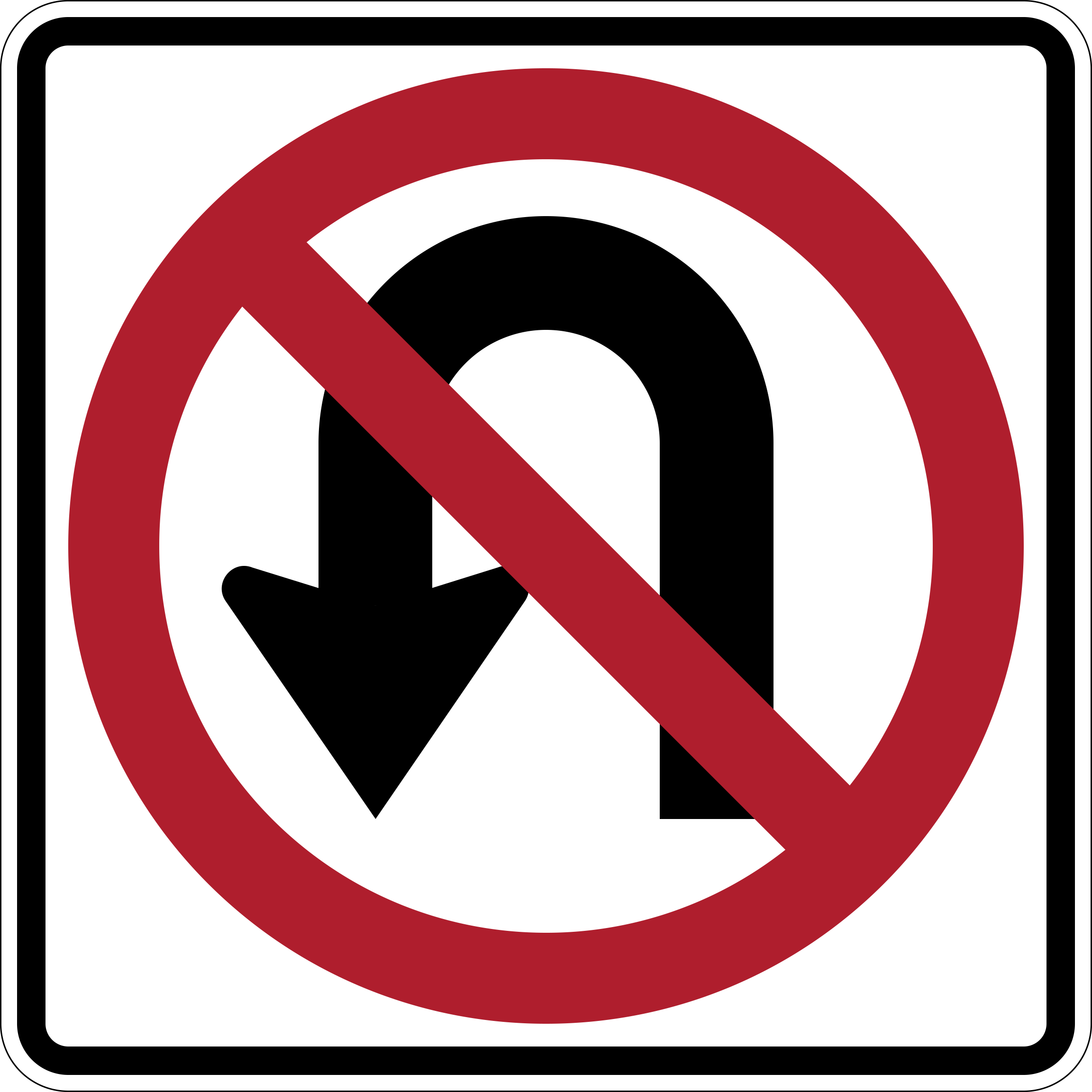
- Making a U-turn at that location
- Driving straight through the intersection
- Turning right after yielding to traffic
- Changing lanes on a multilane roadway
Show answer
Making a U-turn at that location. The pictured symbol identifies a prohibited movement, and the U-shaped arrow points to a U-turn. The red circle and slash do not ban every movement at the intersection. Driving straight, making a permitted right turn, or changing lanes are separate actions unless another sign or marking restricts them. Read the shape beneath the slash rather than treating the symbol as a general stop instruction. The cue is the turnaround arrow: do not reverse direction there.
Study this in the handbook: Pavement markings, crosswalks and lane use
12. When must a driver yield to a pedestrian in a crosswalk?
- Only when the crosswalk has a traffic signal
- Even when the crosswalk is unmarked
- Only when the pedestrian is moving faster than traffic
- Never when the driver is turning right
Show answer
Even when the crosswalk is unmarked. Drivers must yield to a pedestrian in a crosswalk even when the crossing is unmarked. The rule also covers mid-block crosswalks identified by warning signs and pavement markings, so a driver cannot treat missing paint as permission to continue. A signal is not required, walking speed does not change the pedestrian's protection, and a right turn still requires yielding. Reduce speed early and scan beyond the nearest vehicle for someone entering the crossing.
Study this in the handbook: Pedestrians and blind pedestrians
13. At a stop light or sign, how close should a driver stop to a crosswalk when there is no advanced stop bar?
- Anywhere beyond the intersection if pedestrians are absent
- At least twenty feet before the crosswalk
- With the front bumper inside the crosswalk
- No more than five feet from the crosswalk
Show answer
No more than five feet from the crosswalk. The manual says a vehicle should not stop more than five feet from the crosswalk at a stop light or sign unless an advanced stop bar is provided. Stopping far back can make the vehicle harder for a blind pedestrian to hear and locate. Entering the crosswalk blocks the pedestrian path, and stopping beyond the intersection ignores the control device. Approach slowly, stop before the crossing, and follow an advanced bar when one is painted farther back.
Study this in the handbook: Pedestrians and blind pedestrians
14. What should a driver assume about having the right of way?
- A driver may ignore other traffic after stopping
- The larger vehicle always has the right of way
- The first driver to sound a horn has priority
- No driver should assume an automatic right of way
Show answer
No driver should assume an automatic right of way. Right-of-way rules guide who should yield, but Kentucky cautions that no driver should assume an automatic right of way. Vehicle size, a horn, and a completed stop do not erase the need to judge the actual intersection and surrounding traffic. Approach with controlled speed, watch for people and vehicles already moving through, and be ready to yield even when a rule appears to favor you. The practical cue is uncertainty: if the situation is unclear, slow down and avoid forcing another road user to react.
Study this in the handbook: Yielding the right of way
15. What does Kentucky require of the registration plate?
- It may be displayed in the rear window
- It must be kept legible at all times and illuminated at night
- It must be replaced yearly
- It may be covered by a tinted frame
Show answer
It must be kept legible at all times and illuminated at night. The vehicle must be properly registered with the license plate properly displayed and unobstructed, and the registration plate shall be kept legible at all times and must be illuminated at night. A tinted frame or anything else that hides the plate conflicts with the unobstructed and legible requirement, and the manual sets no yearly replacement rule. The examiner inspects the plate before the road test along with the windshield, lights, horn, and seat belts, so check that it is clean, readable, and lit.
Study this in the handbook: Required equipment, safety belts, air bags and child seats
16. When you hear a siren from an approaching emergency vehicle, where must you go and what must you do?
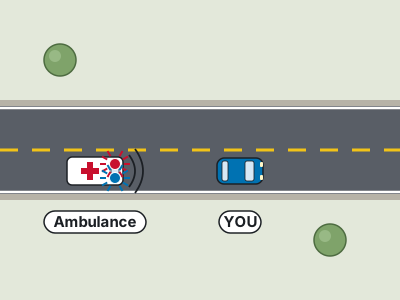
- Remain in the lane and let the vehicle pass around you
- Drive to the right side or curb, clear of the intersection, and stop
- Turn left immediately and continue through the intersection
- Follow the emergency vehicle closely to get through traffic
Show answer
Drive to the right side or curb, clear of the intersection, and stop. A siren announces an emergency vehicle that needs the right of way. Move immediately to the right side of the road or curb, make sure the vehicle is clear of any intersection, and stop. Continuing in the lane leaves less room for the response vehicle. A sudden left turn can create a collision, and following behind the emergency vehicle is separately prohibited within 500 feet. Watch mirrors and listen so the response path stays open.
Study this in the handbook: Emergency vehicles and school buses
17. When does an escorted funeral procession have the right of way at a Kentucky intersection?
- When led by an escort vehicle displaying flashing yellow, red, or blue lights
- Only after every other driver waves it through
- Only when the procession has a green signal
- Whenever its lead vehicle uses hazard lights
Show answer
When led by an escort vehicle displaying flashing yellow, red, or blue lights. An escorted funeral procession may proceed through an intersection when an escort vehicle leads it with flashing yellow, red, or blue lights. A green signal is not the condition that defines this special procession rule, and hazard lights alone are not the stated escort display. Other drivers should recognize the procession as a coordinated group and avoid entering its path. The visual cue is the escort vehicle and its specified flashing colors, followed by the line of funeral vehicles moving through together.
Study this in the handbook: Funeral processions
18. What purpose do Kentucky pavement markings serve on the roadway?
- Directions or warnings on the roadway
- The mechanical condition of nearby vehicles
- The identity of the road maintenance contractor
- A guarantee that every lane is open
Show answer
Directions or warnings on the roadway. Pavement markings can use lines, arrows, words, or symbols to guide drivers and warn them about roadway conditions. They may divide lanes, identify turning lanes, define pedestrian areas, or show where a stop is required. The markings do not report vehicle maintenance, identify contractors, or promise that every lane remains available. Read them together with signs and signals, especially where a lane control or stopping point is marked on the pavement.
Study this in the handbook: Pavement markings, crosswalks and lane use
19. How may an ATV cross a two lane public highway in Kentucky?
- Anywhere, at any angle
- ATVs may never cross public highways
- Only on the shoulder for up to five miles
- At as close to a 90 degree angle as practical, traveling no more than two tenths of a mile on the highway
Show answer
At as close to a 90 degree angle as practical, traveling no more than two tenths of a mile on the highway. A person may operate an ATV on a two lane public highway to cross it, at as close to a 90 degree angle as is practical and safe, and may not travel on the highway for more than two tenths of a mile. Farm or agricultural activities, construction, road maintenance, or snow removal allow other operation on a two lane highway. An ATV operator on a public highway must have a valid operator's license, obey all traffic regulations, and keep at least one headlight and two taillights illuminated.
Study this in the handbook: Rural roads, farm equipment and slow vehicles
20. Why must drivers of electric and hybrid vehicles be extra alert to blind pedestrians, according to the Kentucky manual?
- Those vehicles have weaker brakes
- Blind pedestrians cannot see hybrid badges
- The vehicles are so quiet that a blind pedestrian may not know they are there
- They accelerate faster
Show answer
The vehicles are so quiet that a blind pedestrian may not know they are there. A blind pedestrian uses the sound of your vehicle as a guide, so drivers of electric and hybrid vehicles must be extra alert because the silent nature of these vehicles can leave the pedestrian unaware of your presence. Pull up to the crosswalk so you can be heard, do not give verbal directions, and do not wait so long that the pedestrian becomes confused.
Study this in the handbook: Sharing the road with bicycles, motorcycles and trucks
QualitySpace is expanding to Kentucky
We are a California-based independent insurance brokerage working on licensing in more states. We cannot help with Kentucky insurance yet. Leave your email and we will let you know when we can.
Every question is written from the official Kentucky Driver Manual. Need paper? Printable KY practice test with answer key.
Last verified 2026-10-05. How we check every question · Study all 500 as flashcards
Frequently asked questions
How many questions are on this Kentucky practice test?
This fixed set has 20 questions. It is test 3 of 25 from the 500 question Kentucky bank.
How does this fixed test relate to the full Kentucky bank?
Each numbered test is a fixed set of questions in a fixed order, so you can retake the same test later and compare. Every test mixes road signs and the other topics in about the same proportion as the full bank. Tests 1 to 25 together cover every question in the Kentucky bank once. The full practice page mixes the whole bank at random.
Last verified 2026-10-05. See the Kentucky DMV facts page for sourced state details.
Return to the full Kentucky practice test · Study road signs