
Test 1 of 25 · 20 questions · Free 2026
KY Permit Practice Test 1
Jump to the test ↓A fixed 20 question set from the Kentucky bank with answers and plain English explanations.
Question 1 of 20 · 0 right so far
All 20 questions in test 1
Every question below comes from the Kentucky question bank on this page. Open a question to see the correct answer and the explanation. Nothing here is hidden behind a signup.
1. What visual field does Kentucky's bioptic program require?
- 180 degrees horizontally
- No field requirement
- 90 degrees in each eye
- 120 degrees horizontally and 80 degrees vertically in the better eye
Show answer
120 degrees horizontally and 80 degrees vertically in the better eye. The bioptic program requires a visual field of 120 degrees horizontally and 80 degrees vertically in the better eye, along with 20/200 acuity with corrective lenses and 20/60 through the bioptic device, and no ocular diagnosis that predicts significant decline. Field of vision matters because peripheral sight is how a driver detects cars and pedestrians entering from the side. Training is required before the restriction is issued.
2. On a main road and a minor road, which driver must yield?
- The driver who reaches the center line first
- The driver on the main road
- The driver traveling below the speed limit
- The driver on the minor road
Show answer
The driver on the minor road. Kentucky assigns the yield duty to the driver on the minor road when traffic meets a main road. The main-road driver does not lose priority because the other vehicle is larger, faster, or reaches the center line first. Scan for the roadway hierarchy before entering, then slow or stop so the main-road traffic can continue safely. A minor road may be a side street or another less prominent route, so use signs, lane arrangement, and the intersection layout together rather than guessing from vehicle size or arrival speed.
Study this in the handbook: Turns, lane changes and passing
3. May a driver enter the gap between vehicles in a Kentucky funeral procession?
- Yes, when the gap is large enough
- No, unless a police or safety officer authorizes it
- Yes, after turning on headlights
- No, but only on an interstate
Show answer
No, unless a police or safety officer authorizes it. Drivers must not place their vehicle between funeral procession vehicles unless a police or safety officer authorizes that movement. A large gap does not erase the procession's protected continuity, and turning on headlights cannot grant permission. The interstate choice is also too narrow, because the rule is not limited to interstates and the stated exception is authorization by an officer. If a procession is passing, wait outside the line, keep a predictable position, and let the entire group clear before crossing or joining its path.
Study this in the handbook: Headlights, turn signals and night driving
4. A yellow traffic light appears while you are approaching the intersection. What is the proper response?
- Continue at the same speed because yellow permits unrestricted entry
- Accelerate so the signal cannot turn red before you enter
- Stop when stopping can be done safely
- Reverse away from the intersection immediately
Show answer
Stop when stopping can be done safely. Yellow warns that the signal is about to become red. A driver should stop when a safe stop is possible, checking traffic behind before braking. The tempting acceleration choice treats the interval as extra time to enter, yet the manual specifically directs drivers to stop rather than race the change. If you are already too close for a safe stop, continuing through cautiously is different from deliberately speeding up. A useful cue is to see yellow as a transition toward stop, not as permission to begin another approach through the intersection.
Study this in the handbook: Traffic lights and arrows
5. Why must speed be reduced on a wet roadway?
- Rain affects only vehicles with worn tires
- The posted limit automatically becomes a minimum speed in rain
- Wet pavement improves braking, so speed should be increased
- Slippery conditions can reduce tire grip and cause a skid or hydroplane
Show answer
Slippery conditions can reduce tire grip and cause a skid or hydroplane. Water reduces the tires’ contact and grip, increasing the chance of a skid or hydroplaning. A posted number does not guarantee that speed is suitable for current pavement conditions, and wet roads do not improve braking. The worn-tire choice is too narrow because even a properly maintained vehicle must adapt to water. Ease off the accelerator before the vehicle loses traction, and avoid abrupt braking or steering. A strong cue is visible water on the roadway: adjust speed early, while the tires still respond normally.
Study this in the handbook: Skids, pavement drop offs and collisions
6. At a narrow or single lane bridge in rural Kentucky, which driver generally has the right of way?
- The heavier vehicle
- The driver who reaches the bridge first
- The driver traveling uphill
- The vehicle with more passengers
Show answer
The driver who reaches the bridge first. At a narrow or single lane bridge, Kentucky's manual advises taking turns and generally gives priority to the first driver who reaches the bridge. Vehicle weight, passenger count, and uphill travel are not the deciding cues in this guidance. Slow before the bridge, look for the warning sign, and make sure the other approach is understood before entering. If another vehicle is already committed to the single lane, wait rather than forcing a meeting in the confined space.
Study this in the handbook: Funeral processions
7. A Kentucky applicant age 21 or older gets a permit. How long must it be held before the road test?
- 180 days
- 30 days
- 7 days
- One year
Show answer
30 days. Applicants 21 and over must hold the permit for 30 days before they are eligible to take the road test, and practice is encouraged during that period. One hundred eighty days is the holding period for applicants under 21. Seven days is the retest wait after failing the road test, which the manual states as one week. One year is not a holding period. A licensed driver 21 or older must still ride in the front passenger seat.
8. What may be placed on a Kentucky windshield?
- Only certificates or papers required by law and sun screening material along a strip at the top
- Tint film over the whole glass
- Signs advertising a business
- Any sticker below the mirror
Show answer
Only certificates or papers required by law and sun screening material along a strip at the top. It is unlawful to operate a motor vehicle with any sign, sun screening material, product or covering on the windshield; only certificates or papers required by law and sun screening material along a strip at the top of the windshield are acceptable. The driver's view must be unobstructed, and a windshield wiper is required on the driver's side. The examiner inspects the windshield before the road test.
Study this in the handbook: Required equipment, safety belts, air bags and child seats
9. What does a Kentucky Class C commercial license cover?
- Any vehicle over 26,001 pounds
- Motorcycles only
- Farm trucks within 150 miles
- A single vehicle under 26,001 pounds that is placarded for hazardous materials or designed to carry more than 16 people including the driver
Show answer
A single vehicle under 26,001 pounds that is placarded for hazardous materials or designed to carry more than 16 people including the driver. Class C covers any single vehicle with a gross combination weight rating of less than 26,001 pounds that is placarded for hazardous materials or designed to transport more than 16 people including the driver. Class B covers single vehicles of 26,001 pounds or more towing no more than 10,000 pounds, and Class A covers heavier combinations. The cargo or passengers, not just weight, decide the class.
Study this in the handbook: License classes and the tests
10. According to the Kentucky manual, when does alcohol impairment begin?
- With the first drink
- Only after two drinks
- Only when a driver feels dizzy
- Only after reaching 0.08 BAC
Show answer
With the first drink. The manual warns that impairment starts with the first drink, so a driver should not use a personal feeling of sobriety as a safety test. Waiting for dizziness overlooks earlier effects on judgment and driving ability. The 0.08 figure is a legal threshold discussed elsewhere, not a promise that lower amounts are harmless. A practical cue is to arrange a sober ride before drinking rather than trying to calculate a safe number of drinks afterward.
Study this in the handbook: Alcohol, other drugs and the BAC limits
11. Should a driver assume another road user will always yield the right of way?
- No, the intersection’s situation and circumstances must be considered
- Yes, a right-of-way rule guarantees the path is clear
- Yes, if the driver reached the intersection first
- No, right-of-way rules never apply at intersections
Show answer
No, the intersection’s situation and circumstances must be considered. Kentucky presents right-of-way rules as guidance, not a guarantee that other people will behave as expected. Even when a rule appears to favor you, consider the actual intersection, visibility, pedestrians, and other traffic before moving. The first-arrival rule does not make the path automatically safe, and right-of-way rules do apply at intersections. The useful cue is uncertainty: if another driver may not yield, slow or wait rather than assert priority. Avoiding a collision is more important than proving that another person was supposed to stop.
Study this in the handbook: Turns, lane changes and passing
12. A flashing yellow arrow tells the driver to:
- Turn opposite the arrow to avoid traffic
- Stop until a solid green circle appears
- Proceed with caution in the arrow’s direction
- Treat the signal exactly like a flashing red light
Show answer
Proceed with caution in the arrow’s direction. A flashing yellow arrow permits movement in the arrow’s direction, but it requires caution. The indication is not a mandatory stop like a red signal, and it does not direct traffic opposite the arrow. Treating it as flashing red would impose the wrong control. Before moving, confirm that the path and conflict area are clear, then make the indicated turn carefully. The key cue is the combination of yellow and the arrow: movement is allowed in that direction, with attention to other roadway users and changing conditions.
Study this in the handbook: Traffic lights and arrows
13. At a highway railroad crossing, what should you do if a train is approaching?
- Stop behind the stop line or before the intersection and wait
- Cross quickly before the train reaches the crossing
- Stop on the tracks to watch the train pass
- Drive around the warning devices if the road looks clear
Show answer
Stop behind the stop line or before the intersection and wait. A train approaching the crossing requires a complete stop behind the stop line or before the intersection. The train has priority, and the vehicle must remain stopped until the intersection is clear. Crossing quickly is dangerous because a train cannot stop as rapidly as a car. Stopping on the tracks creates a second hazard, while driving around gates or other devices violates the warning. The useful cue is simple: approaching train means stop before the tracks and wait.
Study this in the handbook: Railroad crossings
14. Who may direct a stopped driver to move before an emergency vehicle has passed?
- Any driver waiting behind
- A police officer or firefighter
- A passenger in the stopped vehicle
- A nearby pedestrian
Show answer
A police officer or firefighter. Kentucky allows a stopped driver to move before the emergency vehicle has passed only when directed by a police officer or a firefighter. A waiting driver, passenger, or pedestrian does not have the authority described in this rule. Otherwise, remain stopped until the emergency vehicle has passed and keep clear of the intersection. Watch for authorized directions while maintaining awareness of the emergency scene. The key cue is the identity of the person giving the instruction, not convenience or pressure from surrounding traffic.
Study this in the handbook: Emergency vehicles and school buses
15. After taking the officer's test, what extra test does Kentucky law let the driver have?
- A blood test by a qualified person of the driver's choosing, at the driver's expense
- A free retest by the same officer
- A urine test paid by the state
- No additional test is allowed
Show answer
A blood test by a qualified person of the driver's choosing, at the driver's expense. If you take the requested test or tests, you have the right to have a blood test performed by a person of your choosing, such as a physician, registered nurse, phlebotomist or medical technologist, within a reasonable time of arrest and at your own expense. The state does not pay for it, and it is not a retest by the officer. Saying no additional test is allowed contradicts KRS 189A.103.
Study this in the handbook: Alcohol, other drugs and the BAC limits
16. When turning, what does the manual tell a driver to search for?
- Only vehicles directly behind the car
- Traffic controls, pedestrians, and other vehicles at all corners
- Only the lane line at the exit of the turn
- Only pedestrians after the turn is complete
Show answer
Traffic controls, pedestrians, and other vehicles at all corners. Before and during a turn, the driver should search all corners for traffic controls, pedestrians, other vehicles, and similar hazards, then signal the intention. Looking only behind misses conflicts at the sides and ahead. Focusing on one lane line or waiting until the turn is over delays the search until it is too late to respond. Slow to an appropriate speed, keep the intended path in view, and check each corner so the turn is guided by what is actually around the vehicle.
Study this in the handbook: Headlights, turn signals and night driving
17. What does the pictured white X-shaped railroad crossbuck require when a train approaches?
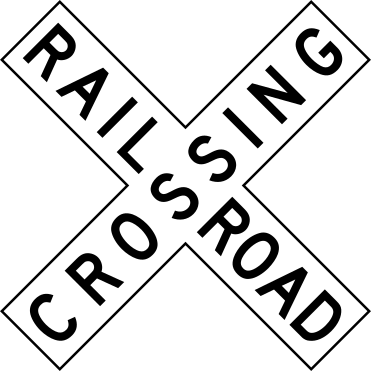
- Stop only if a crossing gate is also present
- Speed up because the crossbuck gives trains no priority
- Stop behind the stop line or before the intersection until it is clear
- Drive onto the tracks and wait for a signal from the train
Show answer
Stop behind the stop line or before the intersection until it is clear. The crossbuck stands at the highway railroad crossing and requires a driver to stop before the intersection when a train or railroad vehicle approaches. A gate is not required for the stopping duty, and the sign never grants permission to race the train. Waiting on the tracks creates a dangerous obstruction. Look for the stop line or the point before the intersection, halt there, and remain until the crossing is clear.
Study this in the handbook: Railroad crossings
18. What does the pictured fluorescent yellow pedestrian warning sign alert you to?

- A roadway where pedestrians are prohibited
- A pedestrian crossing ahead
- A route marker for a hospital
- A railroad crossing with a crossbuck
Show answer
A pedestrian crossing ahead. The manual lists pedestrian crossings among the locations identified by fluorescent yellow warning signs. The sign alerts the driver to a possible pedestrian hazard ahead, not to a prohibition on walking, a hospital route, or railroad equipment. Reduce speed when needed, search the crossing and its approaches, and be prepared to stop for people using it. Treat the walking figure as an advance warning that attention must shift toward the roadway edges and crossing area.
Study this in the handbook: Traffic lights and arrows
19. What does Kentucky require of a vehicle's muffler?
- No muffler on vehicles over 10 years old
- A muffler only on trucks
- A muffler on the exhaust to reduce noise and smoke while protecting occupants from poisonous fumes
- A muffler cutout for highway use
Show answer
A muffler on the exhaust to reduce noise and smoke while protecting occupants from poisonous fumes. A muffler must be on the exhaust to reduce noise and annoying smoke while protecting the occupants from poisonous fumes. The examiner also checks for a horn loud enough to be heard in ordinary traffic, working mechanical turn signals, two headlights and two taillights, mirrors adjusted for a rear view, and a legible license plate illuminated at night. Equipment that makes the vehicle unlawful or unsafe may cause the road test to be canceled or rescheduled.
Study this in the handbook: Required equipment, safety belts, air bags and child seats
20. What does a red circle with a red slash over a symbol on a regulatory sign indicate?
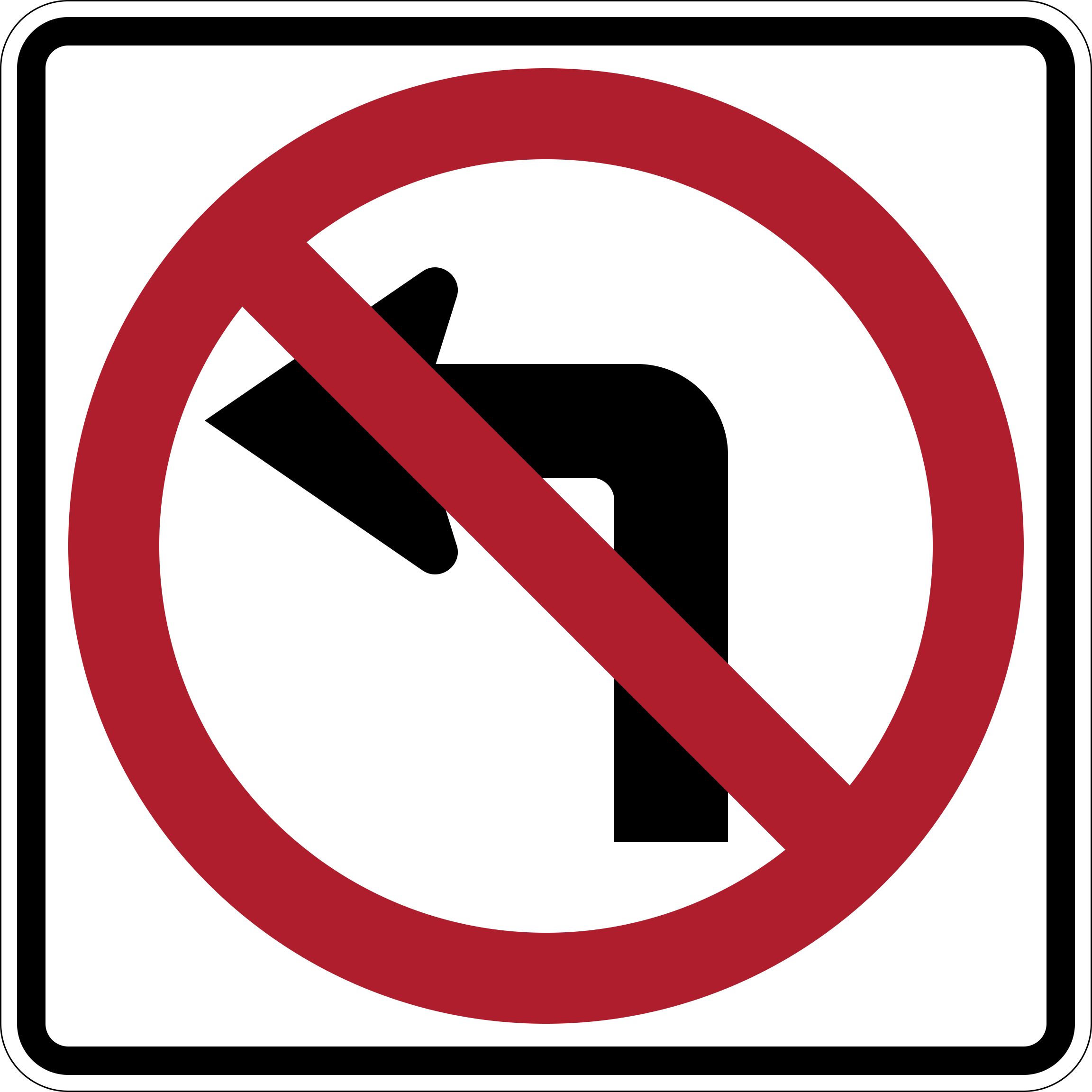
- The sign marks a route used only by emergency vehicles
- The action shown is recommended at the next intersection
- The symbol identifies a nearby highway service area
- The action shown by the symbol is prohibited
Show answer
The action shown by the symbol is prohibited. A red circle with a red slash over a symbol marks an action that the regulatory sign prohibits. The slash is not a suggestion, a service marker, or an emergency route designation. Read the underlying symbol to identify the restricted movement or behavior, then obey the restriction at that location. For example, a slash over a turn arrow bars that turn. The visual cue is the combination of the red circle, diagonal slash, and symbol beneath it. Other roadway duties, such as yielding or stopping, still apply when separate signs or signals require them.
Study this in the handbook: Pavement markings, crosswalks and lane use
QualitySpace is expanding to Kentucky
We are a California-based independent insurance brokerage working on licensing in more states. We cannot help with Kentucky insurance yet. Leave your email and we will let you know when we can.
Every question is written from the official Kentucky Driver Manual. Need paper? Printable KY practice test with answer key.
Last verified 2026-10-05. How we check every question · Study all 500 as flashcards
Frequently asked questions
How many questions are on this Kentucky practice test?
This fixed set has 20 questions. It is test 1 of 25 from the 500 question Kentucky bank.
How does this fixed test relate to the full Kentucky bank?
Each numbered test is a fixed set of questions in a fixed order, so you can retake the same test later and compare. Every test mixes road signs and the other topics in about the same proportion as the full bank. Tests 1 to 25 together cover every question in the Kentucky bank once. The full practice page mixes the whole bank at random.
Last verified 2026-10-05. See the Kentucky DMV facts page for sourced state details.
Return to the full Kentucky practice test · Study road signs