
Test 2 of 25 · 20 questions · Free 2026
KY Permit Practice Test 2
Jump to the test ↓A fixed 20 question set from the Kentucky bank with answers and plain English explanations.
Question 1 of 20 · 0 right so far
All 20 questions in test 2
Every question below comes from the Kentucky question bank on this page. Open a question to see the correct answer and the explanation. Nothing here is hidden behind a signup.
1. Who must accompany a Kentucky permit holder while the permit holder is driving?
- Any passenger at least 18 years old in the back seat
- A licensed driver at least 21 years old in the front passenger seat
- A parent only, regardless of age or seat
- A licensed driver at least 16 years old in another vehicle
Show answer
A licensed driver at least 21 years old in the front passenger seat. A permit holder must be accompanied by a person with a valid operator’s license who is at least 21 years old and occupies the front passenger seat beside the operator. A younger passenger, a person in the back seat, or a parent who fails the age and seating conditions does not satisfy the rule. Use a simple pre-drive check: verify the supervising driver’s license, age, and front-seat position before moving the vehicle.
Study this in the handbook: The learner's permit phase for teens
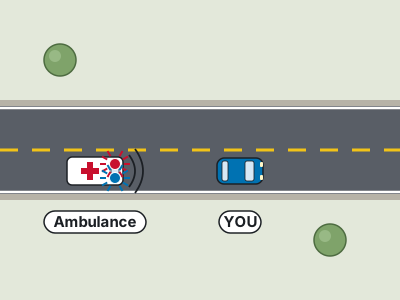
2. What is the safest response when an ambulance approaches using its lights and siren?
- Treat the ambulance like an ordinary passenger car
- Maintain speed until the ambulance passes without changing position
- Stop only if you are traveling behind the ambulance
- Yield the right of way and clear its path when safe
Show answer
Yield the right of way and clear its path when safe. Lights and a siren identify an urgent road user whose movement takes priority. Yielding may mean slowing, stopping, or moving aside, but any maneuver must be made safely and without creating a new conflict. The fixed-speed choice leaves the driver passive when action is needed. Whether the ambulance is ahead, behind, or approaching from another direction, the response is not restricted to one lane relationship. Check mirrors, predict the vehicle’s route, and give it usable space. The cue is emergency equipment in operation, not the vehicle’s size.
Study this in the handbook: Emergency vehicles and school buses
3. Which situation is an exception to a funeral procession’s intersection right-of-way rule?
- The procession includes more than three cars
- A driver is running late for work
- An emergency vehicle requires the right of way
- The weather is clear and dry
Show answer
An emergency vehicle requires the right of way. The manual lists an emergency vehicle’s required right of way as an exception to a funeral procession’s intersection priority. It also lists directions from a police or safety officer and a train or locomotive. Personal urgency, the number of cars, and clear weather do not create an exception. Give the procession room and do not drive between its vehicles unless authorized. When an emergency vehicle needs the intersection, follow that emergency priority while watching for instructions from officers managing the scene.
Study this in the handbook: Funeral processions
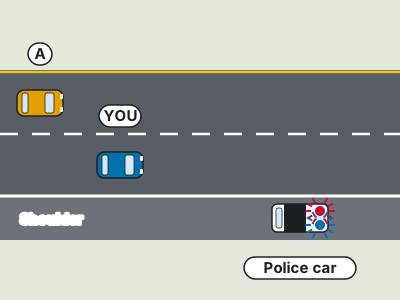
4. On a four-lane highway, what should a driver do when approaching an emergency vehicle stopped on the shoulder?
- Turn around before reaching the stopped vehicle
- Stop in the left lane beside the emergency vehicle
- Accelerate in the right lane to pass quickly
- Approach slowly and move into the left lane if it is safe
Show answer
Approach slowly and move into the left lane if it is safe. Kentucky advises drivers approaching a stopped emergency vehicle on a four-lane highway to approach slowly and move into the left lane when it is safe to do so. Stopping beside the emergency vehicle blocks traffic and places the driver near roadside personnel. Accelerating reduces the space and time available, while turning around is not the required response. Check mirrors and traffic before changing lanes, then pass with caution. If the move is not safe, reduce speed and maintain a safe path instead of forcing the lane change.
Study this in the handbook: The move over law and traffic stops
5. What does a flashing yellow traffic light require a driver to do?
- Stop and remain stopped until a green light appears
- Slow down and watch for other road users
- Speed up because cross traffic must stop completely
- Turn only if the signal changes to a red arrow
Show answer
Slow down and watch for other road users. A flashing yellow light calls for reduced speed and careful observation of others. It is not the same as a flashing red signal, which requires a full stop, so the choice “Stop and remain stopped until a green light appears” is too restrictive. Speeding through an intersection removes the caution the signal demands, and a red arrow would prohibit a turn rather than authorize one. Treat the flashing yellow as a warning to approach under control, scan for vehicles and pedestrians, and continue only when the path is safe.
Study this in the handbook: Traffic lights and arrows
6. How does the slow-moving vehicle emblem on a Kentucky farm vehicle appear during the day and at night?
- A fluorescent orange triangle by day and a reflective red border at night
- A white circle by day and a flashing amber light at night
- A green diamond by day and a blue border at night
- A yellow square by day and a white border at night
Show answer
A fluorescent orange triangle by day and a reflective red border at night. The slow-moving vehicle emblem is designed to be seen in both light conditions. In daylight the fluorescent orange triangle in the center of the symbol catches your eye, and at night the reflective red border shows in your headlights. Farm tractors, horse-drawn wagons and other equipment that travel well below traffic speed carry the emblem, so when you see it, slow down early and be sure the road ahead is clear before you pass. The white circle, green diamond and yellow square are not emblems used for this purpose. Closing speed on a slow vehicle is deceptive, so start braking as soon as you recognize the triangle.
Study this in the handbook: The move over law and traffic stops
7. Before moving into another lane, which sequence is required for a safe lane change?
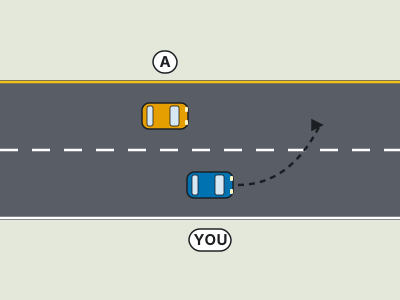
- Check mirrors and the blind spot, find a gap, signal, look again, and move when safe
- Signal only after crossing the lane line
- Rely on the inside mirror without turning your head
- Use emergency flashers and let surrounding traffic decide
Show answer
Check mirrors and the blind spot, find a gap, signal, look again, and move when safe. A safe lane change combines observation, communication, and a suitable opening. Check mirrors, look over the shoulder into the planned lane’s blind spot, identify a gap in traffic, signal, look again in the direction of the lane change, adjust speed, and steer into the lane. The mirror-only answer misses an area mirrors cannot show, while late signaling gives others less time. Hazard flashers are not a substitute for a turn signal or a traffic check. The cue is a shoulder check before commitment, followed by a second look as the vehicle begins moving.
Study this in the handbook: Turns, lane changes and passing
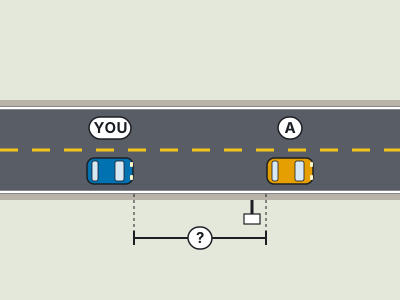
8. How can a driver check whether the following distance is too short?
- Wait until the vehicle ahead brakes before measuring space
- Count the number of cars visible in the rearview mirror
- Count the seconds to reach a stationary point after the vehicle ahead passes it
- Use the posted speed limit as the distance in feet
Show answer
Count the seconds to reach a stationary point after the vehicle ahead passes it. To measure space, choose a sign, pole, or other stationary point. Start counting when the vehicle ahead passes it and compare the time your vehicle takes to reach the same point. Reaching it before the count reaches one thousand four means you are following too closely. Rearview visibility and the posted speed limit do not measure time or stopping space. Make the gap larger, then repeat the count at another fixed object.
Study this in the handbook: Looking ahead, stopping distance and following distance
9. Which Kentucky drivers are not eligible to attend State Traffic School?
- Drivers with a minor speeding ticket
- Non-licensed and out-of-state drivers
- Drivers 18 or older
- Drivers referred by a Kentucky court
Show answer
Non-licensed and out-of-state drivers. Non-licensed and out-of-state drivers are not eligible for Kentucky State Traffic School. A driver also cannot attend while under suspension at the time of the citation, cannot attend for a conviction carrying mandatory suspension, and can attend only once every twelve months. Minor traffic violations are exactly what the program is for. Adult drivers can attend, and referrals must come from the Kentucky District or Federal court where the violation happened.
Study this in the handbook: The point system and losing your license
10. Before a DUI test in Kentucky, how long is a driver given to try to contact an attorney?
- Up to 2 hours
- No time at all
- At least 10 minutes but not more than 15 minutes
- 24 hours
Show answer
At least 10 minutes but not more than 15 minutes. During the period right before any test is given, a Kentucky driver is afforded an opportunity of at least ten minutes but not more than fifteen minutes to attempt to contact and communicate with an attorney. Two hours and 24 hours are not the stated window, and no time at all contradicts the law. Although the license will be suspended, the driver may also be eligible right away for an ignition interlock license allowing driving during the suspension.
Study this in the handbook: Implied consent and DUI penalties
11. What must a driver do after becoming stalled on railroad tracks in Kentucky?
- Wait for a second train to pass
- Remain inside and restart the car
- Run along the tracks toward the crossing
- Abandon the car and run in the direction the train is coming
Show answer
Abandon the car and run in the direction the train is coming. If a vehicle is boxed in or stalled on a railroad crossing, the manual says to leave it immediately and move away from the track in the direction the train is coming. That direction reduces the chance of being struck by debris from a collision. Staying inside, attempting a restart, or running along the track leaves a person exposed. Once at a safe distance, call the posted railroad number or 911 and report the disabled vehicle so dispatchers can warn approaching trains.
Study this in the handbook: Railroad crossings
12. What is the stated purpose of the Kentucky driver manual?
- To issue driver's licenses directly
- To replace all traffic signs
- To provide only vehicle repair instructions
- To explain safe driving skills and review licensing and traffic law
Show answer
To explain safe driving skills and review licensing and traffic law. The manual is intended to build a basic understanding of safe driving skills and best practices while reviewing the licensing process and Kentucky traffic law. It does not replace roadside signs, function as a repair guide, or issue credentials itself. Use it as preparation and reference material, then follow current signs, signals, and directions while driving. The practical cue is its broad scope: it covers both how to drive safely and how Kentucky's licensing and traffic rules work.
Study this in the handbook: License classes and the tests
13. For a driver age 21 or older operating a noncommercial vehicle in Kentucky, what is the lowest BAC covered by the general alcohol per se threshold?
- 0.08 or above
- 0.02 or above for every driver
- 0.15 or above only
- 0.10 or above
Show answer
0.08 or above. Kentucky’s manual says a person violates the DUI law when operating a vehicle with an alcohol concentration of 0.08 or above. The 0.02 figure applies to drivers under 21, not every driver. The 0.15 figure is listed as an aggravating circumstance within two hours of stopping operation, so it is not the general concentration threshold. Keep the distinction clear: a lower reading can still accompany an impaired-driving violation when evidence supports it.
Study this in the handbook: Alcohol, other drugs and the BAC limits
14. Who has priority when a driver enters a Kentucky roundabout?
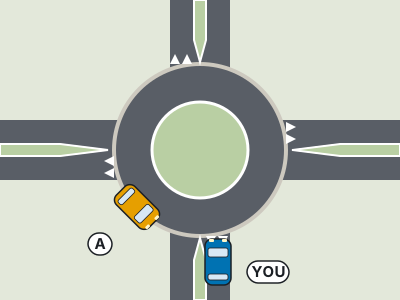
- The vehicle that accelerates first
- Traffic entering from the right
- The largest vehicle
- Traffic already circulating
Show answer
Traffic already circulating. Entering traffic must yield to vehicles already circulating around the roundabout. The entering driver's side, vehicle size, or acceleration does not change that ordering. Slow before entry, check the circulating lane, and wait for a safe gap. Once inside, travel counterclockwise and signal the intended exit. Treat the raised center island and the circular lane as a continuous flow, not as an ordinary intersection where an entering vehicle can claim priority by arriving first.
Study this in the handbook: Roundabouts and traffic circles
15. What does the pictured DO NOT ENTER sign tell a driver?
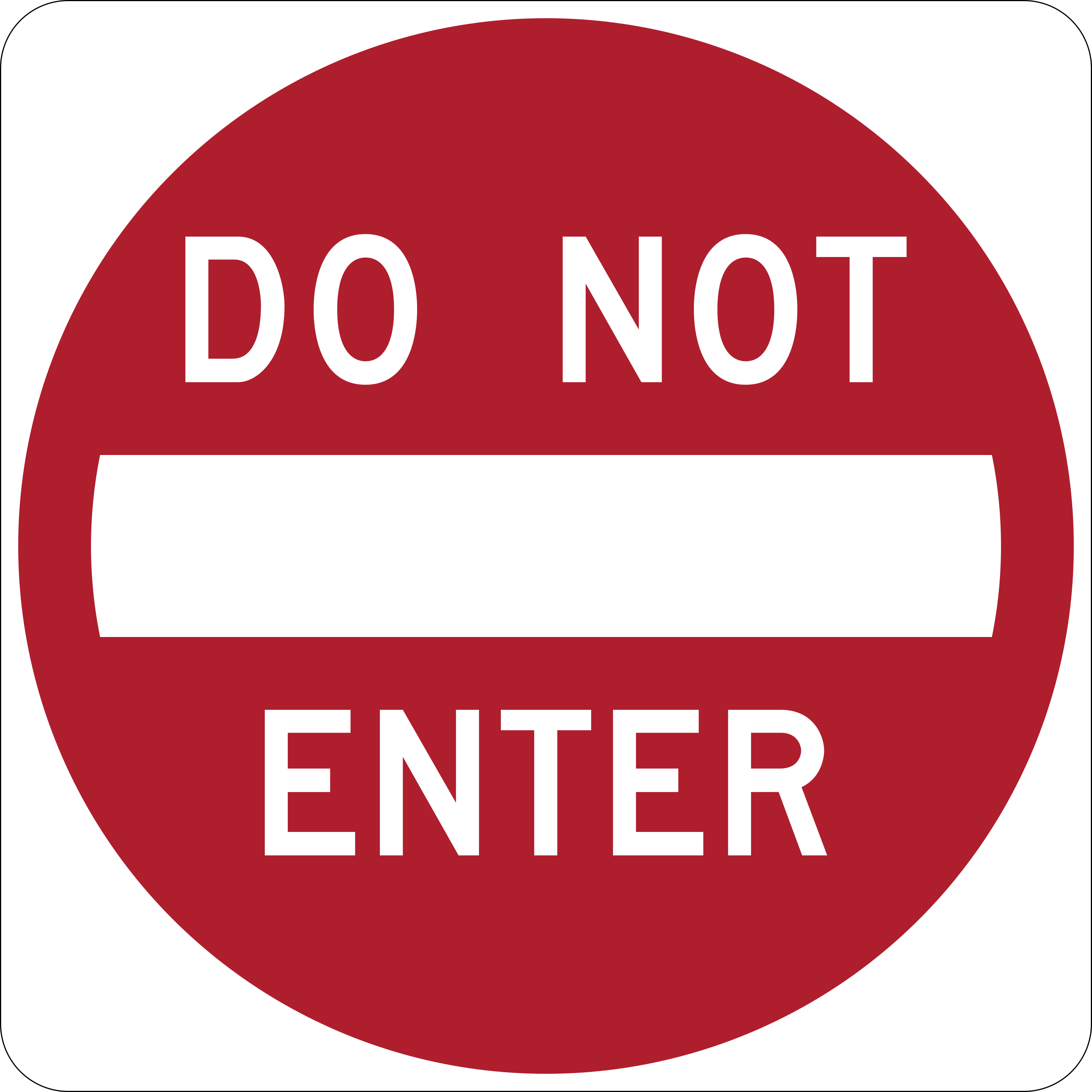
- The driver may enter only after stopping for pedestrians
- The driver cannot enter that street or roadway
- The roadway permits travel in either direction
- The street is reserved for emergency vehicles only
Show answer
The driver cannot enter that street or roadway. DO NOT ENTER means the driver cannot enter the street or roadway facing the sign. The manual notes that this sign is often placed at exit ramps and at the beginning of one-way streets, so an apparently open pavement path can still be the wrong direction. A pedestrian stop does not cancel the prohibition, and the sign does not announce two-way travel or an emergency-only roadway. Treat the red message as an entry ban and find a lawful route.
Study this in the handbook: Regulatory signs
16. What minimum following distance does the Kentucky manual recommend in front of your vehicle?
- Four seconds
- One second
- Two car lengths regardless of speed
- Ten seconds in every condition
Show answer
Four seconds. The manual recommends at least four seconds between your vehicle and the one ahead. A time interval adjusts better to changing speeds than a fixed number of car lengths and gives more room to react when traffic stops. One second is too short, and the manual does not make two car lengths a universal measure. Ten seconds is not required in every ordinary situation, although poor weather, darkness, and heavy vehicles may call for additional space.
Study this in the handbook: Sharing the road with bicycles, motorcycles and trucks
17. A green arrow pointing left permits a driver to:
- Proceed straight regardless of the arrow direction
- Turn right from any lane
- Turn left when in the proper lane
- Ignore pedestrians and vehicles in the intersection
Show answer
Turn left when in the proper lane. A green arrow authorizes movement in the arrow’s direction when the driver is in the proper lane. A left arrow therefore supports a left turn, not a right turn or an unrelated straight movement. The signal does not erase lane requirements or make it safe to ignore people and vehicles already in the intersection. Check the lane under the arrow, follow the indicated path, and remain alert for anything lawfully occupying the roadway. The arrow’s direction is the immediate cue, while the proper lane determines whether the movement applies to you.
Study this in the handbook: Traffic lights and arrows
18. How should you respond to the pictured warning sign showing a STOP symbol ahead?

- Slow down and be prepared to stop at the upcoming STOP sign
- Stop immediately beside the warning sign and remain there
- Continue at speed because the small symbol is advisory only
- Turn around before reaching the intersection
Show answer
Slow down and be prepared to stop at the upcoming STOP sign. The pictured sign is a warning about a possible traffic control point ahead. Warning signs tell drivers to slow down and be prepared to stop if necessary, so the driver should approach the upcoming STOP sign under control. Stopping beside the advance warning sign is not the same as obeying the later stop control, and continuing at speed wastes the preparation distance. Turning around is not required. Ease off the accelerator, scan ahead, and stop at the actual line or crosswalk.
Study this in the handbook: Traffic lights and arrows
19. What should you prepare to do when you see the pictured round yellow railroad warning sign?

- Maintain speed because the tracks are already behind you
- Slow down, look and listen, and be prepared to stop
- Stop in the travel lane even when no crossing is ahead
- Turn around immediately before reaching any railroad sign
Show answer
Slow down, look and listen, and be prepared to stop. The round yellow sign with the X and RR letters appears before a highway railroad grade crossing. It tells the driver to slow down, look and listen for a train or railroad vehicle, and be prepared to stop if one approaches. Maintaining speed discards the warning time, while stopping in an active travel lane without a reason creates a separate hazard. Use the sign as an advance cue to search both directions before reaching the crossing.
Study this in the handbook: Railroad crossings
20. How far must Kentucky headlights reveal a person ahead on high beam and on low beam?
- 100 feet on high and 50 on low
- 350 feet on high beam and 100 feet on low beam
- 1,000 feet on high and 500 on low
- 500 feet on both
Show answer
350 feet on high beam and 100 feet on low beam. Your vehicle must have two headlights and two taillights, and headlights on high beam must be strong enough to reveal a person 350 feet ahead and 100 feet ahead on low beam, without shining a glaring light into the eyes of an oncoming driver. Headlights must be on from one half hour after sunset to one half hour before sunrise. The examiner checks lights before the road test.
Study this in the handbook: Required equipment, safety belts, air bags and child seats
QualitySpace is expanding to Kentucky
We are a California-based independent insurance brokerage working on licensing in more states. We cannot help with Kentucky insurance yet. Leave your email and we will let you know when we can.
Every question is written from the official Kentucky Driver Manual. Need paper? Printable KY practice test with answer key.
Last verified 2026-10-05. How we check every question · Study all 500 as flashcards
Frequently asked questions
How many questions are on this Kentucky practice test?
This fixed set has 20 questions. It is test 2 of 25 from the 500 question Kentucky bank.
How does this fixed test relate to the full Kentucky bank?
Each numbered test is a fixed set of questions in a fixed order, so you can retake the same test later and compare. Every test mixes road signs and the other topics in about the same proportion as the full bank. Tests 1 to 25 together cover every question in the Kentucky bank once. The full practice page mixes the whole bank at random.
Last verified 2026-10-05. See the Kentucky DMV facts page for sourced state details.
Return to the full Kentucky practice test · Study road signs