
Test 16 of 25 · 20 questions · Free 2026
KY Permit Practice Test 16
Jump to the test ↓A fixed 20 question set from the Kentucky bank with answers and plain English explanations.
Question 1 of 20 · 0 right so far
All 20 questions in test 16
Every question below comes from the Kentucky question bank on this page. Open a question to see the correct answer and the explanation. Nothing here is hidden behind a signup.
1. What maximum speed may a vehicle still meet while qualifying as a moped in Kentucky?
- Not more than 30 miles per hour
- Not more than 25 miles per hour
- Not more than 20 miles per hour
- Not more than 35 miles per hour
Show answer
Not more than 30 miles per hour. A moped must be capable of a maximum speed of not more than 30 miles per hour, together with limits on brake horsepower, cylinder capacity, and transmission type. Twenty miles per hour is the design ceiling for an electric low speed scooter, a different device. Twenty five and 35 do not match this definition. When a question lists several engineering limits, answer from the one it actually asks about: here the speed ceiling, which also matches the rule barring mopeds on limited-access highways where the minimum speed is more than 30 miles per hour.
Study this in the handbook: License classes and the tests
2. For an alert driver, what average perception time does Kentucky use in stopping distance?
- About one quarter second
- Three quarters of a second to 1 second
- About 2 seconds
- Three to 4 seconds
Show answer
Three quarters of a second to 1 second. Perception time is the time it takes to recognize that you must stop. The manual gives an alert driver's average perception time as three-quarters of a second to one second. Reaction time, for moving the foot from the accelerator to begin braking, is a separate interval with the same stated average range. A quarter second understates alert perception, which runs three quarters to one second.
Study this in the handbook: Kentucky speed limits
3. On a rural road with gravel or dirt surface, how should you adjust your driving?
- Increase speed so the tires spend less time on loose material
- Follow more closely so dust does not obscure your view
- Reduce speed, increase following distance, and expect possible skidding when stopping
- Center the vehicle across both lanes for better traction
Show answer
Reduce speed, increase following distance, and expect possible skidding when stopping. Traction can be reduced on gravel or dirt roads. Reduce your speed, increase your following distance, and be aware that the vehicle may skid when you try to stop. On narrow rural roads, center your vehicle in your own lane and watch for oncoming traffic. The manual says to reduce speed because traction can be reduced on gravel or dirt. A shorter gap in dust raises the chance of striking the vehicle ahead.
Study this in the handbook: Funeral processions
4. What must vehicles carrying hazardous materials do at every railroad crossing?
- Honk twice and proceed without stopping
- Slow to 25 mph and cross in the lowest gear
- Display a flag and cross only behind a truck
- Stop at all railroad crossings
Show answer
Stop at all railroad crossings. Vehicles carrying hazardous materials must stop at all railroad crossings, and following drivers should be prepared for that full stop even where ordinary traffic rolls through. Honking twice and proceeding skips the stop entirely. Slowing to 25 mph still leaves a loaded hazardous cargo moving across the rails. A flag and a truck escort appear nowhere in this rule. These vehicles are clearly marked with the type of hazardous materials they are transporting, so a placard ahead at a crossing is your warning to expect a complete stop before the tracks.
Study this in the handbook: Emergency vehicles and school buses
5. Which group of prescription drugs is named as capable of impairing driving like alcohol?
- Antibiotics, vitamins, and fluoride rinses
- Antidepressants, pain reducers, sleep aids, and sedatives
- Insulin, inhalers, and eyedrops only
- No prescription drug affects driving
Show answer
Antidepressants, pain reducers, sleep aids, and sedatives. Prescription medication can impair reflexes, judgment, vision, and alertness in ways similar to alcohol. The classes named for that warning are antidepressants, pain reducers, sleep aids, and sedatives. Antibiotics and vitamins are not the group singled out for alcohol like impairment. Insulin and inhalers matter medically, but they are not the listed driving warning group, and eyedrops alone do not define it. Denying any prescription effect contradicts the label guidance entirely. Check prescription packaging for driving warnings before taking a dose, and ask the prescribing doctor or pharmacist when the answer is unclear.
Study this in the handbook: Alcohol, other drugs and the BAC limits
6. When may accelerating be the right crash avoidance option?
- Whenever traffic ahead slows down
- When another vehicle is about to hit you from behind or the side
- To beat a yellow light at an intersection
- While being passed on a two lane road
Show answer
When another vehicle is about to hit you from behind or the side. The manual identifies braking, steering, and accelerating as three options to avoid a crash or reduce its impact. It says accelerating may be necessary when another vehicle is about to hit you from behind or from the side. Accelerating toward slowing traffic worsens the threat. For a yellow light, the manual says to stop if you can do so safely; it does not recommend accelerating to beat the light.
Study this in the handbook: Skids, pavement drop offs and collisions
7. Two drivers approach on perpendicular roads and arrive at the same time at a four-way intersection controlled by stop signs. Under the manual's simultaneous-arrival rule, which driver should be yielded to?
- The driver on the left
- The driver in the larger vehicle
- The driver traveling faster
- The driver on the right
Show answer
The driver on the right. When two drivers arrive at the same time at a four-way intersection controlled by stop signs, yield to the driver on your right. The manual also cautions that no one should assume an automatic right of way; the situation and circumstances must be considered. On a simultaneous arrival the left driver yields; the driver on the right proceeds. Approach speed does not assign right of way at stop signs.
Study this in the handbook: Yielding the right of way
8. What does a red arrow at a traffic signal require?
- Turning is permitted after a brief pause
- No turning in the direction of the arrow until it turns green
- The arrow is a warning only and may be ignored
- Turn only if no police officer is present
Show answer
No turning in the direction of the arrow until it turns green. A red arrow means no turning in the direction of the arrow until it turns green. When there is more than one traffic light, obey the one over your lane. If a police officer is directing traffic at an intersection, follow the officer's instructions regardless of traffic-control devices or signs. A pause does not permit the turn; the arrow must turn green first. A red arrow is binding, not an ignorable warning.
Study this in the handbook: Traffic lights and arrows
9. When the outside mirrors are adjusted by leaning left against the closed window and right over the center console, setting each mirror to barely show that side of the vehicle, how much viewing area is added on each side?
- It adds 4 to 6 degrees to each side
- It adds no measurable viewing area
- It adds 25 to 30 degrees to each side
- It adds 12 to 16 degrees to each side
Show answer
It adds 12 to 16 degrees to each side. Adjusting the outside mirrors by leaning toward each side and setting the mirror to barely show the rear edge of the vehicle adds 12 to 16 degrees of additional viewing area to each side. The smaller range understates the gain and the larger range overstates it. Claiming no gain ignores why the method exists: the driver will not see the sides of the vehicle in the mirrors, but blind spots shrink. Cue: trade the view of your own rear edge for a wider view of traffic beside you.
10. What does a round yellow sign with an X and black RR letters warn of?
- A road closed for track repairs
- A rest area with railroad exhibits
- A railroad crossing ahead; slow down, look and listen, and be ready to stop
- A crossing where trains have the right to sound horns only
Show answer
A railroad crossing ahead; slow down, look and listen, and be ready to stop. The round yellow sign with an X and black RR letters warns of a highway-railroad grade crossing ahead. Slow down, look and listen for a train or railroad vehicle, and be ready to stop if a train approaches. The white X-shaped Railroad Crossing sign is located at the crossing itself. The sign warns of a grade crossing ahead, not a rest facility. It does not announce a closure; it urges slowing, looking, and listening.
Study this in the handbook: Railroad crossings
11. When changing lanes, what should you check before identifying a gap and signaling?
- Signal first, then check mirrors after moving
- Check the rearview mirror only and move when it looks empty
- Steer into the gap, then check the blind spot
- Check mirrors, then check blind spots by turning your head over your shoulder
Show answer
Check mirrors, then check blind spots by turning your head over your shoulder. Check your mirrors, then check your blind spots by turning your head and looking over your shoulder in the direction you plan to move. Identify a gap, signal, and look again in that direction. Adjust your speed and steer into the lane. The manual lists checking mirrors and blind spots before identifying a gap and signaling. Check mirrors and blind spots before steering into the new lane.
Study this in the handbook: Pavement markings, crosswalks and lane use
12. A Kentucky driver finishes driver education through Alive at 25 or the online provider RightLane. What must that driver do about submitting the completion?
- Mail the certificate to Frankfort personally
- Wait seven days before checking eligibility
- Nothing; the completion is submitted automatically
- Bring the paper form to a State Police post
Show answer
Nothing; the completion is submitted automatically. Drivers completing Alive at 25 or RightLane do not need to submit their completion to the Division of Driver Licensing. Completions take two full business days to process before a full unrestricted license can be issued. Mailing the certificate to Frankfort personally and bringing a paper form to a State Police post both require a submission these providers handle automatically. Waiting seven days also misstates the processing time, which is two full business days.
13. Which trip planning habit does Kentucky guidance offer to reduce driving and vehicle emissions?
- Take a separate trip for every errand
- Let the vehicle idle while combining errands
- Drive faster so the engine runs for less time
- Combine as many trips as you can and consider carpooling, bus, bicycle, or walking
Show answer
Combine as many trips as you can and consider carpooling, bus, bicycle, or walking. The manual recommends driving only when necessary and combining as many trips as possible. It also suggests carpooling, taking a bus, bicycling, or walking, and says a vehicle is safest and most economical when parked. Separate trips increase driving rather than reduce it. The manual recommends driving smoothly at moderate speeds and combining trips, not driving faster to shorten engine-running time. The listed trip-planning advice is to combine trips and consider other transportation; it does not recommend idling during errands.
14. When may a rental vehicle be used for the Kentucky road test?
- Only if the applicant's name appears on the rental contract as an operator
- Any rental may be used if it is insured
- Only if the rental company sends a representative
- Rental vehicles are never allowed
Show answer
Only if the applicant's name appears on the rental contract as an operator. A rental vehicle may be used only if the applicant’s name appears on the rental contract as an operator. The examiner also inspects the vehicle and reviews registration and insurance documents. Insurance by itself does not meet the named operator condition. The manual’s rental-specific condition is that the applicant be named as an operator on the rental contract. Rentals are allowed when the applicant is a named operator.
Study this in the handbook: License classes and the tests
15. A parent signed a Kentucky minor's license application and later withdraws that responsibility. What happens to the minor's permit or license?
- It is canceled until another application is signed
- It stays valid until the minor turns 18
- Only the road test result is voided
- It converts automatically to an adult permit
Show answer
It is canceled until another application is signed. A parent or legal guardian may withdraw responsibility by submitting the completed withdrawal form to a Transportation Cabinet Regional Office. Once it is received and entered, the minor’s permit or license is canceled until another application is signed. Withdrawal cancels the credential rather than leaving it active. A test score is not the credential that gets canceled. No automatic adult conversion follows a withdrawal.
Study this in the handbook: The learner's permit phase for teens
16. An active duty service member titles a vehicle in Kentucky using out of state insurance but receives an uninsured notice. How is the problem resolved?
- Pay the uninsured penalty without providing records
- Retitle the vehicle in another state immediately
- Show proof of active military service, such as a pay stub or identification, to the County Clerk's office
- Cancel the registration and stop driving for one year
Show answer
Show proof of active military service, such as a pay stub or identification, to the County Clerk's office. Active-duty military personnel may use out-of-state insurance to title and register vehicles in their name in Kentucky. If the policy is recorded as a standard personal policy rather than a military policy, the vehicle may be flagged as possibly uninsured. Show proof of active military service, such as a pay stub or ID, to the County Clerk’s office to resolve the issue.
17. What ignition interlock benefit applies during a DUI license suspension?
- The driver may be eligible immediately for an ignition interlock license, with credit toward any later interlock requirement from the same arrest
- The driver must wait out the full suspension with no driving at all
- Interlock driving begins only after reinstatement fees are doubled
- The interlock license replaces all court penalties
Show answer
The driver may be eligible immediately for an ignition interlock license, with credit toward any later interlock requirement from the same arrest. You may be eligible immediately for an ignition interlock license allowing driving during suspension. If convicted of DUI, you receive credit toward any other ignition interlock requirement arising from the same arrest. Waiting out the full suspension with no driving at all ignores the immediate eligibility the quote describes. Doubled reinstatement fees are not stated as a gate for eligibility, and interlock driving during suspension does not replace separate court penalties tied to the arrest.
Study this in the handbook: Implied consent and DUI penalties
18. A student from another state wants to keep driving on a home state license while attending college in Kentucky. What must that student carry when driving?
- A student identification card from the Kentucky school, in immediate possession
- A Kentucky vehicle registration receipt
- A letter from the home state licensing office
- Proof of Kentucky insurance only
Show answer
A student identification card from the Kentucky school, in immediate possession. Kentucky lets enrolled students keep a valid home license under set conditions. The student must be a United States citizen, enrolled full time or part time at a Kentucky university, college, or technical college, and carry that school identification card in immediate possession while driving here. Registering the car in Kentucky is not part of this student exception. A home office letter adds paper the rule never requests. Insurance matters generally, yet the defining carry item is the student card. Slip the card beside the license so any stop shows both credentials together.
19. Who must a Kentucky driver yield to when a pedestrian is in a marked or unmarked crosswalk?
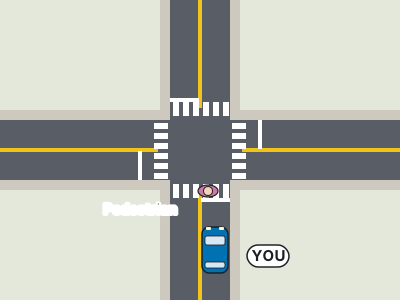
- No one unless the crosswalk is painted
- The pedestrian
- The vehicle closest to the curb
- Only a pedestrian with a signal
Show answer
The pedestrian. A pedestrian in a crosswalk has priority, and Kentucky's guidance includes unmarked crosswalks. The rule is not limited to pedestrians who have a special signal, and a painted marking is not required before yielding. Vehicle position near the curb does not create priority over someone crossing. Scan for people before entering the crossing, reduce speed early, and be prepared to stop. This is especially important at intersections where the crosswalk may be legally present even when its lines are difficult to see.
Study this in the handbook: Pedestrians and blind pedestrians
20. A Kentucky driver does not pay a court judgment for damages from a crash. When is the driving privilege suspended?
- Only after 5 years
- Never, because judgments are civil
- If it is not satisfied within 60 days of the judgment
- Immediately on the day of the crash
Show answer
If it is not satisfied within 60 days of the judgment. Any person failing to satisfy a judgment for damages from operating a motor vehicle within 60 days from the date of the judgment will have the driving privilege suspended by the Transportation Cabinet. The suspension stays in effect indefinitely, or until the judgment is satisfied and a court-attested copy of the satisfaction is sent in. Five years and the crash date are not the trigger, and civil judgments do affect the license.
Study this in the handbook: The point system and losing your license
QualitySpace is expanding to Kentucky
We are a California-based independent insurance brokerage working on licensing in more states. We cannot help with Kentucky insurance yet. Leave your email and we will let you know when we can.
Every question is written from the official Kentucky Driver Manual. Need paper? Printable KY practice test with answer key.
Last verified 2026-10-05. How we check every question · Study all 500 as flashcards
Frequently asked questions
How many questions are on this Kentucky practice test?
This fixed set has 20 questions. It is test 16 of 25 from the 500 question Kentucky bank.
How does this fixed test relate to the full Kentucky bank?
Each numbered test is a fixed set of questions in a fixed order, so you can retake the same test later and compare. Every test mixes road signs and the other topics in about the same proportion as the full bank. Tests 1 to 25 together cover every question in the Kentucky bank once. The full practice page mixes the whole bank at random.
Last verified 2026-10-05. See the Kentucky DMV facts page for sourced state details.
Return to the full Kentucky practice test · Study road signs