
Key points
Flashing red lights at a crossing mean stop. Go only after they stop and no train is coming.
Source: Handbook p. 35
“Two flashing red lights mark a railroad crossing. Stop and proceed only after the red lights stop flashing and you determine no train is approaching.”
Kentucky Driver Manual, Handbook p. 35The crossbuck is a regulatory sign that means the same as a yield sign.
Source: Handbook p. 35
“The familiar cross-buck sign near the tracts is a regulatory sign that means the same as a yield sign.”
Kentucky Driver Manual, Handbook p. 35The round yellow advance sign means slow down, look and listen, and be ready to stop.
Source: Handbook p. 36
“The sign cautions you to slow down, look and listen for a train or railroad vehicle, and be prepared to stop if a train is approaching.”
Kentucky Driver Manual, Handbook p. 36When a train is approaching, stop behind the stop line until the crossing is clear.
Source: Handbook p. 36
“When a train or railroad vehicle is approaching the intersection, you must stop behind the stop line or before the intersection until the intersection is clear.”
Kentucky Driver Manual, Handbook p. 36If you stall on the tracks, leave the car at once and run toward the direction the train is coming, away from the track.
Source: Handbook p. 37
“If you do get boxed in or stalled on a railroad crossing, abandon your car immediately and run away from the railroad track in the direction the train is coming, in order to avoid being hit by flying debris.”
Kentucky Driver Manual, Handbook p. 37From a safe distance, call the 800 number posted near the crossbuck, or 911.
Source: Handbook p. 37
“Once you are at a safe distance, call the 800 number posted on or near the crossbuck, or call 911, to alert the dispatcher of your stalled vehicle.”
Kentucky Driver Manual, Handbook p. 37A freight train at 55 mph may need a mile or more to stop.
Source: Handbook p. 37
“The stopping distance for an average freight train at 55 miles per hour may be a mile or more.”
Kentucky Driver Manual, Handbook p. 37Where there is more than one track, do not start as soon as the train passes.
Source: Handbook p. 37
“If you are stopped at a railroad crossing where there is more than one track, do not start up as soon as the train passes.”
Kentucky Driver Manual, Handbook p. 37Crossing after the lights flash or gates come down is illegal.
Source: Handbook p. 37
“Crossing a railroad track after the warning lights are flashing or the crossing gates are down is against the law, and you could be cited.”
Kentucky Driver Manual, Handbook p. 37Vehicles carrying hazardous materials must stop at all railroad crossings, so be ready.
Source: Handbook p. 64
“Vehicles carrying hazardous materials must stop at all railroad crossings. Be prepared.”
Kentucky Driver Manual, Handbook p. 64
Numbers to know
| Number | What it means | Manual |
|---|---|---|
| 800 number or 911 | who to call after escaping a stalled vehicle | Handbook p. 37 |
| 55 mph: a mile or more | stopping distance of an average freight train | Handbook p. 37 |
Recognize these signs

Railroad advance warning 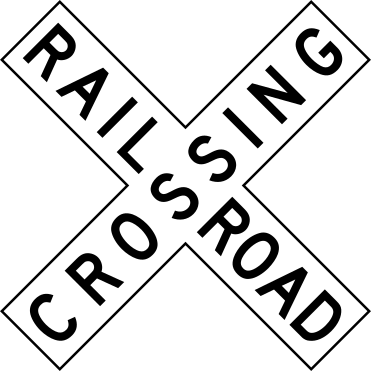
Railroad crossbuck 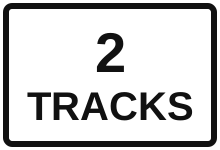
Multiple tracks
3 questions from the Kentucky practice test
1. At a highway railroad crossing, what should you do if a train is approaching?
- Stop behind the stop line or before the intersection and wait
- Cross quickly before the train reaches the crossing
- Stop on the tracks to watch the train pass
- Drive around the warning devices if the road looks clear
Show answer
Stop behind the stop line or before the intersection and wait. A train approaching the crossing requires a complete stop behind the stop line or before the intersection. The train has priority, and the vehicle must remain stopped until the intersection is clear. Crossing quickly is dangerous because a train cannot stop as rapidly as a car. Stopping on the tracks creates a second hazard, while driving around gates or other devices violates the warning. The useful cue is simple: approaching train means stop before the tracks and wait.
2. What must a driver expect from a vehicle carrying hazardous materials when it reaches a railroad crossing?
- It may bypass the crossing on the shoulder
- It may continue if no train is visible
- It stops only at crossings with gates
- It must stop at every railroad crossing
Show answer
It must stop at every railroad crossing. The manual tells drivers that vehicles carrying hazardous materials must stop at all railroad crossings. A driver should therefore anticipate a full stop even when no train is visible and should not pass on the shoulder or assume gates are required. The safest cue is the vehicle’s hazardous-materials marking combined with the approaching crossing. Increase following distance, remain patient, and be prepared for the carrier to stop before the tracks.
3. After escaping a vehicle stalled on Kentucky railroad tracks, whom does the manual say to call?
- Only a tow truck
- The railroad's business office
- The 800 number posted on or near the crossbuck, or 911
- No one until the train has passed
Show answer
The 800 number posted on or near the crossbuck, or 911. If your vehicle stalls on the tracks, get out immediately and run away from the track in the direction the train is coming from to avoid flying debris. Once at a safe distance, call the 800 number posted on or near the crossbuck, or call 911, to alert the dispatcher of your stalled vehicle, and do not try to restart the vehicle until a dispatcher says no trains are approaching.
Practice this topic
Lock it in with emergencies questions from the free Kentucky practice test. Every answer comes with a plain English explanation.
Source: the Kentucky Driver Manual, Section Six: Rules of the Road. This lesson is a plain English summary, not the law itself; where it differs, the manual and the statute govern. Last checked 2026-10-02.