
Key points
Yield to any vehicle with a flashing red or blue light or a siren.
Source: Handbook p. 64
“Kentucky law specifically requires drivers to yield the right-of-way to any vehicle displaying a flashing red or blue light or sounding a siren.”
Kentucky Driver Manual, Handbook p. 64Immediately drive to the right side of the road or curb, clear of intersections, and stop.
Source: Handbook p. 65
“you must immediately drive to the right side of the road or to the curb, clear of any intersection, and stop.”
Kentucky Driver Manual, Handbook p. 65Stay stopped until the emergency vehicle passes, unless a police officer or firefighter tells you to move.
Source: Handbook p. 65
“You must remain stopped until the emergency vehicle has passed, unless you are directed by a police officer or a firefighter to move.”
Kentucky Driver Manual, Handbook p. 65It is unlawful to follow an emergency vehicle closer than 500 feet.
Source: Handbook p. 65
“It is also unlawful to follow any emergency vehicle closer than 500 feet.”
Kentucky Driver Manual, Handbook p. 65Stop for a school or church bus loading or unloading, and stay stopped until everyone is clear and the bus moves.
Source: Handbook p. 44
“When you come to a school or church bus that is stopped on any roadway to load or unload passengers you must stop. By law you must remain stopped until all people are clear of the roadway and the bus is in motion.”
Kentucky Driver Manual, Handbook p. 44You must stop for a stopped school or church bus from either direction on all roads.
Source: Handbook p. 44
“A stop is required for a stopped school bus or church bus from either direction on all roads.”
Kentucky Driver Manual, Handbook p. 44The only exception: traffic going the opposite way on a road of four or more lanes separated by an elevated barrier or an unpaved median does not have to stop.
Source: Handbook p. 44
“A stop is not required only when traveling in the opposite direction on a roadway with four or more lanes that is separated by an elevated barrier or an unpaved median.”
Kentucky Driver Manual, Handbook p. 44Never pass a stopped school or church bus that is loading or unloading passengers.
Source: Handbook p. 44
“Do not attempt to pass any school or church bus when the bus is stopped upon a highway to receive or discharge passengers”
Kentucky Driver Manual, Handbook p. 44
Numbers to know
| Number | What it means | Manual |
|---|---|---|
| 500 feet | minimum distance when following an emergency vehicle | Handbook p. 65 |
| 4 or more lanes | opposite direction traffic need not stop only on such a road separated by an elevated barrier or unpaved median | Handbook p. 44 |
Recognize these signs
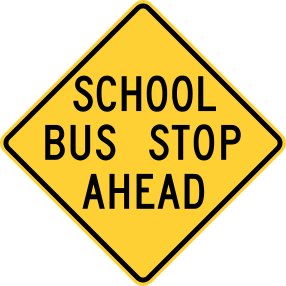
School bus stop ahead
3 questions from the Kentucky practice test
1. When you hear a siren from an approaching emergency vehicle, where must you go and what must you do?
- Remain in the lane and let the vehicle pass around you
- Drive to the right side or curb, clear of the intersection, and stop
- Turn left immediately and continue through the intersection
- Follow the emergency vehicle closely to get through traffic
Show answer
Drive to the right side or curb, clear of the intersection, and stop. A siren announces an emergency vehicle that needs the right of way. Move immediately to the right side of the road or curb, make sure the vehicle is clear of any intersection, and stop. Continuing in the lane leaves less room for the response vehicle. A sudden left turn can create a collision, and following behind the emergency vehicle is separately prohibited within 500 feet. Watch mirrors and listen so the response path stays open.
2. A school bus is stopped on a two-lane road to load or unload passengers. What must approaching drivers do?
- Continue if the opposite lane appears empty
- Pass slowly if no child is visible
- Stop only when traveling behind the bus
- Stop and remain stopped until people are clear and the bus moves
Show answer
Stop and remain stopped until people are clear and the bus moves. A stopped school bus loading or unloading passengers requires a complete stop. Remain stopped until all people are clear of the roadway and the bus is moving. Visibility of children does not cancel the protection, and an empty opposite lane does not authorize passing on a two-lane road. The behind-only choice overlooks that traffic approaching from either direction can endanger passengers. Watch for the bus’s stop arm and signal lights, brake before reaching it, and wait through the entire loading event. The cue is stopped bus plus passenger activity.
3. A school bus is stopped with its stop arm and signal lights activated. When is a driver approaching from the opposite direction not required to stop?
- Whenever the bus is more than 100 feet away from your vehicle
- On a highway of four or more lanes divided by an elevated barrier or unpaved median
- On any highway with four or more lanes, even with no median or barrier
- Whenever no children appear to be getting on or off the bus
Show answer
On a highway of four or more lanes divided by an elevated barrier or unpaved median. Kentucky amended KRS 189.370 effective July 15, 2026. Drivers approaching a stopped school or church bus from any direction must stop, and the only exception is for traffic coming from the opposite direction on a highway of four or more lanes divided by an elevated barrier or an unpaved median. Lane count alone no longer excuses a stop, so an undivided four lane road, or one split only by painted lines or a center turn lane, still requires opposing traffic to stop. Distance from the bus and whether children appear to be aboard do not create an exception. Check the stop arm, the lights, and the physical divider before continuing.
Practice this topic
Lock it in with emergencies questions from the free Kentucky practice test. Every answer comes with a plain English explanation.
Source: the Kentucky Driver Manual, Sections Seven and Ten: School Buses and Emergency Vehicles. This lesson is a plain English summary, not the law itself; where it differs, the manual and the statute govern. Last checked 2026-10-02.