
Key points
About 40,000 people a year are injured in work zone crashes.
Source: Handbook p. 69
“Approximately 40,000 people per year are injured as a result of motor vehicle crashes in work zones.”
Kentucky Driver Manual, Handbook p. 69Always slow down in a work zone, even if no workers are there.
Source: Handbook p. 69
“Always reduce your speed in a work zone, even if there are no workers.”
Kentucky Driver Manual, Handbook p. 69In a work zone, slow down, increase following distance and be ready to stop.
Source: Handbook p. 69
“Reduce your speed, increase your following distance, watch the traffic around you, and be prepared to stop.”
Kentucky Driver Manual, Handbook p. 69Follow the instructions of a flagger directing traffic in a work zone.
Source: Handbook p. 37
“In work zones, traffic may be controlled by a person with a sign or flag to tell you which direction to travel or to slow down or stop. You must follow their instructions.”
Kentucky Driver Manual, Handbook p. 37Fines double in a highway work zone when signs say so and at least 1 worker is present.
Source: Handbook p. 69
“Note that Kentucky law allows for fines to be doubled in a highway work zone when signs are displayed informing drivers of the existence of a highway work zone and that fines are double in it. Additionally, at least one (1) bona fide worker must by present.”
Kentucky Driver Manual, Handbook p. 69Obey work zone signs until you see End Road Work.
Source: Handbook p. 69
“Observe the posted work zone signs until you see "End Road Work."”
Kentucky Driver Manual, Handbook p. 69Put 60 percent of a trailer's cargo weight in front and 40 percent in back.
Source: Handbook p. 70
“Sixty percent of the cargo weight of a trailer should go in the front (nearest the towing vehicle) and 40 percent in the back.”
Kentucky Driver Manual, Handbook p. 70If a trailer sways, steer straight and slow gradually without braking. Never speed up.
Source: Handbook p. 71
“If the trailer begins to sway or whip, steer straight and reduce speed gradually, do not apply the brakes. Never increase speed.”
Kentucky Driver Manual, Handbook p. 71If a trailer starts to jackknife, stop and pull ahead to straighten out.
Source: Handbook p. 71
“If the trailer starts to jackknife - STOP - and pull ahead to straighten out; then start again.”
Kentucky Driver Manual, Handbook p. 71
Numbers to know
| Number | What it means | Manual |
|---|---|---|
| 40,000 | people injured each year in work zone crashes | Handbook p. 69 |
| 1 worker | must be present for doubled work zone fines | Handbook p. 69 |
| 60 percent front, 40 percent back | how to load a trailer | Handbook p. 70 |
Recognize these signs
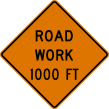
Road work ahead 
Flagger ahead 
End road work
3 questions from the Kentucky practice test
1. What should you do when entering a work zone where workers and equipment are present?
- Keep the normal speed because the zone is temporary
- Reduce speed, stay alert, and be prepared to stop suddenly
- Follow the vehicle ahead more closely to discourage merging
- Cross the barriers if the open lane appears shorter
Show answer
Reduce speed, stay alert, and be prepared to stop suddenly. Work zones can contain workers, equipment, detours, changing surfaces, and sudden traffic control. Reduce speed and remain ready for an abrupt stop, since the roadway may change faster than expected. The normal-speed answer ignores the reduced margin, and tailgating leaves no room to react. Barriers are placed to keep traffic out of hazardous areas, so crossing them is not a shortcut. Look beyond the vehicle ahead, obey signs and flaggers, and leave extra space. The cue is active work: expect changing conditions, not a routine lane.
2. How many people are injured each year in work zone crashes, according to the Kentucky manual?
- About 5,000
- About 500
- Approximately 40,000
- About 1 million
Show answer
Approximately 40,000. Approximately 40,000 people per year are injured as a result of motor vehicle crashes in work zones, which have become increasingly dangerous for workers and drivers. Reduce speed, increase following distance, watch the traffic around you and be prepared to stop, and use extreme caution at night whether or not workers are present. Adjust your lane position to allow space for workers and construction vehicles, and obey the posted work zone signs until you see End Road Work.
3. Where should most of a trailer’s cargo weight be placed for stability?
- All cargo behind the axle
- About 60 percent in back and 40 percent in front
- Exactly half at each end
- About 60 percent in front and 40 percent in back
Show answer
About 60 percent in front and 40 percent in back. The manual recommends placing about 60 percent of a trailer’s cargo weight in the front, nearest the towing vehicle, and 40 percent in the back. Front loading reduces the possibility of sway, so shifting the heavier share rearward creates the wrong balance. An exact half-and-half split is also not the stated recommendation. Before driving, put heavy items low and forward, then secure the load so it cannot shift during travel.
Practice this topic
Lock it in with safe driving questions from the free Kentucky practice test. Every answer comes with a plain English explanation.
Source: the Kentucky Driver Manual, Section Eleven: Special Driving Situations. This lesson is a plain English summary, not the law itself; where it differs, the manual and the statute govern. Last checked 2026-10-02.