
Test 6 of 25 · 20 questions · Free 2026
KY Permit Practice Test 6
Jump to the test ↓A fixed 20 question set from the Kentucky bank with answers and plain English explanations.
Question 1 of 20 · 0 right so far
All 20 questions in test 6
Every question below comes from the Kentucky question bank on this page. Open a question to see the correct answer and the explanation. Nothing here is hidden behind a signup.
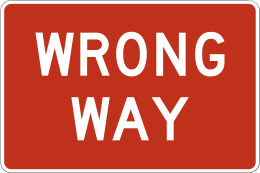
1. What warning does the pictured WRONG WAY sign give?
- The driver is traveling in the wrong direction
- The driver is approaching a rough pavement section
- The driver may use the lane only to pass
- The driver must stop because a school zone begins
Show answer
The driver is traveling in the wrong direction. WRONG WAY tells a driver that travel is going in the wrong direction. The manual says this sign is often found at exit ramps and at the beginning of one-way streets. Rough pavement, passing permission, and a school zone are separate roadway messages, so they do not explain this red regulatory warning. If it appears ahead, stop the unsafe movement, check surrounding traffic, and follow a lawful route rather than continuing into opposing flow.
Study this in the handbook: Pavement markings, crosswalks and lane use
2. For a person under 18 convicted of an alcohol offense, what does the manual say about the license suspension?
- It is replaced by a warning with no suspension
- It is automatically canceled permanently
- It is limited to exactly 30 days
- It may be longer than the listed suspension
Show answer
It may be longer than the listed suspension. Kentucky gives the under-18 driver a possible longer license suspension after an alcohol conviction. The manual does not make the suspension permanently cancel the license, limit it to exactly 30 days, or replace it with a warning. Age changes the potential duration, so do not apply an adult range mechanically to a younger driver. When reviewing a penalty question, identify both the offense and the driver’s age before selecting a time period. The cue is the phrase under eighteen, which signals that the suspension may exceed the ordinary listed period.
Study this in the handbook: Implied consent and DUI penalties
3. What minimum age must an applicant reach to apply for a Kentucky operator's, motorcycle, or moped license?
- 14 years
- 15 years
- 16 years
- 18 years
Show answer
15 years. Kentucky's July 2026 driver manual lowered the licensing starting point: an applicant must have reached the fifteenth birthday before applying for an operator's, motorcycle, or moped license. That matches KRS 186.450, which lets a person who is at least 15 years old apply for an instruction permit. Fourteen is below that floor. Sixteen was the age printed in earlier editions of the manual, so it is now outdated, and 18 is simply higher than the minimum. Reaching the minimum age only opens eligibility; the applicant still needs driving privileges that have not been withdrawn and must complete the permit, testing, and graduated licensing steps.
Study this in the handbook: License classes and the tests
4. What do work zone signs alert drivers to?
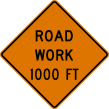
- Work zones ahead and people working on or near the roadway
- A guaranteed open lane with no construction activity
- A nearby hospital or fuel station
- A route that permits passing in every lane
Show answer
Work zones ahead and people working on or near the roadway. Work zone signs alert drivers to roadwork ahead and warn that people may be working on or near the roadway. They do not guarantee an open lane, identify a service location, or authorize passing in every lane. When orange signs appear, reduce speed, scan for workers and equipment, and expect lane changes, detours, or rough surfaces. The useful cue is the combination of warning color and changing roadway conditions, which calls for extra space and a controlled approach.
Study this in the handbook: Railroad crossings
5. What may control traffic at an intersection?
- A driver’s preferred route through the intersection
- Only the largest vehicle present
- Traffic signals, signs, or right-of-way rules
- The weather forecast for the roadway
Show answer
Traffic signals, signs, or right-of-way rules. At an intersection, traffic may be controlled by signals, signs, or right-of-way rules. The largest vehicle does not automatically direct traffic, and a driver’s preferred route has no legal control. Weather can affect how cautiously you drive, but it is not a traffic-control device. Scan for the signal, sign, or applicable yield rule before entering, then account for pedestrians and vehicles already in the intersection. This layered check prevents a driver from treating an uncontrolled appearance as permission to proceed without judgment.
Study this in the handbook: Yielding the right of way
6. What sequence is recommended when a vehicle is accelerating out of control?
- Pump the accelerator until the engine responds normally
- Lock the brakes and keep the vehicle in the travel lane
- Shift into park while moving and open the driver's door
- Turn off the engine, shift to neutral, steer smoothly, and pull off
Show answer
Turn off the engine, shift to neutral, steer smoothly, and pull off. An out-of-control acceleration problem requires reducing the engine's ability to drive the vehicle and creating a controlled escape path. The manual lists turning off the engine, shifting to neutral, steering smoothly, braking gently, and pulling off the roadway. Locking the brakes can produce a skid, while park is not a normal moving-vehicle gear and opening a door adds another hazard. Pumping the accelerator keeps applying the control that is malfunctioning. Once safely stopped, the pedal should be repaired before the vehicle is driven again.
Study this in the handbook: Brake failure, blowouts and other vehicle failures
7. What should you do at the first sign of rain, snow, sleet, or ice?
- Maintain speed so the tires stay warm
- Reduce speed because the roadway may become slippery
- Brake hard before traction decreases
- Turn quickly to test how much grip remains
Show answer
Reduce speed because the roadway may become slippery. The manual says to reduce speed at the first sign of rain, snow, sleet, or ice because slippery pavement reduces tire grip, lengthens stopping distance, and makes turning harder. Maintaining speed does not preserve traction. Hard braking or a quick steering test can cause a skid before the driver has adjusted. Ease off the accelerator, leave more room ahead, and use smooth steering and braking while the roadway is wet or icy.
Study this in the handbook: Kentucky speed limits
8. How much following distance must a driver leave behind an emergency vehicle?
- At least 500 feet
- At least 100 feet
- No more than 50 feet
- Only one car length
Show answer
At least 500 feet. Kentucky prohibits following an emergency vehicle closer than 500 feet. The distance gives responders room to move through traffic and reduces the chance that a trailing vehicle will interfere with the emergency operation. One hundred feet, 50 feet, and one car length are all shorter than the stated minimum and therefore do not satisfy the rule. Once the emergency vehicle has passed, let it build distance before continuing behind it. The concrete cue is the large number: emergency response needs a substantial buffer, not ordinary car-following space.
Study this in the handbook: Emergency vehicles and school buses
9. What minimum following interval should a driver generally keep behind the vehicle ahead?
- Exactly one car length
- At least four seconds
- Two seconds only when traveling below 25 mph
- Less than one second when traffic is moving steadily
Show answer
At least four seconds. The manual recommends a minimum four-second gap between your vehicle and the one ahead. This is measured by watching the lead vehicle pass a fixed object, then counting until your vehicle reaches that same point. One car length changes with speed and does not provide a reliable interval. The two-second option is too short, and steady traffic is not a reason to follow within one second. Use a pole or sign as a timing marker, then add more space for poor conditions.
Study this in the handbook: Looking ahead, stopping distance and following distance
10. What penalty do a Kentucky vehicle owner and driver face for driving without insurance?
- A $25 fine
- A warning
- A fine of $500 to $1,000, up to 90 days in jail or both, plus revocation of the registration
- A one year suspension only
Show answer
A fine of $500 to $1,000, up to 90 days in jail or both, plus revocation of the registration. Any owner who fails to maintain insurance has the vehicle registration revoked, and the owner and driver are subject to a fine of $500 to $1,000, up to 90 days in jail, or both. Kentucky requires $25,000 per person and $50,000 per accident for bodily injury, and $25,000 for property damage, or a single limit policy of $60,000, with basic reparations benefits, and written proof must be kept in the vehicle.
Study this in the handbook: Renewal, registration and insurance
11. Which of these is an aggravating circumstance that requires mandatory jail time in a Kentucky DUI case?
- Driving at 5 mph over the limit
- Having a passenger over 65
- Driving during daylight
- Transporting a passenger under 12 years of age
Show answer
Transporting a passenger under 12 years of age. Kentucky requires mandatory jail time when aggravating circumstances exist, including driving more than 30 mph over the limit, driving the wrong way on a limited access highway, causing a crash with death or serious injury, a BAC of .15 or higher within two hours, refusing a requested test on a second or later offense, and transporting a passenger under the age of twelve. Five mph over the limit, an older passenger and daylight driving are not on the list.
Study this in the handbook: Implied consent and DUI penalties
12. Which roadway features are pavement markings used to show?
- The exact arrival time of the next traffic signal
- Only the shoulder's condition after rain
- Lanes, passing permissions, turn lanes, and pedestrian walkways
- Whether every approaching driver has insurance
Show answer
Lanes, passing permissions, turn lanes, and pedestrian walkways. The manual assigns pavement markings several jobs: dividing lanes, telling drivers when passing or changing lanes is allowed, indicating lanes for turns, defining pedestrian walkways, and identifying stopping locations. They cannot report a shoulder's weather condition, predict signal timing, or verify insurance. The useful habit is to inspect the full roadway surface before maneuvering. Arrows, lane boundaries, stop lines, and crosswalk markings should be interpreted as guidance that works with the nearby signs and traffic lights.
Study this in the handbook: Pavement markings, crosswalks and lane use
13. What kind of information can guide signs provide?
- Intersecting roads, cities, towns, and highway points of interest
- The legal blood alcohol limit for the driver
- A command to stop at every intersection
- A warning that a railroad gate is descending
Show answer
Intersecting roads, cities, towns, and highway points of interest. Guide signs help drivers navigate by identifying intersecting roads, directing travel toward cities and towns, and showing points of interest along a highway. They may also identify services, but they are not substitutes for regulatory commands or hazard warnings. A blood alcohol limit belongs to law and licensing information, while stop commands and railroad alerts use other traffic-control signs. Use guide information early to choose the proper route and lane, then continue obeying the separate signs that control speed, movement, and stopping.
Study this in the handbook: Warning, work zone and guide signs
14. In a Kentucky school zone when lights are flashing or children are present, how should a driver respond?
- Obey the slower posted limit
- Drive at the regular highway limit
- Stop until the lights turn green
- Use the shoulder to pass slowly
Show answer
Obey the slower posted limit. A school zone can require a slower speed when its lights are flashing or children are present. The regular highway limit does not override that school zone condition, and a driver does not wait for a green light because the situation is governed by the posted speed rule. Using the shoulder creates a separate hazard and is not a way to comply. The roadside cue is simple: flashing school zone lights or visible children mean reduce speed, increase attention, and be ready for a child to enter the roadway.
Study this in the handbook: Pedestrians and blind pedestrians
15. A rectangular white sign lists a speed, parking restriction, or turn rule. What does that sign family indicate?
- A temporary suggestion with no legal effect
- A warning of a possible curve or grade
- A service sign for food and lodging
- A regulatory instruction that must be obeyed
Show answer
A regulatory instruction that must be obeyed. Regulatory signs communicate specific laws, including traffic direction, lane use, turning, speed, parking, and other special situations. Their instructions are obligations, so treating one as an optional suggestion is unsafe and may be unlawful. A curve warning belongs to the warning category, while food and lodging information is guide material. Use the sign’s words and symbols to identify the required action, then comply before reaching the controlled point. The cue is a white panel carrying a rule rather than a hazard symbol.
Study this in the handbook: Pavement markings, crosswalks and lane use
16. When is it against Kentucky law to enter an intersection after a traffic signal changes?
- Only when the intersection contains a pedestrian
- After the light turns yellow
- After the light turns red
- Only when another vehicle sounds its horn
Show answer
After the light turns red. Kentucky states that it is against the law to enter an intersection after the light turns red. A vehicle already in the intersection may clear it if it entered while the signal was yellow, but that exception does not authorize a new entry after red. Yellow and pedestrian conditions do not replace the signal rule, and a horn has no legal effect on the light. Approach changing signals attentively, stop when a safe stop is possible, and do not cross the stop line once red has begun.
Study this in the handbook: Traffic lights and arrows
17. What braking distance does the Kentucky manual give at 50 mph on dry pavement with good brakes?
- About 30 feet
- About 158 feet
- About 500 feet
- About 1,000 feet
Show answer
About 158 feet. At 50 mph on dry pavement with good brakes, braking distance alone can take about 158 feet, in addition to perception and reaction time. To check following distance, pick a stationary point and count; if you pass it before counting to one thousand four you are too close, so reduce speed and count again. Four seconds is the minimum, more in bad weather.
Study this in the handbook: Looking ahead, stopping distance and following distance
18. How many reckless driving convictions within twelve months can lead to a Kentucky suspension or revocation?
- Three
- Two
- Four
- One
Show answer
Three. Reckless driving, with three convictions within twelve months, is on Kentucky's list of reasons a license may be suspended or revoked. One or two convictions in that span do not meet this ground, and four is more than required. Other grounds include DUI, refusing a chemical test, fleeing police, leaving a crash scene, and failing to satisfy a citation or court summons.
Study this in the handbook: The point system and losing your license
19. What must a Kentucky intermediate license holder do to become eligible for a full unrestricted license?
- Hold it 30 days and pass a new written test
- Hold the intermediate license 180 days, complete driver education, and reach age 17
- Turn 21
- Log 100 more practice hours
Show answer
Hold the intermediate license 180 days, complete driver education, and reach age 17. The July 2026 Kentucky manual says drivers are eligible for a full unrestricted license after holding an intermediate license for 180 days while also completing the driver education requirements and reaching age 17. Kentucky accepts a free classroom course, an online course, high school driver education, or an approved private school course with four hours of classroom training. Thirty days and a new written test are not the rule, and age 21 and 100 extra practice hours are not requirements.
Study this in the handbook: The intermediate license and full license
20. How many points within two years can lead to a Kentucky suspension for a driver under 18?
- 12 points
- 4 points
- 10 points
- 7 points
Show answer
7 points. Under Kentucky's point system, accumulating 12 points within a two-year period, or 7 points if the driver is under eighteen, can lead to suspension of the privilege to drive. Twelve points is the adult threshold. Four and ten points are not thresholds in the manual. Drivers are given a chance to meet with a hearing officer before any suspension, and points expire two years after the conviction date.
Study this in the handbook: The point system and losing your license
QualitySpace is expanding to Kentucky
We are a California-based independent insurance brokerage working on licensing in more states. We cannot help with Kentucky insurance yet. Leave your email and we will let you know when we can.
Every question is written from the official Kentucky Driver Manual. Need paper? Printable KY practice test with answer key.
Last verified 2026-10-05. How we check every question · Study all 500 as flashcards
Frequently asked questions
How many questions are on this Kentucky practice test?
This fixed set has 20 questions. It is test 6 of 25 from the 500 question Kentucky bank.
How does this fixed test relate to the full Kentucky bank?
Each numbered test is a fixed set of questions in a fixed order, so you can retake the same test later and compare. Every test mixes road signs and the other topics in about the same proportion as the full bank. Tests 1 to 25 together cover every question in the Kentucky bank once. The full practice page mixes the whole bank at random.
Last verified 2026-10-05. See the Kentucky DMV facts page for sourced state details.
Return to the full Kentucky practice test · Study road signs