
Test 5 of 25 · 20 questions · Free 2026
KY Permit Practice Test 5
Jump to the test ↓A fixed 20 question set from the Kentucky bank with answers and plain English explanations.
Question 1 of 20 · 0 right so far
All 20 questions in test 5
Every question below comes from the Kentucky question bank on this page. Open a question to see the correct answer and the explanation. Nothing here is hidden behind a signup.
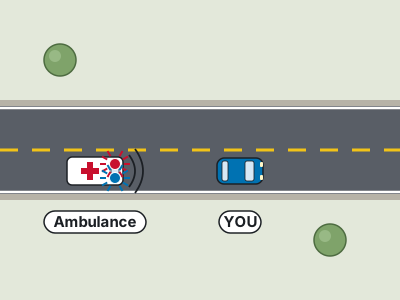
1. What should a driver do when an emergency vehicle approaches with flashing lights and a siren?
- Stop in the center of the intersection to let it choose a path
- Pull to the edge of the road, clear of an intersection, and stop
- Continue at the same speed if the emergency vehicle can pass
- Follow closely behind the emergency vehicle through traffic
Show answer
Pull to the edge of the road, clear of an intersection, and stop. When the emergency vehicle’s lights and siren are active, drivers must yield by moving to the edge of the road or curb, staying clear of an intersection, and stopping. Stopping in the intersection blocks the route the responding vehicle may need. Continuing at speed leaves the emergency driver less room, even if a pass seems possible. Following closely is specifically unsafe, and Kentucky prohibits following an emergency vehicle closer than 500 feet. The visual and audio cue together require an immediate, orderly path clearance.
Study this in the handbook: Emergency vehicles and school buses
2. Which warning signs may be fluorescent yellow?

- Work zones, detours, and construction equipment only
- Railroad crossings, hospitals, and fuel stations
- Interstate routes, city limits, and county roads
- School zones, school crossings, and pedestrian crossings
Show answer
School zones, school crossings, and pedestrian crossings. The manual names school zones, school crossings, and pedestrian crossings as examples of warning signs that may be fluorescent yellow. The color helps draw attention where people may enter the roadway, especially children near school areas. Railroad warnings and guide signs belong to other categories, and work-zone signs are generally orange. When fluorescent yellow appears, reduce speed, search both sides of the road, and be ready for a pedestrian or child to move unexpectedly into the crossing area.
Study this in the handbook: Traffic lights and arrows
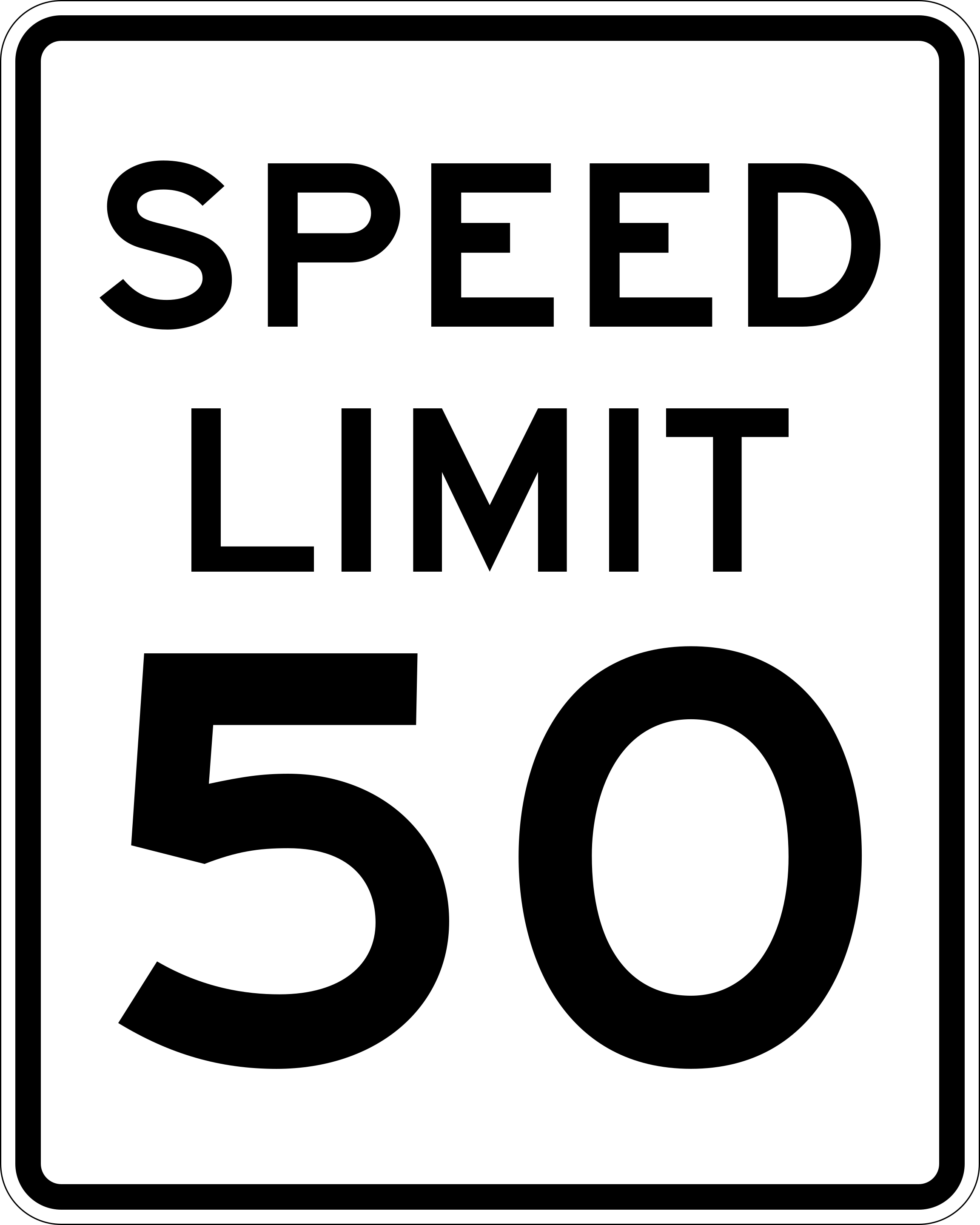
3. What does the pictured black and white SPEED LIMIT sign indicate?
- A minimum speed required in every weather condition
- A suggested speed that may be exceeded whenever traffic is light
- The maximum legal speed allowed in ideal conditions
- A truck-only speed restriction that excludes passenger cars
Show answer
The maximum legal speed allowed in ideal conditions. Black and white speed limit signs state the maximum legal speed allowed in ideal conditions. The word ideal matters: rain, snow, congestion, visibility, or another hazard can require a slower speed. The sign is not merely a suggestion, does not create a universal minimum, and is not limited to trucks unless a separate sign says so. Check the posted number, then adjust downward whenever road or weather conditions make that maximum unsafe.
Study this in the handbook: Pavement markings, crosswalks and lane use
4. Where should most of a trailer’s cargo weight be placed for stability?
- All cargo behind the axle
- About 60 percent in back and 40 percent in front
- Exactly half at each end
- About 60 percent in front and 40 percent in back
Show answer
About 60 percent in front and 40 percent in back. The manual recommends placing about 60 percent of a trailer’s cargo weight in the front, nearest the towing vehicle, and 40 percent in the back. Front loading reduces the possibility of sway, so shifting the heavier share rearward creates the wrong balance. An exact half-and-half split is also not the stated recommendation. Before driving, put heavy items low and forward, then secure the load so it cannot shift during travel.
Study this in the handbook: Work zones and towing a trailer
5. How often may a Kentucky driver complete State Traffic School?
- Whenever a driver receives any ticket
- Once every two years
- Once every twelve months
- Only once during a lifetime
Show answer
Once every twelve months. Kentucky’s manual permits a driver to complete State Traffic School once every twelve months. The two-year choice confuses this limit with other point-system timing, and a ticket does not automatically make every driver eligible. The program is not a lifetime-only opportunity either. Before relying on traffic school, check the referral and eligibility rules, then count twelve months from the prior completion rather than from an unrelated license renewal.
Study this in the handbook: The point system and losing your license
6. What credential may an autocycle operator use in Kentucky instead of a motorcycle license or endorsement?
- Only a motorcycle instruction permit
- Only a commercial driver's license
- A valid operator's license
- No license of any kind
Show answer
A valid operator's license. An autocycle operator is exempt from obtaining a motorcycle license or endorsement when the operator possesses a valid operator's license. That does not mean the vehicle can be driven without licensing, so the no license choice is unsafe. A commercial license and motorcycle permit are not the credentials identified for this exemption. Before driving, confirm that the vehicle fits the manual's autocycle category and keep the valid operator credential available, since the exemption is tied to that condition.
Study this in the handbook: Rural roads, farm equipment and slow vehicles
7. A Kentucky intermediate license holder commits a moving violation. How does that affect the full license?
- It has no effect
- It cancels the intermediate license permanently
- It adds 30 days
- It adds at least 180 days from the violation before applying for the full unrestricted license
Show answer
It adds at least 180 days from the violation before applying for the full unrestricted license. Violations of the intermediate license restrictions, moving violations under KRS 189, and DUI violations under KRS 189A are not permitted. If one occurs, it adds an additional minimum of one hundred eighty days from the date of the violation before the driver may apply for a full unrestricted license. It does have an effect, so the no effect choice is wrong. The manual does not describe permanent cancellation here, and 30 days understates the delay.
Study this in the handbook: The intermediate license and full license
8. After a Kentucky point hearing, the driver is placed on probation instead of suspension. When can probation be considered again?
- Not until two years after the end of the previous probation period
- After 30 days
- Any time
- Never again
Show answer
Not until two years after the end of the previous probation period. After a hearing, the department may put the driver on probation instead of suspension and require a driver improvement clinic, State Traffic School. Once on probation, the driver shall not be considered for probation again until two years have passed from the ending date of any previous probation period, whether served or not. Thirty days and any time are too soon. Never again overstates the rule.
Study this in the handbook: The point system and losing your license
9. After an engine shuts off while driving, what braking method does the Kentucky manual recommend?
- Brake hard immediately and keep moving straight
- Use steady pressure, slow down, and pull off the roadway
- Release the brake completely until the engine restarts
- Use repeated sharp steering instead of braking
Show answer
Use steady pressure, slow down, and pull off the roadway. A power failure can make steering difficult, but the vehicle can still be guided. The manual says to look for an escape path, avoid hard braking, use steady pressure on the pedal, slow down, and then pull off the roadway. Hard braking may reduce control, while abandoning the brake or replacing it with sharp steering does not bring the disabled vehicle to a safe stop. Keep a strong grip on the wheel, maintain deliberate pedal pressure, and attempt a restart only after reaching a safe stopping location.
Study this in the handbook: Brake failure, blowouts and other vehicle failures
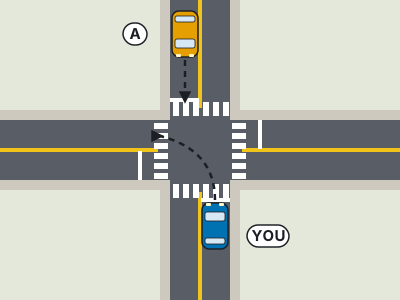
10. At an intersection, what traffic must a driver yield to before making a left turn?
- Only vehicles approaching from behind
- Oncoming traffic in the opposing lane
- Vehicles parked on the destination street
- No traffic once the turn signal is activated
Show answer
Oncoming traffic in the opposing lane. A left-turning driver must yield to oncoming traffic because that traffic is continuing through the intersection in the opposing lane. Activating a turn signal communicates intention but does not grant priority. Vehicles behind the turning car and parked vehicles on the destination street are not the rule described here. Search the intersection, signal early, maintain the proper lane position, and wait for a gap that leaves enough room for oncoming vehicles to pass safely before turning across their path.
Study this in the handbook: Yielding the right of way
11. Where does the Kentucky manual say a child safety seat should ideally be placed?
- In the middle of the rear seat, anchored so it cannot move
- Behind the driver only
- Anywhere with the belt loose
- In the front passenger seat
Show answer
In the middle of the rear seat, anchored so it cannot move. The safety seat should ideally be placed in the middle of the rear seat and anchored to prevent any movement in a collision, and it will not give maximum protection if installed incorrectly. Help with installation is available at a Child Safety Seat Inspection Site at a Kentucky State Police post. A booster seat elevates an older child so the lap and shoulder belt fit properly.
Study this in the handbook: Required equipment, safety belts, air bags and child seats
12. What should you do when entering a work zone where workers and equipment are present?
- Keep the normal speed because the zone is temporary
- Reduce speed, stay alert, and be prepared to stop suddenly
- Follow the vehicle ahead more closely to discourage merging
- Cross the barriers if the open lane appears shorter
Show answer
Reduce speed, stay alert, and be prepared to stop suddenly. Work zones can contain workers, equipment, detours, changing surfaces, and sudden traffic control. Reduce speed and remain ready for an abrupt stop, since the roadway may change faster than expected. The normal-speed answer ignores the reduced margin, and tailgating leaves no room to react. Barriers are placed to keep traffic out of hazardous areas, so crossing them is not a shortcut. Look beyond the vehicle ahead, obey signs and flaggers, and leave extra space. The cue is active work: expect changing conditions, not a routine lane.
Study this in the handbook: Work zones and towing a trailer
13. What does a yellow traffic light indicate?
- The signal is changing directly to a flashing green
- The signal guarantees a protected left turn
- The signal permits traffic to stop in the intersection
- The signal is about to turn red
Show answer
The signal is about to turn red. A yellow traffic light warns that the signal is about to turn red. It is not a promise of a protected left turn and does not permit a driver to stop in the intersection. The flashing-green option describes a signal behavior not stated in this rule. If you can stop safely, stop before the line; if you are already clearing the intersection, continue out of it. The visual cue is yellow as a transition warning, so decide early rather than accelerating to beat the red.
Study this in the handbook: Traffic lights and arrows
14. What does a Kentucky yield sign look like?
- A white rectangle with a green route number
- A yellow diamond with black arrows
- A red and white downward-pointing triangle with red letters
- An orange circle with blue letters
Show answer
A red and white downward-pointing triangle with red letters. A Kentucky yield sign is a red and white downward-pointing triangle with red letters. Its distinctive shape and colors help a driver recognize the sign before reading it fully. A yellow diamond is normally associated with warnings, a white rectangle with green route information is a guide sign, and an orange circle with blue letters is not the described yield design. Recognize the sign early, slow down, and allow vehicles and pedestrians that have priority to clear the intersection before entering. The appearance identifies the instruction to yield.
Study this in the handbook: Pavement markings, crosswalks and lane use
15. Under Kentucky’s implied consent law, what has a driver implicitly agreed to do when operating a vehicle?
- Take a lawfully requested test of blood, breath, urine, or a combination
- Refuse every chemical test unless arrested
- Take only a roadside breath test
- Submit only to a test requested in the licensing state
Show answer
Take a lawfully requested test of blood, breath, urine, or a combination. Operating a vehicle carries implied consent to a lawfully requested test of blood, breath, urine, or any combination of those tests. The agreement is broader than a roadside breath test and does not depend on where the driver received a license. Refusing is not a protected default; the manual says refusal may lead to license suspension and may be used as evidence. When stopped on suspicion of impairment, identify whether the request is lawful and understand the consequences before responding.
Study this in the handbook: Implied consent and DUI penalties
16. What unposted speed limit applies in a Kentucky off street parking facility open for public use?
- 10 mph
- 20 mph
- 15 mph
- 25 mph
Show answer
15 mph. The manual sets the default for an off street parking facility offered for public use at 15 mph, whether the property is public or private. The 10 mph option is lower than the stated figure, while 20 mph and 25 mph are higher and have no support in this rule. The practical cue is the location: this limit concerns a public use parking facility, so do not automatically carry a nearby roadway limit into the lot when no sign is posted.
Study this in the handbook: Kentucky speed limits
17. What information can pavement markings provide to drivers?
- A guarantee that all cross traffic will stop
- Only the names of nearby towns
- The mechanical condition of every vehicle ahead
- Directions, warnings, and places where stopping is required
Show answer
Directions, warnings, and places where stopping is required. Pavement markings communicate roadway guidance through lines, arrows, words, and symbols. They can divide lanes, identify permitted passing or lane changes, designate turning lanes, define pedestrian walkways, and show where a stop is required. They do not provide town names, diagnose vehicles, or guarantee that another road user will obey. Read markings together with signs and signals, then adjust lane position and speed before reaching the marked area. A painted line is an active traffic-control cue, not merely decoration on the pavement.
Study this in the handbook: Pavement markings, crosswalks and lane use
18. How should you pass a horseback rider on a Kentucky road?
- Pass with caution and avoid using the horn or revving the engine
- Honk repeatedly so the rider moves off the roadway
- Rev the engine to warn the animal before passing
- Pass closely because the animal can move onto the shoulder
Show answer
Pass with caution and avoid using the horn or revving the engine. Animal-drawn vehicles and horseback riders can be frightened by sudden noise. The manual says to pass with caution and avoid the horn or a revving engine, because startling the animal can cause a crash. Repeated honking and engine noise are not safer warnings, and passing closely leaves no room for an unexpected movement. Reduce speed, give the rider generous space, and anticipate that an animal-drawn vehicle may turn left into a field or driveway.
Study this in the handbook: Rural roads, farm equipment and slow vehicles
19. Which locations may be identified by a guide sign?
- Hospitals, service stations, restaurants, and hotels
- Only temporary lane closures during storms
- The exact distance a vehicle needs to stop
- The identity of the driver in the next lane
Show answer
Hospitals, service stations, restaurants, and hotels. Guide signs can help motorists find hospitals, service stations, restaurants, and hotels. This is location and service information, not a temporary lane-control instruction or a calculation of stopping distance. It also cannot identify another driver. Brown, blue, and green square or rectangular signs commonly carry guide information. Notice the sign early, select a safe lane and speed for the upcoming destination, and avoid abrupt movement across traffic when the service or point of interest is reached.
Study this in the handbook: Pavement markings, crosswalks and lane use
20. At what BAC within two hours of driving does Kentucky treat a DUI as aggravated?
- .08 or higher
- .15 or higher
- .02 or higher
- .10 or higher
Show answer
.15 or higher. One aggravating circumstance is an alcohol concentration in the blood or breath of .15 BAC or higher within two hours of stopping driving, which brings mandatory jail time. Point zero eight is the ordinary DUI line for adults, and .02 is the under 21 limit and the interlock setting. Point ten is not in the list. Other aggravating circumstances include going more than 30 mph over the limit and carrying a passenger under 12.
Study this in the handbook: Implied consent and DUI penalties
QualitySpace is expanding to Kentucky
We are a California-based independent insurance brokerage working on licensing in more states. We cannot help with Kentucky insurance yet. Leave your email and we will let you know when we can.
Every question is written from the official Kentucky Driver Manual. Need paper? Printable KY practice test with answer key.
Last verified 2026-10-05. How we check every question · Study all 500 as flashcards
Frequently asked questions
How many questions are on this Kentucky practice test?
This fixed set has 20 questions. It is test 5 of 25 from the 500 question Kentucky bank.
How does this fixed test relate to the full Kentucky bank?
Each numbered test is a fixed set of questions in a fixed order, so you can retake the same test later and compare. Every test mixes road signs and the other topics in about the same proportion as the full bank. Tests 1 to 25 together cover every question in the Kentucky bank once. The full practice page mixes the whole bank at random.
Last verified 2026-10-05. See the Kentucky DMV facts page for sourced state details.
Return to the full Kentucky practice test · Study road signs