
Test 8 of 25 · 20 questions · Free 2026
KY Permit Practice Test 8
Jump to the test ↓A fixed 20 question set from the Kentucky bank with answers and plain English explanations.
Question 1 of 20 · 0 right so far
All 20 questions in test 8
Every question below comes from the Kentucky question bank on this page. Open a question to see the correct answer and the explanation. Nothing here is hidden behind a signup.
1. When may a Kentucky permit holder under 18 drive between midnight and 6:00 a.m.?
- Any time with a friend who is 18
- Never, with no exceptions
- Only on weekends
- Only if the person can demonstrate good cause for driving
Show answer
Only if the person can demonstrate good cause for driving. Permit holders under the age of 18 may not drive between midnight and 6:00 a.m. unless they can demonstrate good cause for driving. The intermediate license has the same hours and gives emergencies, school and work-related activities as examples of good cause. An 18 year old friend is not a qualified supervisor, since permit holders need a licensed driver 21 or older. A total ban ignores the good cause exception, and weekends are not an exception.
Study this in the handbook: The learner's permit phase for teens
2. Your vehicle breaks down on a roadway. Which action helps warn approaching drivers?
- Leave the vehicle in the lane with no lights so traffic can pass quietly
- Turn on emergency flashers and place warning flares behind the vehicle when available
- Stand in the travel lane and wave vehicles around the disabled car
- Turn off all lights to preserve the battery while waiting
Show answer
Turn on emergency flashers and place warning flares behind the vehicle when available. A disabled vehicle should be made visible and moved fully off the road when possible. Emergency flashers announce the problem, and flares placed about 200 to 300 feet behind give approaching drivers time to change lanes. Leaving the car dark or standing in the lane increases exposure to a collision. Battery conservation is less important than warning traffic about a roadway obstruction. Pull right, choose a location visible from a distance, activate the flashers, and notify authorities if needed. The cue is visibility plus advance warning.
Study this in the handbook: Brake failure, blowouts and other vehicle failures
3. Which lights may appear on the escort vehicle leading a Kentucky funeral procession?
- Flashing yellow, red, or blue lights
- Steady green lights only
- Flashing white lights only
- Headlights only, with no flashing lights
Show answer
Flashing yellow, red, or blue lights. A funeral procession has intersection right-of-way when it is led by an escort vehicle displaying flashing yellow, red, or blue lights. Steady green lights, flashing white lights, and ordinary headlights are not the escort display the manual describes. Drivers should also avoid driving between procession vehicles and should not pass unless a police or safety officer directs it, subject to the listed exceptions. When those escort lights identify a procession, slow down and allow the group to proceed together.
Study this in the handbook: Headlights, turn signals and night driving
4. When must a Kentucky driver yield to an emergency vehicle displaying a flashing red or blue light?
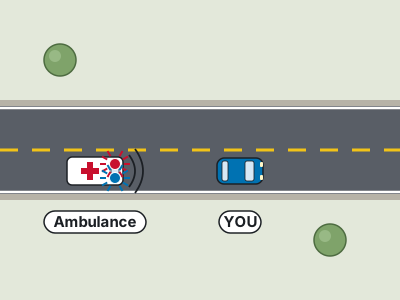
- Only after entering the intersection
- Only when the emergency vehicle is directly behind
- When the flashing light or siren signals the emergency vehicle, by pulling to the road edge
- Only when the driver can see a police officer
Show answer
When the flashing light or siren signals the emergency vehicle, by pulling to the road edge. The manual requires a driver to yield to an emergency vehicle displaying a flashing red or blue light or sounding a siren. The driver should move to the right side or curb, clear of an intersection, and stop. Waiting until the vehicle is directly behind or until an officer is visible delays the required response. As soon as the signal is noticed or heard, check the intersection, move safely aside, and remain stopped until the vehicle passes.
Study this in the handbook: Emergency vehicles and school buses
5. At an uncontrolled rural intersection in Kentucky, what should a driver do?
- Accelerate because cross traffic must yield
- Slow down and be prepared to stop for crossing or oncoming traffic
- Stop only if a traffic signal is present
- Maintain speed because the intersection has priority signs
Show answer
Slow down and be prepared to stop for crossing or oncoming traffic. At an uncontrolled rural intersection, the manual advises approaching with caution, slowing down, and being prepared to stop for crossing or oncoming traffic. The absence of a yield or stop sign does not make the crossing automatically safe, and it does not justify accelerating through. A signal or priority sign is not required before caution becomes necessary. Reduce speed early, scan both directions, and keep enough room to stop smoothly.
Study this in the handbook: Rural roads, farm equipment and slow vehicles
6. What should a Kentucky driver do at an intersection when a traffic signal turns green?
- Accelerate immediately because cross traffic must stop
- Check that the path is clear before moving
- Enter while looking only left
- Use the opposite lane until traffic clears
Show answer
Check that the path is clear before moving. A green signal permits movement only after the driver checks that the path is clear. The manual warns that someone may disobey a control device, so immediate acceleration and a one direction glance can expose the vehicle to crossing traffic or bicyclists. Using the opposite lane is not a safe substitute for waiting. Before moving, look left, right, and left again, then proceed only when there is enough space to cross or turn into the proper lane.
Study this in the handbook: Pedestrians and blind pedestrians
7. How should you interpret the pictured ONE WAY arrow?
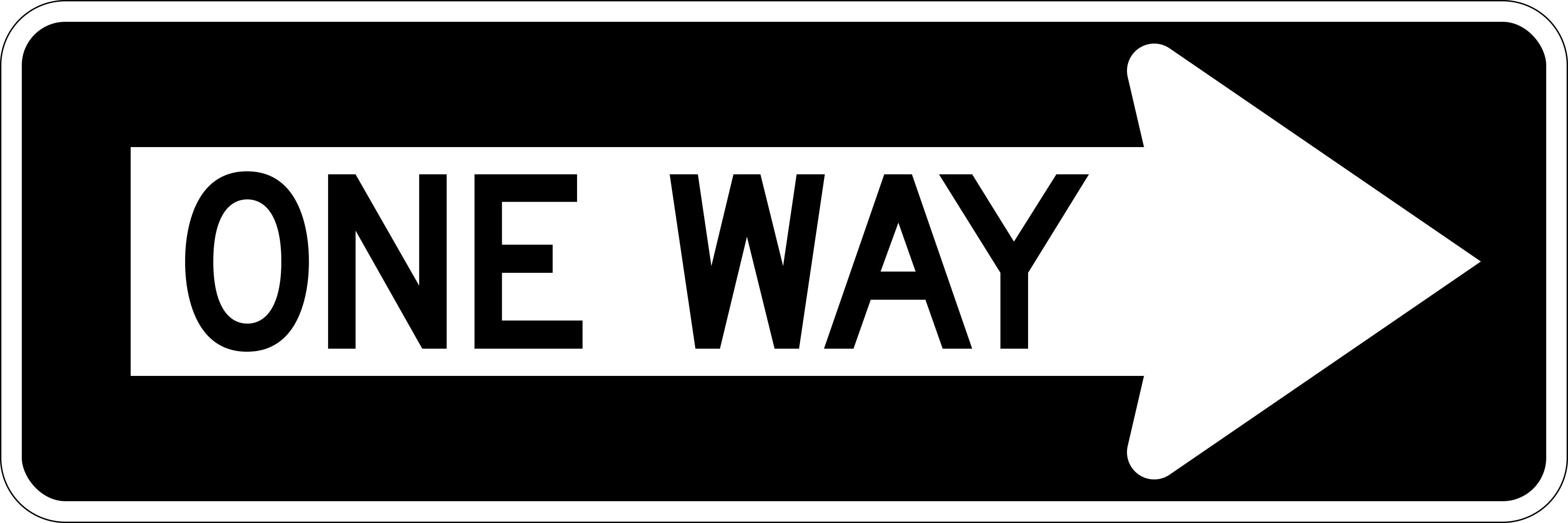
- The arrow marks a lane reserved for left turns
- Traffic may travel either way when no cars are nearby
- Traffic flows only in the direction of the arrow
- The arrow permits turning opposite its direction after stopping
Show answer
Traffic flows only in the direction of the arrow. A one-way sign establishes a single direction for traffic, shown by its arrow. The manual specifically says not to turn in the opposite direction of the arrow. An empty street does not convert it to two-way travel, and the arrow is not a left-turn-only lane marking. Stopping first also does not authorize an opposing turn. Use the direction cue before entering, and continue with traffic rather than treating the sign as advisory.
Study this in the handbook: Pavement markings, crosswalks and lane use
8. At the pictured STOP sign, where must you stop when a stop line or crosswalk is present?
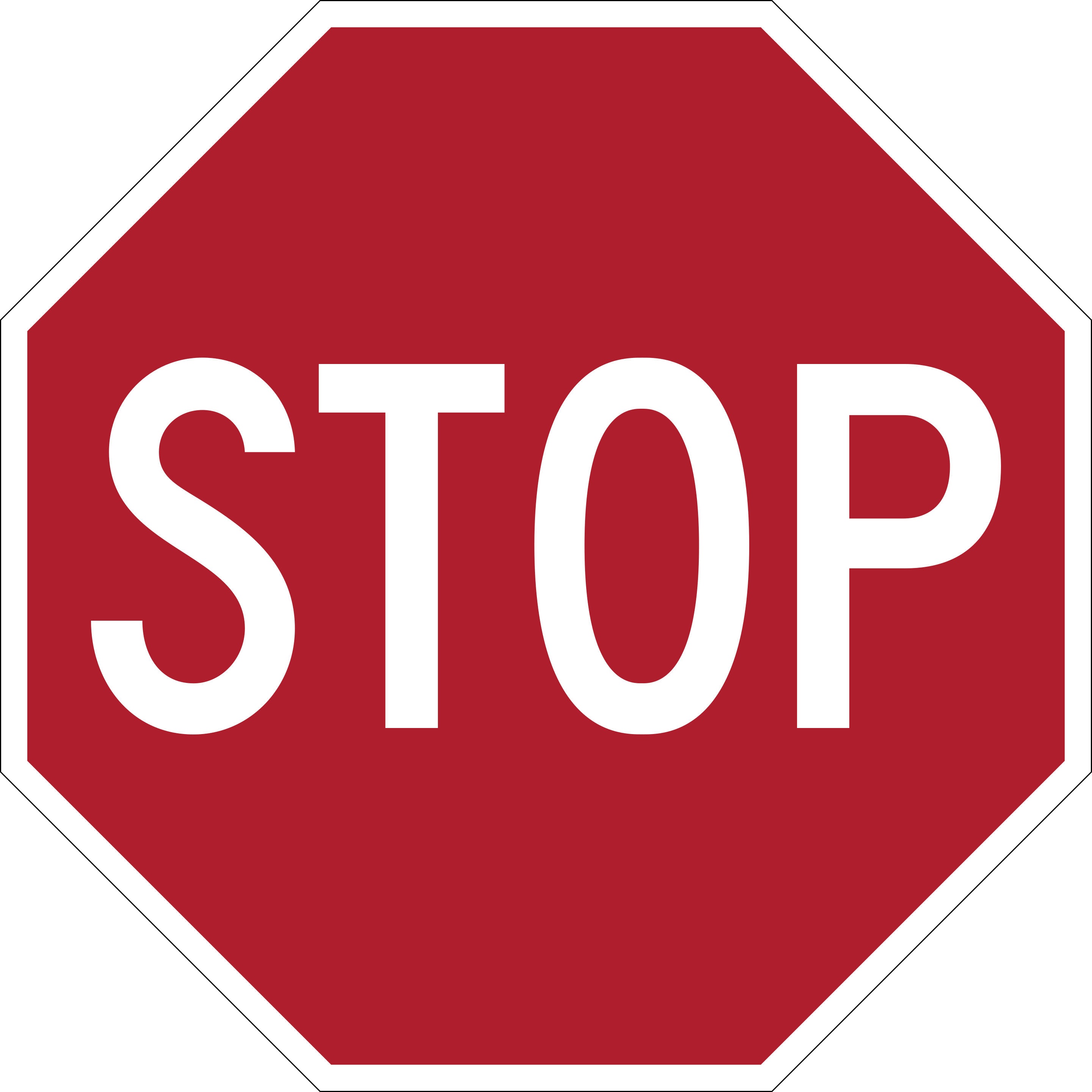
- Only at the edge of the roadway if another vehicle is visible
- After entering the intersection so the rear bumper clears traffic
- Behind the stop line or crosswalk, then yield to crossing traffic and pedestrians
- Before the sign, even when that blocks the crosswalk
Show answer
Behind the stop line or crosswalk, then yield to crossing traffic and pedestrians. The octagonal red sign requires a stop behind the stop line or crosswalk when one is present. After stopping, yield to crossing vehicles and pedestrians in every direction before proceeding. Stopping inside the intersection gives up the protected stopping position, and waiting for another vehicle is not a condition attached to the sign. Stopping before the sign can also place the vehicle where it blocks the crosswalk. Scan for the line first, then stop and check all directions.
Study this in the handbook: Regulatory signs
9. Within a two-year period, how many points may lead to suspension for a Kentucky driver age 18 or older?
- 20 points
- 7 points
- 5 points
- 12 points
Show answer
12 points. Kentucky’s point system says a driver age 18 or older may face suspension after accumulating 12 points within a two-year period. The seven-point threshold applies to a driver under age 18. Five points is not the stated trigger, and 20 points would set the bar too high. A useful review habit is to pair the number with both the time window and the driver’s age, because changing either condition changes the rule.
Study this in the handbook: The point system and losing your license
10. What minimum liability coverage does Kentucky require for all bodily injury in one accident?
- $25,000
- $60,000
- $100,000
- $50,000
Show answer
$50,000. Kentucky requires $25,000 for bodily injury to any one person, not less than $50,000 for all bodily injury in one accident, and $25,000 for property damage. Alternatively, a single limit policy of $60,000 is acceptable. So $25,000 is the per person and property figure, and $60,000 is the single limit option. One hundred thousand dollars is not the minimum. The policy must also provide basic reparations benefits unless the vehicle is a motorcycle.
Study this in the handbook: Renewal, registration and insurance
11. Kentucky points expire two years after conviction. How long does the conviction entry stay on the record?
- Two years
- Five years from the conviction date
- Ten years
- Permanently
Show answer
Five years from the conviction date. Points assessed under Kentucky's system expire two years from the date of conviction, but the conviction entry remains part of the driver's record for five years from the conviction date. So two years is when the points stop counting, not when the record clears. Ten years is the look-back window for counting DUI offenses. Traffic convictions are not kept permanently under this rule.
Study this in the handbook: The point system and losing your license
12. What rural-road hazard should drivers expect from farm machinery?
- Tractors and other equipment may cross or travel on state highways and may not hear approaching vehicles
- Farm equipment always has priority and may use either side without warning
- Tractors are required to move onto the shoulder whenever a car approaches
- Farm machinery can be passed safely by sounding the horn continuously
Show answer
Tractors and other equipment may cross or travel on state highways and may not hear approaching vehicles. Rural drivers should watch for tractors, combines, and other farm equipment crossing roads or traveling on state highways. The operator may not hear an approaching vehicle, so passing requires caution and a careful speed choice. Farm machinery does not receive an unlimited right to use either side, and the manual does not require it to move onto the shoulder when a car approaches. Continuous horn use is not a safety substitute. Reduce surprise by scanning ahead and passing only when the path is clearly safe.
Study this in the handbook: Rural roads, farm equipment and slow vehicles
13. What is a shared center lane marked for left turns reserved for?
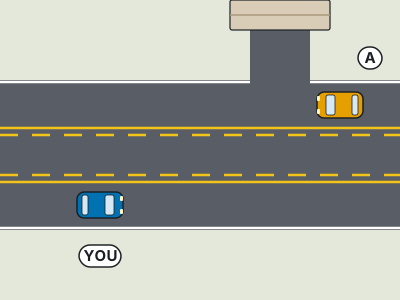
- Vehicles accelerating onto an interstate
- Passing traffic traveling straight through
- Parking while waiting for a signal
- Left-turning vehicles from either direction
Show answer
Left-turning vehicles from either direction. A shared center lane marked for left turns serves vehicles turning left from either direction. It is not a through lane and should not be used to pass. Parking there creates a hazard for traffic approaching from both sides, and an interstate acceleration lane is a separate roadway feature. Before entering, check opposing traffic, use the lane only for the intended turn, and leave it promptly once the turn is completed. The arrows and yellow lane boundaries provide the visual cue that this space is for turning, not cruising.
Study this in the handbook: Pavement markings, crosswalks and lane use
14. If the brakes stop working while you are driving, what should you try first?
- Use the parking brake slowly so the rear wheels do not lock
- Press the accelerator to restore hydraulic pressure
- Turn sharply toward the nearest travel lane
- Continue driving until the warning light turns off
Show answer
Use the parking brake slowly so the rear wheels do not lock. For brake failure, the manual directs a driver to use the parking brake slowly and be ready to release it if the vehicle begins to skid. A gradual application helps avoid locking the rear wheels. Accelerating cannot repair failed brakes, and a sharp turn creates another loss-of-control risk. Continuing to drive with ineffective brakes is especially dangerous. If the parking brake does not work, turn off the engine and find a safe place to stop off the roadway.
Study this in the handbook: Brake failure, blowouts and other vehicle failures
15. How may a refusal to take a breath, blood or urine test be used in a Kentucky DUI case?
- As evidence against you in court, in addition to a license suspension
- It cannot be mentioned in court
- Only to reduce the charge
- Only if the driver is under 21
Show answer
As evidence against you in court, in addition to a license suspension. If you refuse a requested breath, blood, or urine test, the refusal may be used against you in court as evidence of violating KRS 189A.010, the DUI statute. Refusal may also result in the court suspending your driver's license. For a second or greater offense within ten years, refusing a breath or urine test counts as an aggravating circumstance that brings a mandatory minimum jail sentence twice as long. Nothing in the rule limits it to drivers under 21, and refusal never reduces the charge.
Study this in the handbook: Alcohol, other drugs and the BAC limits
16. What does an octagonal red sign require?
- A reduced speed without stopping
- A complete stop behind the stop line or crosswalk when present
- A yield only to vehicles approaching from the left
- A turn into the nearest open lane
Show answer
A complete stop behind the stop line or crosswalk when present. The octagonal red sign is a stop sign. Stop behind the stop line or crosswalk when one is present, then yield to crossing vehicles and pedestrians in every direction. Merely reducing speed fails to satisfy the stop requirement. The sign is not limited to traffic from the left, and it does not instruct a driver to turn. The shape and color provide a fast recognition cue, but the roadway markings still matter: stop before the marked boundary, look across the full intersection, and proceed only after yielding.
Study this in the handbook: Pavement markings, crosswalks and lane use
17. Why is driving while fatigued dangerous?
- Fatigue makes stopping distances shorter
- Fatigue improves concentration during long trips
- Fatigue affects only passengers, not vehicle control
- Fatigue can affect vision and increase decision time
Show answer
Fatigue can affect vision and increase decision time. Fatigue is more than feeling sleepy. Kentucky describes it as physical or mental tiredness and warns that it can affect vision and increase the time needed to make decisions. That delay can leave less time to recognize a hazard, steer, or stop. It does not improve concentration, and its effects apply to the driver rather than only passengers. Tiredness also does not shorten stopping distance. A useful driving cue is any growing sleepiness: avoid continuing, pull off at a safe place, and rest before returning to the road.
Study this in the handbook: Fatigue, distraction and emotions
18. At a yield sign with no visible cross traffic, the driver should:
- Maintain speed because no vehicle is visible
- Stop for a fixed amount of time every time
- Slow down, check for traffic, and stop if necessary
- Accelerate into the intersection before checking
Show answer
Slow down, check for traffic, and stop if necessary. A yield sign requires the driver to slow down and allow traffic with the right of way to cross before entering. A complete stop may be needed, but the manual does not require a fixed stop when the path is already clear. Maintaining speed or accelerating would reduce the time available to see a hidden vehicle, cyclist, or pedestrian. The sign is a prompt to verify the conflict area, not permission to assume it is empty. Ease off, look carefully, stop when needed, and enter only after yielding.
Study this in the handbook: Pavement markings, crosswalks and lane use
19. After the Kentucky Transportation Cabinet prepares an application, which agency administers the required tests?
- A private driving school
- The county clerk's office
- The Kentucky Attorney General's office
- Kentucky State Police
Show answer
Kentucky State Police. The manual assigns test administration to Kentucky State Police after the Transportation Cabinet prepares the application. A county clerk may handle other vehicle or document matters, but the quoted licensing sequence does not place testing there. The Attorney General's office and private schools likewise are not named as the administering agency. Remember the handoff: the Cabinet prepares the application, then Kentucky State Police conducts the required testing before the licensing office issues the credential.
20. When no sign gives a different number, what speed limit applies on a Kentucky state highway that is not an interstate or a parkway?
- 55 mph
- 45 mph
- 60 mph
- 70 mph
Show answer
55 mph. Kentucky assigns a 55 mph default to state highways that are not interstates or parkways. The 45 mph and 60 mph choices substitute numbers that are not listed for this road category. The 70 mph choice describes a possible increase on specific highways, not the ordinary unposted rule. A useful cue is to identify the road type before choosing a number: interstate and parkway limits are handled separately, while all other state highways use the 55 mph baseline unless a sign changes it.
Study this in the handbook: Kentucky speed limits
QualitySpace is expanding to Kentucky
We are a California-based independent insurance brokerage working on licensing in more states. We cannot help with Kentucky insurance yet. Leave your email and we will let you know when we can.
Every question is written from the official Kentucky Driver Manual. Need paper? Printable KY practice test with answer key.
Last verified 2026-10-05. How we check every question · Study all 500 as flashcards
Frequently asked questions
How many questions are on this Kentucky practice test?
This fixed set has 20 questions. It is test 8 of 25 from the 500 question Kentucky bank.
How does this fixed test relate to the full Kentucky bank?
Each numbered test is a fixed set of questions in a fixed order, so you can retake the same test later and compare. Every test mixes road signs and the other topics in about the same proportion as the full bank. Tests 1 to 25 together cover every question in the Kentucky bank once. The full practice page mixes the whole bank at random.
Last verified 2026-10-05. See the Kentucky DMV facts page for sourced state details.
Return to the full Kentucky practice test · Study road signs