
Test 24 of 25 · 20 questions · Free 2026
IL Permit Practice Test 24
Jump to the test ↓A fixed 20 question set from the Illinois bank with answers and plain English explanations. The real IL exam is 35 questions, 80 percent to pass; take the full length version on the main practice page.
Question 1 of 20 · 0 right so far
All 20 questions in test 24
Every question below comes from the Illinois question bank on this page. Open a question to see the correct answer and the explanation. Nothing here is hidden behind a signup.
1. When parking facing uphill on a street with a curb, which way should the front wheels be turned?
- Toward the curb
- Away from the curb
- Straight ahead
- Either direction is equally safe
Show answer
Away from the curb. For uphill parking on a street with a curb, turn the front wheels away from the curb. The manual gives the opposite wheel direction, toward the curb, for downhill parking with a curb. Consider "Toward the curb": Toward the curb fits downhill parking, the opposite slope. Its rival "Straight ahead" fails for a separate reason: The manual requires the front wheels to be turned away from the curb, not kept straight.
Study this in the handbook: School buses, emergency vehicles and railroad crossings
2. Fog becomes too dense to drive in safely. What should a driver do?
- Keep crawling at 5-10 mph with hazard lights on
- Switch to high beams and maintain normal speed
- Pull off the roadway and stop rather than crawling at 5-10 mph
- Follow the taillights ahead as closely as possible
Show answer
Pull off the roadway and stop rather than crawling at 5-10 mph. If fog is too dense, pull off the roadway and stop; do not drive at 5-10 mph. In fog, use dim headlights or fog lights, increase following distance, stay within the limits of your vision, and brake early when approaching a stop. The option "Keep crawling at 5-10 mph with hazard lights on" should be set aside: The manual says to pull off the roadway and stop if fog is too dense, rather than drive at 5-10 mph.
Study this in the handbook: Speed limits, school zones and work zones
3. A driver leaves the scene of an Illinois crash that caused more than $1,000 in property damage but no injuries. What happens to the license?
- Nothing, if no one was hurt
- It will be revoked permanently
- It will be suspended
- Only a $50 fine applies
Show answer
It will be suspended. Leaving the scene of a crash in Illinois carries criminal charges, and the license action depends on the harm. When damage is more than $1,000, driving privileges will be suspended. When someone is killed or injured, the Secretary of State must revoke the license. Leaving the scene is illegal even when no one is hurt. Permanent revocation and a $50 fine do not match the manual. At an unattended vehicle, leave your contact details and notify police.
Study this in the handbook: Crashes, reports and insurance
4. What license plate light does Illinois require?
- A red light making the plate readable from 500 feet
- A white light making the plate readable from 50 feet, on whenever headlights are on
- Any colored light, needed only during vehicle inspections
- A light readable from 300 feet, used only on rural roads
Show answer
A white light making the plate readable from 50 feet, on whenever headlights are on. Vehicles must have a white light that makes the license plate readable from 50 feet away. This light must be on whenever the headlights are on. "A red light making the plate readable from 500 feet" is a distractor here: Plate lights are white; red describes taillight coloring. Another rival, "Any colored light, needed only during vehicle inspections", is wrong on its own terms: The light is required during normal night driving, not inspections only.
Study this in the handbook: Required vehicle equipment
5. Who may prohibit U turns on some Illinois roadways?
- Individual property owners
- Only the Secretary of State personally
- Municipalities
- No authority may prohibit them
Show answer
Municipalities. Municipalities may prohibit U-turns on some roadways. Drivers must not turn around on curves and hills unless they can see at least 500 feet in all directions. The option "Individual property owners" should be set aside: The manual identifies municipalities as able to prohibit U-turns on some roadways. "Only the Secretary of State personally" loses out as well: The manual expressly allows municipalities to prohibit U-turns on some roadways.
Study this in the handbook: Passing, turning, roundabouts and parking
6. How does a strong tailwind affect stopping, according to the Illinois manual?
- It can make a vehicle very difficult to stop
- It shortens stopping distance
- It has no effect on stopping
- It affects only motorcycles
Show answer
It can make a vehicle very difficult to stop. Among the factors for deciding your speed, the manual lists the direction of the wind and how fast it is blowing. It says a strong tailwind can make it very difficult to stop. Wind pushing from behind works against the brakes, so allow more room and a lower speed when you notice it. The factor is not limited to motorcycles or lighter vehicles.
Study this in the handbook: Speed limits, school zones and work zones
7. What window tinting does Illinois allow on the front windshield?
- Full tint across the whole windshield at any darkness
- A 12-inch strip along the entire top
- Tint only across the lower half near the dashboard
- No tint on the windshield itself, except a 6-inch strip along the entire top
Show answer
No tint on the windshield itself, except a 6-inch strip along the entire top. Tint is not allowed on the front windshield except for a 6-inch strip along the entire top. All window glass must be approved safety glass, and the windshield must be free of defects that distort vision. Against "Full tint across the whole windshield at any darkness", note this: Full windshield tint is prohibited, not permitted at any shade. Compare "A 12-inch strip along the entire top" next: The allowed top strip measures six inches, not twelve.
Study this in the handbook: Required vehicle equipment
8. When approaching a stationary emergency vehicle with flashing lights, what should an Illinois driver do if a lane change is possible?
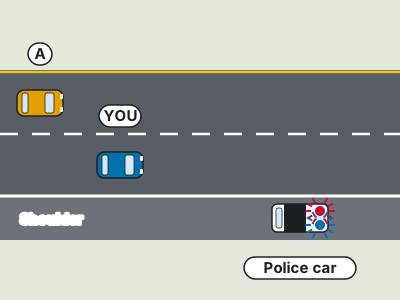
- Keep the same speed and remain in the lane nearest the emergency vehicle
- Stop in the traffic lane until the emergency vehicle turns off its lights
- Pass the emergency vehicle on the shoulder without reducing speed
- Change to a lane away from the emergency workers, yield, and proceed cautiously
Show answer
Change to a lane away from the emergency workers, yield, and proceed cautiously. Illinois requires a driver nearing a stationary emergency or maintenance vehicle with visual signals to yield, move to a lane away from workers when possible, and continue cautiously. The nearby vehicle may be stopped at an emergency scene, so reducing speed and staying alert remain important until it is safely passed. The choice that keeps the same speed ignores the required response to the flashing lights. Stopping in the traffic lane can create another hazard, while using the shoulder at full speed is not the prescribed maneuver. A useful cue is to move over, slow down, and give the scene room.
Study this in the handbook: Speed limits, school zones and work zones
9. An Illinois officer has reasonable suspicion that a driver is impaired by cannabis. What must the driver do?
- Refuse, because roadside tests are optional
- Submit to field sobriety testing and/or validated roadside chemical tests
- Submit only to a written questionnaire
- Drive to the nearest police station alone
Show answer
Submit to field sobriety testing and/or validated roadside chemical tests. If an officer stops a vehicle and has reasonable suspicion to believe the person is impaired by the use of cannabis, the driver must submit to field sobriety testing and/or validated roadside chemical tests. Refusal to submit to testing, or failure of the tests, results in suspension of the driver's license. Refusal to submit to testing, or failure of the tests, results in suspension of the license.
Study this in the handbook: DUI, implied consent and summary suspension
10. When does a Cooperative Driver Testing Certificate expire?
- Thirty days after it is issued
- It never expires
- One year after the driving exam
- On the same day as the student's instruction permit
Show answer
On the same day as the student's instruction permit. The Cooperative Driver Testing Certificate expires on the same day as the student’s instruction permit and will not be extended. It must be signed by the driver education instructor and the student’s parent or legal guardian and presented at the DMV when applying for a license. Against "Thirty days after it is issued", note this: Thirty days invents a short fuse nowhere attached to the certificate.
11. What does signing a traffic ticket at the roadside mean in Illinois?
- It pleads guilty to the offense on the spot
- It waives the right to argue the ticket in court
- It acknowledges receiving the ticket; it is not an admission of guilt
- It promises to pay the fine within 24 hours
Show answer
It acknowledges receiving the ticket; it is not an admission of guilt. Signing a traffic ticket acknowledges receiving it and is not an admission of guilt. The manual says not to refuse to sign or argue about the ticket when it is issued. If you believe the ticket was unfair, you can present your case in traffic court. The option "It pleads guilty to the offense on the spot" should be set aside: Signing acknowledges receipt of the ticket and is not an admission of guilt.
Study this in the handbook: Phones, distracted driving and traffic stops
12. After being stopped by law enforcement, how should you position yourself in the vehicle?
- Step out promptly and walk back to meet the officer
- Stay in the vehicle with both hands clearly in sight on the steering wheel until the officer instructs otherwise
- Reach into the glove box immediately for paperwork
- Rest one hand out the window and wave the officer forward
Show answer
Stay in the vehicle with both hands clearly in sight on the steering wheel until the officer instructs otherwise. Stay in the vehicle with both hands clearly visible on the steering wheel until the officer instructs otherwise or the stop is complete. Do not exit unless asked. If requested documents are in the glove box or under a seat, tell the officer and follow directions before retrieving them. "Step out promptly and walk back to meet the officer" is a distractor here: Getting out unasked can be perceived as aggressive and threatening.
Study this in the handbook: Phones, distracted driving and traffic stops
13. Who may ride along during an Illinois driving exam?
- A parent may ride in the back seat
- Only the examiner may be with the applicant
- A child may ride if secured in a safety seat
- A driving instructor may ride beside the applicant
Show answer
Only the examiner may be with the applicant. Only the examiner rides with an applicant during the driving exam, and children or pets cannot stay in the vehicle or wait unattended inside the facility. A parent in back, a secured child, or an instructor alongside each adds a person the exam room on wheels excludes, so anyone bringing children or pets must also bring someone to care for them. Plan childcare before test day rather than discovering the empty passenger rule at the counter.
Study this in the handbook: Vision screening, written exam and driving exam
14. May passengers ride inside a house trailer while it is being moved on an Illinois street or highway?
- No, riding in a house trailer while it is being moved is prohibited
- Yes, if the trailer has safety belts installed
- Yes, but only below 30 mph
- Yes, when the trailer doors are locked from inside
Show answer
No, riding in a house trailer while it is being moved is prohibited. Illinois prohibits riding in a house trailer while it is being moved on a street or highway. The manual states no exception for safety belts, speeds below 30 mph, or locked doors. Consider "Yes, if the trailer has safety belts installed": Safety belts do not create an exception to the prohibition on riding in a moving house trailer. Its rival "Yes, but only below 30 mph" fails for a separate reason: Low speed towing still counts as moving on a highway.
Study this in the handbook: Passing, turning, roundabouts and parking
15. A first time Illinois DUI offender skips the Monitoring Device Driving Permit and is caught driving during the suspension. What is the offense?
- A petty offense
- A felony
- A warning
- A parking violation
Show answer
A felony. A first time DUI offender may apply for a Monitoring Device Driving Permit, which requires a breath alcohol ignition interlock on the vehicle, or may choose not to drive during the suspension. An offender who skips the program and then drives during the suspension is guilty of a felony. It is not a petty offense, a warning, or a parking matter. The offender pays the permit and device costs unless declared indigent, and the device reports drinking or tampering.
Study this in the handbook: DUI, implied consent and summary suspension
16. A parent cannot accompany a minor to the Illinois facility. Who may sign the Affidavit/Consent for Minor to Drive?
- Any friend of the minor who is over age 18
- A legal guardian or a responsible adult over age 21
- The minor's school principal
- Any adult who holds a valid license
Show answer
A legal guardian or a responsible adult over age 21. When a parent or guardian cannot accompany a minor to the facility, an Affidavit/Consent for Minor to Drive must be signed by a legal guardian or a responsible adult over age 21. The age threshold is 21, not 18, and the signer must be a legal guardian or responsible adult. A school principal or any licensed adult without that role does not qualify.
17. Which markings are used to mark fixed obstructions?
- Yellow or white diagonal stripes
- A white stop line across a lane
- A red painted curb
- White arrows in a two-way left-turn lane
Show answer
Yellow or white diagonal stripes. Yellow or white diagonal stripes mark fixed obstructions. Solid white or yellow lines may channel traffic around a hazard. White diagonal lines may also appear inside crosswalks for visibility. White stop lines show where to stop for a stop sign or red light, and two-way left-turn lanes use yellow lines and white arrows. Against "A white stop line across a lane", note this: A white stop line shows where to stop at a stop sign or red light.
Study this in the handbook: Right of way and pedestrians
18. How long does an Illinois denial for a serious moving violation by a person under 18 last?
- Either nine months or until the 18th birthday, whichever is shorter
- Exactly two years from the offense date
- Until the 21st birthday in every case
- Thirty days from the court date
Show answer
Either nine months or until the 18th birthday, whichever is shorter. For a person under age 18 convicted of a serious moving violation, this denial lasts nine months or until the 18th birthday, whichever is shorter. It bars a driver’s license application but allows an instruction permit application. Existing license privileges are reduced to an instruction permit. Consider "Exactly two years from the offense date": Two years overshoots the stated shorter period cap.
19. While waiting to make a left turn, how should the front wheels be pointed?
- Turned sharply left
- Turned sharply right
- Straight ahead until starting the turn
- Alternating left and right
Show answer
Straight ahead until starting the turn. Waiting left turners keep the wheels pointed straight ahead until the turn actually begins. The instruction is timed to the start of the turn, so wheels turned left or right during the wait depart from it before any turning movement begins. Alternating the wheels likewise fails the straight ahead direction during the wait itself. Keep the wheels straight while waiting, then turn them only when starting the turn.
20. What minimum advance warning distances does the manual give for a school bus stop in town and in rural areas?
- At least 100 feet, and 200 feet in rural areas
- 50 feet in town, 100 feet in rural areas
- 300 feet everywhere
- Only after the bus stops
Show answer
At least 100 feet, and 200 feet in rural areas. A school bus gives warning at least 100 feet before a stop, or 200 feet in rural areas, using flashing lights on the front and rear. The stop signal arm extends after the bus has come to a complete stop. Against "50 feet in town, 100 feet in rural areas", note this: Both figures halve the actual warning distances. Compare "300 feet everywhere" next: 300 feet is not the stated minimum: the manual gives 100 feet, or 200 feet in rural areas.
Study this in the handbook: School buses, emergency vehicles and railroad crossings
QualitySpace is expanding to Illinois
We are a California-based independent insurance brokerage working on licensing in more states. We cannot help with Illinois insurance yet. Leave your email and we will let you know when we can.
Every question is written from the official Illinois Rules of the Road. Need paper? Printable IL practice test with answer key.
Last verified 2026-10-05. How we check every question · Study all 500 as flashcards
Frequently asked questions
How many questions are on this Illinois practice test?
This fixed set has 20 questions. It is test 24 of 25 from the 500 question Illinois bank. The real IL exam asks 35 questions and you need 28 correct.
What is the passing score for the real Illinois test?
80% must be answered correctly to be eligible for a Class D license (92 Ill. Adm. Code 1030.80) That figure comes from the official Illinois source cited on the DMV facts page.
How does this fixed test relate to the full Illinois bank?
Each numbered test is a fixed set of questions in a fixed order, so you can retake the same test later and compare. Every test mixes road signs and the other topics in about the same proportion as the full bank. Tests 1 to 25 together cover every question in the Illinois bank once. The full practice page mixes the whole bank at random.
Last verified 2026-10-05. See the Illinois DMV facts page for sourced state details.
Return to the full Illinois practice test · Study road signs