
Test 4 of 25 · 20 questions · Free 2026
IL Permit Practice Test 4
Jump to the test ↓A fixed 20 question set from the Illinois bank with answers and plain English explanations. The real IL exam is 35 questions, 80 percent to pass; take the full length version on the main practice page.
Question 1 of 20 · 0 right so far
All 20 questions in test 4
Every question below comes from the Illinois question bank on this page. Open a question to see the correct answer and the explanation. Nothing here is hidden behind a signup.
1. What is the minimum revocation for a second DUI conviction within 20 years in Illinois?
- One year minimum
- Three years
- Five years
- Lifetime
Show answer
Five years. Illinois revokes driving privileges for at least one year on a first DUI conviction and at least five years on a second conviction within 20 years. A third conviction brings at least 10 years, and a fourth or later brings lifetime revocation. One year is the first conviction minimum. Three years is the refusal suspension for a second offender, not a conviction revocation. Lifetime is reserved for a fourth conviction.
Study this in the handbook: DUI, implied consent and summary suspension
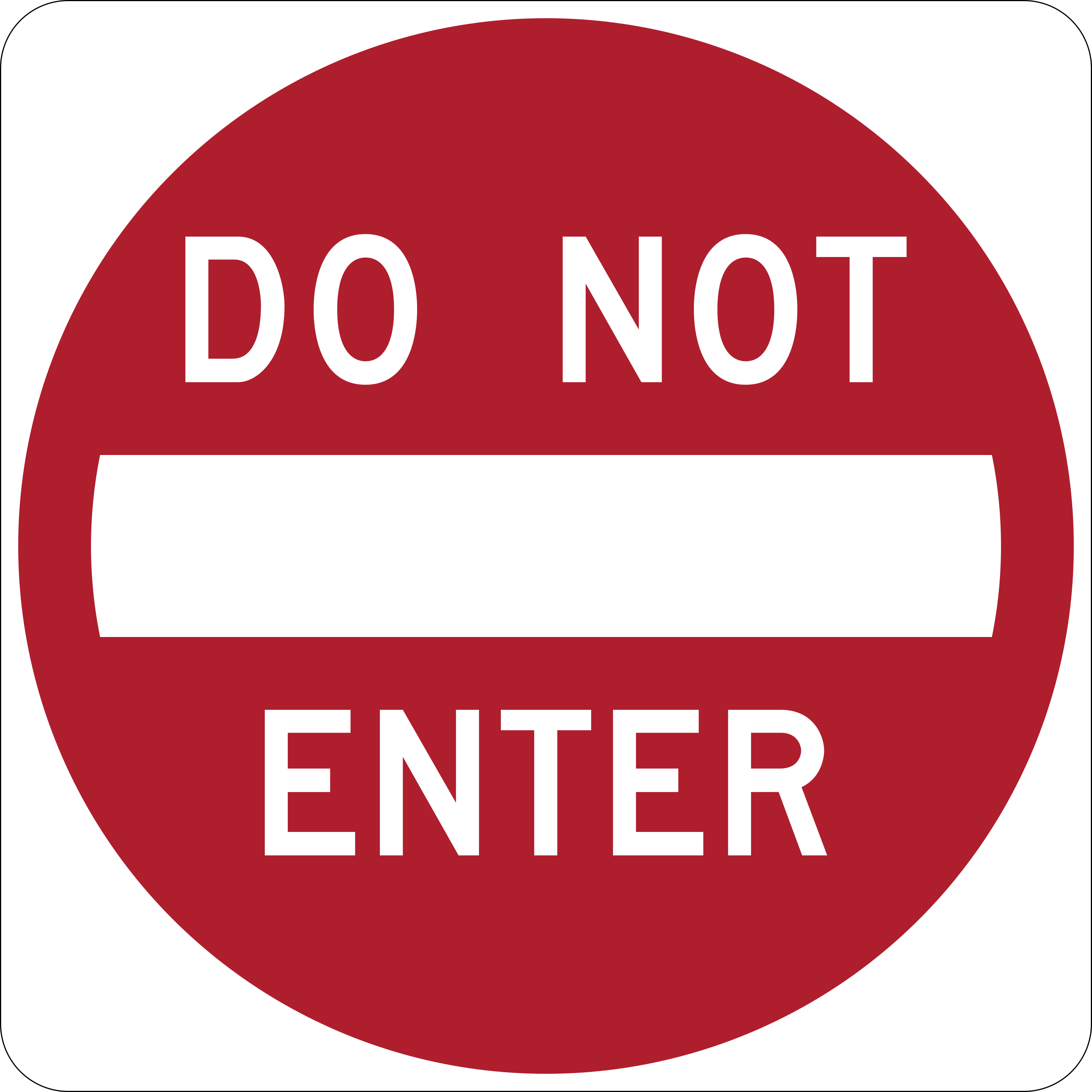
2. Where might an Illinois driver encounter a DO NOT ENTER sign?
- At every legal entrance to a two-way residential street
- Only where parking is reserved for emergency vehicles
- At a one-way street or an expressway ramp entered in the wrong direction
- At a railroad crossing where trains have stopped
Show answer
At a one-way street or an expressway ramp entered in the wrong direction. Illinois uses DO NOT ENTER signs on one-way streets and other roadways where entry is prohibited. The manual specifically notes that a driver may see one when attempting to enter an expressway ramp in the wrong direction. The residential-street choice invents a universal restriction that the sign does not communicate. Reserved parking and railroad operations are unrelated meanings. Treat the sign as a firm barrier to entry, then reassess the route and look for the lawful direction of travel. This sign is especially important at ramp mouths where a wrong turn could place you against traffic.
3. What do two solid yellow lines in the center of a roadway separate?
- Lanes moving in the same direction
- A parking lane from a curb
- A bicycle lane from a shoulder
- Traffic moving in opposite directions
Show answer
Traffic moving in opposite directions. Two solid yellow lines mark the center of a roadway where traffic travels in opposite directions. The lines are not the white markings used to separate same-direction lanes, and they do not identify a bicycle or parking lane. Illinois permits crossing double yellow lines for certain left turns to or from an alley, private road, driveway, or street, but that limited use does not make them passing lines. Read the color and location together before changing position on the roadway.
Study this in the handbook: Pavement markings
4. What does a constantly lit yellow arrow mean?
- A protected turn may continue without checking traffic
- The green arrow is ending or the light is about to turn red
- The driver must reverse before the signal changes
- The intersection is closed to all traffic
Show answer
The green arrow is ending or the light is about to turn red. A constantly lit yellow arrow warns that the protected green-arrow phase is ending or that the signal is about to turn red. A driver should not treat it as a fresh permission to begin an unrestricted turn. The other choices either invent a protected movement, close the intersection without a basis, or require reversing, none of which is the signal's meaning. The useful response is to check whether the movement can be completed safely and to obey the upcoming red indication rather than entering late.
Study this in the handbook: Traffic signals and arrows
5. At what speed does an Illinois Class 3 electric bicycle stop providing assistance?
- 20 mph
- 28 mph, and only while the rider is pedaling
- 15 mph
- 35 mph
Show answer
28 mph, and only while the rider is pedaling. Illinois defines three classes of low speed electric bicycles: Class 1 assists only while the rider pedals and stops at 20 mph, Class 2 assists without pedaling up to 20 mph, and Class 3 engages only while pedaling and provides assistance up to 28 mph. All must have a motor under 1 horsepower, and the rider must be at least 16. Bicycles stay off expressways.
6. What is the general function of Illinois regulatory signs?
- They identify scenic locations without directing traffic
- They warn only about weather changes
- They instruct drivers what to do and must be obeyed
- They mark every railroad track in advance
Show answer
They instruct drivers what to do and must be obeyed. Regulatory signs communicate required driver behavior. Illinois emphasizes that they instruct drivers on what to do and must be obeyed, which includes signs such as STOP, YIELD, DO NOT ENTER, and restrictions on turns or passing. Guide signs provide destinations and services, while warning signs alert drivers to conditions ahead. A railroad advance sign is one particular warning device, not the definition of all regulatory signs. When a regulatory sign is posted, treat its instruction as a traffic rule rather than a suggestion.
7. When does Illinois law require a driver to use headlights because of weather?
- When operating the windshield wipers
- Only during heavy snow
- Only when visibility is reduced by fog
- Whenever the temperature is below 50 degrees
Show answer
When operating the windshield wipers. Illinois requires headlights when the driver is operating the windshield wipers. The rule is not limited to heavy snow or fog, and it does not depend on a particular temperature. The wipers themselves are the trigger, so the requirement applies in daylight as well as at night. Separately, the manual says lights should be used from sunset to sunrise. When the wipers are on for weather, turn on the headlights as well, and remember that the manual also calls for turning off cruise control and increasing following distance in rain.
Study this in the handbook: Following distance, night driving and weather
8. The owner of a car was not driving when it illegally passed a stopped Illinois school bus. What must the owner do to avoid a registration suspension?
- Pay a $300 fine personally
- Nothing, since the owner was not driving
- Take a school bus safety class
- Give the State's Attorney's Office the name of the driver
Show answer
Give the State's Attorney's Office the name of the driver. When a car passes a stopped school bus and the owner was not driving, the owner must give the State's Attorney's Office the driver's name, or the vehicle registration is suspended for three months. The $300 mandatory fine and community service fall on the convicted driver, along with a license suspension. Doing nothing leads to the registration suspension. A safety class is not the listed remedy.
Study this in the handbook: School buses, emergency vehicles and railroad crossings
9. What should an Illinois driver do when light rain begins to make the roadway slippery?
- Keep cruise control on and follow more closely
- Turn off cruise control and increase following distance
- Brake hard repeatedly to dry the tires
- Accelerate to pass through the wet area quickly
Show answer
Turn off cruise control and increase following distance. Light rain can make the road slippery because water mixes with dust, oil, and leaves. Illinois advises turning off cruise control and increasing following distance as soon as those conditions begin. Following closely removes reaction time, while repeated hard braking and sudden acceleration can reduce control. The manual also recommends extra care on curves and turns and slower speeds to avoid hydroplaning. Use the first wet sheen as the cue to make these adjustments. Do not wait until the roadway looks heavily flooded or the vehicle begins to slide before responding.
Study this in the handbook: School buses, emergency vehicles and railroad crossings
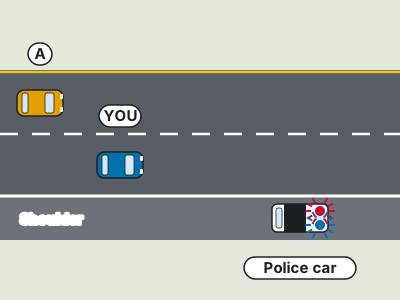
10. If a lane change away from a stationary Illinois emergency vehicle is not possible, what must the driver do?
- Stop in the travel lane and wait indefinitely
- Speed up to pass before the next vehicle arrives
- Use the shoulder to bypass the scene
- Reduce speed and proceed with caution
Show answer
Reduce speed and proceed with caution. If moving to a lane away from a stationary emergency vehicle is not possible, Illinois requires the driver to reduce speed and proceed with caution. The driver should maintain that reduced speed until safely past stationary emergency vehicles. Stopping in the travel lane can create another hazard, while speeding or using the shoulder adds risk and is not the stated alternative. The useful sequence is yield, change lanes when possible, or slow down when a safe lane change cannot be made.
Study this in the handbook: Speed limits, school zones and work zones
11. What does the round yellow railroad crossing sign warn an Illinois driver about?

- A roundabout where traffic moves clockwise
- A railroad track crossing the roadway ahead
- A no-passing zone caused by a hill
- A reduced speed school zone
Show answer
A railroad track crossing the roadway ahead. The round yellow railroad crossing sign is an advance warning that a railroad track will cross the roadway ahead. Illinois advises the driver to slow down, look, and stop if necessary. It is not a roundabout sign, a no-passing marker, or a school-zone sign, even though each of those situations can require extra attention. Begin scanning before reaching the tracks, listen for a train, and be ready to stop. The warning is placed in advance so the driver has time to make a safe decision rather than braking abruptly at the rails.
Study this in the handbook: Sign shapes and colors
12. What hazard is shown by the yellow crossroad warning sign?

- An intersection ahead where traffic may cross
- A hospital entrance ahead
- A divided highway begins
- A school bus stop with a reduced speed zone
Show answer
An intersection ahead where traffic may cross. The crossroad symbol belongs to the group of intersection warning signs. The manual says these signs warn you of intersections ahead where traffic may exist or a right or left turn may be required, so approach slowly and observe carefully. Services along the roadway are shown on blue guide signs, while a divided highway warning has a different median symbol. School areas use yellow or yellow green school signs. At a crossroad, check both directions and be ready for vehicles entering from either side.
13. When you parallel park on an Illinois street with two-way traffic, how close to the curb must the right-hand wheels be?
- Within 12 inches
- Within 18 inches
- Within 24 inches
- Within 6 inches
Show answer
Within 12 inches. Illinois tells drivers parking on a street with traffic in both directions to park with the right side wheels parallel to the curb and no more than 12 inches from it. On a one way street the car may be parked within 12 inches of either the right or the left curb. In every case the vehicle must face the direction traffic is moving. Parking close to the curb keeps the travel lane clear for passing traffic.
Study this in the handbook: Passing, turning, roundabouts and parking
14. What is the default Illinois speed limit in an alley when no other limit is posted?
- 10 mph
- 15 mph
- 20 mph
- 30 mph
Show answer
15 mph. Alleys carry the lowest default speed limit in the Illinois list: 15 mph unless a different limit is posted. Alleys are narrow and people can step out from between buildings with little warning, so the low figure leaves more time to stop. City and town streets default to 30, and school zones drop to 20 mph during the posted school day hours when children are present.
Study this in the handbook: Seat belts, air bags and child seats
15. What happens if an Illinois driver refuses chemical testing after a crash with serious injury or death?
- Driving privileges are revoked for a minimum of one year
- Nothing until conviction
- A 30 day suspension
- A $100 fine
Show answer
Driving privileges are revoked for a minimum of one year. If you refuse to submit to chemical testing after being involved in a crash where serious personal injury or death was involved, your Illinois driving privileges will be revoked for a minimum of one year. A revocation is the indefinite withdrawal of driving privileges, and you may be eligible to reapply for a license only after the minimum period. When operating on Illinois roadways you automatically consent to these tests, so refusing does not delay the consequence until a conviction. A 30 day suspension or a small fine understates the penalty.
Study this in the handbook: DUI, implied consent and summary suspension
16. When does an Illinois scooter count as a motorcycle requiring a Class M license?
- At any engine size
- Only when it exceeds 500cc
- When the engine displacement is 150cc or greater
- Never, scooters are bicycles
Show answer
When the engine displacement is 150cc or greater. If a scooter has an engine with 150cc displacement or greater, it is a motorcycle and a Class M license is required. Smaller motor driven cycles have their own class, and low speed electric bicycles under 1 horsepower need no license but a rider at least 16. If driven at night a scooter needs a headlight visible from 500 feet and a taillight visible from 100 to 600 feet.
17. What should a driver do when rain, ice, or snow makes normal speed unsafe?
- Keep the posted speed and shorten the gap ahead
- Reduce speed and increase following distance
- Use cruise control to maintain a steady pace
- Drive on the shoulder to avoid spray
Show answer
Reduce speed and increase following distance. Illinois winter-driving guidance calls for slower travel and a larger space cushion because roadway conditions can vary with ice, snow, shade, and surface temperature. Keeping the posted speed or shortening the following gap removes time needed to react. Cruise control is specifically unsuitable when pavement is wet, icy, or snowy, and the shoulder is not a normal travel lane. Slow before hazards, leave more room, and make gentle control inputs so the tires can retain traction.
Study this in the handbook: School buses, emergency vehicles and railroad crossings
18. What should a driver do upon coming to a roadway or viaduct that has been flooded by heavy rain?
- Enter slowly after checking only the near edge
- Stop in the deepest section and wait for the water to recede
- Follow the vehicle ahead because its tires show the water depth
- Avoid driving through it, turn around, and find another route
Show answer
Avoid driving through it, turn around, and find another route. Illinois says that if you come across a roadway or viaduct flooded by heavy rain, do not drive through the flooded area, because it is impossible to determine the depth or current of the water. Turn your vehicle around and find another route instead. Checking only the near edge or watching the vehicle ahead cannot reveal the depth or current, and stopping in the deepest section keeps you in the water rather than finding another route.
Study this in the handbook: School buses, emergency vehicles and railroad crossings
19. Which vehicles may not be sold or operated in Illinois without safety belts?
- Only commercial vehicles
- Only vehicles built after 1990
- All vehicles regardless of year
- Vehicles manufactured in 1965 or after
Show answer
Vehicles manufactured in 1965 or after. Vehicles manufactured in 1965 or after may not be sold or operated in Illinois without safety belts. Other equipment rules require bumpers on vehicles of 9,000 pounds or less and all recreational vehicles, turn signals visible from 300 feet, no more than four 300 candlepower lights burning, and no suspension lift over 3 inches from the chassis frame. A vehicle used for the driving exam must have the required equipment.
Study this in the handbook: Required vehicle equipment
20. Who has the right of way at an Illinois crosswalk?
- Pedestrians crossing in the crosswalk
- Vehicles approaching from the nearest lane
- The vehicle traveling at the posted speed limit
- The driver who reaches the crosswalk first
Show answer
Pedestrians crossing in the crosswalk. Illinois gives pedestrians the right of way in a crosswalk. A driver must slow down and be prepared to stop rather than relying on speed, arrival order, or proximity to decide who proceeds. The nearest lane does not automatically give a vehicle priority, and reaching the crossing first does not cancel a pedestrian’s protection. Scan both sides before entering the crosswalk area, especially where a stopped vehicle can hide someone from view. Treat the marked crossing as a place where people may legally be walking, then continue only after the path is clear.
Study this in the handbook: Right of way and pedestrians
QualitySpace is expanding to Illinois
We are a California-based independent insurance brokerage working on licensing in more states. We cannot help with Illinois insurance yet. Leave your email and we will let you know when we can.
Every question is written from the official Illinois Rules of the Road. Need paper? Printable IL practice test with answer key.
Last verified 2026-10-05. How we check every question · Study all 500 as flashcards
Frequently asked questions
How many questions are on this Illinois practice test?
This fixed set has 20 questions. It is test 4 of 25 from the 500 question Illinois bank. The real IL exam asks 35 questions and you need 28 correct.
What is the passing score for the real Illinois test?
80% must be answered correctly to be eligible for a Class D license (92 Ill. Adm. Code 1030.80) That figure comes from the official Illinois source cited on the DMV facts page.
How does this fixed test relate to the full Illinois bank?
Each numbered test is a fixed set of questions in a fixed order, so you can retake the same test later and compare. Every test mixes road signs and the other topics in about the same proportion as the full bank. Tests 1 to 25 together cover every question in the Illinois bank once. The full practice page mixes the whole bank at random.
Last verified 2026-10-05. See the Illinois DMV facts page for sourced state details.
Return to the full Illinois practice test · Study road signs