
Test 8 of 25 · 20 questions · Free 2026
IL Permit Practice Test 8
Jump to the test ↓A fixed 20 question set from the Illinois bank with answers and plain English explanations. The real IL exam is 35 questions, 80 percent to pass; take the full length version on the main practice page.
Question 1 of 20 · 0 right so far
All 20 questions in test 8
Every question below comes from the Illinois question bank on this page. Open a question to see the correct answer and the explanation. Nothing here is hidden behind a signup.
1. How long should an Illinois driver keep speed reduced after passing a disabled vehicle when a lane change was not safe?
- Only until the front bumper reaches it
- Until the next traffic signal
- Until well past the disabled vehicle
- For exactly 500 feet
Show answer
Until well past the disabled vehicle. When a safe lane change is unavailable near a disabled vehicle, Illinois tells the driver to reduce speed while approaching and passing. Speed should not be increased until well past the disabled vehicle. The front bumper is too early, and the manual gives no fixed 500-foot or traffic-signal distance for this situation. Think in terms of clearing the hazard completely rather than reaching a particular landmark. Once the vehicle is well behind the driver, normal speed can be considered in light of other conditions.
2. How many traffic violation convictions within 12 months can lead to suspension for an Illinois driver age 21 or older?
- Three
- Two
- Four
- Six
Show answer
Three. Illinois may suspend a driver's license after three traffic violation convictions during a 12 month period. For drivers under 21 at the time of arrest, the threshold drops to two violations within any 24 month period. Two in 12 months is not the adult standard. Four and six are more than the listed number. A driver 21 or older suspended for three violations may qualify for a probationary license by completing a driver improvement course.
3. When does an Illinois statutory summary suspension begin?
- On the 46th day from the notice date provided by the police officer
- On the 15th day after the court hearing
- After the driver receives a renewal notice
- Immediately when the traffic stop begins
Show answer
On the 46th day from the notice date provided by the police officer. Illinois does not start the statutory summary suspension on the day of the stop. The manual places the start on the 46th day from the notice date supplied by the police officer. That timing gives the driver a defined period after notice, while the immediate-stop choice confuses arrest timing with suspension timing. A court hearing is not the trigger identified here, and a license renewal notice has no role in starting the suspension. Keep the notice date and the 46th-day rule together when reviewing the sequence of events.
Study this in the handbook: DUI, implied consent and summary suspension
4. What minimum space must an Illinois driver leave when passing a bicyclist, even one in a bike lane?
- 1 foot
- 2 feet
- 3 feet
- 6 feet
Show answer
3 feet. Illinois requires at least 3 feet of distance when passing a bicyclist on any road, including one riding on the shoulder or in a dedicated bike lane. The same 3 foot minimum applies when passing a pedestrian walking on the road or shoulder. One and 2 feet are too close, and 6 feet is more than the legal minimum. If you cannot give 3 feet, wait until you can pass safely.
Study this in the handbook: Passing, turning, roundabouts and parking
5. What does a solid double white line separating same-direction lanes mean?
- Crossing it is prohibited
- Crossing is required before every turn
- Passing is permitted whenever traffic is light
- It separates opposing directions of travel
Show answer
Crossing it is prohibited. Solid double white lines separate lanes moving in the same direction, and Illinois prohibits crossing them. They are not a signal to change lanes before every turn, and light traffic does not create an exception. Yellow center lines, rather than double white lines, separate opposing traffic. Before moving laterally, confirm that the lane marking is broken or otherwise permits the maneuver.
Study this in the handbook: Pavement markings
6. Lanes are reduced for construction and traffic is dense and slow moving. How does Illinois advise you to merge?
- Merge into the open lane as soon as you see the first sign
- Stop in the closing lane until a long gap opens
- Drive on the shoulder past the closed lane
- Use both lanes up to the reduction point, then merge there, taking turns
Show answer
Use both lanes up to the reduction point, then merge there, taking turns. Illinois gives two answers depending on traffic. When the road is not heavily congested, drivers should merge early into the open lane. In dense, slow moving traffic, the manual advises using both lanes to advance to the lane reduction point and merging there with vehicles alternating turns. Using both lanes shortens the backup, and taking turns at one point keeps the merge orderly instead of forcing sudden lane changes far upstream.
Study this in the handbook: Following distance, night driving and weather
7. A driver's license is suspended before age 21 in Illinois. What must the driver complete to get it back?
- Nothing beyond waiting out the suspension
- A driver remedial education course, and possibly a full license exam
- Only a vision test
- A commercial driver course
Show answer
A driver remedial education course, and possibly a full license exam. Illinois requires a driver whose license was suspended before age 21 to complete a driver remedial education course, and the driver may also have to take a complete driver's license examination to be reissued a license. Simply waiting out the suspension is not enough. A vision test alone and a commercial driver course are not what the manual requires. The same chapter sets a two year minimum revocation for a first DUI conviction under 21.
Study this in the handbook: Drivers under 21 and alcohol
8. What does an Illinois five-sided sign with two children walking identify?

- A school zone or school crossing
- A pedestrian-free recreation area
- A truck inspection station
- A railroad crossing at a school
Show answer
A school zone or school crossing. The five sided yellow or yellow green sign with two children walking identifies either a SCHOOL ZONE or SCHOOL CROSSING. If the sign shows two children walking, a school is nearby; with a downward pointing arrow, you are at a school crossing. The sign does not announce a pedestrian free area, a truck inspection station, or a railroad crossing. Diamond shaped signs are the general warning signs, while this five sided shape carries the school message. Stay alert, watch for children, slow down, and stop when necessary.
Study this in the handbook: Sign shapes and colors
9. What should an Illinois driver do when approaching a road curve warning sign?

- Wait until the middle of the curve before braking hard
- Reduce speed before entering the curve and follow any advisory speed
- Accelerate so the vehicle exits before opposing traffic arrives
- Treat the arrow as a mandatory turn at the next intersection
Show answer
Reduce speed before entering the curve and follow any advisory speed. Illinois places curve and turn signs before the change in direction, and a small plaque may show the maximum safe speed for the curve or turn. The driver should reduce speed before entering so the vehicle remains stable through the bend. Braking hard in the middle can upset control, while acceleration reduces the time available to respond. The arrow warns about roadway shape, not a mandatory intersection movement. Read the advisory plaque, check the lane, and enter at a speed that leaves room for the curve, weather, and visibility.
Study this in the handbook: Following distance, night driving and weather
10. What do solid white lane lines separate?
- Lanes moving in the same direction, with crossing discouraged
- Lanes carrying opposing traffic where passing is required
- A travel lane from a railroad crossing only
- A lane that must be crossed before every turn
Show answer
Lanes moving in the same direction, with crossing discouraged. Solid white lines separate lanes moving in the same direction, and Illinois says crossing one requires special care and is discouraged. They are not yellow center lines dividing opposing traffic, so the passing choice misreads the marking. The line does not require a lane change before every turn either. Treat it as a boundary that may be crossed only when the movement is necessary, legal, and carefully checked.
Study this in the handbook: Pavement markings
11. How long is an Illinois temporary registration permit valid?
- 90 days from issuance, reissuable if the plates have not arrived
- One year
- 10 days
- 30 days
Show answer
90 days from issuance, reissuable if the plates have not arrived. The temporary registration permit is valid for 90 days from the issuance date, and it may be reissued if the license plates do not arrive within 90 days. Registration can be renewed online, by mail, at a facility or by phone using the renewal notice. Personalized and vanity plates carry additional fees beyond the standard $151 passenger plate fee, and the permit must be displayed as directed.
12. If a driver enters an intersection while the light is green to make a left turn, what may the driver do if the light turns red?
- Reverse out of the intersection immediately
- Stop in the intersection until the light turns green again
- Yield to traffic behind the vehicle before turning
- Finish the turn after checking that the path is clear
Show answer
Finish the turn after checking that the path is clear. A driver who entered the intersection on a green light may complete the left turn even if the signal changes to red. The key is that the vehicle is already in the intersection, not that a red light generally permits entering it. Reversing can create a collision, and waiting for another green signal leaves the vehicle exposed in the intersection. Traffic behind the turning vehicle does not control the maneuver. Enter only when the path is clear, keep the turn controlled, and finish safely when the signal changes.
Study this in the handbook: Speed limits, school zones and work zones
13. If trying to free a stuck gas pedal with a toe does not work, what should the driver do next?
- Pump the accelerator harder to release it
- Turn off the engine immediately while moving fast
- Shift into neutral and brake gently to slow down
- Keep the vehicle in gear and steer toward traffic
Show answer
Shift into neutral and brake gently to slow down. Illinois first advises hooking a toe under a stuck gas pedal to free it. If that attempt fails, the next step is to shift into neutral and brake gently to slow down. Pumping the accelerator does nothing to free the pedal, and turning off the engine is not the step the manual gives. Keeping the vehicle in gear and steering toward traffic is plainly dangerous. Once the vehicle is slowed, steer to a safe place and stop. The sequence matters because the question concerns the step after the pedal remains stuck.
Study this in the handbook: Crashes, reports and insurance
14. What action is appropriate after seeing a diamond-shaped warning sign?
- Increase speed to clear the hazard
- Slow down and use caution
- Stop in the lane regardless of traffic
- Treat the sign as a destination guide
Show answer
Slow down and use caution. A diamond-shaped warning sign alerts the driver to a roadway hazard or possible hazard. Illinois instructs drivers to slow down and use caution when seeing this type of sign. Accelerating reduces reaction time, and an automatic stop can itself create danger unless another sign or condition requires one. Destination guidance uses a different sign function. Read the symbol, scan ahead for the condition, and adjust speed before reaching it.
Study this in the handbook: Sign shapes and colors
15. What is an Illinois two-way left turn lane intended for?
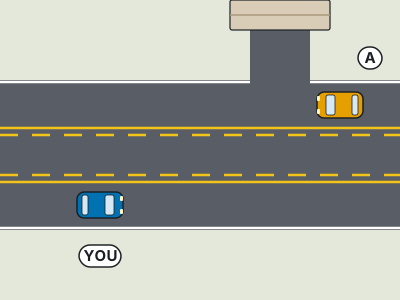
- Passing slower traffic on either side of the roadway
- Left turns at intersections or into and out of a middle-of-block drive
- Continuous travel when the regular lanes are congested
- Right turns around a median or traffic island
Show answer
Left turns at intersections or into and out of a middle-of-block drive. Illinois describes the two-way left turn lane as a safe area for cars making left turns at intersections or for vehicles turning left into or out of a drive in the middle of a block. It is not a passing lane or a regular travel lane for bypassing congestion. The lane also does not create a special path for right turns around medians. Approach it only as part of a planned left-turn maneuver, watch for vehicles using it from the opposite direction, and yield as required before crossing the opposing lanes.
Study this in the handbook: Passing, turning, roundabouts and parking
16. Where are bicyclists prohibited from riding in Illinois?
- On any road with a speed limit over 30 mph
- Nowhere, bicycles may use any road
- On all city streets
- On controlled access highways, expressways and other marked roadways
Show answer
On controlled access highways, expressways and other marked roadways. Bicyclists are prohibited on controlled access highways, expressways and other roadways marked as closed to them. On most roadways, bicyclists have the same rights and responsibilities as other roadway users, so a 30 mph cutoff and a ban on city streets are not the rule. Drivers must keep at least 3 feet from a bicyclist when passing, including one riding on the shoulder or in a bicycle lane, and should check for bicyclists before opening a vehicle door.
17. What does the walking-person signal permit a pedestrian to do?
- Cross only after a driver stops and waves
- Enter the roadway in any direction
- Remain in the crosswalk until the light turns red
- Cross the roadway in the direction of the signal
Show answer
Cross the roadway in the direction of the signal. The walking-person signal gives permission to cross the roadway in the direction shown by that signal. It does not authorize movement in any direction, and a pedestrian should still watch for vehicles and remain attentive while crossing. Waiting for a driver to wave is not the signal rule, while lingering in the crosswalk after the indication changes can create a conflict. Use the displayed direction as the cue for a lawful crossing.
Study this in the handbook: Traffic signals and arrows
18. What should a driver do when meeting or passing a horseback rider?
- Sound the horn repeatedly before passing
- Accelerate past the animal with little clearance
- Pass cautiously and be prepared to stop
- Drive onto the shoulder to pass immediately
Show answer
Pass cautiously and be prepared to stop. A horse may react unpredictably to noise or a close vehicle. Illinois says to pass a horseback rider with caution and be prepared to stop, while separately warning drivers never to sound a horn near a horse or other livestock. Repeated honking can frighten the animal and cause a crash. Slow down, leave useful clearance, and wait when the rider’s movement or road width makes passing uncertain.
Study this in the handbook: Passing, turning, roundabouts and parking
19. What speed applies in a posted Illinois school zone when the listed conditions are present?
- 15 mph
- 25 mph
- 20 mph
- 30 mph
Show answer
20 mph. The school-zone limit described in the handbook is 20 mph. That figure applies in a marked school zone during the stated school-day conditions, rather than automatically applying around every school property. The 15 mph option belongs to alleys, while 30 mph is the ordinary city or town figure. A practical cue is to connect the school-zone sign and children being present with the lower 20 mph limit. Always watch for a different posted local rule as well.
Study this in the handbook: Speed limits, school zones and work zones
20. What subjects are covered by the basic Illinois written driver examination?
- Vehicle repairs, insurance pricing, and county registration procedures
- Traffic signs, signals, pavement markings, traffic laws, safety, crash prevention, and equipment
- Only road signs and the names of Illinois highways
- Parking fees, fuel economy, and commercial vehicle loading rules
Show answer
Traffic signs, signals, pavement markings, traffic laws, safety, crash prevention, and equipment. The basic written examination covers visual controls and practical driving knowledge. You may need to identify signs, signals, and pavement markings, then answer questions about traffic laws, safety rules, crash prevention, and vehicle equipment. The signs-only choice leaves out the rule and safety portions, while repair costs and registration procedures are not listed as exam subjects. A useful study cue is to review both what drivers see on the road and what they must do in response. Motorcycle, truck, and bus examinations have different requirements, so this description applies to the basic driver exam.
Study this in the handbook: Vision screening, written exam and driving exam
QualitySpace is expanding to Illinois
We are a California-based independent insurance brokerage working on licensing in more states. We cannot help with Illinois insurance yet. Leave your email and we will let you know when we can.
Every question is written from the official Illinois Rules of the Road. Need paper? Printable IL practice test with answer key.
Last verified 2026-10-05. How we check every question · Study all 500 as flashcards
Frequently asked questions
How many questions are on this Illinois practice test?
This fixed set has 20 questions. It is test 8 of 25 from the 500 question Illinois bank. The real IL exam asks 35 questions and you need 28 correct.
What is the passing score for the real Illinois test?
80% must be answered correctly to be eligible for a Class D license (92 Ill. Adm. Code 1030.80) That figure comes from the official Illinois source cited on the DMV facts page.
How does this fixed test relate to the full Illinois bank?
Each numbered test is a fixed set of questions in a fixed order, so you can retake the same test later and compare. Every test mixes road signs and the other topics in about the same proportion as the full bank. Tests 1 to 25 together cover every question in the Illinois bank once. The full practice page mixes the whole bank at random.
Last verified 2026-10-05. See the Illinois DMV facts page for sourced state details.
Return to the full Illinois practice test · Study road signs