
Test 2 of 25 · 20 questions · Free 2026
IL Permit Practice Test 2
Jump to the test ↓A fixed 20 question set from the Illinois bank with answers and plain English explanations. The real IL exam is 35 questions, 80 percent to pass; take the full length version on the main practice page.
Question 1 of 20 · 0 right so far
All 20 questions in test 2
Every question below comes from the Illinois question bank on this page. Open a question to see the correct answer and the explanation. Nothing here is hidden behind a signup.
1. How long does a DUI conviction stay on an Illinois driving record?
- Five years
- Ten years
- Permanently
- Until the fine is paid
Show answer
Permanently. Illinois classifies DUI as a violent crime, and a DUI conviction remains on the driving record permanently. Five and ten years understate that, and paying the fine does not remove it. An arrest or conviction can also cost the driver's license and vehicle registration and bring fines or jail. A DUI conviction also requires filing Financial Responsibility Insurance for three years, and a third DUI can be charged as Aggravated DUI.
Study this in the handbook: DUI, implied consent and summary suspension
2. An Illinois driver is convicted of driving without the required insurance. What follows?
- At least a three month loss of privileges and a $100 reinstatement fee, with no driving permit
- A warning for a first offense
- A one year suspension with a work permit
- Only a $25 fine
Show answer
At least a three month loss of privileges and a $100 reinstatement fee, with no driving permit. A mandatory insurance conviction in Illinois costs the driver's privileges for at least three months, requires a $100 reinstatement fee, and no driving permit is available during that time. A warning understates it. A one year suspension with a work permit changes both the length and the permit rule. A $25 fine alone is not the penalty. Three or more insurance violations also require filing proof of financial responsibility.
Study this in the handbook: Crashes, reports and insurance
3. Which cellphone use does Illinois prohibit while operating a motor vehicle?
- Using a handheld cellphone
- Using a cellphone while parked on the shoulder
- Using a cellphone while stopped because normal traffic is obstructed, with the vehicle in park
- Reporting an emergency
Show answer
Using a handheld cellphone. Illinois prohibits handheld cellphone use while a motor vehicle is operating. The manual separately permits cellphone use to report an emergency, while parked on the shoulder, or while stopped because normal traffic is obstructed when the vehicle is in neutral or park. Those exceptions do not turn ordinary handheld conversation into a permitted activity. The useful check is the vehicle’s operating status and the reason for using the device. If none of the listed emergency or stopped conditions applies, do not handle the phone while driving.
Study this in the handbook: Phones, distracted driving and traffic stops
4. What must a driver do at an Illinois YIELD sign before proceeding?
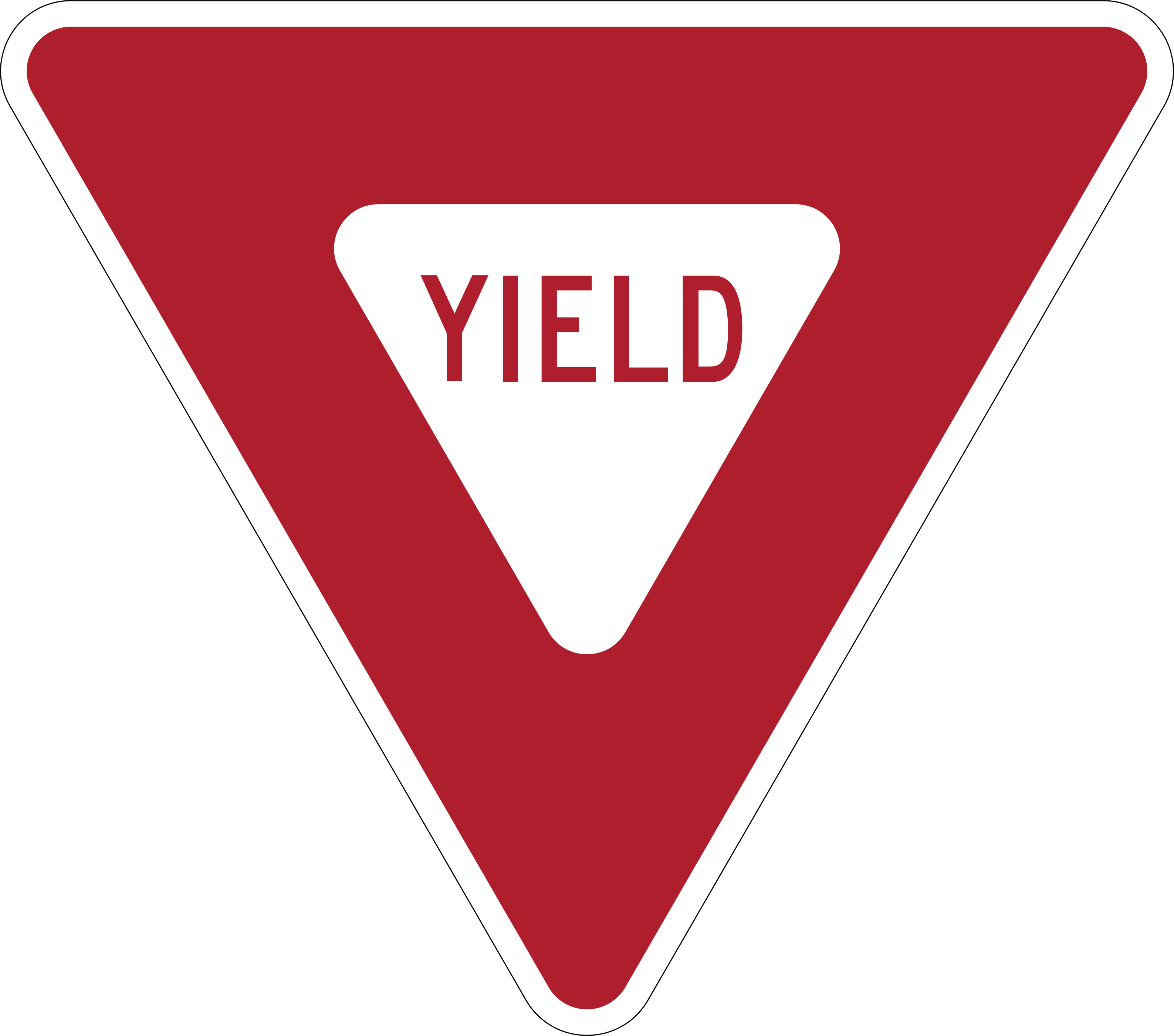
- Accelerate through the intersection before other traffic arrives
- Let all traffic and pedestrians go first, slowing or stopping if necessary
- Enter first whenever the driver is already near the sign
- Stop only when a police officer is directing traffic
Show answer
Let all traffic and pedestrians go first, slowing or stopping if necessary. The Illinois YIELD sign means you must let all traffic and pedestrians go before proceeding. Slow to a safe speed, and stop if that is needed to avoid interfering with them. The choice about accelerating treats the sign like a race for space, which is the opposite of yielding. The duty applies whether or not a police officer is present; a handheld stop sign is a different control used by authorized people such as school guards or flaggers. Being close to the sign does not grant priority. Scan both directions and stop when the gap is not safe.
Study this in the handbook: Sign shapes and colors
5. You approach a pedestrian using a guide dog, a white cane, or a wheelchair on the roadway. What does Illinois require?
- Sound the horn so the person knows you are there
- Pass quickly to clear the area
- Expect the person to wait for your vehicle
- Yield, because the person has the right of way
Show answer
Yield, because the person has the right of way. Illinois gives a pedestrian with a disability who is using a guide dog, a white cane, a wheelchair, or another assistive device the right of way, along with the same rights as any other pedestrian. A driver should slow, stop if needed, and wait until the person is safely clear. Honking can startle a person who relies on hearing to travel, and a guide dog may react to a sudden loud sound in a way that puts both of them at risk.
6. How much following distance should you leave behind a motorcycle in Illinois?
- At least three to four seconds
- At least one to two seconds
- About one car length
- At least ten seconds
Show answer
At least three to four seconds. Illinois asks drivers to allow at least three to four seconds of following distance behind a motorcycle. A rider may need room to swerve around a pothole or debris, and in dry conditions a motorcycle can stop more quickly than a car, so a close follower may not be able to stop in time. Illinois also says to dim your headlights when following any vehicle, including a motorcycle, and notes that a rider's ability to stop quickly may depend on experience and training.
7. How far before a turn must a continuous signal be given in a business or residential area?
- At least 25 feet
- At least 200 feet
- Only while entering the intersection
- At least 100 feet
Show answer
At least 100 feet. In a business or residential area, Illinois requires a continuous turn signal for at least 100 feet before turning. The 200-foot distance applies in other areas, so using it here confuses the location-specific rule. Signaling only while entering the intersection gives following traffic too little notice. Activate the signal early enough to provide the full distance and keep it on continuously until the turn is complete.
Study this in the handbook: Passing, turning, roundabouts and parking
8. Why are special lights sometimes displayed above individual highway lanes?
- To identify a lane reserved for parked vehicles
- To replace every other traffic control
- To show that the road has no speed limit
- To change the flow of traffic during certain hours
Show answer
To change the flow of traffic during certain hours. Illinois uses special lights above lanes to change the flow of traffic during certain hours. Those signals help manage lane availability, but they do not replace speed limits, pavement markings, or other controls. A lane light is not a parking designation and does not erase every other rule. Before entering, read the display over your lane, follow its current indication, and continue watching for a later change in traffic flow.
Study this in the handbook: Traffic signals and arrows
9. What is the mandatory fine for illegally passing a stopped school bus in Illinois?
- $50
- $300 plus court ordered community service
- $1,000
- A warning for a first offense
Show answer
$300 plus court ordered community service. A vehicle is not required to stop for a school bus only when both vehicles are on a four lane roadway and the bus is stopped in the opposite direction. Any other time, you must stop before meeting or passing a school bus that is stopped loading or unloading. If convicted of passing a stopped school bus you face a mandatory fine of $300 and community service set by the court, and the conviction will result in suspension of your driver's license.
Study this in the handbook: School buses, emergency vehicles and railroad crossings
10. Who is required to wear a safety belt under Illinois law?
- Only the driver and front-seat passengers
- Only passengers younger than age 8
- Drivers and passengers in front and back seats age 8 and older
- Only occupants in vehicles without air bags
Show answer
Drivers and passengers in front and back seats age 8 and older. Illinois requires drivers and passengers in both front and back seats who are age 8 or older to wear safety belts, even when air bags are present. Limiting the rule to the front seats misses rear passengers, and air bags do not replace belts. Children under 8 fall under child-restraint requirements instead. A quick cue is to identify the occupant's age and seating position, then apply the matching protection rule.
Study this in the handbook: Seat belts, air bags and child seats
11. How close to a fire hydrant may you stand or park in Illinois?
- No closer than 5 feet
- No closer than 15 feet
- No closer than 30 feet
- No closer than 50 feet
Show answer
No closer than 15 feet. Illinois prohibits standing or parking within 15 feet of a fire hydrant, whether or not someone is in the vehicle, and in front of any public or private driveway. Five feet is far too close. Thirty feet is the distance from a STOP sign, YIELD sign, or signal, and 50 feet is the distance from the nearest rail of a railroad crossing. Twenty feet applies to fire station driveways and intersection crosswalks.
Study this in the handbook: Passing, turning, roundabouts and parking
12. What roadway change does the Illinois TWO-WAY ROADWAY sign announce?

- A one-way road is beginning with passing allowed in both directions
- A divided highway is starting with a median ahead
- The driver is leaving a divided roadway and approaching a two-way highway
- Two lanes in the same direction will merge at the next signal
Show answer
The driver is leaving a divided roadway and approaching a two-way highway. The TWO-WAY ROADWAY sign tells the driver that a divided roadway is ending and a two-way highway is ahead. Traffic will no longer be separated by a center strip, so the driver should prepare for opposing vehicles and keep the vehicle in the proper lane. The one-way and divided-highway choices describe the opposite transition. A lane merge at a signal is a different warning. Reduce speed as needed, watch for the center line and oncoming traffic, and avoid carrying divided-road assumptions into the two-way section.
13. What should an Illinois driver prepare to do at a MERGING LANES sign?

- Block the adjacent lane so no vehicle can enter it
- Stop on the ramp until all traffic has left the highway
- Change lanes or allow other traffic to merge into the lane
- Use the shoulder as the permanent travel lane
Show answer
Change lanes or allow other traffic to merge into the lane. A MERGING LANES sign means two lanes traveling in the same direction will soon become one. Drivers should be ready either to change lanes or to allow other traffic to merge into their lane. Blocking the adjacent lane defeats the safety purpose of the warning, and stopping on a ramp is not the general instruction. The shoulder is not a substitute travel lane. Adjust speed and position early, check mirrors and blind spots, and cooperate with nearby drivers so the two streams form one orderly lane without a sudden conflict.
14. For how long must motorists obey a posted Illinois construction-zone speed limit?
- Only while workers are visible beside the roadway
- Only after a construction vehicle enters the lane
- Only during weekday daylight hours
- Twenty-four hours a day, seven days a week
Show answer
Twenty-four hours a day, seven days a week. A posted construction-zone speed limit remains in force around the clock, every day of the week, regardless of whether workers are present. The visible-worker choice is tempting because worker presence can cause an additional reduction, but it does not determine whether the posted limit applies. Daylight and construction-vehicle activity are also irrelevant to the stated duration. Treat the sign as active until you safely pass the work zone or another lawful sign changes the limit.
Study this in the handbook: Speed limits, school zones and work zones
15. Before an Illinois driver under 18 becomes eligible for a license at age 16, how much supervised practice is required?
- At least 50 nighttime hours with no daytime requirement
- At least 30 hours, including 5 hours at night
- At least 50 hours, including 10 hours at night
- At least 10 total hours, all completed with a driving instructor
Show answer
At least 50 hours, including 10 hours at night. Illinois requires at least 50 hours of supervised behind-the-wheel driving for drivers under 18, with 10 of those hours completed at night, in addition to driver education. The 30-hour choice confuses classroom study with practice, while 50 nighttime hours inflates the nighttime portion. Instructor-only practice also misses the broader supervised-driving requirement. Record the hours in the driving log and remember the compact formula: 50 total, including 10 nighttime hours.
Study this in the handbook: Instruction permit and the graduated license program
16. Under Illinois' Child Passenger Protection Act, which children must use an appropriate child safety restraint system?
- Only children under age 2
- All children under age 8
- Children under age 12, with no exception for an adult belt
- Only children seated in the front seat
Show answer
All children under age 8. Illinois requires every child under age 8 to be properly secured in an appropriate child safety restraint system. The rule includes booster seats, which must be used with a lap and shoulder belt. Limiting it to age 2 misses the broader child restraint requirement, and seat location does not determine whether the act applies. The under-12 choice confuses a recommendation about back-seat placement with the restraint threshold. Check the child's age and the restraint manufacturer's fit guidance before every trip, including short rides.
Study this in the handbook: Seat belts, air bags and child seats
17. What do orange roadway signs generally warn drivers about?
- Construction and maintenance conditions
- A permanent speed limit for city streets
- Directions to hospitals and fuel stations
- A railroad crossbuck yield requirement
Show answer
Construction and maintenance conditions. Orange is used for construction and maintenance warning signs in Illinois. These signs alert drivers to changing roadway conditions, workers, equipment, lane shifts, or other work zone hazards. A permanent speed limit is a regulatory matter, service directions are guide information, and a railroad crossbuck has its own sign and meaning. When orange appears, reduce speed as directed, watch for barriers and workers, and be ready for a lane change or an unexpected surface condition. The color is a work zone cue, not a destination cue.
Study this in the handbook: Sign shapes and colors
18. What should a driver do when the vehicle's wheels drift onto the shoulder?
- Jerk the wheel left immediately to return to the lane
- Accelerate on the shoulder and merge without checking traffic
- Brake hard while keeping both wheels on the pavement edge
- Grip the wheel firmly, ease off the gas, brake gently, check behind, and steer back gradually
Show answer
Grip the wheel firmly, ease off the gas, brake gently, check behind, and steer back gradually. A sudden correction from the shoulder can cause the vehicle to cross into oncoming traffic or lose balance. Illinois recommends gripping the wheel, easing off the gas, braking gently, checking traffic behind, and steering back onto the pavement gradually. Jerked steering is specifically dangerous, and acceleration without a traffic check creates a merge conflict. Hard braking at the edge can also upset the vehicle. First stabilize the vehicle, then choose a safe opening and make a smooth return rather than forcing the wheel toward the lane.
Study this in the handbook: Following distance, night driving and weather
19. How must cannabis be carried in a vehicle in Illinois?
- In a sealed, odor-proof, and child-resistant container
- In the glove box, if the driver is 21 or older
- Anywhere, if the driver has a medical card
- In an open bag on the back seat
Show answer
In a sealed, odor-proof, and child-resistant container. Illinois allows cannabis in a vehicle only in a sealed, odor proof, and child resistant container, and no driver or passenger may use cannabis in the vehicle. Being 21 or older does not make an unsealed product in the glove box legal. A medical registry card does not change the container rule; illegal transportation can even cost a medical card holder the card for two years. An open bag fails every part of the requirement.
Study this in the handbook: DUI, implied consent and summary suspension
20. What is the proper entry movement when approaching an Illinois roundabout?
- Accelerate and enter from the left side
- Slow down and enter by turning right when it is safe
- Change lanes while entering without checking mirrors
- Stop inside the circle before choosing an exit
Show answer
Slow down and enter by turning right when it is safe. Illinois directs drivers approaching a roundabout to slow down and enter by turning right when it is safe to do so. The driver should also read signs and pavement markings, stay in the lane, and use the right turn signal when exiting. Accelerating into circulating traffic or entering from the wrong side reverses the intended flow. Stopping inside the circle and changing lanes without checking for other vehicles can disrupt traffic and create a collision risk.
Study this in the handbook: Passing, turning, roundabouts and parking
QualitySpace is expanding to Illinois
We are a California-based independent insurance brokerage working on licensing in more states. We cannot help with Illinois insurance yet. Leave your email and we will let you know when we can.
Every question is written from the official Illinois Rules of the Road. Need paper? Printable IL practice test with answer key.
Last verified 2026-10-05. How we check every question · Study all 500 as flashcards
Frequently asked questions
How many questions are on this Illinois practice test?
This fixed set has 20 questions. It is test 2 of 25 from the 500 question Illinois bank. The real IL exam asks 35 questions and you need 28 correct.
What is the passing score for the real Illinois test?
80% must be answered correctly to be eligible for a Class D license (92 Ill. Adm. Code 1030.80) That figure comes from the official Illinois source cited on the DMV facts page.
How does this fixed test relate to the full Illinois bank?
Each numbered test is a fixed set of questions in a fixed order, so you can retake the same test later and compare. Every test mixes road signs and the other topics in about the same proportion as the full bank. Tests 1 to 25 together cover every question in the Illinois bank once. The full practice page mixes the whole bank at random.
Last verified 2026-10-05. See the Illinois DMV facts page for sourced state details.
Return to the full Illinois practice test · Study road signs