
Test 11 of 25 · 20 questions · Free 2026
IL Permit Practice Test 11
Jump to the test ↓A fixed 20 question set from the Illinois bank with answers and plain English explanations. The real IL exam is 35 questions, 80 percent to pass; take the full length version on the main practice page.
Question 1 of 20 · 0 right so far
All 20 questions in test 11
Every question below comes from the Illinois question bank on this page. Open a question to see the correct answer and the explanation. Nothing here is hidden behind a signup.
1. What must Illinois law enforcement officers provide when a driver asks during a traffic stop?
- The reason for every prior stop that day
- Their names and badge numbers
- A written warning instead of any ticket
- The home address of the reporting complainant
Show answer
Their names and badge numbers. Officers are required to provide their names and badge numbers upon request. If you believe an officer acted inappropriately, report the conduct to the officer's superiors as soon as possible. Written complaints can be filed with the agency's internal affairs division or civilian complaint board. Against "The reason for every prior stop that day", note this: The manual requires officers to provide their names and badge numbers upon request.
Study this in the handbook: Phones, distracted driving and traffic stops
2. What extra form must an Illinois applicant present when applying for an ID card based on a disability?
- A court order signed by a judge
- A statement from the applicant's employer
- An Application for an Illinois Person with a Disability Identification Card, completed and signed by a medical professional
- A school transcript
Show answer
An Application for an Illinois Person with a Disability Identification Card, completed and signed by a medical professional. Those applying for an ID card as a person with a disability must also present a form titled Application for an Illinois Person with a Disability Identification Card. The form must be properly completed and signed by a medical professional. A court order, an employer statement, or a school record does not replace it. Ask the facility for the form before your visit.
3. What can happen to the vehicle of a driver convicted of driving while the license is suspended or revoked for DUI in Illinois?
- It is returned to the owner after one week
- It can be seized and possibly forfeited
- It is placed on a payment plan
- It receives a special parking sticker
Show answer
It can be seized and possibly forfeited. A driver convicted of driving while the license is revoked or suspended for DUI, aggravated DUI, reckless homicide, or leaving the scene of a fatal or personal injury crash is subject to criminal penalties, including jail time. The suspension or revocation period is extended, and the vehicle can be seized and possibly forfeited. Never drive while your privileges are suspended or revoked.
Study this in the handbook: Drivers under 21 and alcohol
4. How is a Class 2 low speed electric bicycle defined in Illinois?
- Motor assists only while pedaling up to 28 mph
- A motor that may propel the bicycle alone but cannot engage once the bicycle reaches 20 mph
- A motor with no speed cutoff at all
- A motor that engages only above 20 mph
Show answer
A motor that may propel the bicycle alone but cannot engage once the bicycle reaches 20 mph. A Class 2 low-speed electric bicycle has a motor that may propel the bicycle without pedaling but cannot engage when the bicycle reaches 20 mph. A Class 1 motor assists only while the rider pedals and ceases assistance at 20 mph. The manual describes Class 3 as engaging only while the rider pedals and providing assistance when the bicycle reaches 28 mph; its operator must be at least age 16.
5. What does the Illinois manual call the most common cause of motorcycle crashes?
- Motorcyclists riding in the spring and summer only
- Motorcycles stopping faster than cars
- Motorcyclists using the whole lane
- Motorists failing to detect and recognize motorcycles in traffic
Show answer
Motorists failing to detect and recognize motorcycles in traffic. The manual says the failure of motorists to detect and recognize motorcycles in traffic is the most common cause of motorcycle crashes. Because of their small size, motorcycles may be difficult to see, and motorists tend to underestimate their speed. A driver should expect to see motorcycles in traffic at any time, not just in the spring and summer. Look twice for motorcycles at intersections and before changing lanes.
6. What does Illinois say about pedestrians walking on a highway under the influence?
- Allowed on the shoulder at night
- Allowed if a friend walks alongside
- Allowed below a BAC of .08%
- Pedestrians should not walk on a highway when under the influence of alcohol or other drugs
Show answer
Pedestrians should not walk on a highway when under the influence of alcohol or other drugs. The manual says pedestrians should not walk on a highway when under the influence of alcohol or other drugs. If there is no sidewalk but a shoulder is available, pedestrians should walk on the shoulder as far from the roadway as possible. In two-way traffic, pedestrians should face oncoming traffic. Pedestrian tunnels or crossing bridges should be used when available.
7. What follows when a person drives while the Illinois license is suspended or revoked?
- The suspension clock pauses until court
- Extension of the suspension or revocation period, plus possible incarceration
- Automatic conversion to a restricted permit
- Only a reinstatement fee increase
Show answer
Extension of the suspension or revocation period, plus possible incarceration. Driving while a license is suspended or revoked results in an extension of the suspension or revocation period and may result in incarceration. Consider "The suspension clock pauses until court": Illegal driving extends time rather than pausing it. Its rival "Automatic conversion to a restricted permit" fails for a separate reason: No permit converts automatically from an illegal drive. Finally, "Only a reinstatement fee increase" also misses the rule: Fee changes alone miss added time and jail.
8. If a driver neither pays a minor traffic ticket nor appears on the court date, what happens next?
- The ticket disappears
- A second court date may be set a minimum of 30 days later
- The license expires immediately
- The fine doubles automatically that day
Show answer
A second court date may be set a minimum of 30 days later. If a driver fails to pay a minor traffic ticket or appear on the indicated court date, a second court date may be set at least 30 days later. The court clerk sends notice using the contact methods described in the manual. Failure to appear on the second date results in an ex-parte conviction, reported to the Secretary of State and treated like any other conviction.
Study this in the handbook: Crashes, reports and insurance
9. May a driver leave the roadway to get around a traffic signal in Illinois?
- Never; leaving the roadway to avoid a signal is prohibited
- Yes, whenever the shoulder is clear and firm
- Yes, but only below 15 mph on gravel shoulders
- Yes, when the signal cycle seems unusually long
Show answer
Never; leaving the roadway to avoid a signal is prohibited. Traffic signals and pavement markings must be obeyed unless a police or traffic control officer directs otherwise. A driver may never leave the roadway to avoid a traffic signal. Consider "Yes, whenever the shoulder is clear and firm": A clear shoulder does not authorize bypassing a traffic signal. Its rival "Yes, but only below 15 mph on gravel shoulders" fails for a separate reason: No slow speed exception permits driving off the roadway around signals.
Study this in the handbook: Traffic signals and arrows
10. What is the only way to remove the effects of alcohol from the body?
- Drinking coffee
- Eating a meal
- Taking a shower
- Time
Show answer
Time. Time is the only way to remove the effects of alcohol. Food, coffee, and showers do not speed up its elimination from the body. Alcohol affects driving even below the level of illegal intoxication. Consider "Drinking coffee": Coffee does not speed up the elimination of alcohol from the body. Its rival "Eating a meal" fails for a separate reason: Food does not speed up the elimination of alcohol from the body.
Study this in the handbook: DUI, implied consent and summary suspension
11. How must a vehicle be parked on an Illinois one-way street?
- Within 12 inches of the right or left curb, in the direction traffic moves
- Within 24 inches of either curb, facing any direction
- Only beside the right curb, facing traffic
- At a forty five degree angle to the left curb
Show answer
Within 12 inches of the right or left curb, in the direction traffic moves. On a one-way street or road, park within 12 inches of the right or left curb, in the direction traffic is moving. On a street with two-way traffic, park with the right-hand wheels parallel to and within 12 inches of the curb. "Within 24 inches of either curb, facing any direction" is a distractor here: The manual specifies within 12 inches of either curb and in the direction traffic is moving.
Study this in the handbook: Passing, turning, roundabouts and parking
12. Who may post speed limits that differ from the statewide limits listed in the Illinois manual?
- Only the Secretary of State
- Each driver, based on how the road feels
- Local municipalities, at their discretion
- No one; the listed limits are fixed on every road
Show answer
Local municipalities, at their discretion. The manual says local municipalities have the discretion to post speed limits different from those listed. That is why the posted sign always comes first and the default table applies only when no other limit is posted. That is why the posted sign always comes first and the manual's table applies only when no different limit is posted. Watch for changes when you enter a new city or town, since local limits can differ from the statewide figures.
Study this in the handbook: Seat belts, air bags and child seats
13. How does Illinois define a headset for the law that prohibits headset use while driving?
- Only a device worn over both ears
- Any hearing aid that amplifies sound
- Any device, other than a hearing aid, that allows a person to hear or receive electronic communications
- Only a device connected to a radio
Show answer
Any device, other than a hearing aid, that allows a person to hear or receive electronic communications. Illinois law prohibits the use of headsets while driving, and the manual defines a headset as any device, other than a hearing aid, that allows a person to hear or receive electronic communications. A hearing aid is therefore excluded. A single sided headset or earpiece used with a wireless or cellphone device is permitted while driving, and motorcycle operators may use intercom helmets.
Study this in the handbook: Phones, distracted driving and traffic stops
14. When may you turn left across a paved dividing space in Illinois?
- Unless a traffic control sign or signal does not permit it
- At any time and place
- Only between midnight and dawn
- Only for commercial vehicles
Show answer
Unless a traffic control sign or signal does not permit it. A paved dividing space may be crossed for a left turn by default, and the permission disappears only where a traffic control sign or signal forbids the movement. The manual separately prohibits crossing median strips such as unpaved strips or median barriers; permission to turn across a paved dividing space does not by itself designate that space as a two-way left-turn lane. Open season at any time ignores posted prohibitions, while overnight only and commercial only limits invent restrictions absent from the rule. Read the signs first, then turn across the space with normal yielding care.
Study this in the handbook: Passing, turning, roundabouts and parking
15. During an Illinois traffic stop, from which side may the officer approach the vehicle?
- Only the driver side, in every case
- Only the passenger side, in every case
- Either the driver side or the passenger side
- Whichever side the driver requests by signal
Show answer
Either the driver side or the passenger side. Be prepared for the officer to approach from either the driver side or the passenger side. Keep both hands clearly in sight on the steering wheel until instructed otherwise or the traffic stop is complete. The option "Only the driver side, in every case" should be set aside: The officer may approach from the passenger side as well as the driver side.
Study this in the handbook: Phones, distracted driving and traffic stops
16. When approaching a MERGE sign with through traffic, what must you do?
- Stop completely before entering
- Increase or decrease speed to avoid a crash
- Sound the horn continuously
- Yield only to trucks
Show answer
Increase or decrease speed to avoid a crash. At a MERGE sign with through traffic, yield the right of way and increase or decrease speed to avoid a crash. Consider "Stop completely before entering": The MERGE instruction calls for increasing or decreasing speed to avoid a crash, not a mandatory complete stop. Its rival "Sound the horn continuously" fails for a separate reason: The stated action is adjusting speed to avoid a crash, not continuously sounding the horn.
Study this in the handbook: Speed limits, school zones and work zones
17. You renewed online before expiration but the sticker has not arrived. How long is the printed receipt valid proof?
- For 30 days from the expiration of the sticker currently displayed
- For 90 days from the date of online purchase
- Until the end of the calendar year
- For 7 days from the purchase date only
Show answer
For 30 days from the expiration of the sticker currently displayed. If you purchased the renewal sticker online before expiration and have not received it, you may drive with the Secretary of State receipt in the vehicle. The printed receipt is valid as proof of registration for 30 days from the expiration of the sticker currently displayed. Consider "For 90 days from the date of online purchase": Ninety days is the temporary permit span, not receipt validity.
18. What must accompany removing a wrecked vehicle from an Illinois roadway?
- Removing all glass and other debris from the roadway
- Leaving debris for the next road crew
- Moving the vehicle only after dark
- Photographing the debris for the owner
Show answer
Removing all glass and other debris from the roadway. When removing a wrecked or damaged vehicle from the roadway, all glass and other debris must also be removed. Illinois law also requires a disabled, unattended, or abandoned vehicle to be removed from the roadway as soon as possible. The option "Leaving debris for the next road crew" should be set aside: All glass and other debris must be removed when the wrecked or damaged vehicle is removed.
19. On an Illinois regulatory sign, what does a red circle with a diagonal slash mean?
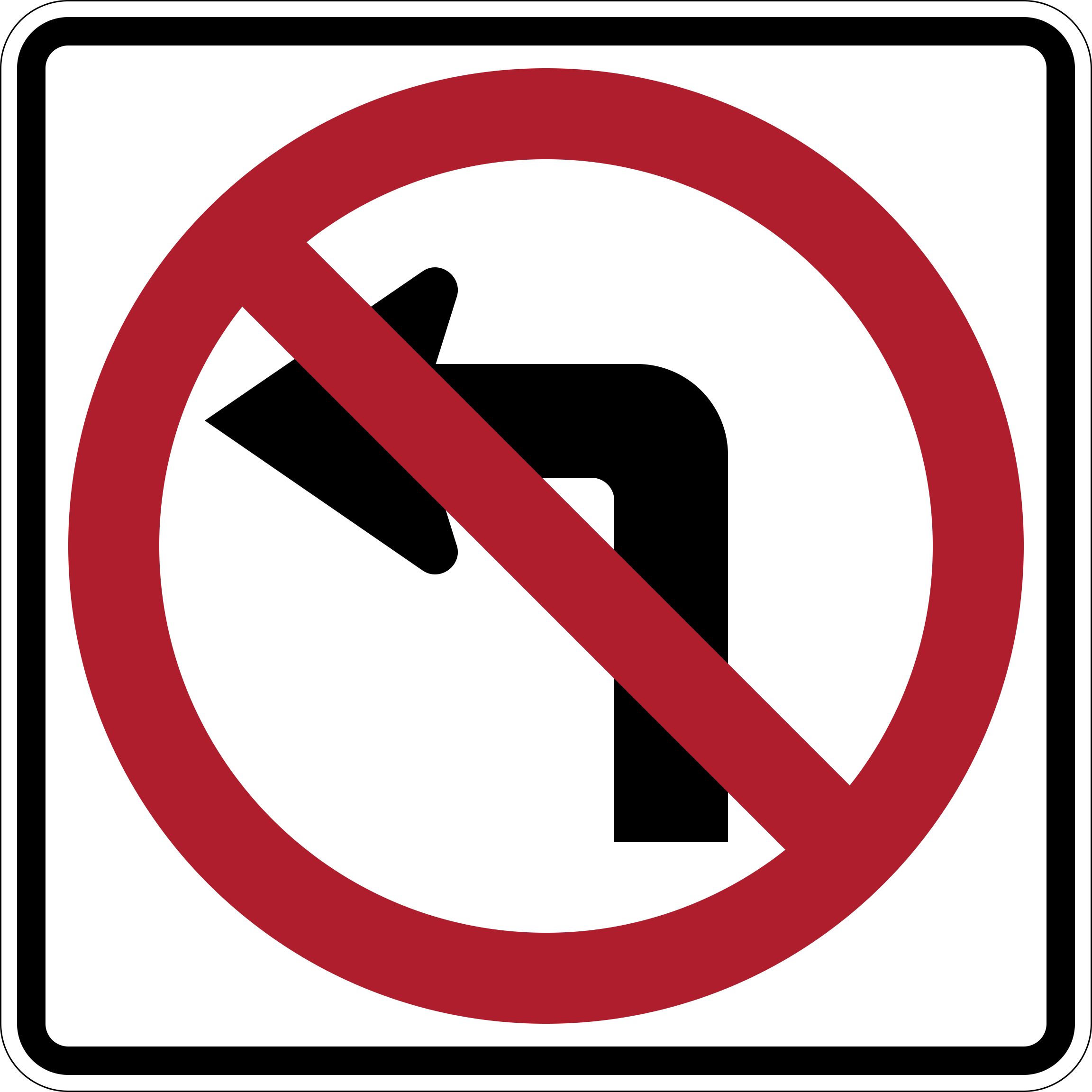
- The pictured action is recommended
- The pictured action is not allowed
- The pictured action is required at the next intersection
- The pictured action is a warning about a possible hazard
Show answer
The pictured action is not allowed. A red circle crossed by a diagonal slash marks a prohibited action. The symbol inside the circle identifies the movement or behavior you may not perform, such as making a prohibited turn. This is a regulatory message, not a suggestion and not a prediction that the hazard might occur. A warning sign instead alerts you to a condition ahead, while a required maneuver must be stated by the applicable regulatory sign or signal. When you see the slash, read the symbol inside it and remove that action from your choices before proceeding. The slash is the quick visual cue for no or not allowed.
20. How should headlights be used at night near an oncoming bicyclist in Illinois?
- High beam lights should not be used when approaching an oncoming bicyclist
- High beams should stay on to spot the bicycle early
- Headlights should be turned off until the bicyclist passes
- Only parking lights may be used near bicyclists
Show answer
High beam lights should not be used when approaching an oncoming bicyclist. Do not use high beams at night when approaching an oncoming bicyclist. Use headlights from sunset to sunrise; glare from lights may interfere with vision. Against "High beams should stay on to spot the bicycle early", note this: The manual says not to use high beams at night when approaching an oncoming bicyclist. Compare "Headlights should be turned off until the bicyclist passes" next: The manual says lights should be used from sunset to sunrise.
QualitySpace is expanding to Illinois
We are a California-based independent insurance brokerage working on licensing in more states. We cannot help with Illinois insurance yet. Leave your email and we will let you know when we can.
Every question is written from the official Illinois Rules of the Road. Need paper? Printable IL practice test with answer key.
Last verified 2026-10-05. How we check every question · Study all 500 as flashcards
Frequently asked questions
How many questions are on this Illinois practice test?
This fixed set has 20 questions. It is test 11 of 25 from the 500 question Illinois bank. The real IL exam asks 35 questions and you need 28 correct.
What is the passing score for the real Illinois test?
80% must be answered correctly to be eligible for a Class D license (92 Ill. Adm. Code 1030.80) That figure comes from the official Illinois source cited on the DMV facts page.
How does this fixed test relate to the full Illinois bank?
Each numbered test is a fixed set of questions in a fixed order, so you can retake the same test later and compare. Every test mixes road signs and the other topics in about the same proportion as the full bank. Tests 1 to 25 together cover every question in the Illinois bank once. The full practice page mixes the whole bank at random.
Last verified 2026-10-05. See the Illinois DMV facts page for sourced state details.
Return to the full Illinois practice test · Study road signs