
Test 5 of 25 · 20 questions · Free 2026
IL Permit Practice Test 5
Jump to the test ↓A fixed 20 question set from the Illinois bank with answers and plain English explanations. The real IL exam is 35 questions, 80 percent to pass; take the full length version on the main practice page.
Question 1 of 20 · 0 right so far
All 20 questions in test 5
Every question below comes from the Illinois question bank on this page. Open a question to see the correct answer and the explanation. Nothing here is hidden behind a signup.
1. During the Illinois permit phase, how many passengers may ride with a teen driver?
- Any number, as long as an adult supervises
- One in the front seat and no more than the number of safety belts in the back seat
- None at all
- Two in the front seat and three in the back
Show answer
One in the front seat and no more than the number of safety belts in the back seat. In the Illinois permit phase, passengers are limited to one in the front seat and no more than the number of safety belts in the back seat. An adult's presence does not lift the limit, and a permit driver is not barred from all passengers. Two people in the front is never allowed. After the first 12 months of licensing, the same front seat and safety belt limits apply to the Initial Licensing Phase.
Study this in the handbook: Instruction permit and the graduated license program
2. What does the round railroad advance warning sign indicate?
- A circular traffic pattern begins
- A hospital entrance is nearby
- Passing is allowed in both directions
- A highway-railway crossing is ahead
Show answer
A highway-railway crossing is ahead. The round yellow sign with a black X and the letters RR warns that a highway-railway crossing is ahead. It gives the driver advance notice to slow, look, listen, and stop if a train is approaching. The shape is not a roundabout instruction, and the sign does not authorize passing or identify a medical facility. At a crossing, never race a train. Be prepared to stop at the required location and wait until it is safe to proceed.
3. How long is an Illinois license valid for drivers ages 81 to 86, and for drivers 87 and older?
- Eight years for both
- Four years for both
- One year for both
- Two years for ages 81 to 86, with annual renewal at 87 and older
Show answer
Two years for ages 81 to 86, with annual renewal at 87 and older. Drivers ages 81 to 86 receive a license valid for two years, and drivers 87 and older must renew annually. Drivers 87 and older, including those turning 87 at renewal, must also take a driving exam. Every driver takes the written exam every eight years unless they have no traffic convictions. Renewal notices arrive about 90 days before expiration and list the documents and tests needed.
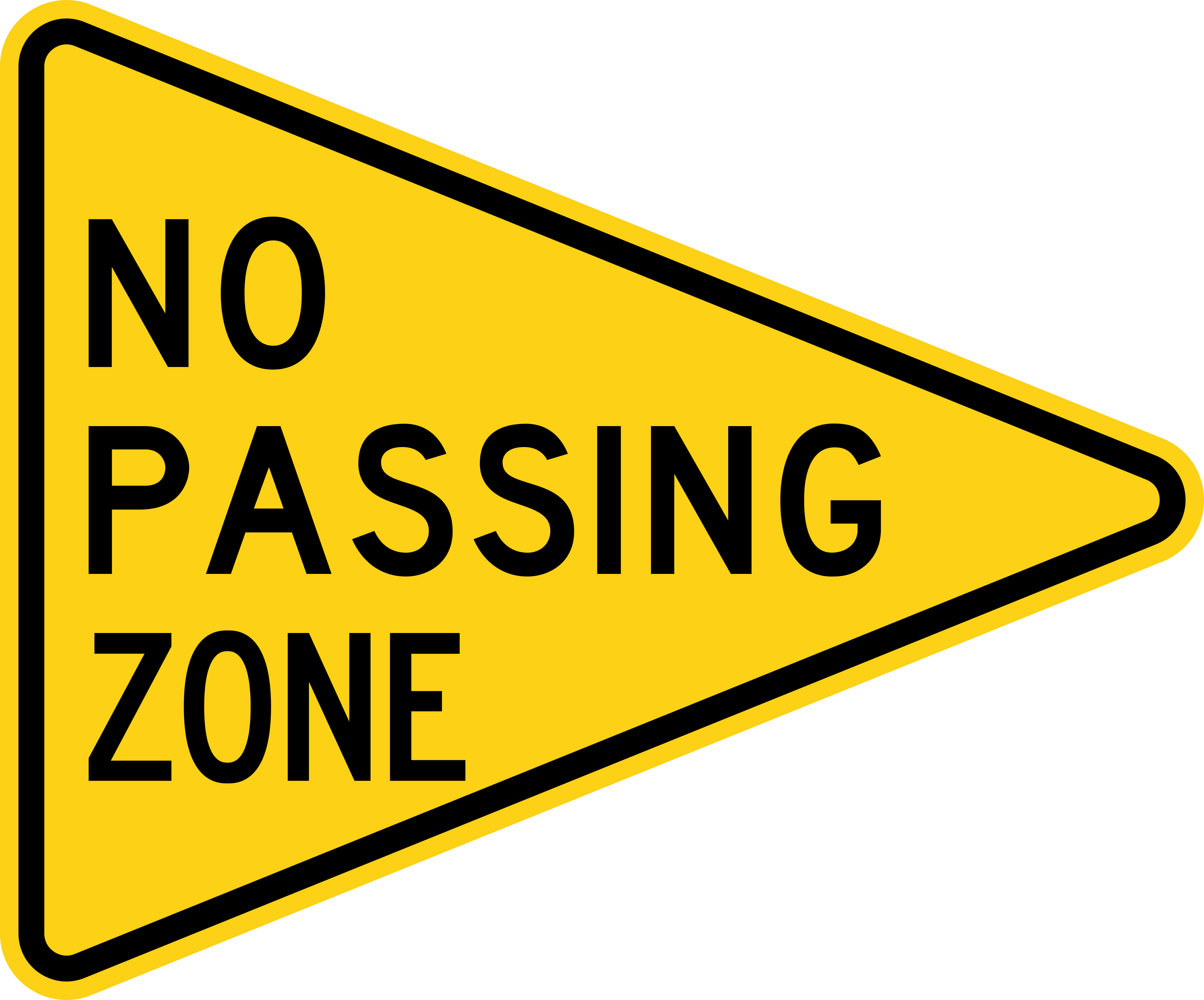
4. Where is the yellow triangular no-passing sign placed when a no-passing area begins?
- On the right side of every multilane roadway
- Above the entrance to a parking garage
- On the left side of a two-lane, two-way roadway
- At the end of a railroad crossing
Show answer
On the left side of a two-lane, two-way roadway. Illinois describes the no-passing sign as a three-sided yellow sign with black letters. It appears on the left side of a two-lane, two-way roadway at the beginning of the area where no-passing pavement markings also appear. The sign is not a general parking or railroad marker, and its placement is not the right side of every multilane road. When this sign and the pavement markings are present, a driver should stay behind slower traffic until passing becomes legal and safe.
Study this in the handbook: Sign shapes and colors
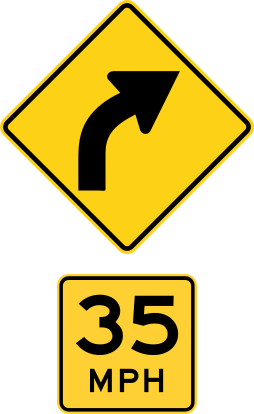
5. What does a small speed panel below a curve warning sign show?
- The number of lanes after the curve
- The minimum legal speed for the roadway
- The distance to the next service area
- The maximum safe speed for the curve or turn
Show answer
The maximum safe speed for the curve or turn. The small panel used with a curve or turn warning sign gives the maximum safe speed for that feature. It is an advisory safety cue for negotiating the curve, not a minimum speed requirement or a distance marker. The number of lanes is shown by separate roadway signs. Drivers should slow before entering the bend so the vehicle remains stable and controllable. Braking hard after the turn begins can create a loss of traction, especially when the roadway is wet or otherwise difficult.
6. What do Illinois warning signs tell drivers?

- They authorize drivers to ignore nearby traffic signals
- They establish the exact speed for every roadway
- They identify only one-way streets and expressway entrances
- They alert drivers to conditions ahead that require special attention
Show answer
They alert drivers to conditions ahead that require special attention. Illinois warning signs alert drivers to conditions ahead and situations that require special attention. They commonly use a diamond shape, with yellow as the usual background, although some pedestrian, bicycle, and school signs use fluorescent yellow-green. A warning sign does not set every roadway's speed, identify only one-way roads, or cancel a traffic signal. The practical cue is to reduce distractions, scan beyond the sign, and prepare for the hazard or change in roadway conditions it announces.
7. What does a steady yellow traffic light warn an Illinois driver?
- The signal is changing from green to red
- The signal will remain green for another full cycle
- Cross traffic must stop immediately
- The driver may enter without checking the intersection
Show answer
The signal is changing from green to red. A steady yellow light warns that the signal is changing from green to red. It is not a promise of another green cycle and does not mean the driver may enter without checking the intersection. Cross traffic does not automatically receive a separate command from the yellow indication. The manual adds that when the red light appears, a driver must not enter the intersection. Treat yellow as a transition warning, check position and traffic, and avoid starting an entry that cannot be completed safely.
Study this in the handbook: Traffic signals and arrows
8. Who may not talk on a hands free phone while driving in Illinois?
- Drivers over 65
- Commercial drivers
- Drivers under age 19
- No one, hands free is legal for all
Show answer
Drivers under age 19. Illinois allows hands-free devices or Bluetooth technology only for drivers age 19 and older. A driver under 19 may not use a wireless phone while driving at all, even hands-free, except to contact law enforcement, a health care provider or emergency services in an emergency. Handheld phone use, texting and other electronic communications are banned for every driver, with narrow exceptions such as reporting an emergency or being parked on the shoulder. Age over 65 and commercial status are not the dividing line in this rule; age 19 is.
Study this in the handbook: Phones, distracted driving and traffic stops
9. Two vehicles reach an uncontrolled Illinois intersection at the same time. Which vehicle yields?
- The vehicle on the left yields to the vehicle on the right
- The vehicle traveling faster proceeds first
- The vehicle on the right yields to the vehicle on the left
- Both vehicles must reverse before either continues
Show answer
The vehicle on the left yields to the vehicle on the right. At an uncontrolled intersection, Illinois assigns the yield duty to the vehicle on the left when vehicles on different roadways arrive at the same time. The vehicle on the right has priority under this tie rule. Speed gives no priority, the reversed version has the right vehicle yielding, which is the opposite of the rule, and nothing requires either vehicle to back up. The manual uses the same left yields to right rule when two vehicles reach a four way stop together. Slow down, look for other road users, and be prepared to yield.
Study this in the handbook: Right of way and pedestrians
10. What is the recommended steering response when an Illinois driver starts to skid?
- Lock the brakes and turn sharply away from the skid
- Accelerate hard while holding the wheel straight
- Ease off the gas or brakes and steer into the direction of the skid
- Switch off the headlights and leave the lane immediately
Show answer
Ease off the gas or brakes and steer into the direction of the skid. A skid means the tires have lost traction, so abrupt control inputs can make the vehicle less stable. Illinois advises easing off the gas pedal or brakes and steering into the skid until traction returns, then straightening the vehicle. Locking the brakes and turning away fights the vehicle's movement. Acceleration does not restore grip, and changing lanes is not a substitute for regaining control. Keep the wheel movement smooth, reduce the force that caused the slide, and wait for the tires to respond before correcting back to your intended path.
Study this in the handbook: Following distance, night driving and weather
11. Your vehicle stalls on Illinois railroad tracks. What does the manual say to do?
- Stay inside and wait for help
- Everyone gets out immediately, calls 911, and moves away from the tracks at a 45 degree angle toward the train
- Push the vehicle off the tracks
- Wave at the train to stop
Show answer
Everyone gets out immediately, calls 911, and moves away from the tracks at a 45 degree angle toward the train. If your vehicle becomes disabled or stalls on railroad tracks, everyone should get out immediately, call 911, and move away from the tracks at a 45 degree angle in the direction of the train, so debris from a collision flies past rather than toward you. If possible the driver or a passenger should also call the railroad's Emergency Notification System number posted at the crossing.
Study this in the handbook: School buses, emergency vehicles and railroad crossings
12. What is an Illinois defensive-driving response when another driver's action is uncertain?
- Accelerate to establish priority before the other driver moves
- Follow the other vehicle closely so its next action is easier to see
- Stay prepared to react and do not assume you know what the other driver will do
- Use the horn continuously until the other driver yields
Show answer
Stay prepared to react and do not assume you know what the other driver will do. Defensive driving begins with recognizing that another driver's intentions cannot be known with certainty. Illinois tells drivers to remain prepared to react and avoid assuming what the other driver will do. Accelerating to claim priority increases conflict, while tailgating reduces the time available to respond. Continuous horn use is not a substitute for space and observation. Scan for lane movement, brake lights, turn signals, and changing gaps, then leave yourself a safe option if the other road user behaves differently than expected.
Study this in the handbook: Following distance, night driving and weather
13. Within what distance of an emergency scene does Illinois prohibit cellphone use, subject to stated exceptions?
- Within 50 feet
- Within 500 feet
- Only while passing the emergency vehicle
- Within 1,000 feet
Show answer
Within 500 feet. Illinois prohibits photography and wireless or cellphone use within 500 feet of an emergency scene, except in circumstances allowed by law. The rule covers the whole 500 foot area around the scene, not only the moment of passing the emergency vehicle. The 50 foot and 1,000 foot figures are not the stated boundary. Watch for the active lights that identify an emergency scene and put the phone away early.
Study this in the handbook: Speed limits, school zones and work zones
14. What does an upward-pointing green arrow permit?
- Travel straight ahead only
- Turn left across opposing traffic
- Turn right onto any side street
- Back through the intersection
Show answer
Travel straight ahead only. The direction of a green arrow defines the permitted movement. Illinois states that an upward-pointing arrow allows the driver to go straight ahead only. A left-pointing arrow authorizes a left turn and a right-pointing arrow authorizes a right turn. The upward indication does not authorize either turn, and no traffic signal authorizes backing through an intersection. Continue straight while watching for pedestrians, vehicles already in the intersection, and any additional signs or lane controls.
Study this in the handbook: Traffic signals and arrows
15. Outside an urban district, what must a vehicle parked on an Illinois highway between sunset and sunrise display?
- Front and rear parking lights
- Flashing hazard lights only
- High beam headlights
- No lights, as long as it is off the pavement
Show answer
Front and rear parking lights. Illinois prohibits parking on a highway between sunset and sunrise unless the front and rear parking lights are on. The one exception is a vehicle parked within an urban district where lights are not required. If headlights are left on while parked, they must be dimmed so they do not blind oncoming drivers. A dark car on a rural road at night is very hard to see until it is too late to steer around it.
Study this in the handbook: Passing, turning, roundabouts and parking
16. A driver refuses a breath test in Illinois and is later found guilty of DUI. What cost may the driver have to pay?
- Up to $50
- Up to $5,000
- Nothing, since the driver refused
- Up to $500 for the cost of blood tests
Show answer
Up to $500 for the cost of blood tests. If a driver refuses a breath test, or an officer believes a blood test may show drugs, the driver can be held financially liable for up to $500 of the blood test costs if found guilty of DUI. Fifty dollars understates it, and $5,000 overstates it. Refusing does not avoid the cost; it is one of the situations that triggers it. Refusal also brings its own one year suspension for a first offender.
Study this in the handbook: DUI, implied consent and summary suspension
17. Unless a different limit is posted, what is the Illinois speed limit in city and town areas?
- 30 mph
- 20 mph
- 35 mph
- 25 mph
Show answer
30 mph. Illinois lists default speed limits that apply whenever no other limit is posted. In city and town areas the default is 30 mph. Interstates and tollways allow 70, highways with four lanes allow 65, and other highways and rural areas allow 55. Lower defaults cover alleys at 15 and posted school zones at 20 mph on school days when children are present. Local municipalities may post their own limits, and a posted sign always controls.
Study this in the handbook: Seat belts, air bags and child seats
18. How should a driver approach a slow-moving vehicle from the rear?
- Follow closely until the operator notices
- Pass immediately because the vehicle cannot turn
- Prepare to slow down and pass only when it is safe
- Use the shoulder to avoid waiting
Show answer
Prepare to slow down and pass only when it is safe. Farm vehicles, construction equipment, and animal-drawn vehicles may share Illinois roads, and drivers approaching from behind should use caution and prepare to slow down. A slow-moving vehicle may be wide and may turn right or left into an unmarked entrance, so following closely or assuming it cannot turn is unsafe. The shoulder is not a substitute for a legal passing movement. Stay a safe distance back, make sure the operator knows your presence and intent, and pass only with adequate space and visibility.
Study this in the handbook: Passing, turning, roundabouts and parking
19. What rental vehicles may an Illinois Class D license holder drive?
- Any rental truck of any weight
- Rental vehicles up to 26,000 pounds when moving personal or immediate family property for nonbusiness purposes within Illinois
- No rental trucks over 10,000 pounds
- Only rental cars
Show answer
Rental vehicles up to 26,000 pounds when moving personal or immediate family property for nonbusiness purposes within Illinois. Holders of a Class D license may operate rental vehicles up to 26,000 pounds when transporting their own personal property or that of an immediate family member for nonbusiness purposes within the state of Illinois. The rental company should provide information on a safety course for operating that vehicle. The weight limit and the personal, in state purpose both matter, so any weight, a 10,000 pound cap, or cars only all misstate the rule.
20. For an Illinois second offender, what happens after refusing chemical testing?
- Driving privileges are suspended for 45 days
- Driving privileges are suspended for three years
- Driving privileges are suspended for six months
- Driving privileges are revoked for five years
Show answer
Driving privileges are suspended for three years. Illinois treats a qualifying prior statutory summary suspension, refusal, court supervision, or DUI conviction within the last five years as a second-offender situation. A refusal of chemical testing in that situation brings a three-year suspension. Six months belongs to a qualifying chemical test result, and 45 days is only the temporary driving receipt after arrest. Five years is associated with the minimum revocation for a second DUI conviction within 20 years, not a refusal suspension. Look for the combination of second offender and refusal, which points to three years.
Study this in the handbook: DUI, implied consent and summary suspension
QualitySpace is expanding to Illinois
We are a California-based independent insurance brokerage working on licensing in more states. We cannot help with Illinois insurance yet. Leave your email and we will let you know when we can.
Every question is written from the official Illinois Rules of the Road. Need paper? Printable IL practice test with answer key.
Last verified 2026-10-05. How we check every question · Study all 500 as flashcards
Frequently asked questions
How many questions are on this Illinois practice test?
This fixed set has 20 questions. It is test 5 of 25 from the 500 question Illinois bank. The real IL exam asks 35 questions and you need 28 correct.
What is the passing score for the real Illinois test?
80% must be answered correctly to be eligible for a Class D license (92 Ill. Adm. Code 1030.80) That figure comes from the official Illinois source cited on the DMV facts page.
How does this fixed test relate to the full Illinois bank?
Each numbered test is a fixed set of questions in a fixed order, so you can retake the same test later and compare. Every test mixes road signs and the other topics in about the same proportion as the full bank. Tests 1 to 25 together cover every question in the Illinois bank once. The full practice page mixes the whole bank at random.
Last verified 2026-10-05. See the Illinois DMV facts page for sourced state details.
Return to the full Illinois practice test · Study road signs