
Key points
For an emergency vehicle using lights and sirens, immediately pull to the right side of the road and let it pass.
Source: Handbook p. 25
“When being approached by an emergency vehicle using audible and visual signals (lights and/or sirens), Illinois law requires motorists to immediately pull to the right side of the road and allow the emergency vehicle to pass.”
Illinois Rules of the Road, Handbook p. 25For a stopped emergency vehicle with flashing lights, yield, change to a lane away from it if possible and proceed with caution.
Source: Handbook p. 25
“Illinois law requires motorists to yield, change to a lane away from the emergency workers when possible, and proceed with caution.”
Illinois Rules of the Road, Handbook p. 25Phone use and photography are banned within 500 feet of an emergency scene, with some exceptions.
Source: Handbook p. 25
“Illinois law prohibits photography and the use of wireless/cellphones within 500 feet of an emergency scene, except in certain circumstances.”
Illinois Rules of the Road, Handbook p. 25You need not stop for a school bus when both of you are on a four-lane road and it is stopped going the other way.
Source: Handbook p. 32
“A vehicle is not required to stop for a school bus when both vehicles are on a four-lane roadway and the bus is stopped in the opposite direction from which a driver is traveling.”
Illinois Rules of the Road, Handbook p. 32Passing a stopped school bus brings a license suspension and a mandatory $300 fine plus community service.
Source: Handbook p. 33
“passing a stopped school bus with flashing lights and the stop arm extended will result in the suspension of your driver's license. If convicted of this violation, you will be subject to a mandatory fine of $300 and community service”
Illinois Rules of the Road, Handbook p. 33At a railroad crossing, stop within 15 to 50 feet when there is a stop sign, flashing signal or lowered gate.
Source: Handbook p. 33
“When approaching a railroad crossing, you must stop within 15-50 feet if there is a posted stop sign, if the electric signal is flashing, or if the crossing gate is lowered.”
Illinois Rules of the Road, Handbook p. 33Do not enter a crossing unless there is room for your vehicle on the other side.
Source: Handbook p. 33
“You may not enter a highway railroad crossing unless there is sufficient space on the other side of the crossing to accommodate your vehicle”
Illinois Rules of the Road, Handbook p. 33If you stall on the tracks, get everyone out, call 911 and move away at a 45-degree angle toward the train.
Source: Handbook p. 33
“everyone in the vehicle should get out immediately, call 911, and move away from the tracks at a 45-degree angle in the direction of the train.”
Illinois Rules of the Road, Handbook p. 33After a train passes, look for a second train on another track before you go.
Source: Handbook p. 34
“Once a train has passed, always look for a second train on another track before proceeding.”
Illinois Rules of the Road, Handbook p. 34Do not drive through a flooded roadway or viaduct.
Source: Handbook p. 85
“If you come across a roadway or viaduct that has been flooded due to heavy rain, do not drive through the flooded area.”
Illinois Rules of the Road, Handbook p. 85
Numbers to know
| Number | What it means | Manual |
|---|---|---|
| 500 feet | no phone zone around an emergency scene | Handbook p. 25 |
| $300 | mandatory fine for passing a stopped school bus | Handbook p. 33 |
| 15 to 50 feet | where to stop from the tracks | Handbook p. 33 |
| 45 degrees | angle to move away from the tracks | Handbook p. 33 |
| 911 | call after leaving a stalled car | Handbook p. 33 |
Recognize these signs
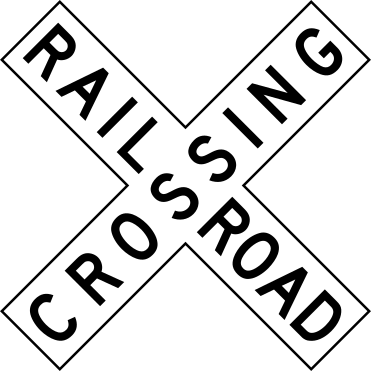
Railroad crossbuck 
Railroad crossing ahead 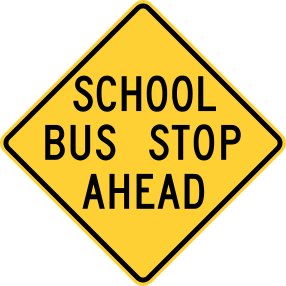
School bus stop ahead
3 questions from the Illinois practice test
1. What should an Illinois driver do when an emergency vehicle approaches using audible and visual signals?
- Continue at the same speed in the current lane
- Immediately pull to the right side and allow it to pass
- Turn left at the next intersection to get ahead of it
- Stop only if the emergency vehicle is directly beside the car
Show answer
Immediately pull to the right side and allow it to pass. When an emergency vehicle approaches with audible and visual signals, Illinois requires motorists to immediately pull to the right side of the road and allow it to pass. In some situations a complete stop may be necessary. Continuing in the lane delays the emergency response, and waiting until the vehicle is alongside leaves too little time to clear its path. At an intersection with two-way traffic, remain stopped until the emergency vehicle passes through the intersection. Sirens or lights should trigger an immediate response.
2. Your vehicle stalls on Illinois railroad tracks. What does the manual say to do?
- Stay inside and wait for help
- Everyone gets out immediately, calls 911, and moves away from the tracks at a 45 degree angle toward the train
- Push the vehicle off the tracks
- Wave at the train to stop
Show answer
Everyone gets out immediately, calls 911, and moves away from the tracks at a 45 degree angle toward the train. If your vehicle becomes disabled or stalls on railroad tracks, everyone should get out immediately, call 911, and move away from the tracks at a 45 degree angle in the direction of the train, so debris from a collision flies past rather than toward you. If possible the driver or a passenger should also call the railroad's Emergency Notification System number posted at the crossing.
3. At a railroad crossing, what must a driver do when the flashing lights begin?
- Stop and remain stopped until the train passes and the lights stop flashing
- Continue if the crossing appears clear from the driver's lane
- Drive around a lowered gate before it reaches the pavement
- Stop only if a horn can be heard
Show answer
Stop and remain stopped until the train passes and the lights stop flashing. Flashing railroad crossing lights are a command to stop, not a suggestion based on whether a train is immediately visible. Illinois says to remain stopped until the train has passed and the lights have stopped flashing. Visual clearance or the absence of a horn does not cancel the warning. Going around a lowering gate is especially dangerous because the train may be hidden by distance, weather, or another obstruction. Stop before the crossing, keep clear of the tracks, and wait for the complete signal sequence to end.
Practice this topic
Lock it in with emergencies questions from the free Illinois practice test. Every answer comes with a plain English explanation.
Source: the Illinois Rules of the Road, Chapter 4: Traffic Laws. This lesson is a plain English summary, not the law itself; where it differs, the manual and the statute govern. Last checked 2026-09-27.