
Test 19 of 25 · 20 questions · Free 2026
IL Permit Practice Test 19
Jump to the test ↓A fixed 20 question set from the Illinois bank with answers and plain English explanations. The real IL exam is 35 questions, 80 percent to pass; take the full length version on the main practice page.
Question 1 of 20 · 0 right so far
All 20 questions in test 19
Every question below comes from the Illinois question bank on this page. Open a question to see the correct answer and the explanation. Nothing here is hidden behind a signup.
1. An Illinois driver under age 21 may not drive which for-hire vehicle?
- A vehicle for hire carrying nine passengers on a local route
- A vehicle for hire carrying more than 10 passengers, a commuter van, or a school bus
- A private car carrying three friends to a game
- A rental car used for a family vacation
Show answer
A vehicle for hire carrying more than 10 passengers, a commuter van, or a school bus. The under twenty one restriction targets larger passenger work: a vehicle for hire transporting more than ten passengers, along with commuter vans, religious organization buses, school buses, senior citizen transport, and child care vehicles. Nine passengers sits below the stated threshold, friends riding in a private car involve no hiring, and a family rental is personal use. Count the passengers first, because crossing beyond ten changes what a younger driver may legally operate for pay.
2. With a solid yellow line paired beside a broken yellow line, when may you pass?
- Only when the solid yellow line is nearest your lane
- Only when the broken yellow line is nearest your lane
- From either side whenever traffic is light
- Never, because any solid yellow paint bans all passing
Show answer
Only when the broken yellow line is nearest your lane. Paired yellow lines assign permission by side: the broken segment nearest a lane allows that side to pass, while the solid segment holds the opposite flow back. Reversing the arrangement would send drivers across against the restriction placed on their side. Light traffic does not erase the paint, yet the pairing is not a total ban either, since one direction keeps a lawful passing opportunity. Glance down before any pass and confirm the broken half sits on your side of the center.
Study this in the handbook: Right of way and pedestrians
3. Which group receives an Illinois Organization parking placard?
- Any business with a loading dock
- Any person who volunteers at a hospital
- Organizations that offer free transportation to persons with disabilities
- Any government vehicle fleet
Show answer
Organizations that offer free transportation to persons with disabilities. The Organization placard is issued to organizations that offer free transportation to persons with disabilities. It allows the authorized holder to park in spaces reserved for persons with disabilities when transporting persons with disabilities. It is not for businesses with loading needs, volunteers, or government fleets, and it applies only while the vehicle is carrying the people it is meant to serve.
4. With a manual transmission, when should a driver shift down near railroad tracks?
- While crossing the tracks
- After crossing the tracks
- Before reaching the tracks
- Only if the train is visible
Show answer
Before reaching the tracks. With a manual transmission, shift down before reaching railroad tracks. Do not change gears while crossing the track, to avoid stalling. "While crossing the tracks" is a distractor here: A mid crossing shift invites a stall on the tracks. Another rival, "After crossing the tracks", is wrong on its own terms: Shifting afterward does nothing for the crossing itself. Finally, "Only if the train is visible" also misses the rule: Train visibility does not change the shifting precaution.
Study this in the handbook: School buses, emergency vehicles and railroad crossings
5. How should a driver use Illinois' three-second rule on a good road in good weather?
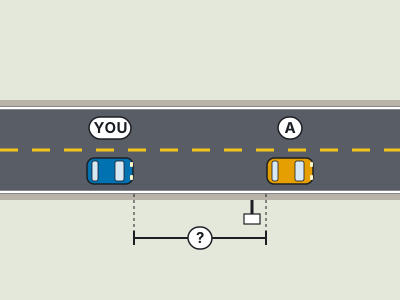
- Use the rule only when following a motorcycle
- Count one second from the time the vehicle ahead passes any object
- Keep one car length between vehicles at every speed
- Choose a fixed object and ensure the vehicle reaches it no sooner than three seconds after the vehicle ahead
Show answer
Choose a fixed object and ensure the vehicle reaches it no sooner than three seconds after the vehicle ahead. Illinois uses a three-second check for ordinary conditions. Pick a fixed object, such as a sign or tree, and begin counting when the vehicle ahead passes it. Your vehicle should not reach that object before one-thousand-three. The one-second option leaves too little reaction space, and a car-length formula changes with speed instead of measuring time. The motorcycle-only choice is also too narrow because this guidance addresses following distance generally. If rain, ice, or another hazard reduces traction or visibility, add more time rather than treating three seconds as a maximum.
Study this in the handbook: Following distance, night driving and weather
6. What does Illinois say about passing in construction zones?
- Passing is allowed at reduced speed
- Passing is allowed on the shoulder
- Passing is allowed only at night
- All construction zones are no passing zones
Show answer
All construction zones are no passing zones. The manual states that all construction zones in Illinois are no-passing zones. Reducing speed or driving at night does not create an exception to that stated prohibition. Consider "Passing is allowed at reduced speed": Slower travel is required, but passing stays prohibited regardless. Its rival "Passing is allowed only at night" fails for a separate reason: Darkness does not lift a zone wide passing ban.
Study this in the handbook: Passing, turning, roundabouts and parking
7. How must horseback riders position themselves on Illinois public roadways?
- Facing traffic on the left edge
- In the same direction as other traffic, as far to the right as possible
- In the center lane reserved for slow traffic
- On controlled-access highways during daylight
Show answer
In the same direction as other traffic, as far to the right as possible. Horseback riders must travel in the same direction as other traffic and as far to the right as possible. They may use public roadways except controlled-access highways and most expressways. Drivers should pass cautiously, be prepared to stop, and never sound a horn near horses or other livestock. Against "Facing traffic on the left edge", note this: Facing traffic copies pedestrian practice onto riders.
Study this in the handbook: Passing, turning, roundabouts and parking
8. Which tires does Illinois generally make illegal except for listed vehicles and dates?
- Tires that are wider than the fender
- Tires with a tread pattern in the shape of a block
- Pneumatic tires with metal studs
- Any tires bought before the current year
Show answer
Pneumatic tires with metal studs. Illinois lists pneumatic tires with metal studs as restricted equipment. They are illegal except for a few cases, such as mail carriers in rural areas and vehicles displaying Persons with Disabilities or Disabled Veteran plates between November 15 and April 1 whose owners live on a county or township road in an unincorporated area, along with some agricultural and road building machinery. An ordinary passenger vehicle cannot use studded tires, even in winter.
Study this in the handbook: Required vehicle equipment
9. After a crash involving personal injury or death, what must officers do when they have probable cause to believe a driver was impaired?
- Request a drug or alcohol test
- Wait for the driver to volunteer for testing
- Release the driver until court supervision begins
- Test only passengers who appear impaired
Show answer
Request a drug or alcohol test. When a driver is involved in a personal injury crash or a crash causing another person’s death, officers must request a drug or alcohol test if they have probable cause to believe the driver was impaired. Refusing chemical testing after a crash involving serious personal injury or death results in revocation for at least one year. "Wait for the driver to volunteer for testing" is a distractor here: Officers must request the test when the stated crash and probable-cause conditions are met.
Study this in the handbook: DUI, implied consent and summary suspension
10. What changed on July 1, 2024 for Temporary Visitors Driver's Licenses (TVDLs) in Illinois?
- They are no longer issued
- They are issued for ten years
- They are issued only by mail
- They are issued only to students
Show answer
They are no longer issued. The Illinois manual states that, effective July 1, 2024, Temporary Visitors Driver's Licenses will no longer be issued. The statement appears more than once in the licensing chapter because it affects applicants, renewals, and documents. Anyone planning to rely on a TVDL should check current licensing options with the Secretary of State instead. Check the current options with the Secretary of State before applying.
11. What minimum jail time applies to taking any part of an Illinois driver's license exam for another person?
- A mandatory minimum of 3 days
- A mandatory minimum of 7 days
- A mandatory minimum of 30 days
- No jail time is possible
Show answer
A mandatory minimum of 7 days. Taking any part of the driver’s license exam for another person is a criminal offense punishable by a fine and a mandatory minimum of seven days in jail. The separate 30-day rule prohibits an applicant caught cheating from retaking the exam. The option "A mandatory minimum of 3 days" should be set aside: Three days falls below the compulsory custody floor for proxy testing.
Study this in the handbook: Vision screening, written exam and driving exam
12. What minimum peripheral vision must an Illinois license applicant demonstrate?
- At least 105 degrees
- At least 120 degrees
- At least 140 degrees
- At least 180 degrees
Show answer
At least 140 degrees. An applicant must have at least 140 degrees of peripheral vision, meaning the ability to see to the side, with or without corrective lenses. Against "At least 105 degrees", note this: 105 degrees is below the required minimum of 140 degrees. Compare "At least 120 degrees" next: One hundred twenty degrees still falls twenty degrees short of screening. Likewise, "At least 120 degrees" misses the rule: One hundred twenty degrees still falls twenty degrees short of screening.
Study this in the handbook: Vision screening, written exam and driving exam
13. A motorist turning right finds a bicyclist approaching on the right. What should the motorist do?
- Turn quickly ahead of the bicyclist
- Let the bicyclist go through the intersection first, then turn
- Honk until the bicyclist stops
- Pass the bicyclist inside the intersection
Show answer
Let the bicyclist go through the intersection first, then turn. When turning right with a bicyclist approaching on the right, let the bicyclist go through the intersection before turning. Remember to signal the turn. "Turn quickly ahead of the bicyclist" is a distractor here: The manual says to let the bicyclist go through first, not turn ahead of the rider. Another rival, "Honk until the bicyclist stops", is wrong on its own terms: A horn cannot revoke the bicyclist right of way.
14. After a traffic crash, what information should you ask from all those involved?
- Names, addresses, phone numbers, driver's license numbers, and license plate numbers
- Only first names
- Insurance agent home addresses
- Vehicle purchase prices
Show answer
Names, addresses, phone numbers, driver's license numbers, and license plate numbers. After a crash, ask all those involved for their names, addresses, phone numbers, driver’s license numbers, and license plate numbers. The manual also directs drivers to stop safely, help injured people if necessary or requested, call 911 immediately, and warn other drivers with emergency flashers and flares if available. "Only first names" is a distractor here: The manual calls for names, addresses, phone numbers, driver’s license numbers, and license plate numbers, not just first names.
Study this in the handbook: Crashes, reports and insurance
15. What does Illinois say about radar jamming devices?
- They are allowed in passenger cars but not trucks
- They are allowed when purchased outside Illinois
- Only their use is banned; possession is unrestricted
- Possession and use are prohibited in all vehicles
Show answer
Possession and use are prohibited in all vehicles. Radar jamming equipment gets a flat ban covering both possession and use across every vehicle class. Splitting the rule by vehicle type or purchase location invents exemptions the equipment section never grants, and holding an unused jammer still counts as prohibited possession. The ban sits alongside other restricted gear such as driver visible televisions and front facing red lights. If a vehicle arrives with a jammer installed, removing it entirely is the compliant move rather than simply switching it off.
Study this in the handbook: Required vehicle equipment
16. A school guard holds up a handheld STOP sign. When may you move ahead in Illinois?
- Only after the authorized person signals that it is safe to proceed
- As soon as you have slowed to a crawl and checked for pedestrians
- After counting three seconds, even if the sign is still raised
- Whenever the road ahead looks clear, since handheld signs are only advisory
Show answer
Only after the authorized person signals that it is safe to proceed. A handheld STOP sign carries the same authority as a posted one. The manual says to stop until an authorized person, such as a school guard or construction zone flagger, signals that it is safe to proceed. Waiting for your own count or judging the road clear yourself is not enough. Treat any person with this authority exactly as you would a posted sign, and keep watching for children or workers who may still be crossing. Do not creep forward while waiting, because the sign means a full stop.
Study this in the handbook: Sign shapes and colors
17. What does a constant yellow upraised hand pedestrian signal mean?
- Cross if no traffic is approaching
- Cross at a faster pace
- Do not cross unless directed by a pedestrian control sign or police officer
- The walk phase is just beginning
Show answer
Do not cross unless directed by a pedestrian control sign or police officer. The pedestrian signal list includes a yellow light with a constant upraised hand. It means do not cross unless directed by a pedestrian control sign or a police officer. It is different from the walking person signal, which allows crossing, and from the orange upraised hand signals, which tell pedestrians not to enter the roadway. It is a signal for pedestrians, so drivers should also expect people to wait at the curb.
Study this in the handbook: Traffic signals and arrows
18. What do large vehicles often do just before a right turn, according to the Illinois manual?
- They make a wide turn and may leave an open space to the right
- They signal and turn from the far right of the lane
- They stop and wait for traffic behind them to pass
- They turn only from the left lane
Show answer
They make a wide turn and may leave an open space to the right. The Illinois manual warns that large vehicles make wide right turns and sometimes leave an open space to the right just before the turn. A car that slips into that space can be trapped or struck as the vehicle swings around. Stay out of the gap, give large vehicles plenty of room to maneuver, and pay close attention to their turn signals.
19. What may a driver face after causing a crash through distracted driving in Illinois?
- Only a warning recorded on the driving record
- Criminal penalties and incarceration
- A mandatory vehicle inspection within thirty days
- Loss of insurance coverage with no court action
Show answer
Criminal penalties and incarceration. If distracted driving causes a crash with a motor vehicle, bicyclist, pedestrian, or any other road user, the driver may face criminal penalties and incarceration. Against "Only a warning recorded on the driving record", note this: A warning understates exposure that includes incarceration. Compare "A mandatory vehicle inspection within thirty days" next: The manual lists possible criminal penalties and incarceration for a crash caused by distracted driving.
Study this in the handbook: Seat belts, air bags and child seats
20. What does the Illinois manual say about joining a funeral procession?
- Any vehicle may join to gain the right of way
- Vehicles are prohibited from joining a procession to secure the right of way or to pass vehicles in it
- Joining is allowed if headlights are on
- Joining is allowed on multilane roads only
Show answer
Vehicles are prohibited from joining a procession to secure the right of way or to pass vehicles in it. The manual prohibits vehicles from joining a funeral procession to secure the right of way or attempt to pass any vehicle in an organized procession, except where a passing lane has been specifically provided. Motorists encountering a procession must yield to all vehicles in it, and motorists in a procession should have their headlights and hazard lights turned on. Give the procession room and wait patiently rather than trying to cut in.
Study this in the handbook: Speed limits, school zones and work zones
QualitySpace is expanding to Illinois
We are a California-based independent insurance brokerage working on licensing in more states. We cannot help with Illinois insurance yet. Leave your email and we will let you know when we can.
Every question is written from the official Illinois Rules of the Road. Need paper? Printable IL practice test with answer key.
Last verified 2026-10-05. How we check every question · Study all 500 as flashcards
Frequently asked questions
How many questions are on this Illinois practice test?
This fixed set has 20 questions. It is test 19 of 25 from the 500 question Illinois bank. The real IL exam asks 35 questions and you need 28 correct.
What is the passing score for the real Illinois test?
80% must be answered correctly to be eligible for a Class D license (92 Ill. Adm. Code 1030.80) That figure comes from the official Illinois source cited on the DMV facts page.
How does this fixed test relate to the full Illinois bank?
Each numbered test is a fixed set of questions in a fixed order, so you can retake the same test later and compare. Every test mixes road signs and the other topics in about the same proportion as the full bank. Tests 1 to 25 together cover every question in the Illinois bank once. The full practice page mixes the whole bank at random.
Last verified 2026-10-05. See the Illinois DMV facts page for sourced state details.
Return to the full Illinois practice test · Study road signs