
Test 9 of 25 · 20 questions · Free 2026
IL Permit Practice Test 9
Jump to the test ↓A fixed 20 question set from the Illinois bank with answers and plain English explanations. The real IL exam is 35 questions, 80 percent to pass; take the full length version on the main practice page.
Question 1 of 20 · 0 right so far
All 20 questions in test 9
Every question below comes from the Illinois question bank on this page. Open a question to see the correct answer and the explanation. Nothing here is hidden behind a signup.
1. What must an Illinois driver in the Initial Licensing Phase keep in order to move to full privileges at 18?
- A perfect school attendance record
- 100 logged practice hours
- A second driver education course
- A conviction free driving record for the six months before turning 18
Show answer
A conviction free driving record for the six months before turning 18. An Illinois teen in the Initial Licensing Phase must keep a conviction free driving record for the six months before turning 18. A traffic conviction in this phase can extend the restrictions beyond 18. School attendance and extra practice hours are not the rule stated for moving on, and no second course is required. The Full Licensing Phase for ages 18 to 20 has no age related restrictions except the cellphone ban for drivers under 19.
Study this in the handbook: Instruction permit and the graduated license program
2. Who is exempt from the Illinois ban on drinking alcohol in a vehicle?
- Passengers in chartered buses for nonschool purposes, motor homes, and limousines
- Passengers in any car when the driver is sober
- Drivers stopped at a red light
- Passengers over 65
Show answer
Passengers in chartered buses for nonschool purposes, motor homes, and limousines. In Illinois it is illegal for anyone to drink alcohol in a vehicle, and both the driver and passengers can be cited. The exemption covers passengers on chartered buses used for nonschool purposes, motor homes, mini motor homes, and limousines. A sober driver does not make passenger drinking legal in an ordinary car. Being stopped at a light does not change the rule, and age is not an exemption. An opened container is also illegal in the passenger area.
Study this in the handbook: DUI, implied consent and summary suspension
3. An Illinois driver's license is revoked for DUI. Where may the driver legally drive during the revocation?
- Anywhere outside Illinois
- Only in neighboring states
- Only on private roads in another state
- Nowhere; the driver may not drive a motor vehicle in any state
Show answer
Nowhere; the driver may not drive a motor vehicle in any state. When an Illinois driver's privileges are suspended or revoked for DUI, reckless homicide, or leaving the scene of a fatal or personal injury crash, the driver may not drive in any state. Crossing into another state or a neighboring state does not restore the privilege, and an arrest elsewhere for driving while suspended is reported back to Illinois. Driving while revoked for these offenses brings jail time, a longer revocation, and possible vehicle seizure.
Study this in the handbook: Drivers under 21 and alcohol
4. Where should a driver go when an Illinois KEEP RIGHT sign points around an obstruction?
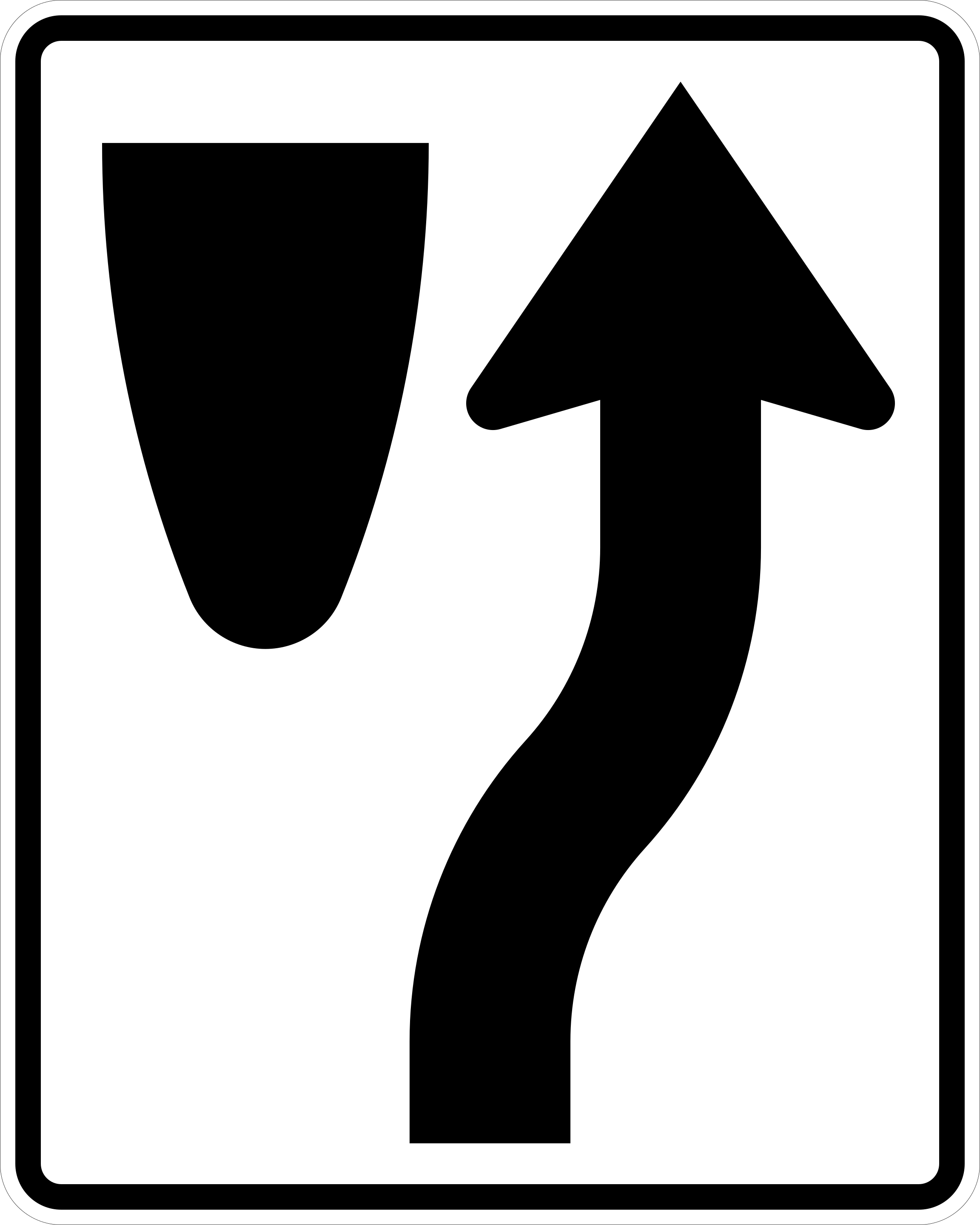
- To the side indicated by the arrow, around the traffic island, median, or obstruction
- Into the opposing lane whenever that lane is empty
- To the left of the obstruction regardless of the arrow
- Only onto the shoulder, even when a lane is open
Show answer
To the side indicated by the arrow, around the traffic island, median, or obstruction. The KEEP RIGHT sign tells drivers where to travel when a traffic island, median, or other obstruction occupies the middle of the roadway. The arrow identifies the side to use, so a driver should guide the vehicle around the obstruction on that indicated side. An empty opposing lane does not make it lawful to use the wrong side, and the left-side choice ignores the sign. The shoulder is not the default route either. Slow enough to position safely, watch surrounding traffic, and follow the arrow through the narrowed area.
5. What does the first Illinois DIVIDED HIGHWAY sign warn a driver about?

- A divided highway is ending and opposing traffic will share one lane
- A U-turn opening is available through the median
- A three-way intersection is ahead with traffic entering from the left
- A divided highway is beginning and a center strip will separate opposing traffic
Show answer
A divided highway is beginning and a center strip will separate opposing traffic. Illinois describes the first divided-highway sign as the sign posted before a divided highway begins. A center strip will separate traffic traveling in opposite directions, so the driver should follow the lane arrangement and remain on the correct side. The ending-roadway choice belongs to the other divided-highway sign. A three-way intersection and a U-turn opening have different meanings and should not be inferred from the arrows around the median. Reduce distractions, identify the separation ahead, and expect opposing traffic to be physically divided rather than crossing directly beside you.
6. What does an Illinois round railroad-crossing sign tell a driver to do?
- Slow down, look, and stop if necessary for a train
- Accelerate because the crossing is several miles away
- Stop only after entering the crossing
- Treat it as a school-zone warning
Show answer
Slow down, look, and stop if necessary for a train. The round yellow railroad-crossing sign is an advance warning that tracks cross the roadway ahead. Drivers should slow down, look, and stop if necessary, listening as well when other noise could hide a train. Accelerating or entering before checking removes the time needed to react. The sign does not itself mean the vehicle is already at the rail, but it demands preparation for the crossing ahead.
Study this in the handbook: Sign shapes and colors
7. How should a driver treat an intersection when its traffic signals are not working?
- As a green light unless another vehicle is visible
- As a flashing yellow signal with no required stop
- As an all-way stop, coming to a complete stop and yielding before entering
- By driving around the signal without entering the intersection
Show answer
As an all-way stop, coming to a complete stop and yielding before entering. A failed traffic signal does not create an uncontrolled intersection. Illinois directs drivers to treat the location as an all-way stop, make a complete stop, then look and yield before entering. Assuming green or proceeding as though the light were flashing yellow skips the required stop. The useful cue is simple: dark or nonworking signals call for a full stop at every approach unless law enforcement gives a different direction.
Study this in the handbook: Traffic signals and arrows
8. What classroom and behind-the-wheel training does an approved Illinois driver education course include?
- At least 30 classroom hours and six hours behind the wheel
- Exactly 12 classroom hours and two hours behind the wheel
- At least 50 classroom hours with no required vehicle training
- Six classroom hours followed by 30 hours behind the wheel
Show answer
At least 30 classroom hours and six hours behind the wheel. An approved driver education course has two required components: a minimum of 30 hours studying in the classroom and six hours of behind-the-wheel training in a regular passenger vehicle. The six-hour figure belongs to vehicle practice, not classroom instruction. A proposed 50-hour classroom course reverses the emphasis and is not the stated course structure. Keep the numbers paired as 30 for classroom and 6 for driving when checking whether a course meets the handbook description.
Study this in the handbook: Instruction permit and the graduated license program
9. Which combination activates the Illinois school-zone rule described in the manual?
- Any roadway within one block of a school, at every hour
- A school zone only after sunset when children are leaving activities
- A marked school zone, school in operation, children present, and the 6:30 a.m. to 4 p.m. period
- A school building visible from the road, even when no sign is posted
Show answer
A marked school zone, school in operation, children present, and the 6:30 a.m. to 4 p.m. period. The manual ties the school-zone duties to several conditions together: the zone must be marked, school must be in operation, children must be present, and the relevant time is between 6:30 a.m. and 4 p.m. The broad one-block choice removes those safeguards and therefore overstates the rule. A visible building alone is not the trigger. When approaching the area, look for the posted zone, the time, school activity, and children before applying the special speed and stopping duties.
Study this in the handbook: Speed limits, school zones and work zones
10. If rain or another poor condition makes the road difficult to use safely, how should following distance change?
- Reduce it so other cars cannot merge
- Increase it beyond the normal gap
- Match the distance used by the vehicle behind
- Keep exactly one car length
Show answer
Increase it beyond the normal gap. The normal three-second method assumes a good road and good weather. When either condition worsens, Illinois directs drivers to increase the following distance even more. A shorter gap leaves less time to react to spray, skids, blocked views, or abrupt braking, so the reduced-distance choice creates added risk. Use a fixed roadside object to measure the interval, then add space whenever traction or visibility is compromised.
Study this in the handbook: Following distance, night driving and weather
11. Where does the Illinois manual specifically tell drivers to slow down?
- Only on straight roads with a clear view
- At intersections, curves, hilltops, and narrow winding roadways
- Only after passing the top of a hill
- Only when a police officer is present
Show answer
At intersections, curves, hilltops, and narrow winding roadways. The handbook names four places that demand reduced speed: approaching or crossing an intersection, going around a curve, approaching the top of a hill, and traveling on a narrow and winding roadway. The straight road choice reverses the warning, and the rule says to slow when approaching the top of a hill, so waiting until after it is too late. This is a condition based instruction, not a rule triggered only by police presence. Look ahead and reduce speed before entering each listed area.
Study this in the handbook: Seat belts, air bags and child seats
12. How soon must a new Illinois resident obtain an Illinois license?
- Within 90 days or before the current license expires, whichever comes first
- Within 10 days
- Within one year
- Only when the old license expires
Show answer
Within 90 days or before the current license expires, whichever comes first. You must obtain an Illinois license within 90 days of becoming a resident or before your out of state license expires, whichever comes first. About 90 days before an Illinois license expires, the Secretary of State mails a renewal notice listing required documents and tests, and a temporary secure paper license valid for 90 days is issued at the facility while the card is produced.
13. On a curve or hill in Illinois, how far must you be able to see in all directions before making a U-turn?
- At least 100 feet
- At least 200 feet
- At least 500 feet
- At least 1,000 feet
Show answer
At least 500 feet. Illinois bars turning around on curves and hills unless you can see at least 500 feet in all directions. One hundred and 200 feet fall short of that distance, and 1,000 feet is more than the manual requires. Municipalities may also prohibit U turns on some roads, so check for signs. Remember that 200 feet is the passing return distance, a different rule: you must be back in your lane before getting within 200 feet of an oncoming vehicle.
Study this in the handbook: Passing, turning, roundabouts and parking
14. How many reckless driving convictions within 12 months can lead to revocation in Illinois?
- One
- Two
- Three
- Five
Show answer
Three. Illinois lists reckless driving among the offenses that can bring revocation when a driver has three reckless driving convictions in 12 months, or when reckless driving causes great bodily harm, permanent disability, or disfigurement. One or two convictions alone do not meet that listed threshold, unless the driving caused serious harm. Five is more than the manual requires. Other revocation offenses include DUI, drag racing, and leaving the scene of an injury crash.
15. How should a driver proceed when facing a flashing yellow traffic signal?
- Stop and remain stopped until a green light appears
- Turn around before entering the intersection
- Treat it as a railroad crossing gate
- Proceed into the intersection with caution
Show answer
Proceed into the intersection with caution. A flashing yellow signal permits movement into the intersection, but it calls for caution rather than ordinary uninterrupted travel. The driver should reduce risk by checking for vehicles, pedestrians, and changing conditions before proceeding. A complete stop is required for a flashing red signal, not the flashing yellow indication. Turning around is unrelated to the signal, and a railroad gate has separate stopping rules. The practical reminder is that flashing yellow means continue carefully while still yielding when another rule requires it.
Study this in the handbook: Traffic signals and arrows
16. If hydroplaning causes a vehicle to skid, what does Illinois advise if control cannot be regained immediately?
- Brake hard and turn toward the nearest shoulder
- Accelerate until the tires cut through the water
- Turn sharply from side to side to find traction
- Release the accelerator and ride out the skid
Show answer
Release the accelerator and ride out the skid. Illinois advises turning off cruise control, increasing following distance, and slowing down to avoid hydroplaning when rain makes the road slippery. If the vehicle skids while hydroplaning, try to regain control; if that is not possible, release the accelerator and ride out the skid. Braking hard while turning toward the shoulder, accelerating, or steering sharply from side to side are not the manual's advice. For other skids, the manual says to ease off the gas or brakes and steer into the direction of the skid until traction returns.
Study this in the handbook: School buses, emergency vehicles and railroad crossings
17. Before opening the driver's door after parking on a street, which hand does Illinois suggest using?
- The left hand, so the door opens faster
- The right hand, which turns your body to look behind for bicyclists
- Either hand, as long as the window is down
- The left hand, while checking only the side mirror
Show answer
The right hand, which turns your body to look behind for bicyclists. Illinois tells motorists to check for bicyclists after parking and before opening a door. It suggests reaching across with the right hand to open the driver's door. That motion forces the upper body to turn, so the driver naturally looks behind for oncoming cyclists and vehicles instead of relying on a quick mirror glance. A quick turn of the head takes only a moment and can prevent a door from opening into a passing rider.
18. What should an Illinois driver do when an emergency vehicle approaches using audible and visual signals?
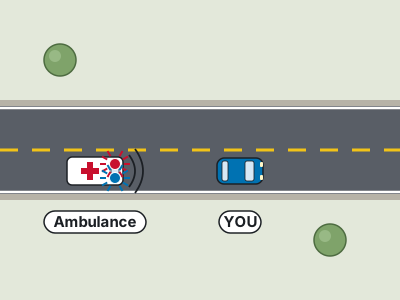
- Continue at the same speed in the current lane
- Immediately pull to the right side and allow it to pass
- Turn left at the next intersection to get ahead of it
- Stop only if the emergency vehicle is directly beside the car
Show answer
Immediately pull to the right side and allow it to pass. When an emergency vehicle approaches with audible and visual signals, Illinois requires motorists to immediately pull to the right side of the road and allow it to pass. In some situations a complete stop may be necessary. Continuing in the lane delays the emergency response, and waiting until the vehicle is alongside leaves too little time to clear its path. At an intersection with two-way traffic, remain stopped until the emergency vehicle passes through the intersection. Sirens or lights should trigger an immediate response.
Study this in the handbook: School buses, emergency vehicles and railroad crossings
19. A driver turning left on a green light must yield to which road users?
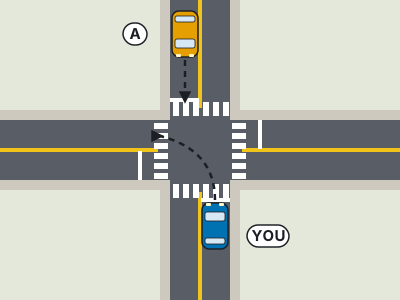
- Only vehicles behind the turning driver
- No one because green always grants an unqualified turn
- Oncoming traffic, pedestrians, and other vehicles in the intersection
- Only bicyclists traveling on the sidewalk
Show answer
Oncoming traffic, pedestrians, and other vehicles in the intersection. A green light permits movement, but it does not remove conflicts from a left turn. The driver must yield to oncoming traffic and to pedestrians and other vehicles in the intersection. The green signal does not guarantee an unqualified turn, and the narrower choices omit road users named by the rule. Check all approaching traffic, keep the wheels straight while waiting, and begin the turn only when the path is open. A driver who has entered on green may finish after the light changes, but that permission does not excuse failing to yield before turning.
20. What is the structure of Illinois's Graduated Driver Licensing program?
- One unrestricted license issued immediately after the permit test
- Three progressive stages that move a teen toward full driving privileges
- Two stages based only on vehicle ownership
- A renewal program that applies only after age 21
Show answer
Three progressive stages that move a teen toward full driving privileges. Illinois describes GDL as three progressive stages that require young drivers to earn movement toward full privileges through their driving behavior. The program is not an immediate unrestricted license, and it is not organized around owning a vehicle. Its staged design is why permit rules, initial licensing limits, and later full-licensing conditions differ. When studying GDL, identify the phase first, then apply that phase’s curfew, passenger, practice, and device restrictions.
Study this in the handbook: Instruction permit and the graduated license program
QualitySpace is expanding to Illinois
We are a California-based independent insurance brokerage working on licensing in more states. We cannot help with Illinois insurance yet. Leave your email and we will let you know when we can.
Every question is written from the official Illinois Rules of the Road. Need paper? Printable IL practice test with answer key.
Last verified 2026-10-05. How we check every question · Study all 500 as flashcards
Frequently asked questions
How many questions are on this Illinois practice test?
This fixed set has 20 questions. It is test 9 of 25 from the 500 question Illinois bank. The real IL exam asks 35 questions and you need 28 correct.
What is the passing score for the real Illinois test?
80% must be answered correctly to be eligible for a Class D license (92 Ill. Adm. Code 1030.80) That figure comes from the official Illinois source cited on the DMV facts page.
How does this fixed test relate to the full Illinois bank?
Each numbered test is a fixed set of questions in a fixed order, so you can retake the same test later and compare. Every test mixes road signs and the other topics in about the same proportion as the full bank. Tests 1 to 25 together cover every question in the Illinois bank once. The full practice page mixes the whole bank at random.
Last verified 2026-10-05. See the Illinois DMV facts page for sourced state details.
Return to the full Illinois practice test · Study road signs